
Ready or not: How are schools responding to Artificial Intelligence? Summary Report
About this resource:
This summary report is about how AI is being used in schools by students, teachers, and leaders in a range of ways. It examines how AI tools are influencing how schools manage classroom practice, assessments, and day-to-day administrative tasks, and the emerging impacts that AI is having on teaching and learning.
Our featured insights
-
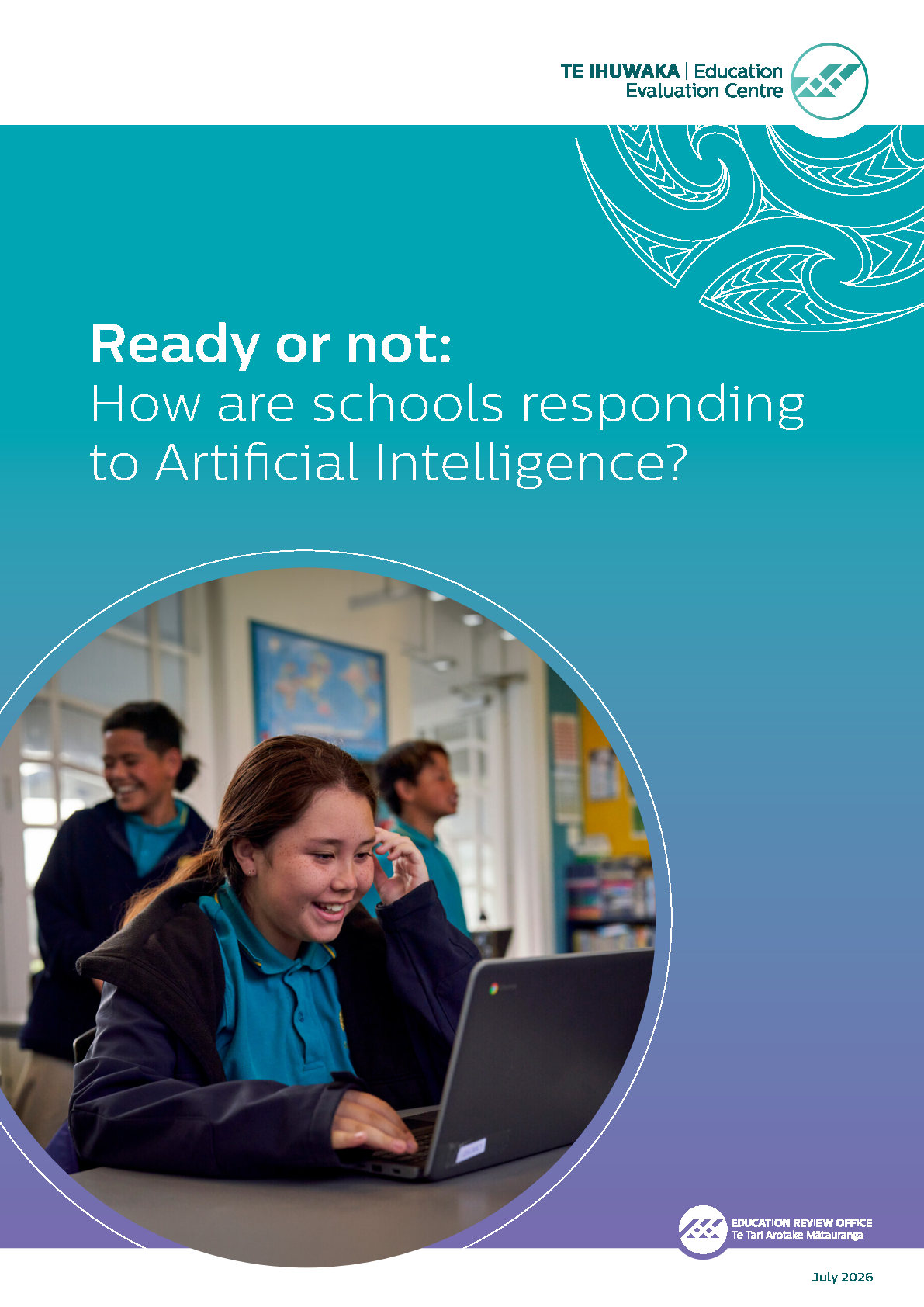 Research report | 60 min read
Ready or not: How are schools responding to Artificial Intelligence?
30 July 2026 -
 Sector insights | 15 min read
Ready or not: How are schools responding to Artificial Intelligence? Insights for Primary School Leaders and Teachers
30 July 2026 -
 Sector insights | 15 min read
Ready or not: How are schools responding to Artificial Intelligence? Insights for Secondary School Leaders and Teachers
30 July 2026 -
 Technical report | 45 min read
Ready or not: How are schools responding to Artificial Intelligence? Technical Appendix
30 July 2026
Read Online
Executive Summary
The use of Generative artificial intelligence is becoming part of everyday school life for students, teachers, and leaders. While it can help reduce workload and has the potential to support teaching and learning, we also heard concerns about potential negative impacts on students and their development of key skills like critical thinking. Most schools remain in the early stages of responding to AI, unplanned, rather than strategic, and often relying on individual teachers to determine how and when it should be used. Schools are also grappling with challenges around reliability, accuracy, and appropriate use. There is an urgent need for a more coherent system-wide approach to help schools use AI safely, consistently, and effectively, to enhance teaching and learning.
Generative artificial intelligence (AI) refers to tools that can create new content including text, images, video, music, or code. These tools are becoming more powerful and widely available, both in free and paid formats, and are increasingly influencing how education is delivered and experienced in New Zealand schools. While we acknowledge that there are genuine concerns around AI-related risks in areas like bullying, inappropriate media creation, and deepfakes, the scope for this report is the use of AI in schools for teaching and learning in a school context, and we do not specifically address personal use by students outside of school.
This report explores how schools are responding to AI and what this means for teaching, learning, and assessment. We found that AI use is already widespread but approaches to managing its use vary significantly between schools. Some schools have been able to develop clear policies and guidance, while others are still developing their responses to the challenges and opportunities AI presents.
Across the schools we visited, AI was most often described as a practical tool that can support efficiency, reduce workload, and assist learning. Leaders and teachers generally see AI as a tool that should support, rather than replace professional judgements. Students similarly described both benefits and risks of AI use, recognising its potential as a time-saver, but also noting the dangers of overreliance or its impact on critical and creative thinking. We also heard concerns around inappropriate use of AI, especially for assessment.
Internationally, education systems have responded to the rapid emergence of artificial intelligence in different ways. Some jurisdictions have moved towards national frameworks with approved tools and centrally supported implementation. In New Zealand, as at the time of reporting, responsibility for developing the specific approaches for managing AI use for teaching and learning sits substantially with schools. As a result, schools are operating in a context where expectations are clear in principle, but flexible in practice. This creates space for locally responsive approaches, but also contributes to uneven levels of readiness, capability, and policy development across the system.
We heard there was strong demand for clearer direction and support for schools as they adapt to the increasing use of AI tools. We acknowledge that planned, strategic use of AI can be of benefit for teachers, leaders, and students, but there are also risks that need managing. Our findings therefore point to the need for a more coherent, system-wide approach that combines clear expectations with practical support to enable schools to move towards a more strategic use of AI. For potential benefits to be realised, and potential risks to be avoided, AI use should be deliberate, planned, and supported by targeted capability building. We have therefore made a set of recommendations for the education system to support schools as they adapt to the emergence and adoption of these powerful and rapidly-changing technologies.
The use of Generative artificial intelligence is becoming part of everyday school life for students, teachers, and leaders. While it can help reduce workload and has the potential to support teaching and learning, we also heard concerns about potential negative impacts on students and their development of key skills like critical thinking. Most schools remain in the early stages of responding to AI, unplanned, rather than strategic, and often relying on individual teachers to determine how and when it should be used. Schools are also grappling with challenges around reliability, accuracy, and appropriate use. There is an urgent need for a more coherent system-wide approach to help schools use AI safely, consistently, and effectively, to enhance teaching and learning.
Generative artificial intelligence (AI) refers to tools that can create new content including text, images, video, music, or code. These tools are becoming more powerful and widely available, both in free and paid formats, and are increasingly influencing how education is delivered and experienced in New Zealand schools. While we acknowledge that there are genuine concerns around AI-related risks in areas like bullying, inappropriate media creation, and deepfakes, the scope for this report is the use of AI in schools for teaching and learning in a school context, and we do not specifically address personal use by students outside of school.
This report explores how schools are responding to AI and what this means for teaching, learning, and assessment. We found that AI use is already widespread but approaches to managing its use vary significantly between schools. Some schools have been able to develop clear policies and guidance, while others are still developing their responses to the challenges and opportunities AI presents.
Across the schools we visited, AI was most often described as a practical tool that can support efficiency, reduce workload, and assist learning. Leaders and teachers generally see AI as a tool that should support, rather than replace professional judgements. Students similarly described both benefits and risks of AI use, recognising its potential as a time-saver, but also noting the dangers of overreliance or its impact on critical and creative thinking. We also heard concerns around inappropriate use of AI, especially for assessment.
Internationally, education systems have responded to the rapid emergence of artificial intelligence in different ways. Some jurisdictions have moved towards national frameworks with approved tools and centrally supported implementation. In New Zealand, as at the time of reporting, responsibility for developing the specific approaches for managing AI use for teaching and learning sits substantially with schools. As a result, schools are operating in a context where expectations are clear in principle, but flexible in practice. This creates space for locally responsive approaches, but also contributes to uneven levels of readiness, capability, and policy development across the system.
We heard there was strong demand for clearer direction and support for schools as they adapt to the increasing use of AI tools. We acknowledge that planned, strategic use of AI can be of benefit for teachers, leaders, and students, but there are also risks that need managing. Our findings therefore point to the need for a more coherent, system-wide approach that combines clear expectations with practical support to enable schools to move towards a more strategic use of AI. For potential benefits to be realised, and potential risks to be avoided, AI use should be deliberate, planned, and supported by targeted capability building. We have therefore made a set of recommendations for the education system to support schools as they adapt to the emergence and adoption of these powerful and rapidly-changing technologies.
Key findings
Area 1: How is AI being used by leaders and teachers?
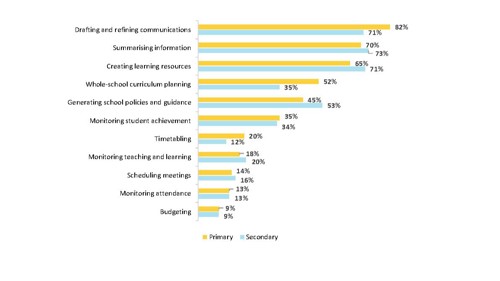
Finding 1: More than nine in ten school leaders are using AI to ease their workload, across administrative and strategic work. While leaders are mainly using AI for drafting communications and summarising information, many are also using it strategically to generate policies and guidance and to help plan the school curriculum.
- More than nine in ten school leaders (93 percent) are using AI. Primary school leaders (94 percent) are using AI more than secondary school leaders (87 percent).
- The most common use is for drafting and communications (80 percent), summarising information (70 percent), and creating learning resources (66 percent).
- Around half of leaders in both primary (45 percent) and secondary (53 percent) use AI to generate school policies and guidance.
- More primary leaders report using AI for curriculum planning (52 percent), compared to secondary leaders (35 percent).
“AI is a personal assistant tool. You drive your personal assistant; you use it to help you do different tasks.”
- TEACHER
Figure 1: Leader use for AI for different tasks, by school type
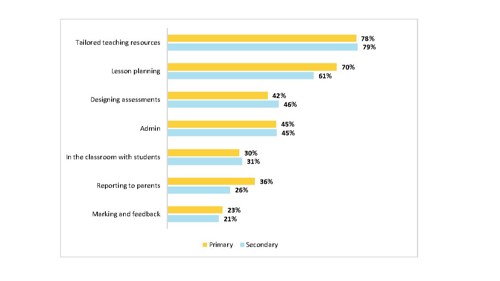
Finding 2: More than four in five teachers are using AI, mainly to streamline planning and preparation. Teachers are mainly using AI to tailor teaching resources and to develop lesson plans. Close to three-quarters of teachers are confident using AI.
- Teachers are mainly using AI to tailor teaching resources (79 percent) and for lesson planning (65 percent) to manage their workload for preparing and personalising learning materials. Usage is lower for marking and feedback (22 percent), due to concerns about how student work will be assessed and judged by AI.
- Primary teachers (36 percent) are using AI more than secondary teachers (26 percent) for reporting to parents and whānau, reflecting that primary teachers more often report across multiple learning areas compared to secondary teachers.
- Teacher confidence in using AI does not vary notably by teacher experience or by school characteristics (school size, socioeconomic level, primary or secondary school, urban or rural school).
Finding 3: Where teachers and leaders are not using AI, or only using it a limited amount, reasons for this include reliability concerns and ethical objections.
- Leaders who do not use AI (only 7 percent of our sample) most commonly report that they do not feel they need it, have ethical concerns, or do not know how to use it properly.
- Among teachers who choose not to use AI in their work (15 percent), we heard concerns about reliability and privacy, questions about its impact on the quality of teaching and learning, and lack of guidance leading to uncertainty about proper use.
“Something that can lower the workload is always welcome. We just have to make sure that we’re doing it safely. Teaching needs a teacher, and you simply can’t replace that.”
- LEADER
Area 1: How is AI being used by leaders and teachers?
Finding 1: More than nine in ten school leaders are using AI to ease their workload, across administrative and strategic work. While leaders are mainly using AI for drafting communications and summarising information, many are also using it strategically to generate policies and guidance and to help plan the school curriculum.
- More than nine in ten school leaders (93 percent) are using AI. Primary school leaders (94 percent) are using AI more than secondary school leaders (87 percent).
- The most common use is for drafting and communications (80 percent), summarising information (70 percent), and creating learning resources (66 percent).
- Around half of leaders in both primary (45 percent) and secondary (53 percent) use AI to generate school policies and guidance.
- More primary leaders report using AI for curriculum planning (52 percent), compared to secondary leaders (35 percent).
“AI is a personal assistant tool. You drive your personal assistant; you use it to help you do different tasks.”
- TEACHER
Figure 1: Leader use for AI for different tasks, by school type
Finding 2: More than four in five teachers are using AI, mainly to streamline planning and preparation. Teachers are mainly using AI to tailor teaching resources and to develop lesson plans. Close to three-quarters of teachers are confident using AI.
- Teachers are mainly using AI to tailor teaching resources (79 percent) and for lesson planning (65 percent) to manage their workload for preparing and personalising learning materials. Usage is lower for marking and feedback (22 percent), due to concerns about how student work will be assessed and judged by AI.
- Primary teachers (36 percent) are using AI more than secondary teachers (26 percent) for reporting to parents and whānau, reflecting that primary teachers more often report across multiple learning areas compared to secondary teachers.
- Teacher confidence in using AI does not vary notably by teacher experience or by school characteristics (school size, socioeconomic level, primary or secondary school, urban or rural school).
Finding 3: Where teachers and leaders are not using AI, or only using it a limited amount, reasons for this include reliability concerns and ethical objections.
- Leaders who do not use AI (only 7 percent of our sample) most commonly report that they do not feel they need it, have ethical concerns, or do not know how to use it properly.
- Among teachers who choose not to use AI in their work (15 percent), we heard concerns about reliability and privacy, questions about its impact on the quality of teaching and learning, and lack of guidance leading to uncertainty about proper use.
“Something that can lower the workload is always welcome. We just have to make sure that we’re doing it safely. Teaching needs a teacher, and you simply can’t replace that.”
- LEADER
Area 2: How are schools managing AI use?
Finding 4: School approaches to AI use and management are either ‘planned/strategic’ or ‘unplanned’. A ‘strategic’ approach is most likely to support future-focused practice, maximising opportunities for teaching and learning, while managing potential risks associated with AI use.
- In New Zealand, responsibility for interpreting and applying AI guidance currently sits substantially with schools. While this allows flexibility for schools to respond to local needs, this also means approaches can vary significantly.
- The Ministry of Education provides high-level guidance and The New Zealand Qualifications Authority (NZQA) provides expectations on the use of AI for NCEA level assessments, but this is not universally accessed or well-embedded in practice, teachers and leaders expressed a clear desire to have more specific guidance. They also reported a need for this to be tailored for different contexts.
Finding 5: Around three in four schools are in the ‘unplanned’ category – many schools don’t yet have guidance for teachers or students, and where guidance exists, it is not always useful. Around seven in ten leaders say they don’t have a policy for data privacy and security around teachers’ use of AI.
- Around one in four leaders (28 percent) report having policy or guidance for teacher use of AI for teaching. Large, urban, and secondary schools are more likely to have guidance in place.
- Having a policy does not guarantee that it is helping teachers or students. Even in schools with policies for student use, fewer than half of teachers (46 percent) and students (47 percent) think these rules are useful.
- One in four leaders in primary schools (24 percent) and two in four leaders in secondary schools (40 percent) report having a policy addressing privacy and security for teacher use of AI, mainly focusing on protecting student data.
Figure 2: Leaders’ reports of schools having a policy for data and security, by school type
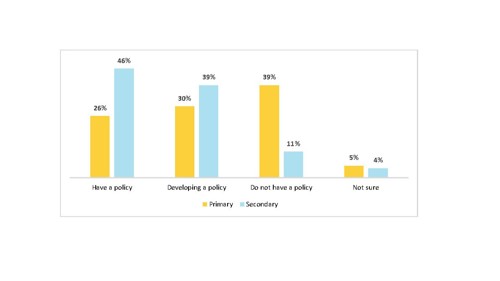
Finding 6: With only a third of school leaders reporting that their school has a policy for student use of AI for learning, many are relying on individual teachers to set expectations.
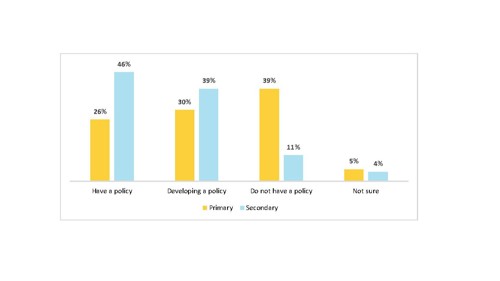
- Only a third of school leaders (26 percent) report their school has rules for student use of AI for learning. A similar proportion of schools are currently developing rules.
- Around a quarter of leaders (25 percent) report individual teachers develop their own rules for students, suggesting that many schools are still working through how to formalise expectations, and that clear, consistent policy guidance is not yet widespread.
- Schools are taking varied approaches to creating policy and guidance, including adapting standard policy templates, embedding AI within broader digital use policies, or co-constructing expectations with students.
Figure 3: Leaders’ report of schools having a policy for student use of AI for learning, by school type
Finding 7: More than three in four leaders in secondary schools say their school has a policy for use of AI for assessment, reflecting NZQA requirements. Fewer than one in four leaders in primary schools report having established rules for AI use in assessments.
- 77 percent of leaders in secondary schools say they have a policy in play for student use of AI for assessment. The remaining secondary school leaders say they are currently developing this, with no secondary leaders reporting not having a policy at all.
- Of secondary students who report that their school has rules, less than half (43 percent) report that the rules for assessment are useful for guiding behaviour and appropriate use. They emphasise the need for clearly defined rules for what is allowed and what is not.
- Primary teachers are less likely to be managing high-stakes assessments and subjectspecific reports. This may reduce the immediate pressure on primary schools to develop policies around assessment.
“The biggest challenge is knowing what we can and can’t do legally, in our professional capacity.”
- TEACHER
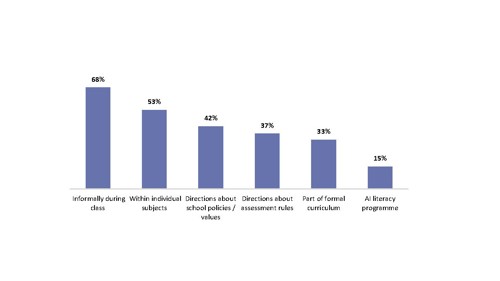
Finding 8: Demand for guidance on how to use AI is high, with threequarters of parents and whānau and around half of students wanting support to use it appropriately for schoolwork. However, only a third of leaders report that their school explicitly teaches how to use AI for learning. Schools want national guidance to improve consistency within and across schools.
- Half of students (50 percent) say it would be useful to learn how to use AI for schoolwork. More than eight in ten parents and whānau (84 percent) want their children to learn how AI works, and three in four parents and whānau (75 percent) want them to learn how to use it appropriately for schoolwork.
- Around a third of school leaders (31 percent) say they explicitly teach students about AI. More than half of teachers (57 percent) and students (53 percent) report that AI use is taught at school.
- Leaders most often report informal teaching of AI through classroom activities (68 percent).
- Across both primary and secondary settings, leaders and teachers consistently expressed a desire for clearer and more specific central guidance. In particular, schools are seeking greater clarity about what constitutes acceptable use of AI in teaching and assessment.
“Workshops about AI would be helpful… More in-depth knowledge about how it works and how to use it. We only really know it at surface level – a tool you put things into and good stuff comes out.”
- STUDENT
Figure 4: Leaders' reporting the different ways students are taught about AI
Area 2: How are schools managing AI use?
Finding 4: School approaches to AI use and management are either ‘planned/strategic’ or ‘unplanned’. A ‘strategic’ approach is most likely to support future-focused practice, maximising opportunities for teaching and learning, while managing potential risks associated with AI use.
- In New Zealand, responsibility for interpreting and applying AI guidance currently sits substantially with schools. While this allows flexibility for schools to respond to local needs, this also means approaches can vary significantly.
- The Ministry of Education provides high-level guidance and The New Zealand Qualifications Authority (NZQA) provides expectations on the use of AI for NCEA level assessments, but this is not universally accessed or well-embedded in practice, teachers and leaders expressed a clear desire to have more specific guidance. They also reported a need for this to be tailored for different contexts.
Finding 5: Around three in four schools are in the ‘unplanned’ category – many schools don’t yet have guidance for teachers or students, and where guidance exists, it is not always useful. Around seven in ten leaders say they don’t have a policy for data privacy and security around teachers’ use of AI.
- Around one in four leaders (28 percent) report having policy or guidance for teacher use of AI for teaching. Large, urban, and secondary schools are more likely to have guidance in place.
- Having a policy does not guarantee that it is helping teachers or students. Even in schools with policies for student use, fewer than half of teachers (46 percent) and students (47 percent) think these rules are useful.
- One in four leaders in primary schools (24 percent) and two in four leaders in secondary schools (40 percent) report having a policy addressing privacy and security for teacher use of AI, mainly focusing on protecting student data.
Figure 2: Leaders’ reports of schools having a policy for data and security, by school type
Finding 6: With only a third of school leaders reporting that their school has a policy for student use of AI for learning, many are relying on individual teachers to set expectations.
- Only a third of school leaders (26 percent) report their school has rules for student use of AI for learning. A similar proportion of schools are currently developing rules.
- Around a quarter of leaders (25 percent) report individual teachers develop their own rules for students, suggesting that many schools are still working through how to formalise expectations, and that clear, consistent policy guidance is not yet widespread.
- Schools are taking varied approaches to creating policy and guidance, including adapting standard policy templates, embedding AI within broader digital use policies, or co-constructing expectations with students.
Figure 3: Leaders’ report of schools having a policy for student use of AI for learning, by school type
Finding 7: More than three in four leaders in secondary schools say their school has a policy for use of AI for assessment, reflecting NZQA requirements. Fewer than one in four leaders in primary schools report having established rules for AI use in assessments.
- 77 percent of leaders in secondary schools say they have a policy in play for student use of AI for assessment. The remaining secondary school leaders say they are currently developing this, with no secondary leaders reporting not having a policy at all.
- Of secondary students who report that their school has rules, less than half (43 percent) report that the rules for assessment are useful for guiding behaviour and appropriate use. They emphasise the need for clearly defined rules for what is allowed and what is not.
- Primary teachers are less likely to be managing high-stakes assessments and subjectspecific reports. This may reduce the immediate pressure on primary schools to develop policies around assessment.
“The biggest challenge is knowing what we can and can’t do legally, in our professional capacity.”
- TEACHER
Finding 8: Demand for guidance on how to use AI is high, with threequarters of parents and whānau and around half of students wanting support to use it appropriately for schoolwork. However, only a third of leaders report that their school explicitly teaches how to use AI for learning. Schools want national guidance to improve consistency within and across schools.
- Half of students (50 percent) say it would be useful to learn how to use AI for schoolwork. More than eight in ten parents and whānau (84 percent) want their children to learn how AI works, and three in four parents and whānau (75 percent) want them to learn how to use it appropriately for schoolwork.
- Around a third of school leaders (31 percent) say they explicitly teach students about AI. More than half of teachers (57 percent) and students (53 percent) report that AI use is taught at school.
- Leaders most often report informal teaching of AI through classroom activities (68 percent).
- Across both primary and secondary settings, leaders and teachers consistently expressed a desire for clearer and more specific central guidance. In particular, schools are seeking greater clarity about what constitutes acceptable use of AI in teaching and assessment.
“Workshops about AI would be helpful… More in-depth knowledge about how it works and how to use it. We only really know it at surface level – a tool you put things into and good stuff comes out.”
- STUDENT
Figure 4: Leaders' reporting the different ways students are taught about AI
Area 3: How is AI being used by students?
Finding 9: Three in four students are using AI for schoolwork and they mainly use it for finding information and generating ideas. Some students report they don’t like using AI due to ethical concerns.
- Just under one in five secondary students (18 percent) report not using AI at all, compared with around a quarter of primary school students (26 percent).
- Despite age restrictions on AI use for children under 13 years of age, students in primary schools do use AI, and more than half of primary students (57 percent) say that they feel confident in using it for learning. However, confidence does not always mean that students understand how to use it critically or effectively to support learning.
- More than half of primary students (58 percent) and almost eight in ten secondary students (77 percent) say they are teaching themselves how to use AI.
- We heard that some students don’t like to use AI for schoolwork because it feels like ‘cheating’ and doesn’t always feel like their own work.
“Students are way ahead of us in adaptation and knowledge about how to use AI… but not in the ability to discern what is going to be acceptable or not.”
- LEADER
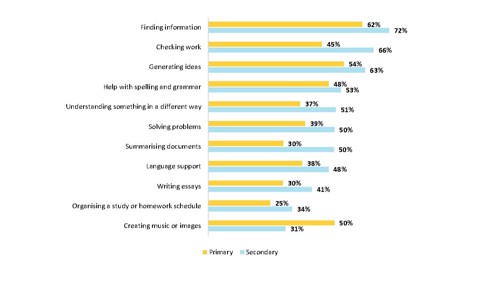
Finding 10: Reported AI use differs in scale between secondary and primary students, but there are similarities in what they use AI for. Both primary and secondary students use AI to support research and idea generation, but secondary students report more sophisticated use for independent learning tasks, such as refining written work. Primary students are more likely to use AI to generate music and images.
- The highest use of AI reported by students is for finding information. Just over seven in ten secondary students (72 percent) and three in five primary students (62 percent) reported using AI for this, followed by generating ideas (63 percent secondary and 54 percent primary).
- The differences in AI use between primary and secondary students are especially evident for independent learning activities, such as summarising documents (30 percent primary and 50 percent secondary) and checking work (45 percent primary and 66 percent secondary).
- Primary students are using AI to generate music and images (50 percent) more than secondary students (31 percent).
“I think we shouldn't be using AI in creative spaces like music and art, because that takes away from the authenticity of your creativeness in your work.”
- SECONDARY SCHOOL STUDENT
“Not everyone learns the same, so AI could be a beneficial tool to help learn something in the way we find learning easiest.”
- STUDENT
Figure 5: Student use of AI for learning, by school type
Finding 11: One in five primary students and two in five secondary students report using AI in ways they know they shouldn’t for assessments.
- Secondary students report significantly higher misuse of AI for assessments or tests – one in five (19 percent) compared to primary school students (11 percent).
- Three in four teachers in secondary schools (77 percent) report encountering inappropriate student use of AI for learning at least occasionally. Some schools are putting in place new processes to authenticate student work or to restrict access to AI tools during assessments.
Figure 6: Students reporting inappropriate use of AI for assessments or tests, by school type
Finding 12: Teachers are concerned that students are using AI inappropriately and end up bypassing learning. They are also concerned about inappropriate use in assessments.
- Students in secondary schools (38 percent) more often report using AI in a way they know they shouldn’t for schoolwork than primary school students (19 percent).
- Students with stronger literacy and digital skills are reporting more sophisticated ways of using AI which make it harder for teachers to detect. This is creating an equity gap, making it easier for some students to benefit from using it in ways that extend beyond appropriate and approved use.
- In primary schools, just over a third of leaders (37 percent) report having no formal consequences in place for students using AI inappropriately for schoolwork, compared to only three percent of secondary leaders. Conversations with students about academic integrity or contacting parents and whānau are the most commonly reported processes to follow up on inappropriate use, with more formal consequences such as failed assessments in secondary schools.
“It's a very good tool to... I use it to get inspiration for when I'm doing my work. But at the same time, I know students who use it as a crutch to do all their work for them.”
- SECONDARY SCHOOL STUDENT
Area 3: How is AI being used by students?
Finding 9: Three in four students are using AI for schoolwork and they mainly use it for finding information and generating ideas. Some students report they don’t like using AI due to ethical concerns.
- Just under one in five secondary students (18 percent) report not using AI at all, compared with around a quarter of primary school students (26 percent).
- Despite age restrictions on AI use for children under 13 years of age, students in primary schools do use AI, and more than half of primary students (57 percent) say that they feel confident in using it for learning. However, confidence does not always mean that students understand how to use it critically or effectively to support learning.
- More than half of primary students (58 percent) and almost eight in ten secondary students (77 percent) say they are teaching themselves how to use AI.
- We heard that some students don’t like to use AI for schoolwork because it feels like ‘cheating’ and doesn’t always feel like their own work.
“Students are way ahead of us in adaptation and knowledge about how to use AI… but not in the ability to discern what is going to be acceptable or not.”
- LEADER
Finding 10: Reported AI use differs in scale between secondary and primary students, but there are similarities in what they use AI for. Both primary and secondary students use AI to support research and idea generation, but secondary students report more sophisticated use for independent learning tasks, such as refining written work. Primary students are more likely to use AI to generate music and images.
- The highest use of AI reported by students is for finding information. Just over seven in ten secondary students (72 percent) and three in five primary students (62 percent) reported using AI for this, followed by generating ideas (63 percent secondary and 54 percent primary).
- The differences in AI use between primary and secondary students are especially evident for independent learning activities, such as summarising documents (30 percent primary and 50 percent secondary) and checking work (45 percent primary and 66 percent secondary).
- Primary students are using AI to generate music and images (50 percent) more than secondary students (31 percent).
“I think we shouldn't be using AI in creative spaces like music and art, because that takes away from the authenticity of your creativeness in your work.”
- SECONDARY SCHOOL STUDENT
“Not everyone learns the same, so AI could be a beneficial tool to help learn something in the way we find learning easiest.”
- STUDENT
Figure 5: Student use of AI for learning, by school type
Finding 11: One in five primary students and two in five secondary students report using AI in ways they know they shouldn’t for assessments.
- Secondary students report significantly higher misuse of AI for assessments or tests – one in five (19 percent) compared to primary school students (11 percent).
- Three in four teachers in secondary schools (77 percent) report encountering inappropriate student use of AI for learning at least occasionally. Some schools are putting in place new processes to authenticate student work or to restrict access to AI tools during assessments.
Figure 6: Students reporting inappropriate use of AI for assessments or tests, by school type
Finding 12: Teachers are concerned that students are using AI inappropriately and end up bypassing learning. They are also concerned about inappropriate use in assessments.
- Students in secondary schools (38 percent) more often report using AI in a way they know they shouldn’t for schoolwork than primary school students (19 percent).
- Students with stronger literacy and digital skills are reporting more sophisticated ways of using AI which make it harder for teachers to detect. This is creating an equity gap, making it easier for some students to benefit from using it in ways that extend beyond appropriate and approved use.
- In primary schools, just over a third of leaders (37 percent) report having no formal consequences in place for students using AI inappropriately for schoolwork, compared to only three percent of secondary leaders. Conversations with students about academic integrity or contacting parents and whānau are the most commonly reported processes to follow up on inappropriate use, with more formal consequences such as failed assessments in secondary schools.
“It's a very good tool to... I use it to get inspiration for when I'm doing my work. But at the same time, I know students who use it as a crutch to do all their work for them.”
- SECONDARY SCHOOL STUDENT
Area 4: What is working well in schools and what could be improved?
Finding 13: When schools are taking a strategic approach to managing AI, they support safe and effective use by putting in place clear school-level guidance for staff and students, building AI capability and confidence, and providing structured opportunities for teachers and students to use AI appropriately.
- We heard from schools that effective approaches to AI use include developing clear school level guidance for both staff and students, supporting a champion to lead AI management within the school, and having safe and supportive environments for teachers and students to build AI confidence to support teaching and learning.
- A champion-based model is harder to implement in smaller schools with fewer staff, and we heard concerns about being too dependent on one champion to front the implementation strategy alone. Finding 14: Some challenges that schools face include concerns about the reliability of AI tools, not knowing enough about how to use these tools well, and not having clear and specific guidance.
- Over half of leaders (56 percent) and nearly half of teachers (45 percent) report they do not know enough to use AI tools properly. This pattern is consistent across different kinds of schools (e.g. size, rurality and socioeconomic level), suggesting it is a system-wide capability gap.
- Around half of leaders (53 percent) and teachers (48 percent) say they lack clear guidance on how to use AI. Students report being unsure about how they can and cannot use it, with 14 percent being unsure if they have ever used it inappropriately for schoolwork. This reflects a wider concern about the absence of a strong national framework, and significant variation in policies and expectations across, and even within, schools.
- Around half of leaders (48 percent) and teachers (53 percent) report that AI tools are not yet trustworthy or reliable. Students also report confusing and irrelevant AI outputs, creating uncertainty about whether AI can be trusted. Teachers and leaders also raise concerns about bias and misleading or overly agreeable responses.
Finding 14: Some challenges that schools face include concerns about the reliability of AI tools, not knowing enough about how to use these tools well, and not having clear and specific guidance.
- Over half of leaders (56 percent) and nearly half of teachers (45 percent) report they do not know enough to use AI tools properly. This pattern is consistent across different kinds of schools (e.g. size, rurality and socioeconomic level), suggesting it is a system-wide capability gap.
- Around half of leaders (53 percent) and teachers (48 percent) say they lack clear guidance on how to use AI. Students report being unsure about how they can and cannot use it, with 14 percent being unsure if they have ever used it inappropriately for schoolwork. This reflects a wider concern about the absence of a strong national framework, and significant variation in policies and expectations across, and even within, schools.
- Around half of leaders (48 percent) and teachers (53 percent) report that AI tools are not yet trustworthy or reliable. Students also report confusing and irrelevant AI outputs, creating uncertainty about whether AI can be trusted. Teachers and leaders also raise concerns about bias and misleading or overly agreeable responses.
“You can search up something about a butterfly, and it will tell you about pickles, but show you a picture of a strawberry."
- PRIMARY SCHOOL STUDENT
Area 4: What is working well in schools and what could be improved?
Finding 13: When schools are taking a strategic approach to managing AI, they support safe and effective use by putting in place clear school-level guidance for staff and students, building AI capability and confidence, and providing structured opportunities for teachers and students to use AI appropriately.
- We heard from schools that effective approaches to AI use include developing clear school level guidance for both staff and students, supporting a champion to lead AI management within the school, and having safe and supportive environments for teachers and students to build AI confidence to support teaching and learning.
- A champion-based model is harder to implement in smaller schools with fewer staff, and we heard concerns about being too dependent on one champion to front the implementation strategy alone. Finding 14: Some challenges that schools face include concerns about the reliability of AI tools, not knowing enough about how to use these tools well, and not having clear and specific guidance.
- Over half of leaders (56 percent) and nearly half of teachers (45 percent) report they do not know enough to use AI tools properly. This pattern is consistent across different kinds of schools (e.g. size, rurality and socioeconomic level), suggesting it is a system-wide capability gap.
- Around half of leaders (53 percent) and teachers (48 percent) say they lack clear guidance on how to use AI. Students report being unsure about how they can and cannot use it, with 14 percent being unsure if they have ever used it inappropriately for schoolwork. This reflects a wider concern about the absence of a strong national framework, and significant variation in policies and expectations across, and even within, schools.
- Around half of leaders (48 percent) and teachers (53 percent) report that AI tools are not yet trustworthy or reliable. Students also report confusing and irrelevant AI outputs, creating uncertainty about whether AI can be trusted. Teachers and leaders also raise concerns about bias and misleading or overly agreeable responses.
Finding 14: Some challenges that schools face include concerns about the reliability of AI tools, not knowing enough about how to use these tools well, and not having clear and specific guidance.
- Over half of leaders (56 percent) and nearly half of teachers (45 percent) report they do not know enough to use AI tools properly. This pattern is consistent across different kinds of schools (e.g. size, rurality and socioeconomic level), suggesting it is a system-wide capability gap.
- Around half of leaders (53 percent) and teachers (48 percent) say they lack clear guidance on how to use AI. Students report being unsure about how they can and cannot use it, with 14 percent being unsure if they have ever used it inappropriately for schoolwork. This reflects a wider concern about the absence of a strong national framework, and significant variation in policies and expectations across, and even within, schools.
- Around half of leaders (48 percent) and teachers (53 percent) report that AI tools are not yet trustworthy or reliable. Students also report confusing and irrelevant AI outputs, creating uncertainty about whether AI can be trusted. Teachers and leaders also raise concerns about bias and misleading or overly agreeable responses.
“You can search up something about a butterfly, and it will tell you about pickles, but show you a picture of a strawberry."
- PRIMARY SCHOOL STUDENT
Area 5: What are the early impacts of AI use?
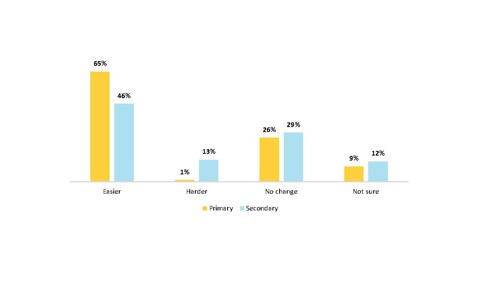
Finding 15: More than half of teachers report that AI is making their job easier overall. Only seven percent report AI is making their job harder. This is despite the challenges authenticating student work, experienced especially by secondary school leaders.
- More than half of teachers (55 percent) report that using AI is making their job easier, while only seven percent say it is making it harder. Nine in ten leaders (90 percent) think that AI is making it easier for their teachers to do their job.
- The use of AI is affecting how teachers distribute their time, with some time saved on administration and preparation freeing up time for other tasks. More than half of teachers report that they have decreased the time they spend on creating tailored teaching resources (61 percent) and lesson planning (52 percent) due to use of AI.
- In secondary schools, teachers are having to spend more time authenticating student work. Secondary teachers who come across students misusing AI for schoolwork are 5.5 times more likely to say that using AI has increased the time they spend on ensuring authenticity of student work, compared to teachers who don't come across misuse.
“It’s a way of doing things smarter sometimes… when you’re under time pressure, which is always.”
- PRIMARY SCHOOL LEADER
Figure 7: Teachers reporting that using AI has made their job easier or harder, by school type
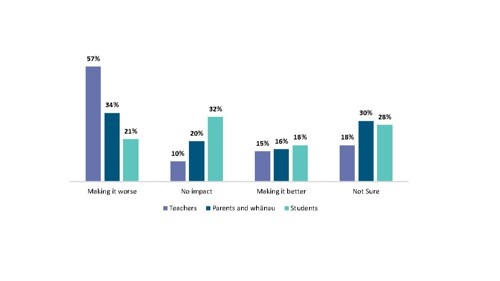
Finding 16: How students use AI shapes the impact on their learning. More than half of teachers report concerns that current, unplanned use is having a negative effect on students’ critical thinking. However, students and teachers report more positive impacts on learning when students use AI to generate ideas, help them solve problems, and check work, rather than to produce work for them.
- More than half of teachers believe that use of AI has negatively impacted students’ critical thinking skills, and this is a stronger concern in secondary schools (71 percent) than primary schools (41 percent), reflecting both amount and kinds of use.
- More than half of teachers (54 percent) also think it is negatively impacting students’ creative thinking, while almost half think it is impacting students’ independent learning positively.
- Parents and whānau and students are divided in their perceptions of impact on different aspects of students’ learning, with relatively even distributions of people reporting positive or negative impacts, or no changes.
- The kind of use matters. Teachers and students who report student use of AI for things like problem solving, checking work, or idea generation are more likely to report positive impacts on critical thinking, creative thinking and independent learning.
- Across all respondents – teachers, leaders, students and parents and whānau, we heard concerns about the negative impacts of students using AI to complete work for them, and becoming too reliant on it, losing the ability to do the important learning themselves.
“When people can’t be bothered thinking for themselves, they’ll use AI.”
- PRIMARY SCHOOL STUDENT
Figure 8: Teachers, students, and parents and whānau reporting impact of AI use on students’ critical thinking
Area 5: What are the early impacts of AI use?
Finding 15: More than half of teachers report that AI is making their job easier overall. Only seven percent report AI is making their job harder. This is despite the challenges authenticating student work, experienced especially by secondary school leaders.
- More than half of teachers (55 percent) report that using AI is making their job easier, while only seven percent say it is making it harder. Nine in ten leaders (90 percent) think that AI is making it easier for their teachers to do their job.
- The use of AI is affecting how teachers distribute their time, with some time saved on administration and preparation freeing up time for other tasks. More than half of teachers report that they have decreased the time they spend on creating tailored teaching resources (61 percent) and lesson planning (52 percent) due to use of AI.
- In secondary schools, teachers are having to spend more time authenticating student work. Secondary teachers who come across students misusing AI for schoolwork are 5.5 times more likely to say that using AI has increased the time they spend on ensuring authenticity of student work, compared to teachers who don't come across misuse.
“It’s a way of doing things smarter sometimes… when you’re under time pressure, which is always.”
- PRIMARY SCHOOL LEADER
Figure 7: Teachers reporting that using AI has made their job easier or harder, by school type
Finding 16: How students use AI shapes the impact on their learning. More than half of teachers report concerns that current, unplanned use is having a negative effect on students’ critical thinking. However, students and teachers report more positive impacts on learning when students use AI to generate ideas, help them solve problems, and check work, rather than to produce work for them.
- More than half of teachers believe that use of AI has negatively impacted students’ critical thinking skills, and this is a stronger concern in secondary schools (71 percent) than primary schools (41 percent), reflecting both amount and kinds of use.
- More than half of teachers (54 percent) also think it is negatively impacting students’ creative thinking, while almost half think it is impacting students’ independent learning positively.
- Parents and whānau and students are divided in their perceptions of impact on different aspects of students’ learning, with relatively even distributions of people reporting positive or negative impacts, or no changes.
- The kind of use matters. Teachers and students who report student use of AI for things like problem solving, checking work, or idea generation are more likely to report positive impacts on critical thinking, creative thinking and independent learning.
- Across all respondents – teachers, leaders, students and parents and whānau, we heard concerns about the negative impacts of students using AI to complete work for them, and becoming too reliant on it, losing the ability to do the important learning themselves.
“When people can’t be bothered thinking for themselves, they’ll use AI.”
- PRIMARY SCHOOL STUDENT
Figure 8: Teachers, students, and parents and whānau reporting impact of AI use on students’ critical thinking
Recommendations
ERO used the key lessons from our findings to develop nine recommendations under three areas. These recommendations aim to establish a coherent and nationally consistent approach to AI in education, supporting schools to integrate AI safely, effectively, and equitably in ways that support teaching and learning.
ERO used the key lessons from our findings to develop nine recommendations under three areas. These recommendations aim to establish a coherent and nationally consistent approach to AI in education, supporting schools to integrate AI safely, effectively, and equitably in ways that support teaching and learning.
Area 1: System leadership and coherence
Recommendation 1: Develop a national AI in education framework, drawing on international AI literacy frameworks (e.g. OECD, UNESCO, SAIL), but adapted for the New Zealand context. This framework will provide a coherent foundation for guidance, policies, curriculum integration, assessment, and capability-building across the education system.
Area 1: System leadership and coherence
Recommendation 1: Develop a national AI in education framework, drawing on international AI literacy frameworks (e.g. OECD, UNESCO, SAIL), but adapted for the New Zealand context. This framework will provide a coherent foundation for guidance, policies, curriculum integration, assessment, and capability-building across the education system.
Area 2: Nationally consistent guidance and expectations
Recommendation 2: Provide clear, nationally consistent policy on the appropriate and effective use of AI by teachers tailored to primary and secondary contexts. This will reduce variability across schools and support safe and confident use in teaching practice.
Recommendation 3: Provide nationally consistent policy for student use of AI in schoolwork, tailored to primary and secondary contexts. This will support consistent expectations and promote responsible use across schools for students in different year levels and with different learning needs.
Recommendation 4: Provide national guidance to support the integration of AI literacy and use across learning areas, aligned with the curriculum refresh. Evidence indicates that benefits for student learning are strongest when AI is embedded in teaching and learning contexts, rather than as a standalone subject.
Recommendation 5: Embed consistent rules and guidance on the use of AI in assessment. Strengthen existing guidance around NCEA assessment, and provide guidance for primary schools and other contexts where assessment expectations are less well defined.
Recommendation 6: Provide nationally consistent guidance for parents and whānau on the use of AI in schoolwork and assessment. This will support shared understanding of appropriate use, strengthen trust, and enable families to support their children's learning.
Area 2: Nationally consistent guidance and expectations
Recommendation 2: Provide clear, nationally consistent policy on the appropriate and effective use of AI by teachers tailored to primary and secondary contexts. This will reduce variability across schools and support safe and confident use in teaching practice.
Recommendation 3: Provide nationally consistent policy for student use of AI in schoolwork, tailored to primary and secondary contexts. This will support consistent expectations and promote responsible use across schools for students in different year levels and with different learning needs.
Recommendation 4: Provide national guidance to support the integration of AI literacy and use across learning areas, aligned with the curriculum refresh. Evidence indicates that benefits for student learning are strongest when AI is embedded in teaching and learning contexts, rather than as a standalone subject.
Recommendation 5: Embed consistent rules and guidance on the use of AI in assessment. Strengthen existing guidance around NCEA assessment, and provide guidance for primary schools and other contexts where assessment expectations are less well defined.
Recommendation 6: Provide nationally consistent guidance for parents and whānau on the use of AI in schoolwork and assessment. This will support shared understanding of appropriate use, strengthen trust, and enable families to support their children's learning.
Area 3: Tools and system supports
Recommendation 7: Set national expectations and provide supporting resources to guide schools in selecting and using AI technologies safely and effectively.
Recommendation 8: Support the development of teacher and leader capability through targeted professional learning and development.
Recommendation 9: Explore the feasibility of establishing centrally-provided AI tools and environments for educational purposes.
Area 3: Tools and system supports
Recommendation 7: Set national expectations and provide supporting resources to guide schools in selecting and using AI technologies safely and effectively.
Recommendation 8: Support the development of teacher and leader capability through targeted professional learning and development.
Recommendation 9: Explore the feasibility of establishing centrally-provided AI tools and environments for educational purposes.
What ERO did
What ERO did For this report, we collected data in Term 1, 2026. We looked at English-medium state and state-integrated schools with students from Year 5 and above. We collected responses from students, parents and whānau, teachers, and school leaders. We also spoke with a range of experts and used other evidence and research to support our findings. The findings of our review are evidenced by a range of data and analysis from:
Almost 4000 survey responses from:
- 1,587 students
- 859 teachers
- 472 school leaders
- 889 parents and whānau
Interviews and focus groups with 129 participants:
- Including students, teachers, school leaders, and parents and whānau
Site visits at:
- Eight case study schools
Data and evidence from:
- A review of international and New Zealand literature
- Administrative data on school use of AI
What ERO did For this report, we collected data in Term 1, 2026. We looked at English-medium state and state-integrated schools with students from Year 5 and above. We collected responses from students, parents and whānau, teachers, and school leaders. We also spoke with a range of experts and used other evidence and research to support our findings. The findings of our review are evidenced by a range of data and analysis from:
Almost 4000 survey responses from:
- 1,587 students
- 859 teachers
- 472 school leaders
- 889 parents and whānau
Interviews and focus groups with 129 participants:
- Including students, teachers, school leaders, and parents and whānau
Site visits at:
- Eight case study schools
Data and evidence from:
- A review of international and New Zealand literature
- Administrative data on school use of AI