
Bridging the Gap: How well do we support students learning in alternative settings? Practical insights for school boards
About this resource:
Across New Zealand, more students from mainstream schools are being taught in alternative settings instead of their regular schools. This happens when students have disengaged from their regular schools and need extra help. The Education Review Office (ERO) did a national review to look at how things are going for these students and found that the system isn’t working well for them. While national, system-level changes are needed to better support these students, there are some actions schools can take too. This guide will help school board members understand ERO’s findings and the board’s role in supporting these students.
Related information
-
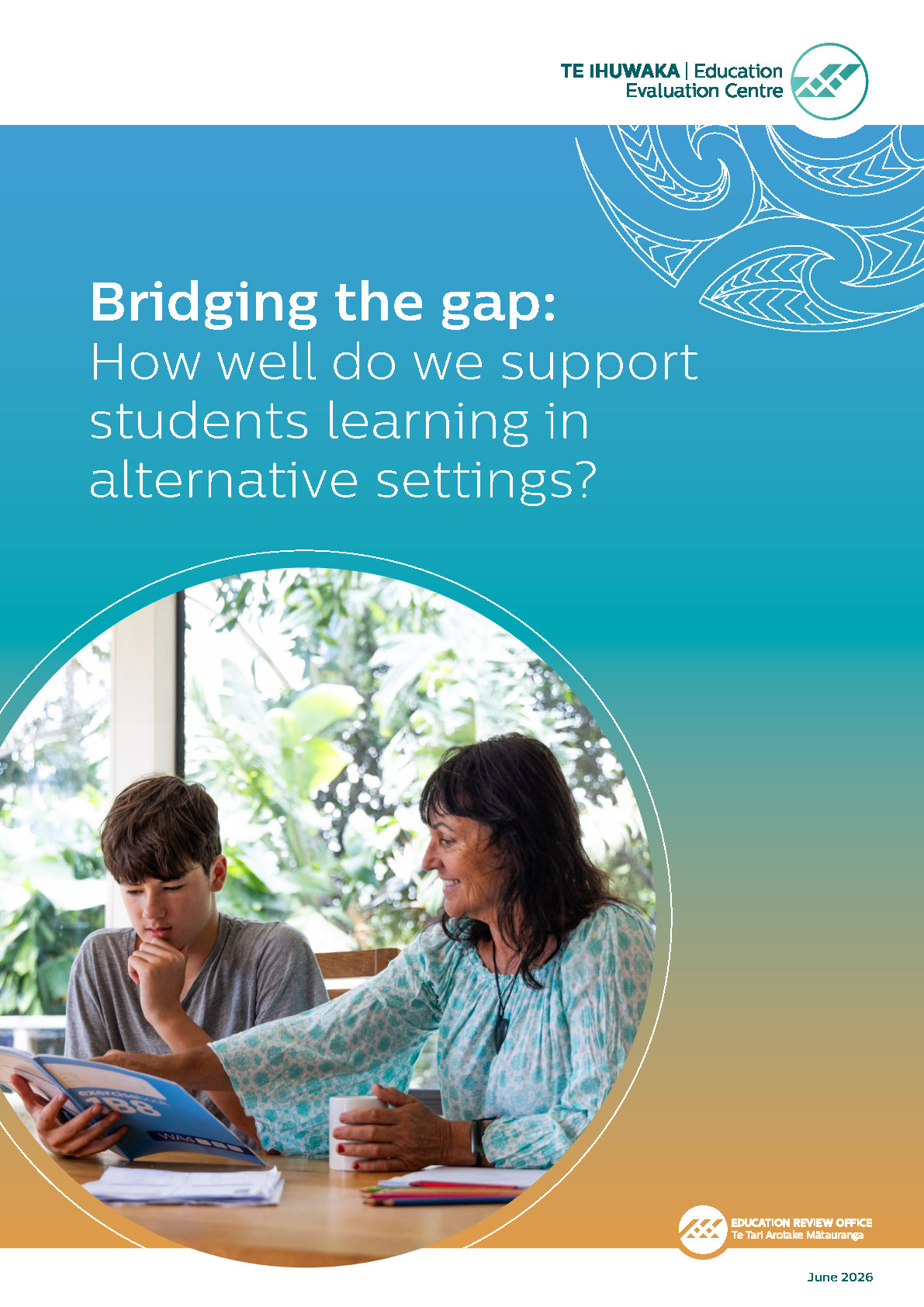 Research report | 60 min read
Bridging the Gap: How well do we support students learning in alternative settings?
23 June 2026 -
 Research summary | 20 min read
Bridging the Gap: How well do we support students learning in alternative settings? Summary report
23 June 2026 -
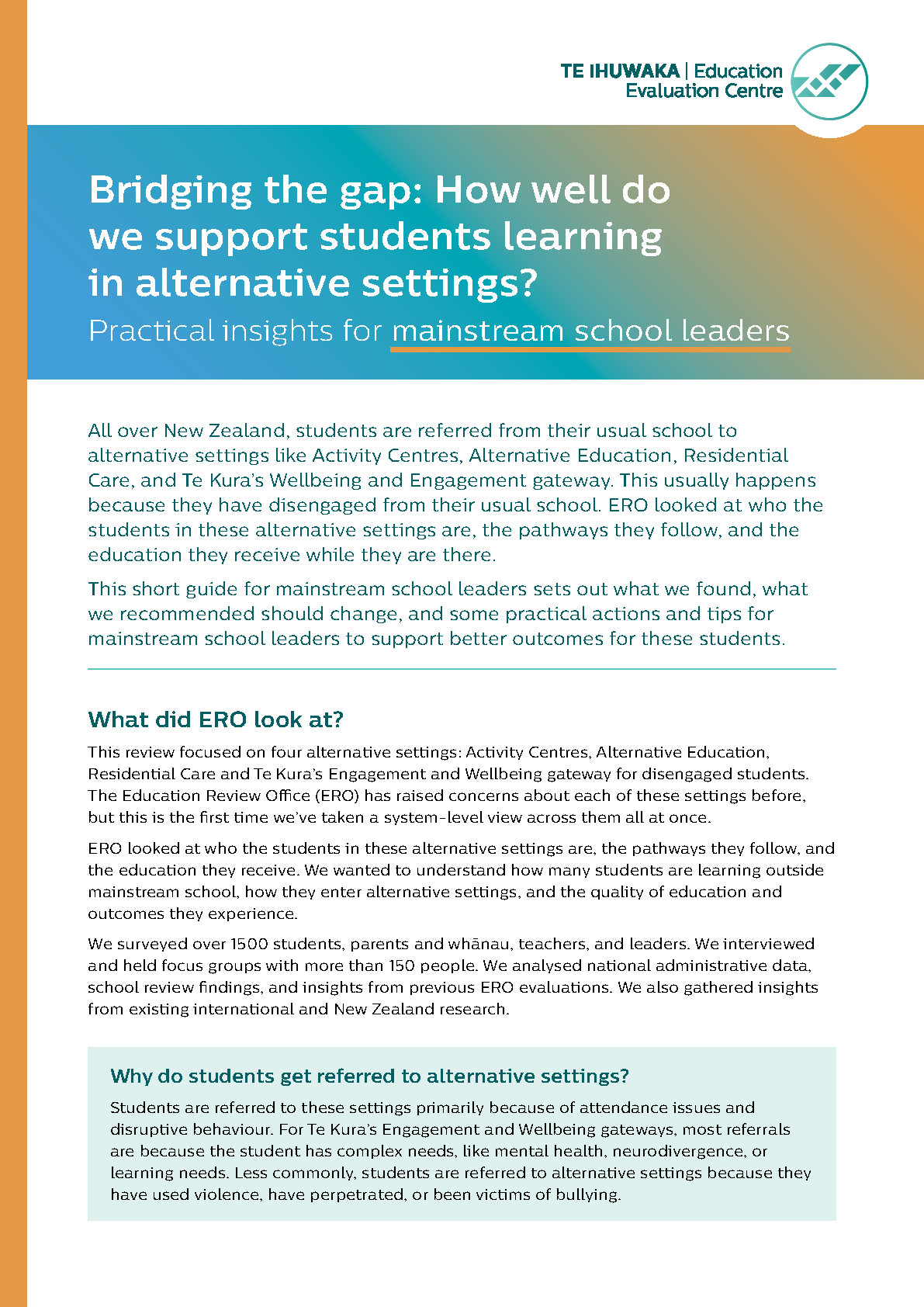 Sector insights | 15 min read
Bridging the Gap: How well do we support students learning in alternative settings? Practical insights for mainstream school leaders
23 June 2026 -
 Technical report | 45 min read
Bridging the Gap: How well do we support students learning in alternative settings? Technical Appendix
23 June 2026
Read Online
Introduction
Across New Zealand, more students from mainstream schools are being taught in alternative settings instead of their regular schools. This happens when students have disengaged from their regular schools and need extra help. The Education Review Office (ERO) did a national review to look at how things are going for these students and found that the system isn’t working well for them.
While national, system-level changes are needed to better support these students, there are some actions schools can take too. This guide will help school board members understand ERO’s findings and the board’s role in supporting these students.
Across New Zealand, more students from mainstream schools are being taught in alternative settings instead of their regular schools. This happens when students have disengaged from their regular schools and need extra help. The Education Review Office (ERO) did a national review to look at how things are going for these students and found that the system isn’t working well for them.
While national, system-level changes are needed to better support these students, there are some actions schools can take too. This guide will help school board members understand ERO’s findings and the board’s role in supporting these students.
ERO looked at education in alternative settings
ERO focused on four alternative settings: Activity Centres, Alternative Education, Residential Care and Te Kura’s Engagement and Wellbeing gateway for disengaged students. Students in alternative settings are some of the most vulnerable young people in the education system. Providing them with a good education is vital for their future.
ERO looked at who the students in these alternative settings are, the pathways they follow, and the education they receive. We wanted to understand how many students are learning outside mainstream school, how they enter alternative settings, and the quality of education and outcomes they experience.
We surveyed over 1500 students, parents and whānau, teachers, and leaders. We interviewed and held focus groups with more than 150 people. We analysed national administrative data, school review findings, and insights from previous ERO evaluations. We also gathered insights from existing international and New Zealand research.
What do alternative settings have to do with school boards?
School boards aim to support every student at their school to achieve. This is set out in their objectives in Education and Training Act 2020.
Many students who are referred from mainstream schools to alternative settings have disengaged from their usual school or need extra support to engage.
It should concern the board if some students are disengaging from the school – there are some ideas for questions you can ask on page 3, about the school’s approach to monitoring, preventing, and responding to disengagement.
DID YOU KNOW?
Students who are referred from your school to an Activity Centre or Alternative Education setting are still enrolled at your school. This means the board has an important responsibility to use supports, systems, and monitoring that support all students, including those who are learning off-site, to achieve the best outcomes.
ERO focused on four alternative settings: Activity Centres, Alternative Education, Residential Care and Te Kura’s Engagement and Wellbeing gateway for disengaged students. Students in alternative settings are some of the most vulnerable young people in the education system. Providing them with a good education is vital for their future.
ERO looked at who the students in these alternative settings are, the pathways they follow, and the education they receive. We wanted to understand how many students are learning outside mainstream school, how they enter alternative settings, and the quality of education and outcomes they experience.
We surveyed over 1500 students, parents and whānau, teachers, and leaders. We interviewed and held focus groups with more than 150 people. We analysed national administrative data, school review findings, and insights from previous ERO evaluations. We also gathered insights from existing international and New Zealand research.
What do alternative settings have to do with school boards?
School boards aim to support every student at their school to achieve. This is set out in their objectives in Education and Training Act 2020.
Many students who are referred from mainstream schools to alternative settings have disengaged from their usual school or need extra support to engage.
It should concern the board if some students are disengaging from the school – there are some ideas for questions you can ask on page 3, about the school’s approach to monitoring, preventing, and responding to disengagement.
DID YOU KNOW?
Students who are referred from your school to an Activity Centre or Alternative Education setting are still enrolled at your school. This means the board has an important responsibility to use supports, systems, and monitoring that support all students, including those who are learning off-site, to achieve the best outcomes.
What did ERO find out and what does it mean for boards?
Referring students to alternative settings should be a last resort.
Students who are moved out of mainstream schooling often have very poor education and life outcomes. Students often don’t get the support for their learning that they need to get back on track. Though these settings are intended as only temporary supports, we found that very few end up coming back to school (or onto a vocational pathway).
DID YOU KNOW?
Fewer than one in six students in alternative settings end up returning to mainstream school.
At age 24, almost two-thirds (63 percent) of people who had attended Alternative Education were receiving a benefit, compared to half (51 percent) of adults with similar backgrounds, but who never went to Alternative Education. (ERO’s 2023 report - An Alternative Education? Support for our most disengaged young people)
These students receive education that is lower in quality.
Sometimes, referring to an alternative setting is the best choice - for example when it is unsafe for them to remain at the school. However, many staff in alternative settings are not trained teachers, so they depend on the referring school to support each student’s learning.
How can boards help?
Make sure school policies support strong transitions, information-sharing, and ongoing connections, with alternative settings. This way, the students can benefit from the expertise of qualified teachers, and maintain a sense of belonging at the school.
Not enough is being done to identify at-risk students early.
There are clear warning signs that a student may disengage early, such as regular absences, moving schools often, or being suspended.
How can boards help?
School data on behaviour, progress, attendance, and wellbeing can tell leaders and the board a lot about students’ engagement at school – and when it starts to drop. Boards can ensure that the school has good policies and processes for collecting and analysing data regularly enough to respond quickly to signs of disengagement.
At some schools, not enough is being done to keep them in mainstream school.
ERO found that schools with very similar students have very different rates of referrals to alternative settings. This shows that some schools are trying harder and having more success keeping students learning on-site. The good news is, we can learn a lot about what works, from the schools that have been successful.
How can boards help?
Boards can work with leaders to ensure there are effective systems and supports that help students catch up on learning and reset their behaviour while remaining at their regular school. This might involve processes for temporary changes to timetables, working closely with dedicated staff, shifting class settings, and more.
Referring students to alternative settings should be a last resort.
Students who are moved out of mainstream schooling often have very poor education and life outcomes. Students often don’t get the support for their learning that they need to get back on track. Though these settings are intended as only temporary supports, we found that very few end up coming back to school (or onto a vocational pathway).
DID YOU KNOW?
Fewer than one in six students in alternative settings end up returning to mainstream school.
At age 24, almost two-thirds (63 percent) of people who had attended Alternative Education were receiving a benefit, compared to half (51 percent) of adults with similar backgrounds, but who never went to Alternative Education. (ERO’s 2023 report - An Alternative Education? Support for our most disengaged young people)
These students receive education that is lower in quality.
Sometimes, referring to an alternative setting is the best choice - for example when it is unsafe for them to remain at the school. However, many staff in alternative settings are not trained teachers, so they depend on the referring school to support each student’s learning.
How can boards help?
Make sure school policies support strong transitions, information-sharing, and ongoing connections, with alternative settings. This way, the students can benefit from the expertise of qualified teachers, and maintain a sense of belonging at the school.
Not enough is being done to identify at-risk students early.
There are clear warning signs that a student may disengage early, such as regular absences, moving schools often, or being suspended.
How can boards help?
School data on behaviour, progress, attendance, and wellbeing can tell leaders and the board a lot about students’ engagement at school – and when it starts to drop. Boards can ensure that the school has good policies and processes for collecting and analysing data regularly enough to respond quickly to signs of disengagement.
At some schools, not enough is being done to keep them in mainstream school.
ERO found that schools with very similar students have very different rates of referrals to alternative settings. This shows that some schools are trying harder and having more success keeping students learning on-site. The good news is, we can learn a lot about what works, from the schools that have been successful.
How can boards help?
Boards can work with leaders to ensure there are effective systems and supports that help students catch up on learning and reset their behaviour while remaining at their regular school. This might involve processes for temporary changes to timetables, working closely with dedicated staff, shifting class settings, and more.
Questions for school board meetings
Boards strongly influence how well a school supports its students to achieve. They do this by examining the data they receive, asking leaders tough questions, and setting expectations (through policy) when things aren’t working. The questions below can help guide board discussions about whether all of your students are getting the support they need.
How is the school tracking student engagement across the areas of attendance, progress, and sense of belonging at the school? Is this data used to spot disengagement early?
What support does the school provide for students who might be at risk, whether that’s with their learning, wellbeing, or relationships? Is this support working? Are our resources allocated where they are needed most?
Are our rates of referral to alternative settings low or high? (In our review, we considered referrals of more than 5 percent of the roll each year to be concerningly high. But this question is about whether or not the school is referring more often than is really necessary.)
If our school has referred students to alternative settings, what ongoing support has been provided to them?
- Do school staff stay in regular contact with those students? Are we maintaining relationships and promoting a continued sense of belonging at the school?
- Does the school provide support for curriculum and assessment?
- Are there realistic plans in place for those students’ pathways back to our school – or on to a vocational pathway?
Boards strongly influence how well a school supports its students to achieve. They do this by examining the data they receive, asking leaders tough questions, and setting expectations (through policy) when things aren’t working. The questions below can help guide board discussions about whether all of your students are getting the support they need.
How is the school tracking student engagement across the areas of attendance, progress, and sense of belonging at the school? Is this data used to spot disengagement early?
What support does the school provide for students who might be at risk, whether that’s with their learning, wellbeing, or relationships? Is this support working? Are our resources allocated where they are needed most?
Are our rates of referral to alternative settings low or high? (In our review, we considered referrals of more than 5 percent of the roll each year to be concerningly high. But this question is about whether or not the school is referring more often than is really necessary.)
If our school has referred students to alternative settings, what ongoing support has been provided to them?
- Do school staff stay in regular contact with those students? Are we maintaining relationships and promoting a continued sense of belonging at the school?
- Does the school provide support for curriculum and assessment?
- Are there realistic plans in place for those students’ pathways back to our school – or on to a vocational pathway?
Want to know more?
We also have a detailed insights guide for school leaders, with examples of schools preventing and responding to disengagement. You can download that here:
- Practical insights for mainstream school leaders
Bridging the Gap: How well do we support students in alternative settings is our full report about this evaluation:
Bridging the Gap: How well do we support students in alternative settings summary report:
We also have a detailed insights guide for school leaders, with examples of schools preventing and responding to disengagement. You can download that here:
- Practical insights for mainstream school leaders
Bridging the Gap: How well do we support students in alternative settings is our full report about this evaluation:
Bridging the Gap: How well do we support students in alternative settings summary report: