
Bridging the Gap: How well do we support students learning in alternative settings? Practical insights for mainstream school leaders
About this resource:
All over New Zealand, students are referred from their usual school to alternative settings like Activity Centres, Alternative Education, Residential Care, and Te Kura’s Wellbeing and Engagement gateway. This usually happens because they have disengaged from their usual school. ERO looked at who the students in these alternative settings are, the pathways they follow, and the education they receive while they are there. This short guide for mainstream school leaders sets out what we found, what we recommended should change, and some practical actions and tips for mainstream school leaders to support better outcomes for these students.
Our featured insights
-
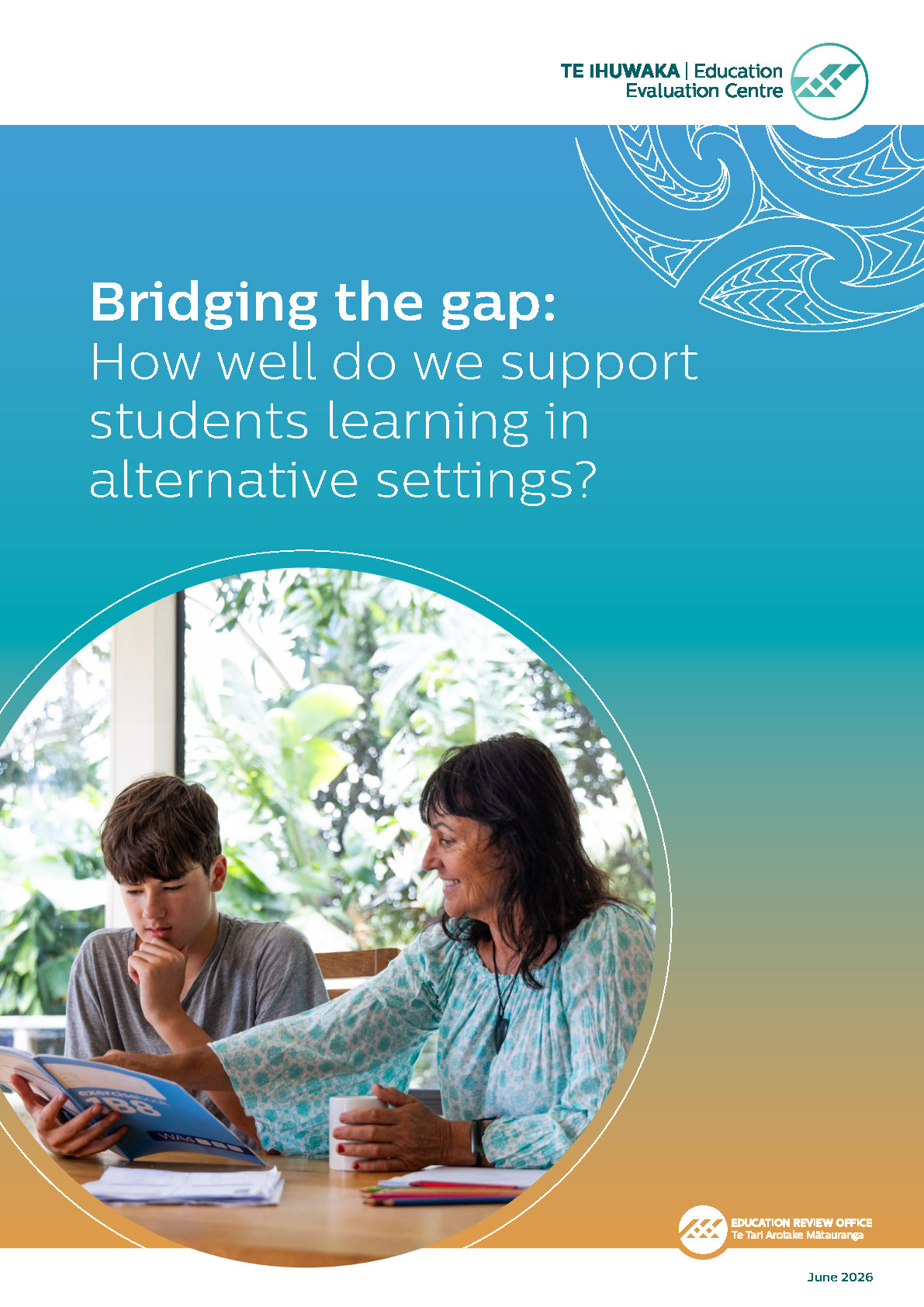 Research report | 60 min read
Bridging the Gap: How well do we support students learning in alternative settings?
23 June 2026 -
 Research summary | 20 min read
Bridging the Gap: How well do we support students learning in alternative settings? Summary report
23 June 2026 -
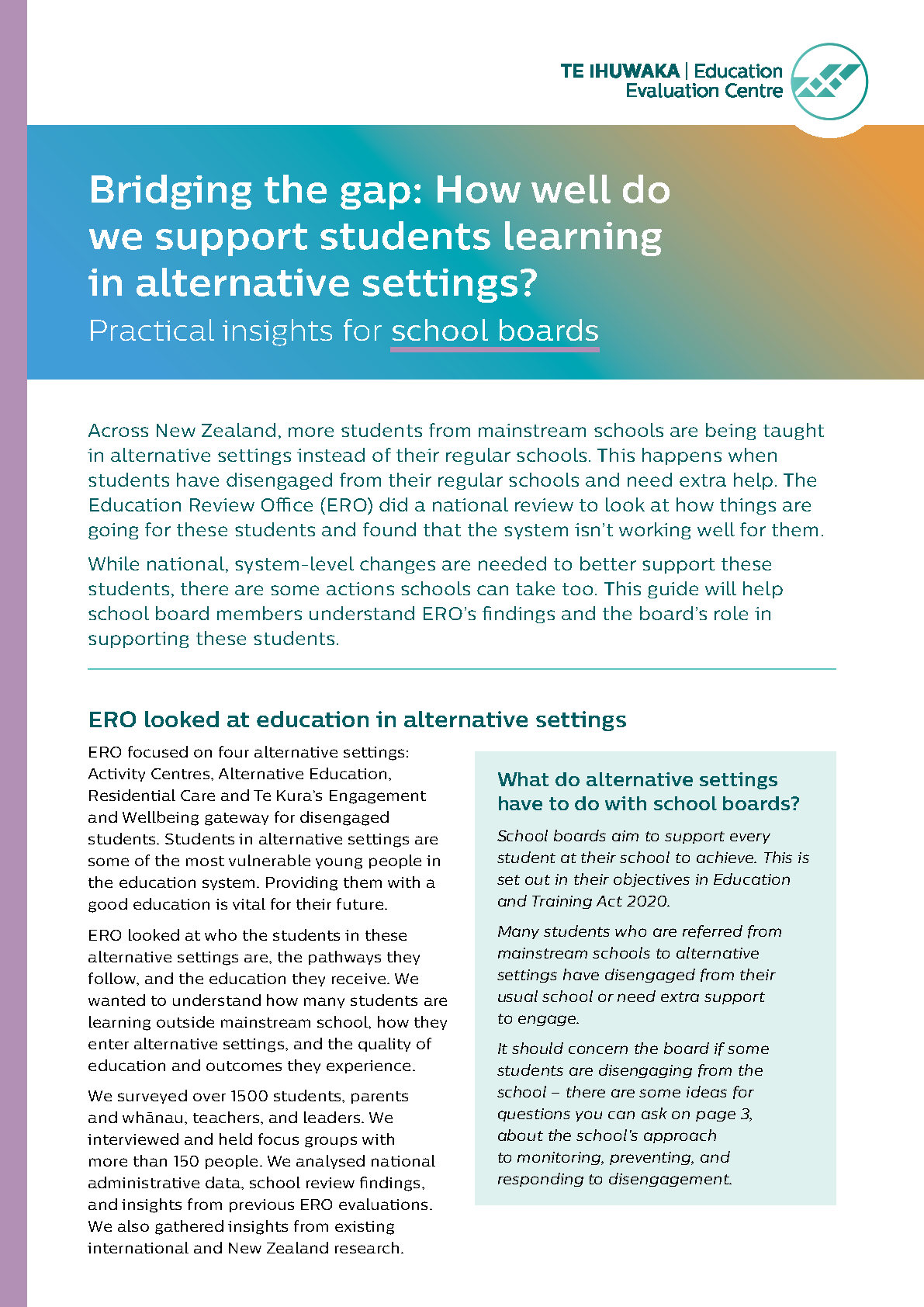 Sector insights | 10 min read
Bridging the Gap: How well do we support students learning in alternative settings? Practical insights for school boards
23 June 2026 -
 Technical report | 45 min read
Bridging the Gap: How well do we support students learning in alternative settings? Technical Appendix
23 June 2026
Read Online
Introduction
All over New Zealand, students are referred from their usual school to alternative settings like Activity Centres, Alternative Education, Residential Care, and Te Kura’s Wellbeing and Engagement gateway. This usually happens because they have disengaged from their usual school. ERO looked at who the students in these alternative settings are, the pathways they follow, and the education they receive while they are there.
This short guide for mainstream school leaders sets out what we found, what we recommended should change, and some practical actions and tips for mainstream school leaders to support better outcomes for these students.
All over New Zealand, students are referred from their usual school to alternative settings like Activity Centres, Alternative Education, Residential Care, and Te Kura’s Wellbeing and Engagement gateway. This usually happens because they have disengaged from their usual school. ERO looked at who the students in these alternative settings are, the pathways they follow, and the education they receive while they are there.
This short guide for mainstream school leaders sets out what we found, what we recommended should change, and some practical actions and tips for mainstream school leaders to support better outcomes for these students.
What did ERO look at?
This review focused on four alternative settings: Activity Centres, Alternative Education, Residential Care and Te Kura’s Engagement and Wellbeing gateway for disengaged students. The Education Review Office (ERO) has raised concerns about each of these settings before, but this is the first time we’ve taken a system-level view across them all at once.
ERO looked at who the students in these alternative settings are, the pathways they follow, and the education they receive. We wanted to understand how many students are learning outside mainstream school, how they enter alternative settings, and the quality of education and outcomes they experience.
We surveyed over 1500 students, parents and whānau, teachers, and leaders. We interviewed and held focus groups with more than 150 people. We analysed national administrative data, school review findings, and insights from previous ERO evaluations. We also gathered insights from existing international and New Zealand research.
Why do students get referred to alternative settings?
Students are referred to these settings primarily because of attendance issues and disruptive behaviour. For Te Kura’s Engagement and Wellbeing gateways, most referrals are because the student has complex needs, like mental health, neurodivergence, or learning needs. Less commonly, students are referred to alternative settings because they have used violence, have perpetrated, or been victims of bullying.
This review focused on four alternative settings: Activity Centres, Alternative Education, Residential Care and Te Kura’s Engagement and Wellbeing gateway for disengaged students. The Education Review Office (ERO) has raised concerns about each of these settings before, but this is the first time we’ve taken a system-level view across them all at once.
ERO looked at who the students in these alternative settings are, the pathways they follow, and the education they receive. We wanted to understand how many students are learning outside mainstream school, how they enter alternative settings, and the quality of education and outcomes they experience.
We surveyed over 1500 students, parents and whānau, teachers, and leaders. We interviewed and held focus groups with more than 150 people. We analysed national administrative data, school review findings, and insights from previous ERO evaluations. We also gathered insights from existing international and New Zealand research.
Why do students get referred to alternative settings?
Students are referred to these settings primarily because of attendance issues and disruptive behaviour. For Te Kura’s Engagement and Wellbeing gateways, most referrals are because the student has complex needs, like mental health, neurodivergence, or learning needs. Less commonly, students are referred to alternative settings because they have used violence, have perpetrated, or been victims of bullying.
What did ERO find?
Students are experiencing poor outcomes in alternative settings.
Students who learn in alternative settings aren’t getting the quality of education they need, and this affects both their learning and their future.
They make less progress and earn fewer qualifications than those in regular schools. Four in five (82 percent) students aged 17 or older leave their alternative setting without any NCEA qualifications.
For most of these students, the alternative setting ends up being their final learning space, and very few return to mainstream schooling.
DID YOU KNOW?
Around three quarters (74 percent) of students who attended alternative settings are receiving Tier 1 benefits by age 24.
Three in ten (31 percent) students who attended Alternative Education or Activity Centres will have had a court charge by age 26.
The system isn’t set up to deliver good quality education.
ERO found that the concerning outcomes from these settings aren’t because teachers and leaders don’t care—they’re working hard. The problem is that the current setup doesn’t consistently offer the levels of support and the kinds of teaching that are needed. The system also isn’t lined up with what we know actually works in education. For example, fewer than half (44 percent) of educators in Alternative Education are registered teachers.
“Schools that have registered teachers send [students] to us because they can’t meet their educational needs. How are students meant to be learning with staff who are well intentioned but have no idea about the curriculum?”
- ALTERNATIVE EDUCATION LEADER
Enrolments in Te Kura have skyrocketed
Te Kura’s roll has grown sharply over the past decade — from about 3,300 students in 2016 to more than 8,600 in 2024. Much of this growth comes from a surge in students referred through the Engagement and Wellbeing gateway, which is used for young people facing serious challenges, not enrolled anywhere, or excluded from school. These referrals have jumped from fewer than 1,500 students in 2015 to more than 6,100 in 2024.
Because Te Kura has no cap on enrolments, unlike Alternative Education or Activity Centres, it can take every student referred through this gateway. As more young people disengage from mainstream schooling, Te Kura increasingly carries the bulk of the system’s demand — effectively becoming the safety net when other options are full. 02 Bridging the gap: How well do we support students learning in alternative settings? Practical insights for mainstream school leaders
Students are experiencing poor outcomes in alternative settings.
Students who learn in alternative settings aren’t getting the quality of education they need, and this affects both their learning and their future.
They make less progress and earn fewer qualifications than those in regular schools. Four in five (82 percent) students aged 17 or older leave their alternative setting without any NCEA qualifications.
For most of these students, the alternative setting ends up being their final learning space, and very few return to mainstream schooling.
DID YOU KNOW?
Around three quarters (74 percent) of students who attended alternative settings are receiving Tier 1 benefits by age 24.
Three in ten (31 percent) students who attended Alternative Education or Activity Centres will have had a court charge by age 26.
The system isn’t set up to deliver good quality education.
ERO found that the concerning outcomes from these settings aren’t because teachers and leaders don’t care—they’re working hard. The problem is that the current setup doesn’t consistently offer the levels of support and the kinds of teaching that are needed. The system also isn’t lined up with what we know actually works in education. For example, fewer than half (44 percent) of educators in Alternative Education are registered teachers.
“Schools that have registered teachers send [students] to us because they can’t meet their educational needs. How are students meant to be learning with staff who are well intentioned but have no idea about the curriculum?”
- ALTERNATIVE EDUCATION LEADER
Enrolments in Te Kura have skyrocketed
Te Kura’s roll has grown sharply over the past decade — from about 3,300 students in 2016 to more than 8,600 in 2024. Much of this growth comes from a surge in students referred through the Engagement and Wellbeing gateway, which is used for young people facing serious challenges, not enrolled anywhere, or excluded from school. These referrals have jumped from fewer than 1,500 students in 2015 to more than 6,100 in 2024.
Because Te Kura has no cap on enrolments, unlike Alternative Education or Activity Centres, it can take every student referred through this gateway. As more young people disengage from mainstream schooling, Te Kura increasingly carries the bulk of the system’s demand — effectively becoming the safety net when other options are full. 02 Bridging the gap: How well do we support students learning in alternative settings? Practical insights for mainstream school leaders
What changes are ERO recommending?
We have identified the following recommendations to reduce the number of students leaving mainstream schooling and improve the education provision and outcomes of students in alternative settings.
Better support for schools to keep students engaged
We want to better support schools so they can keep students engaged and learning in mainstream classrooms, reducing the need for referrals to alternative settings. This includes strengthening behaviour, attendance and learning supports, actively addressing bullying and fostering belonging and providing targeted resourcing to schools with the highest concentrations of at risk students. Together, these actions help schools create safe, inclusive environments where students are supported to stay connected and succeed.
A new model of alternative provision
We need to reform the alternative provision system to improve outcomes for students by creating a more coherent and consistent national framework with clear expectations, roles and responsibilities and stronger oversight. A national model with needs-based funding, qualified teachers, access to the full curriculum, qualifications, and pathways, and strong connections to home schools will improve consistency, quality, and outcomes for students.
We have identified the following recommendations to reduce the number of students leaving mainstream schooling and improve the education provision and outcomes of students in alternative settings.
Better support for schools to keep students engaged
We want to better support schools so they can keep students engaged and learning in mainstream classrooms, reducing the need for referrals to alternative settings. This includes strengthening behaviour, attendance and learning supports, actively addressing bullying and fostering belonging and providing targeted resourcing to schools with the highest concentrations of at risk students. Together, these actions help schools create safe, inclusive environments where students are supported to stay connected and succeed.
A new model of alternative provision
We need to reform the alternative provision system to improve outcomes for students by creating a more coherent and consistent national framework with clear expectations, roles and responsibilities and stronger oversight. A national model with needs-based funding, qualified teachers, access to the full curriculum, qualifications, and pathways, and strong connections to home schools will improve consistency, quality, and outcomes for students.
What does this all mean for mainstream school leaders?
How mainstream schools can take action
1) Try everything else, before referring:
- Identify and respond to disengagement early
- Pay extra attention during transitions
- Find out about students’ specific barriers
- Ensure students have a positive relationship with at least one teacher
- Involve students in activities that connect them with others
2) When referring is the only option, stay close:
- Share lots of information with the alternative setting
- Create a joint plan to move the student out of the alternative setting
- Keep up a strong message of belonging to their main school
ERO is recommending a significant change to the system and structures around alternative settings. There is a limit to how much schools can achieve without these shifts. However, our research found that there are still some key ways that school leaders can have a positive impact for these students.
DID YOU KNOW?
Legal responsibilities
When a student is attending an Activity Centre or Alternative Education, they’re still on the referring school’s roll — which means the school is still legally responsible for their education.
What this means: Your job doesn’t stop when they move to another setting. School staff are expected to keep an eye on their progress and wellbeing, check in on their attendance, and stay involved in supporting them while they’re there and when they’re ready to come back to school, or move on to further study, training, or work. Students should also still be able to access the support and services your school normally provides, like counselling and careers guidance
How mainstream schools can take action
1) Try everything else, before referring:
- Identify and respond to disengagement early
- Pay extra attention during transitions
- Find out about students’ specific barriers
- Ensure students have a positive relationship with at least one teacher
- Involve students in activities that connect them with others
2) When referring is the only option, stay close:
- Share lots of information with the alternative setting
- Create a joint plan to move the student out of the alternative setting
- Keep up a strong message of belonging to their main school
ERO is recommending a significant change to the system and structures around alternative settings. There is a limit to how much schools can achieve without these shifts. However, our research found that there are still some key ways that school leaders can have a positive impact for these students.
DID YOU KNOW?
Legal responsibilities
When a student is attending an Activity Centre or Alternative Education, they’re still on the referring school’s roll — which means the school is still legally responsible for their education.
What this means: Your job doesn’t stop when they move to another setting. School staff are expected to keep an eye on their progress and wellbeing, check in on their attendance, and stay involved in supporting them while they’re there and when they’re ready to come back to school, or move on to further study, training, or work. Students should also still be able to access the support and services your school normally provides, like counselling and careers guidance
1) Try everything else, before referring
Once a student enters an alternative setting, it’s hard for them to go back to mainstream schooling – so few do. School leaders should do everything they can to keep students engaged and learning in their regular school.
DID YOU KNOW?
Only one in seven (16 percent) students return to and remain in mainstream school after leaving an alternative setting. Rates are lowest for young people leaving Residential Care (seven percent).
a) Identify and respond to disengagement quickly
It’s much easier to turn things around when problems are spotted early. Use data to look out for signs of disengagement like non-attendance, behaviour issues, incomplete work, and avoiding assessments.
Case study: A focus on keeping students onsite
One large urban secondary girls’ school has low referral rates for moving students to alternative settings. At this school, keeping students on-site and connected to the school and its support networks is seen as a priority.
Leadership at the school includes a co-ordination role, held by a member of the Senior Management Team that has responsibility for all students who follow a non-linear pathway. They have a team of people working alongside this co-ordinator, including deans, counsellors, a nurse and the careers co-ordinator.
Where students are facing challenges that make it difficult for them to meet attendance, behaviour and participation expectations, the team develops a short-term adapted programme to create some space for that student to overcome these specific challenges and develop some routines and skills that will help them to meet expectations in the future. They are supported by the full pastoral network.
Students on these adapted programmes may take time out in a supervised quiet space, like the school library. Often they are placed on a temporary reduced timetable. Some students choose to enrol in the Te Kura alignment pathway and continue to learn on-site, but have a break from the classroom environment.
The goal is to keep students on-site and in the routine of coming to school. Students are still expected to get up each morning and put on their uniform and get to school—even if they are not participating in a first period class or are on a Te Kura programme. A designated member of the leadership team monitors the students’ logon hours and shares this with their parents and whānau.
At times, the school’s careers department connects students to opportunities that support them to stay in education – if not in the classroom.
Strong interschool networks help schools keep students in mainstream education.
Some regions have developed interschool networks to reduce the need to refer disengaging students to alternative pathways. These networks create shared responsibility across schools, enabling leaders to draw on one another’s pastoral strengths, specialist capabilities, and available places so that students do not fall through the gaps in a single school’s system. For many leaders, this collaborative approach provides a meaningful alternative to referring students out of mainstream schooling altogether.
In one area, secondary schools meet regularly to discuss students with emerging or complex needs, pooling information early so that timely decisions can be made. Through this process, schools can consider a managed transfer to another local school that may be a better fit—whether because of its pastoral culture, specialist programmes, or leadership expertise—rather than defaulting to an alternative setting. This coordinated model is supported by structured mentoring for students at risk of disengagement, which helps sustain relationships and continuity of support even as students move between schools.
“We are highly engaged in this model, where we move students around schools, rather than out of schools. If students are not getting what they need from this school, they could do with a fresh start somewhere else.”
- SCHOOL LEADER
b) Pay extra attention during transitions
Transition points can increase the risk of disengagement, whether they are structured (like moving from intermediate to secondary school) or unstructured (like moving schools during the primary years). Strong support at transition times make a difference. For example, leaders and teachers might collect information about incoming students—like their attendance history (especially any long absences or learning gaps), hobbies, interests, cultural background, languages, attitudes toward school, home life, and previous challenges. Many schools hold entry interviews to capture this information to help identify where extra support might be needed.
DID YOU KNOW?
Frequent, unstructured school moves are a risk factor for disengagement from mainstream education. Each unstructured move (other than standard transitions between primary, intermediate, and secondary) increases the likelihood of entering an alternative setting by almost 10 percent (1.1 times).
c) Find out about students’ specific barriers to engagement
We talked with students and parents and whānau who described juggling several challenges at once — things like neurodiversity (sometimes undiagnosed), Foetal Alcohol Spectrum Disorder, chronic health issues, learning disabilities such as dyslexia, and serious mental health concerns including anxiety, PTSD, OCD, and panic disorders. Across settings, one in four (27 percent) students have a disability or learning need. Many also told us these difficulties were made even harder by experiences of trauma, the disruptions of Covid19, and struggles with addictive behaviours.
When students’ learning or mental health needs aren’t understood or supported, they often show up in ways that schools see as disengagement or “bad behaviour.” Students told us they can struggle to concentrate, feel overwhelmed in busy classrooms, or experience intense anxiety — which then leads to irregular attendance, chronic absenteeism, or pulling back from learning altogether. Parents and whānau said their children sometimes express distress through outbursts, aggression, or difficulty managing emotions, and these behaviours can lead to standdowns, suspensions, or exclusion. This can push students even further away from education and deepen cycles of disadvantage.
Other students experience challenges with their family or home-life that may be affecting their engagement at school. For example, students who have had involvement with Oranga Tamariki much more frequently end up in alternative settings. In both Activity Centres and Alternative Education, more than four in ten (41-42 percent) students have contact with Oranga Tamariki by age 15.
“Often it’s the same that stops other kids attending – things like transport, food, clothing, not having a functional adult home that can support them.”
- ALTERNATIVE EDUCATION LEADER
School leaders can make a difference by working with teachers, parents and whānau, and students to explore the real reasons for disengagement – they might not be what it seems. Then schools can focus their support where it will be most effective.
“We make sure we put the kid with the right adults, who help taking around food parcels, or referring them straight to attendance service for support. We’re about to apply for funding for a cool in-school programme where we work with [at-risk students’] mums.”
- SCHOOL LEADER
Case study: Wraparound needs assessments
Several schools that we talked to use a team approach to step in early rather than waiting for things to get worse. When a student’s attendance drops, their behaviour changes, or there’s talk of a standdown or suspension, these schools often kick off a wraparound needs assessment to figure out what’s actually going on.
The wraparound approach brings together teachers, support staff, health professionals, social workers, the student, and their parents and whānau to build a better picture of the student’s challenges sitting underneath the surface. Together they might uncover things like anxiety, an undiagnosed learning need, family stress, or a mismatch between the student’s strengths and their current programme.
Once the team understands the student’s specific barriers, this informs their plans to put the right support in place—whether that’s mental health help, learning assessments, social worker support, or adjustments to the student’s timetable. When done well, this early, joined-up approach often prevents issues from escalating and helps keep students connected to their school.
d) Involve students in activities and learning that connects them with others
Co-curricular activities and groups, like sports teams, kapa haka, or choir, support students’ sense of belonging. They give students the chance to make friends, explore their interests, and contribute positively at school.
“Extra-curricular activities used to be the only reason I came to school.”
- STUDENT
“We’re more successful with the boys who engage well with the extracurricular activities, like kapa haka and sports. […] that’s a big driver and incentive to be honest.”
- SCHOOL LEADER
The power of belonging and connection
We found schools that refer low numbers of students have something in common: inclusion and belonging are built into everyday teaching. Students and parents and whānau help set learning goals and pathways, giving them a voice in learning. Teaching draws on home contexts and local culture and language, and staff build capability through kaupapa Māori and Pacific-based professional learning to meet the needs of their students.
These practices matter because they build belonging, and belonging is one of the strongest predictors of regular attendance. ERO’s 2025 Back to class report shows that students who feel they belong at school are around five times more likely to attend regularly than those who do not.
e) Ensure students have a positive relationship with at least one teacher
It makes a big difference to belonging when students have at least one adult at school who really ‘gets’ them and shows they care about that student. Structures like homeroom classes or whānau groups – where a specific teacher takes on a mentoring and coaching role – can help build these strong, supportive relationships. It can be useful for staff to reflect as a team on the students who are at risk of disengagement – do they have at least one strong relationship with a staff member? If not, who is best placed to build this relationship as soon as possible?
“Having a teacher who gets you helps you feel safer and more willing to come to school, even when things are hard.”
- STUDENT
“The hub structure with a vertical class helps. The students have friends across year levels and have people they know they can go to. Our teachers are equipped with the skills to have chats on the grounds before things escalate.”
- SCHOOL LEADER
DID YOU KNOW?
Students are five times more likely to think daily attendance is important if they feel they belong at school.
Students are over five times more likely to report school is important for their future if they feel they belong.
Changing attitudes to attendance – ERO Review Report Sept 2025
Case study: An on-site programme for students at risk of disengaging
One medium sized suburban secondary school has developed an on-site programme for students who are finding it challenging to meet the day-to-day expectations of attendance, behaviour and participation in class.
The programme is staffed with teachers, teacher aides, and youth workers who work together to address the students’ learning, practical, and emotional needs. Students’ placement in the programme is reviewed on a termly basis, and parents and whānau are a part of all decision-making and goal setting for their child.
1) Try everything else, before referring
Once a student enters an alternative setting, it’s hard for them to go back to mainstream schooling – so few do. School leaders should do everything they can to keep students engaged and learning in their regular school.
DID YOU KNOW?
Only one in seven (16 percent) students return to and remain in mainstream school after leaving an alternative setting. Rates are lowest for young people leaving Residential Care (seven percent).
a) Identify and respond to disengagement quickly
It’s much easier to turn things around when problems are spotted early. Use data to look out for signs of disengagement like non-attendance, behaviour issues, incomplete work, and avoiding assessments.
Case study: A focus on keeping students onsite
One large urban secondary girls’ school has low referral rates for moving students to alternative settings. At this school, keeping students on-site and connected to the school and its support networks is seen as a priority.
Leadership at the school includes a co-ordination role, held by a member of the Senior Management Team that has responsibility for all students who follow a non-linear pathway. They have a team of people working alongside this co-ordinator, including deans, counsellors, a nurse and the careers co-ordinator.
Where students are facing challenges that make it difficult for them to meet attendance, behaviour and participation expectations, the team develops a short-term adapted programme to create some space for that student to overcome these specific challenges and develop some routines and skills that will help them to meet expectations in the future. They are supported by the full pastoral network.
Students on these adapted programmes may take time out in a supervised quiet space, like the school library. Often they are placed on a temporary reduced timetable. Some students choose to enrol in the Te Kura alignment pathway and continue to learn on-site, but have a break from the classroom environment.
The goal is to keep students on-site and in the routine of coming to school. Students are still expected to get up each morning and put on their uniform and get to school—even if they are not participating in a first period class or are on a Te Kura programme. A designated member of the leadership team monitors the students’ logon hours and shares this with their parents and whānau.
At times, the school’s careers department connects students to opportunities that support them to stay in education – if not in the classroom.
Strong interschool networks help schools keep students in mainstream education.
Some regions have developed interschool networks to reduce the need to refer disengaging students to alternative pathways. These networks create shared responsibility across schools, enabling leaders to draw on one another’s pastoral strengths, specialist capabilities, and available places so that students do not fall through the gaps in a single school’s system. For many leaders, this collaborative approach provides a meaningful alternative to referring students out of mainstream schooling altogether.
In one area, secondary schools meet regularly to discuss students with emerging or complex needs, pooling information early so that timely decisions can be made. Through this process, schools can consider a managed transfer to another local school that may be a better fit—whether because of its pastoral culture, specialist programmes, or leadership expertise—rather than defaulting to an alternative setting. This coordinated model is supported by structured mentoring for students at risk of disengagement, which helps sustain relationships and continuity of support even as students move between schools.
“We are highly engaged in this model, where we move students around schools, rather than out of schools. If students are not getting what they need from this school, they could do with a fresh start somewhere else.”
- SCHOOL LEADER
b) Pay extra attention during transitions
Transition points can increase the risk of disengagement, whether they are structured (like moving from intermediate to secondary school) or unstructured (like moving schools during the primary years). Strong support at transition times make a difference. For example, leaders and teachers might collect information about incoming students—like their attendance history (especially any long absences or learning gaps), hobbies, interests, cultural background, languages, attitudes toward school, home life, and previous challenges. Many schools hold entry interviews to capture this information to help identify where extra support might be needed.
DID YOU KNOW?
Frequent, unstructured school moves are a risk factor for disengagement from mainstream education. Each unstructured move (other than standard transitions between primary, intermediate, and secondary) increases the likelihood of entering an alternative setting by almost 10 percent (1.1 times).
c) Find out about students’ specific barriers to engagement
We talked with students and parents and whānau who described juggling several challenges at once — things like neurodiversity (sometimes undiagnosed), Foetal Alcohol Spectrum Disorder, chronic health issues, learning disabilities such as dyslexia, and serious mental health concerns including anxiety, PTSD, OCD, and panic disorders. Across settings, one in four (27 percent) students have a disability or learning need. Many also told us these difficulties were made even harder by experiences of trauma, the disruptions of Covid19, and struggles with addictive behaviours.
When students’ learning or mental health needs aren’t understood or supported, they often show up in ways that schools see as disengagement or “bad behaviour.” Students told us they can struggle to concentrate, feel overwhelmed in busy classrooms, or experience intense anxiety — which then leads to irregular attendance, chronic absenteeism, or pulling back from learning altogether. Parents and whānau said their children sometimes express distress through outbursts, aggression, or difficulty managing emotions, and these behaviours can lead to standdowns, suspensions, or exclusion. This can push students even further away from education and deepen cycles of disadvantage.
Other students experience challenges with their family or home-life that may be affecting their engagement at school. For example, students who have had involvement with Oranga Tamariki much more frequently end up in alternative settings. In both Activity Centres and Alternative Education, more than four in ten (41-42 percent) students have contact with Oranga Tamariki by age 15.
“Often it’s the same that stops other kids attending – things like transport, food, clothing, not having a functional adult home that can support them.”
- ALTERNATIVE EDUCATION LEADER
School leaders can make a difference by working with teachers, parents and whānau, and students to explore the real reasons for disengagement – they might not be what it seems. Then schools can focus their support where it will be most effective.
“We make sure we put the kid with the right adults, who help taking around food parcels, or referring them straight to attendance service for support. We’re about to apply for funding for a cool in-school programme where we work with [at-risk students’] mums.”
- SCHOOL LEADER
Case study: Wraparound needs assessments
Several schools that we talked to use a team approach to step in early rather than waiting for things to get worse. When a student’s attendance drops, their behaviour changes, or there’s talk of a standdown or suspension, these schools often kick off a wraparound needs assessment to figure out what’s actually going on.
The wraparound approach brings together teachers, support staff, health professionals, social workers, the student, and their parents and whānau to build a better picture of the student’s challenges sitting underneath the surface. Together they might uncover things like anxiety, an undiagnosed learning need, family stress, or a mismatch between the student’s strengths and their current programme.
Once the team understands the student’s specific barriers, this informs their plans to put the right support in place—whether that’s mental health help, learning assessments, social worker support, or adjustments to the student’s timetable. When done well, this early, joined-up approach often prevents issues from escalating and helps keep students connected to their school.
d) Involve students in activities and learning that connects them with others
Co-curricular activities and groups, like sports teams, kapa haka, or choir, support students’ sense of belonging. They give students the chance to make friends, explore their interests, and contribute positively at school.
“Extra-curricular activities used to be the only reason I came to school.”
- STUDENT
“We’re more successful with the boys who engage well with the extracurricular activities, like kapa haka and sports. […] that’s a big driver and incentive to be honest.”
- SCHOOL LEADER
The power of belonging and connection
We found schools that refer low numbers of students have something in common: inclusion and belonging are built into everyday teaching. Students and parents and whānau help set learning goals and pathways, giving them a voice in learning. Teaching draws on home contexts and local culture and language, and staff build capability through kaupapa Māori and Pacific-based professional learning to meet the needs of their students.
These practices matter because they build belonging, and belonging is one of the strongest predictors of regular attendance. ERO’s 2025 Back to class report shows that students who feel they belong at school are around five times more likely to attend regularly than those who do not.
e) Ensure students have a positive relationship with at least one teacher
It makes a big difference to belonging when students have at least one adult at school who really ‘gets’ them and shows they care about that student. Structures like homeroom classes or whānau groups – where a specific teacher takes on a mentoring and coaching role – can help build these strong, supportive relationships. It can be useful for staff to reflect as a team on the students who are at risk of disengagement – do they have at least one strong relationship with a staff member? If not, who is best placed to build this relationship as soon as possible?
“Having a teacher who gets you helps you feel safer and more willing to come to school, even when things are hard.”
- STUDENT
“The hub structure with a vertical class helps. The students have friends across year levels and have people they know they can go to. Our teachers are equipped with the skills to have chats on the grounds before things escalate.”
- SCHOOL LEADER
DID YOU KNOW?
Students are five times more likely to think daily attendance is important if they feel they belong at school.
Students are over five times more likely to report school is important for their future if they feel they belong.
Changing attitudes to attendance – ERO Review Report Sept 2025
Case study: An on-site programme for students at risk of disengaging
One medium sized suburban secondary school has developed an on-site programme for students who are finding it challenging to meet the day-to-day expectations of attendance, behaviour and participation in class.
The programme is staffed with teachers, teacher aides, and youth workers who work together to address the students’ learning, practical, and emotional needs. Students’ placement in the programme is reviewed on a termly basis, and parents and whānau are a part of all decision-making and goal setting for their child.
2) When referring is the only option, stay closely involved
Sometimes even excellent engagement-building strategies don’t work out. Some students face challenges that make it unsafe or unmanageable for them to stay in school, such as repeated violent incidents, severe emotional dysregulation, or behaviours linked to unmet mental health needs. Others may be in crisis, experiencing trauma, or struggling with addictions or acute anxiety, and need a quieter, more supported environment to stabilise before they can return to learning in a mainstream classroom.
When referral is the only option, it’s important to remember that alternative settings are only temporary supports. Both the school and the new provider share responsibility for helping the student set and work towards useful learning goals to get back on track – and usually, to return to the school.
a) Share lots of information with the alternative setting
School leaders can start the process off well by providing as much information as possible about the student’s current achievement and progress, specific learning gaps, strengths, and challenges. Meetings between the referring school, the new provider, parents and whānau, and the student help everyone get on the same page about what progress is needed for the student get back on track for a return to school.
In our study, we heard that information-sharing between mainstream schools and alternative settings is patchy at best.
DID YOU KNOW?
More than six in ten (62 percent) teachers in alternative settings say they do not get the student information they need, which limits their ability to support students effectively.
Only about half of leaders receive even the most essential details from a student’s previous school — such as information about disabilities or learning needs (53 percent), progress and achievement (51 percent), behaviour history (49 percent), or the supports a student requires (46 percent).
“One of the worst situations is where… [the school] literally goes ‘Yep, we’ve got a school,’ and they drop the kid at the door. And we’re like, ‘Are we not going to have a conversation about the kid?”
- ALTERNATIVE EDUCATION LEADER
We also heard that when coordination and information sharing do work well, students stay engaged for longer and get better support. This often looks like agencies and schools meeting together when a student first arrives and checking in throughout their time in the setting. These meetings help ensure everyone involved — school leaders, alternative setting staff, iwi, the Ministry of Education, Oranga Tamariki, and others — is in the same room, sharing information, aligning plans, and taking joint responsibility for the student’s next steps.
“When you’re bringing those [inter-agency] people together, you’re talking about what provision there is for these young people, and how we then connect the dots and have a look at each other’s practice. That’s a highly effective model for collaborating, and it means the korowai around our whānau in the community has got fewer holes in it, basically.”
- ALTERNATIVE EDUCATION LEADER
Case study: Careful transitions into alternative settings
One medium-sized suburban secondary school takes a pro-active approach to managing transitions into and out of alternative settings. If a referral is considered the best option, the first step is for the student and their parents and whānau to visit the setting. Then they meet with the school principal to discuss next steps.
The school holds a ‘professionals meeting’ which includes the child and their parents and whānau, leaders from the school and the setting, and a staff member from the school who knows the student best. (This might be an SLT member, a dean, teacher, or counsellor.) The meeting focuses on identifying the aims of the referral, setting targets for the student, and thinking ahead to the student’s future pathway out of the setting.
As part of the transition planning, they also consider whether there are existing relationships between the student and other students at the setting that need to be managed. They may go to the centre and conduct a restorative session, to ensure the transition is not derailed by past relationship issues.
The school engages in extensive assessment of their students to identify any learning gaps, using standardised assessment tools such as PAT’s or Diebels. This information is shared with the centre so the student’s learning needs are understood and can be met. Staff at the neighbouring setting are regularly invited to the school to participate in PLD that teaching staff receive to help them become familiar with literacy and numeracy interventions the school is using and assessment tools they use also. 10 Bridging the gap: How well do we support students learning in alternative settings? Practical insights for mainstream school leaders
b) Create a joint plan to move the student out of the alternative setting
Alternative settings are temporary support – for students to get back on track, address learning gaps, and rebuild engagement with education. Goals, planning, assessment, and curriculum support should be squarely aimed at a return to mainstream schooling or onto a good vocational pathway. However, we found that planning and assessment in alternative settings wasn’t well set-up for this.
For example, students in alternative settings usually earn their NCEA English and maths credits through unit standards rather than achievement standards. Because these unit standards cannot be transferred back into mainstream schooling or counted toward NCEA, students who return must complete the co-requisite again to gain the 60 associated credits. For this reason, the mainstream school has an important role in setting clear goals and a realistic plan for reentry, so that students understand the pathway ahead and feel supported to transition back successfully.
DID YOU KNOW?
More than four in ten (43 percent) students in alternative settings say that they do not have a plan to return to school, and almost half (48 percent) report having no clear pathway for when they leave.
DID YOU KNOW?
Only 44 percent of staff in Alternative Education centres are registered teachers. Of these teachers, many are primary trained.
“I am there to support the [site] leader to do their job. So [site leader] and I meet once a fortnight for at least an hour. More often if needed. I’ll also just go down and visit there occasionally and see the kids and check in with them... I also know the staff down there reasonably well, particularly the teaching team. And they will contact me sometimes about things and talk through teaching issues with me.”
- LEADER OF A MANAGING SCHOOL
c) Keep up a strong message of belonging to their main school
Belonging matters, and it motivates. School leaders can make a difference by ensuring their staff stay in touch and keep a positive relationship—showing the student that the school still cares about them. This might involve leaders or teachers visiting the student at their alternative setting, supporting them to continue taking part in co-curricular activities (when appropriate), and recognising learning and progress achievements while they’re away. This can go a long way toward breaking down the barriers that can make returning feel difficult.
“[I would need] a little bit of leniency, I guess. Just like, I need help with my work because I don’t quite understand it sometimes. The more help I could get would be better.”
- ALTERNATIVE EDUCATION STUDENT
“We are always talking to them, saying you’re still a [our school] kid ... and always talking about the future, that hope that you’ll come back. This is where you are going to learn some skills to come back.”
- SCHOOL LEADER
Case study: Staying connected
School staff from a medium-sized suburban secondary school visit students regularly to maintain a connection. The goal is for the child to continue to see themselves as a member of the school community. The principal describes it as wanting the child to see that “we are your team.” The most connected teacher to the student is also encouraged and supported to visit them at the centre and maintain that connection.
2) When referring is the only option, stay closely involved
Sometimes even excellent engagement-building strategies don’t work out. Some students face challenges that make it unsafe or unmanageable for them to stay in school, such as repeated violent incidents, severe emotional dysregulation, or behaviours linked to unmet mental health needs. Others may be in crisis, experiencing trauma, or struggling with addictions or acute anxiety, and need a quieter, more supported environment to stabilise before they can return to learning in a mainstream classroom.
When referral is the only option, it’s important to remember that alternative settings are only temporary supports. Both the school and the new provider share responsibility for helping the student set and work towards useful learning goals to get back on track – and usually, to return to the school.
a) Share lots of information with the alternative setting
School leaders can start the process off well by providing as much information as possible about the student’s current achievement and progress, specific learning gaps, strengths, and challenges. Meetings between the referring school, the new provider, parents and whānau, and the student help everyone get on the same page about what progress is needed for the student get back on track for a return to school.
In our study, we heard that information-sharing between mainstream schools and alternative settings is patchy at best.
DID YOU KNOW?
More than six in ten (62 percent) teachers in alternative settings say they do not get the student information they need, which limits their ability to support students effectively.
Only about half of leaders receive even the most essential details from a student’s previous school — such as information about disabilities or learning needs (53 percent), progress and achievement (51 percent), behaviour history (49 percent), or the supports a student requires (46 percent).
“One of the worst situations is where… [the school] literally goes ‘Yep, we’ve got a school,’ and they drop the kid at the door. And we’re like, ‘Are we not going to have a conversation about the kid?”
- ALTERNATIVE EDUCATION LEADER
We also heard that when coordination and information sharing do work well, students stay engaged for longer and get better support. This often looks like agencies and schools meeting together when a student first arrives and checking in throughout their time in the setting. These meetings help ensure everyone involved — school leaders, alternative setting staff, iwi, the Ministry of Education, Oranga Tamariki, and others — is in the same room, sharing information, aligning plans, and taking joint responsibility for the student’s next steps.
“When you’re bringing those [inter-agency] people together, you’re talking about what provision there is for these young people, and how we then connect the dots and have a look at each other’s practice. That’s a highly effective model for collaborating, and it means the korowai around our whānau in the community has got fewer holes in it, basically.”
- ALTERNATIVE EDUCATION LEADER
Case study: Careful transitions into alternative settings
One medium-sized suburban secondary school takes a pro-active approach to managing transitions into and out of alternative settings. If a referral is considered the best option, the first step is for the student and their parents and whānau to visit the setting. Then they meet with the school principal to discuss next steps.
The school holds a ‘professionals meeting’ which includes the child and their parents and whānau, leaders from the school and the setting, and a staff member from the school who knows the student best. (This might be an SLT member, a dean, teacher, or counsellor.) The meeting focuses on identifying the aims of the referral, setting targets for the student, and thinking ahead to the student’s future pathway out of the setting.
As part of the transition planning, they also consider whether there are existing relationships between the student and other students at the setting that need to be managed. They may go to the centre and conduct a restorative session, to ensure the transition is not derailed by past relationship issues.
The school engages in extensive assessment of their students to identify any learning gaps, using standardised assessment tools such as PAT’s or Diebels. This information is shared with the centre so the student’s learning needs are understood and can be met. Staff at the neighbouring setting are regularly invited to the school to participate in PLD that teaching staff receive to help them become familiar with literacy and numeracy interventions the school is using and assessment tools they use also. 10 Bridging the gap: How well do we support students learning in alternative settings? Practical insights for mainstream school leaders
b) Create a joint plan to move the student out of the alternative setting
Alternative settings are temporary support – for students to get back on track, address learning gaps, and rebuild engagement with education. Goals, planning, assessment, and curriculum support should be squarely aimed at a return to mainstream schooling or onto a good vocational pathway. However, we found that planning and assessment in alternative settings wasn’t well set-up for this.
For example, students in alternative settings usually earn their NCEA English and maths credits through unit standards rather than achievement standards. Because these unit standards cannot be transferred back into mainstream schooling or counted toward NCEA, students who return must complete the co-requisite again to gain the 60 associated credits. For this reason, the mainstream school has an important role in setting clear goals and a realistic plan for reentry, so that students understand the pathway ahead and feel supported to transition back successfully.
DID YOU KNOW?
More than four in ten (43 percent) students in alternative settings say that they do not have a plan to return to school, and almost half (48 percent) report having no clear pathway for when they leave.
DID YOU KNOW?
Only 44 percent of staff in Alternative Education centres are registered teachers. Of these teachers, many are primary trained.
“I am there to support the [site] leader to do their job. So [site leader] and I meet once a fortnight for at least an hour. More often if needed. I’ll also just go down and visit there occasionally and see the kids and check in with them... I also know the staff down there reasonably well, particularly the teaching team. And they will contact me sometimes about things and talk through teaching issues with me.”
- LEADER OF A MANAGING SCHOOL
c) Keep up a strong message of belonging to their main school
Belonging matters, and it motivates. School leaders can make a difference by ensuring their staff stay in touch and keep a positive relationship—showing the student that the school still cares about them. This might involve leaders or teachers visiting the student at their alternative setting, supporting them to continue taking part in co-curricular activities (when appropriate), and recognising learning and progress achievements while they’re away. This can go a long way toward breaking down the barriers that can make returning feel difficult.
“[I would need] a little bit of leniency, I guess. Just like, I need help with my work because I don’t quite understand it sometimes. The more help I could get would be better.”
- ALTERNATIVE EDUCATION STUDENT
“We are always talking to them, saying you’re still a [our school] kid ... and always talking about the future, that hope that you’ll come back. This is where you are going to learn some skills to come back.”
- SCHOOL LEADER
Case study: Staying connected
School staff from a medium-sized suburban secondary school visit students regularly to maintain a connection. The goal is for the child to continue to see themselves as a member of the school community. The principal describes it as wanting the child to see that “we are your team.” The most connected teacher to the student is also encouraged and supported to visit them at the centre and maintain that connection.
Conclusion
ERO found that students in alternative settings are experiencing poor outcomes, and the current system is not designed in a way that supports high‑quality teaching and learning. As a result, many learners are not getting the education they need to succeed. ERO is calling for changes to how alternative provision is set up, because schools can only do so much without these shifts. Even so, our research shows there are still practical ways school leaders can help. By paying close attention to at-risk students, being intentional about supporting students through transitions, supporting alternative settings with teaching and learning and keeping students connected when referral is the only option. These measures are essential to improve outcomes for some of our most vulnerable learners.
ERO found that students in alternative settings are experiencing poor outcomes, and the current system is not designed in a way that supports high‑quality teaching and learning. As a result, many learners are not getting the education they need to succeed. ERO is calling for changes to how alternative provision is set up, because schools can only do so much without these shifts. Even so, our research shows there are still practical ways school leaders can help. By paying close attention to at-risk students, being intentional about supporting students through transitions, supporting alternative settings with teaching and learning and keeping students connected when referral is the only option. These measures are essential to improve outcomes for some of our most vulnerable learners.
Useful resources
Report: Bridging the Gap: How well do we support students in alternative settings?
This report describes what we found about the outcomes for students referred into alternative settings. It looks at the quality of education these students receive and how this impacts their future.
- Click here to view the full report
Insights for school boards: Bridging the Gap: How well do we support students in alternative settings?
This resource provides an overview of the review ERO carried out on alternative settings. It focuses on the findings and recommendations that have most relevance to school boards and provides some suggested topics of discussion for board meetings.
- Click here to view the Insights for school boards
Back to class: How are attitudes to attendance to attendance changing?
This report looks at current attendance in New Zealand and identifies barriers to attendance. It also reviews actions schools have taken that have a positive effect on attendance.
- Click here to view the full report
Education for mental health toolkit: Re-engaging the disengaged
Advance HE
- Click here to view the toolkit
Building and strengthening positive relationships to foster engagement
Education Gazette
- Click here to view the article
Supporting pupils through transitions – a trio of challenges
Education Endowment Fund
Report: Bridging the Gap: How well do we support students in alternative settings?
This report describes what we found about the outcomes for students referred into alternative settings. It looks at the quality of education these students receive and how this impacts their future.
- Click here to view the full report
Insights for school boards: Bridging the Gap: How well do we support students in alternative settings?
This resource provides an overview of the review ERO carried out on alternative settings. It focuses on the findings and recommendations that have most relevance to school boards and provides some suggested topics of discussion for board meetings.
- Click here to view the Insights for school boards
Back to class: How are attitudes to attendance to attendance changing?
This report looks at current attendance in New Zealand and identifies barriers to attendance. It also reviews actions schools have taken that have a positive effect on attendance.
- Click here to view the full report
Education for mental health toolkit: Re-engaging the disengaged
Advance HE
- Click here to view the toolkit
Building and strengthening positive relationships to foster engagement
Education Gazette
- Click here to view the article
Supporting pupils through transitions – a trio of challenges
Education Endowment Fund
What ERO did
For this report, we gathered data during Term 3, 2025. We conducted interviews and surveys with students, their parents and whānau, school leaders, and leaders and teachers in alternative settings. We also drew on national administrative data from the Ministry of Education, ERO school review information, and the Integrated Data Infrastructure. In addition, we consulted a range of experts, incorporated insights from our previous reports, and used other relevant evidence and research to inform our findings. The findings of our review are evidenced by a range of data and analysis from:
Over 1,500 survey responses from:
- 104 school leaders
- 70 leaders in alternative settings
- 320 teachers in alternative settings
- 565 students learning in alternative settings
- 531 parents and whānau
Interviews and focus groups with over 150 participants including:
- 11 school leaders
- 26 leaders in alternative settings
- 47 teachers in alternative settings
- 44 students learning in alternative settings
- 15 parents and whānau
- 13 experts
Data and evidence from:
- National administrative data from the Ministry of Education
- Stats NZ’s Integrated Data Infrastructure
- A review of international and New Zealand literature
- ERO’s School Improvement Framework
- Insights from ERO’s reviews of schools
- ERO’s previous reviews of Alternative Education (2023), Activity Centres (2018), Residential Care (2021), Attendance (2025), Behaviour in classrooms (2024), Chronic absence (2024), Disabled students (2022) and the guidance report on School leadership (2016)
We appreciate the work of those who supported this research, particularly the students, parents and whānau, teachers and leaders in alternative settings, and mainstream school leaders. We also thank colleagues in the Ministry of Education and the Social Investment Agency who provided us with data and analysis, and the national and international experts who advised us.
For this report, we gathered data during Term 3, 2025. We conducted interviews and surveys with students, their parents and whānau, school leaders, and leaders and teachers in alternative settings. We also drew on national administrative data from the Ministry of Education, ERO school review information, and the Integrated Data Infrastructure. In addition, we consulted a range of experts, incorporated insights from our previous reports, and used other relevant evidence and research to inform our findings. The findings of our review are evidenced by a range of data and analysis from:
Over 1,500 survey responses from:
- 104 school leaders
- 70 leaders in alternative settings
- 320 teachers in alternative settings
- 565 students learning in alternative settings
- 531 parents and whānau
Interviews and focus groups with over 150 participants including:
- 11 school leaders
- 26 leaders in alternative settings
- 47 teachers in alternative settings
- 44 students learning in alternative settings
- 15 parents and whānau
- 13 experts
Data and evidence from:
- National administrative data from the Ministry of Education
- Stats NZ’s Integrated Data Infrastructure
- A review of international and New Zealand literature
- ERO’s School Improvement Framework
- Insights from ERO’s reviews of schools
- ERO’s previous reviews of Alternative Education (2023), Activity Centres (2018), Residential Care (2021), Attendance (2025), Behaviour in classrooms (2024), Chronic absence (2024), Disabled students (2022) and the guidance report on School leadership (2016)
We appreciate the work of those who supported this research, particularly the students, parents and whānau, teachers and leaders in alternative settings, and mainstream school leaders. We also thank colleagues in the Ministry of Education and the Social Investment Agency who provided us with data and analysis, and the national and international experts who advised us.