
Technical report: Evaluation of Counselling in Schools
About this resource:
This technical report describes what we found about the Counselling in Schools initiative over its period of operation. We highlight the experiences of students who access counselling through the initiative, counsellors and providers involved, teachers and school staff who refer to and have students accessing the initiative, and the parents and whānau of students receiving counselling.
Related insights
Explore related documents that you might be interested in.
-
 Research report | 30 min read
Someone to talk to: Evaluation of Counselling in Schools
14 August 2024 -
 Research summary | 5 min read
Someone to talk to: Evaluation of Counselling in Schools - Summary
14 August 2024 -
 Sector insights | 5 min read
Insights for school leaders: Evaluation of Counselling in Schools
14 August 2024 -
 Sector insights | 5 min read
Insights for counsellors and counselling providers: Evaluation of Counselling in Schools
14 August 2024
Read Online
Acknowledgements
We are grateful for extensive support from the Ministry of Education in this work. In particular, the contributions of Kate Aldworth, Ashleigh Barnes, Jeanette Brown, Rosie Chapman, Sela Finau, Hira Gage, Cheryl Graham, Susie Harcourt, Susan Howan, Helen Hurst, Adam Jang-Jones, Sandra Kersey, Shirley Lammas, Caitlin Lysaght, Mellisa Mitchell-Bain, Clare Old, Talia Pollock, Kate Raggett, Tracy Rohan, Matt Rosingrave, Shari Rutene, Fiona Ryder, Eva Sharma, Michael Stewart, Chloe Banks, Lizzie Dieckermann, Anne O’Brien, Jude Wallace, and Blythe Wood.
We are grateful for extensive support from the Ministry of Education in this work. In particular, the contributions of Kate Aldworth, Ashleigh Barnes, Jeanette Brown, Rosie Chapman, Sela Finau, Hira Gage, Cheryl Graham, Susie Harcourt, Susan Howan, Helen Hurst, Adam Jang-Jones, Sandra Kersey, Shirley Lammas, Caitlin Lysaght, Mellisa Mitchell-Bain, Clare Old, Talia Pollock, Kate Raggett, Tracy Rohan, Matt Rosingrave, Shari Rutene, Fiona Ryder, Eva Sharma, Michael Stewart, Chloe Banks, Lizzie Dieckermann, Anne O’Brien, Jude Wallace, and Blythe Wood.
Chapter 1: Evaluation design
This evaluation focuses on the impacts of Counselling in Schools on students’ mental health and learning and engagement outcomes. This mixed-methods report draws on the experiences of students, teachers and school leaders, counsellors and providers, and parents and whānau. We also draw on our findings from Phase One and Two of this evaluation in creating lessons for future implementation.
This technical report describes what we found about the Counselling in Schools initiative over its period of operation. We highlight the experiences of students who access counselling through the initiative, counsellors and providers involved, teachers and school staff who refer to and have students accessing the initiative, and the parents and whānau of students receiving counselling.
Purpose of the evaluation
This evaluation was commissioned by the Minister of Education to help inform operational improvements and future policy development on wellbeing supports for school students.
This evaluation is part three of a three-phase evaluation, and all three parts informed this report. Phase 1 gave an early update on access to the initiative and implementation lessons. Phase 2 provided another update on access and implementation of the initiative, and early findings into the impacts on students’ mental health and learning and engagement. In this phase we looked at three key questions:
- What was the impact of the initiative on students’ wellbeing/hauora; students’ engagement and learning; and classroom behaviour?
- To what extent did the initiative increase access to counselling for primary school students? For whom? Was access equitable?
- What are some lessons learnt about implementation of this initiative?
How we designed the evaluation
We engaged an expert advisory group to provide specialist expertise and evidence-based perspectives to inform, critique, and support this evaluation. By drawing on the expertise of this group and other key experts, we were able to determine which areas to focus our evaluation on.
This evaluation draws on a mixed-methods approach to ensure that our data is robust and that we are hearing the experiences of students, teachers and school leaders, counsellors and managers, and parents and whānau.
Data collection
ERO has completed a three-phase evaluation; Phases 1 and 2 were focused on implementation and were published in May 2022 and May 2023. Phase 3 is focused on the impact on students.
Quality assurance
The data in this report was subjected to a rigorous internal review process for both quantitative and qualitative data and was carried out at multiple stages across the evaluation process. External data provided by the Ministry of Education is reviewed by them.
Caveats for this report
Administrative data
The administrative data contains information on students who have gone through Counselling in Schools, including session details, and measures of mental health and learning and engagement. The data was collated by the Ministry of Education and relied on counsellors and providers to input data on each individual student that receives counselling. The nature of the input leads to some gaps in the data, which is summarised in the appendices (see Appendix 1).
Evolving delivery approach
The programme changed throughout the pilot, which included changes to counsellor accreditation, session delivery, and methods of implementation changed throughout. This report focuses on how Counselling in Schools looks in its current form.
Terminology
Given the nature of school counselling, mental health as we are using it in this report does not refer to specific diagnosed mental health disorders, rather mental distress or lower levels of mental wellbeing. As defined by the World Health Organisation:
Mental health is a state of mental well-being that enables people to cope with the stresses of life, realise their abilities, learn well and work well, and contribute to their community. It is an integral component of health and well-being that underpins our individual and collective abilities to make decisions, build relationships and shape the world we live in.
In this report, we use the term ‘counsellors’ to refer to the practitioners who are contracted by providers to schools as part of the Counselling in Schools initiative. Due to changes in the programme, counselling practitioners include practitioners who are registered with a professional body, or if not registered, working under the supervision of a registered counselling practitioner.
This evaluation focuses on the impacts of Counselling in Schools on students’ mental health and learning and engagement outcomes. This mixed-methods report draws on the experiences of students, teachers and school leaders, counsellors and providers, and parents and whānau. We also draw on our findings from Phase One and Two of this evaluation in creating lessons for future implementation.
This technical report describes what we found about the Counselling in Schools initiative over its period of operation. We highlight the experiences of students who access counselling through the initiative, counsellors and providers involved, teachers and school staff who refer to and have students accessing the initiative, and the parents and whānau of students receiving counselling.
Purpose of the evaluation
This evaluation was commissioned by the Minister of Education to help inform operational improvements and future policy development on wellbeing supports for school students.
This evaluation is part three of a three-phase evaluation, and all three parts informed this report. Phase 1 gave an early update on access to the initiative and implementation lessons. Phase 2 provided another update on access and implementation of the initiative, and early findings into the impacts on students’ mental health and learning and engagement. In this phase we looked at three key questions:
- What was the impact of the initiative on students’ wellbeing/hauora; students’ engagement and learning; and classroom behaviour?
- To what extent did the initiative increase access to counselling for primary school students? For whom? Was access equitable?
- What are some lessons learnt about implementation of this initiative?
How we designed the evaluation
We engaged an expert advisory group to provide specialist expertise and evidence-based perspectives to inform, critique, and support this evaluation. By drawing on the expertise of this group and other key experts, we were able to determine which areas to focus our evaluation on.
This evaluation draws on a mixed-methods approach to ensure that our data is robust and that we are hearing the experiences of students, teachers and school leaders, counsellors and managers, and parents and whānau.
Data collection
ERO has completed a three-phase evaluation; Phases 1 and 2 were focused on implementation and were published in May 2022 and May 2023. Phase 3 is focused on the impact on students.
Quality assurance
The data in this report was subjected to a rigorous internal review process for both quantitative and qualitative data and was carried out at multiple stages across the evaluation process. External data provided by the Ministry of Education is reviewed by them.
Caveats for this report
Administrative data
The administrative data contains information on students who have gone through Counselling in Schools, including session details, and measures of mental health and learning and engagement. The data was collated by the Ministry of Education and relied on counsellors and providers to input data on each individual student that receives counselling. The nature of the input leads to some gaps in the data, which is summarised in the appendices (see Appendix 1).
Evolving delivery approach
The programme changed throughout the pilot, which included changes to counsellor accreditation, session delivery, and methods of implementation changed throughout. This report focuses on how Counselling in Schools looks in its current form.
Terminology
Given the nature of school counselling, mental health as we are using it in this report does not refer to specific diagnosed mental health disorders, rather mental distress or lower levels of mental wellbeing. As defined by the World Health Organisation:
Mental health is a state of mental well-being that enables people to cope with the stresses of life, realise their abilities, learn well and work well, and contribute to their community. It is an integral component of health and well-being that underpins our individual and collective abilities to make decisions, build relationships and shape the world we live in.
In this report, we use the term ‘counsellors’ to refer to the practitioners who are contracted by providers to schools as part of the Counselling in Schools initiative. Due to changes in the programme, counselling practitioners include practitioners who are registered with a professional body, or if not registered, working under the supervision of a registered counselling practitioner.
Chapter 2: Tools
This evaluation draws on a variety of data collected using mixed methods. These include administrative data with mental health and learning and outcome measures, survey data, and case studies of schools involving students, teachers, school leaders, counsellors, counselling providers, and parents and whānau.
This chapter sets out information about the tools used to collect this data, and how we brought together the multiple sources of information to understand the delivery and impact of Counselling in Schools.
Methodologies
Data sources
Across the three phases of the evaluation, we have drawn on:
|
Phase 1 |
Phase 2 |
Phase 3 |
|
Administrative data Surveys of:
Interviews and focus groups with:
Document analysis of guiding documents and School Delivery Plans of case study school |
Administrative data Surveys of:
Case studies of five primary schools
|
Administrative data of:
Education Counts School Directory data Surveys of:
Interviews with:
|
Child Outcome Rating Scale (CORS)
The Child Outcome Rating Scale (CORS) is a measure to monitor children’s or young people’s feedback on therapeutic progress. The CORS was developed for children of ages 6-12 and involves four items:
- personal or symptom distress (measuring individual wellbeing)
- interpersonal wellbeing (measuring how well the user is getting along in intimate relationships)
- social role (measuring satisfaction with school and relationships outside of home)
- overall wellbeing.
The scale is presented in four visual analogue scales of 10cm lines. The child instructed to place a mark on the line with the low estimate to the left (denoted with a frowning face) and the high estimate to the right (denoted with a smiley face). Each of the four scales are measured (e.g., 4.8cm = score of 4.8), with a maximum total score of 10 on each scale and 40 across the entire measure. The clinical cut-off1 for children (child self-reporting or carer reporting for child) is 28.
The full CORS assessment can be found in the appendices (see Appendix 4).
For this evaluation, students completed the CORS with the help of their counsellor during the first counselling session and again during the final counselling session.
Learning Engagement Measurement Tool (LEMT)
The Learning Engagement Measurement Tool is a rating-scale assessment designed by ERO to measure individual shifts in learning engagement. The tool looks at three dimensions of learning engagement:
- presence (attendance)
- participation (in learning and with others)
- learning gains (achievement and progress).
Each domain is measured from one to nine, with one being minimum and nine being maximum.
The full LEMT assessment, including factors for teachers to consider, is included in the appendices (see Appendix 4).
For this evaluation, teachers completed the LEMT before starting counselling, and again following their final session of counselling.
Surveys
For this phase of the evaluation, surveys were completed by students who have received counselling, teachers and school leaders, counsellors and counselling providers, and parents and whānau. Surveys for teachers and school leaders, and parents and whānau were sent via email to schools to distribute, and surveys for students and counselling providers were sent to providers to distribute.
Full surveys can be found in the appendices (see Appendix 5).
For reporting results from our surveys, we used Kruskal-Wallis tests for group differences and reported at a significance level of p<0.05.
Total n numbers will differ between survey questions, as survey respondents could choose not to answer individual questions.
Interviews
For this phase of the evaluation, interviews were conducted with teachers and school leaders, counsellors, and counselling providers.
We visited six schools suggested to us through the Ministry of Education. At each, we conducted semi-structured interviews with teachers and school leaders, and counsellors and managers. We carried out additional interviews online (where people were unavailable during visits or working remotely from the school). Interviewers were experienced ERO Evaluation Partners.
The qualitative data were analysed in two main ways:
- a semi-inductive approach was initially taken, whereby the interviewer notation was coded into previously established themes, which were organised within the key evaluation questions. Cross-interview themes were established during workshops comprising the qualitative analysis team
- following substantive analysis of both the qualitative and quantitative data, a deductive approach was taken to establish exemplars that illustrated those analyses with real-world experiences.
All quotes were gathered from verbatim records and open-ended survey responses. The research team held workshops to discuss the survey data and the interview results to identify cross-cutting themes. This also made sure that members of the research team were analysing and interpreting the data consistently, and additional investigation could be undertaken to address gaps or inconsistencies.
International evidence
We drew on international evidence including meta-analyses of counselling in schools in the US and UK. Additionally, we drew comparisons with the Malatest evaluation of Mana Ake, the caveats for which are explained in Chapter 7.
Statistical testing
The quantitative data presented in this report, using administrative and survey data, is largely descriptive.
We used regression analyses to test the relationships between the student and counselling model characteristics and mental health and learning outcomes. In regression analyses, our model was specified in the design stage as theoretically relevant to the outcomes of interest. This included variables that would likely influence our outcomes, and require control (e.g., age, gender, ethnicity, and pre-test scores) in order to detect the effect size of our variables of interest (e.g., changes in CORS score, changes in LEMT score).
We further examine the relationships between pairs of variables, comparing school-level (Equity Index group, primary/secondary school) and person-level (age, gender, ethnicity, year level, pre-test score) characteristics using the statistical tests relevant to the question and data – namely, chi-square tests and Kruskal-Wallis tests.
For all tests, results were treated as significant if the p-value was equal to or less than 0.05. All results presented in the report are unweighted.
This evaluation draws on a variety of data collected using mixed methods. These include administrative data with mental health and learning and outcome measures, survey data, and case studies of schools involving students, teachers, school leaders, counsellors, counselling providers, and parents and whānau.
This chapter sets out information about the tools used to collect this data, and how we brought together the multiple sources of information to understand the delivery and impact of Counselling in Schools.
Methodologies
Data sources
Across the three phases of the evaluation, we have drawn on:
|
Phase 1 |
Phase 2 |
Phase 3 |
|
Administrative data Surveys of:
Interviews and focus groups with:
Document analysis of guiding documents and School Delivery Plans of case study school |
Administrative data Surveys of:
Case studies of five primary schools
|
Administrative data of:
Education Counts School Directory data Surveys of:
Interviews with:
|
Child Outcome Rating Scale (CORS)
The Child Outcome Rating Scale (CORS) is a measure to monitor children’s or young people’s feedback on therapeutic progress. The CORS was developed for children of ages 6-12 and involves four items:
- personal or symptom distress (measuring individual wellbeing)
- interpersonal wellbeing (measuring how well the user is getting along in intimate relationships)
- social role (measuring satisfaction with school and relationships outside of home)
- overall wellbeing.
The scale is presented in four visual analogue scales of 10cm lines. The child instructed to place a mark on the line with the low estimate to the left (denoted with a frowning face) and the high estimate to the right (denoted with a smiley face). Each of the four scales are measured (e.g., 4.8cm = score of 4.8), with a maximum total score of 10 on each scale and 40 across the entire measure. The clinical cut-off1 for children (child self-reporting or carer reporting for child) is 28.
The full CORS assessment can be found in the appendices (see Appendix 4).
For this evaluation, students completed the CORS with the help of their counsellor during the first counselling session and again during the final counselling session.
Learning Engagement Measurement Tool (LEMT)
The Learning Engagement Measurement Tool is a rating-scale assessment designed by ERO to measure individual shifts in learning engagement. The tool looks at three dimensions of learning engagement:
- presence (attendance)
- participation (in learning and with others)
- learning gains (achievement and progress).
Each domain is measured from one to nine, with one being minimum and nine being maximum.
The full LEMT assessment, including factors for teachers to consider, is included in the appendices (see Appendix 4).
For this evaluation, teachers completed the LEMT before starting counselling, and again following their final session of counselling.
Surveys
For this phase of the evaluation, surveys were completed by students who have received counselling, teachers and school leaders, counsellors and counselling providers, and parents and whānau. Surveys for teachers and school leaders, and parents and whānau were sent via email to schools to distribute, and surveys for students and counselling providers were sent to providers to distribute.
Full surveys can be found in the appendices (see Appendix 5).
For reporting results from our surveys, we used Kruskal-Wallis tests for group differences and reported at a significance level of p<0.05.
Total n numbers will differ between survey questions, as survey respondents could choose not to answer individual questions.
Interviews
For this phase of the evaluation, interviews were conducted with teachers and school leaders, counsellors, and counselling providers.
We visited six schools suggested to us through the Ministry of Education. At each, we conducted semi-structured interviews with teachers and school leaders, and counsellors and managers. We carried out additional interviews online (where people were unavailable during visits or working remotely from the school). Interviewers were experienced ERO Evaluation Partners.
The qualitative data were analysed in two main ways:
- a semi-inductive approach was initially taken, whereby the interviewer notation was coded into previously established themes, which were organised within the key evaluation questions. Cross-interview themes were established during workshops comprising the qualitative analysis team
- following substantive analysis of both the qualitative and quantitative data, a deductive approach was taken to establish exemplars that illustrated those analyses with real-world experiences.
All quotes were gathered from verbatim records and open-ended survey responses. The research team held workshops to discuss the survey data and the interview results to identify cross-cutting themes. This also made sure that members of the research team were analysing and interpreting the data consistently, and additional investigation could be undertaken to address gaps or inconsistencies.
International evidence
We drew on international evidence including meta-analyses of counselling in schools in the US and UK. Additionally, we drew comparisons with the Malatest evaluation of Mana Ake, the caveats for which are explained in Chapter 7.
Statistical testing
The quantitative data presented in this report, using administrative and survey data, is largely descriptive.
We used regression analyses to test the relationships between the student and counselling model characteristics and mental health and learning outcomes. In regression analyses, our model was specified in the design stage as theoretically relevant to the outcomes of interest. This included variables that would likely influence our outcomes, and require control (e.g., age, gender, ethnicity, and pre-test scores) in order to detect the effect size of our variables of interest (e.g., changes in CORS score, changes in LEMT score).
We further examine the relationships between pairs of variables, comparing school-level (Equity Index group, primary/secondary school) and person-level (age, gender, ethnicity, year level, pre-test score) characteristics using the statistical tests relevant to the question and data – namely, chi-square tests and Kruskal-Wallis tests.
For all tests, results were treated as significant if the p-value was equal to or less than 0.05. All results presented in the report are unweighted.
Chapter 3: How is Counselling in Schools delivered?
Counselling in Schools has grown over time, with more providers and schools participating year on year. The programme combines several models to deliver mental health and social support to students. The number of hours of counselling received and the accreditation of counsellors can vary from school to school.
What we did
In this section, we look at the how Counselling in Schools is being delivered, by looking at the school coverage and models of delivery.
This section sets out:
- school coverage
a. primary/intermediate/secondary
b. region
c. EQI - delivery models
a. referral type
b. session type
c. counselling accreditation
d. hours of counselling.
How we gathered this information
The findings in this section are based on:
- Ministry of Education administrative data
- Education Counts New Zealand Schools Directory
- interviews with counsellors and managers
- interviews with school leaders and teachers.
What we found: an overview
Counselling in Schools has increased year on year, both the number of providers and schools participating. In 2022, there were 141 participating schools and nine providers, in 2023 there were 215 schools and 42 providers, and in 2024 there are 243 schools and 44 providers.
The programme is reaching students in low socio-economic areas. Eight in 10 participating schools (78 percent) are schools in low socio-economic areas. Just one percent are schools in high socio-economic areas.
The Counselling in Schools programme has evolved to be a mix of models that delivers mental health and social support to students. Three-quarters (77 percent) of Counselling in Schools sessions are individual sessions. Fourteen percent offer group sessions and one percent offer all-of-school sessions.
Most schools use staff referral as their primary or only referral pathway. Three in four students (75 percent) are referred to counselling by teachers or school staff. The next most common referrer is parents and whānau (14 percent), followed by self-referrals (4 percent).
Only three in 10 counsellors have a counselling accreditation. Three in 10 counsellors have a counselling accreditation, six in 10 have some other accreditation, and 15 percent have no accreditation.
1. School coverage
School coverage
Access to Counselling in Schools has increased year on year, with an increase in both the number of providers and schools participating.
School directory data
In 2022, there were 141 participating schools and nine providers; in 2023 there were 215 schools and 42 providers; and in 2024 there are 243 schools and 44 providers.
a. Primary/intermediate/secondary coverage
Primary schools make up the majority of schools participating in the initiative (85 percent).
School directory data
Small secondary schools make up 8 percent of the participating schools, and intermediates make up 7 percent (some intermediate aged students in years 7-8 are in primary or secondary schools).
Almost all (97 percent) participating schools are state schools, and the remaining 3 percent are state-integrated schools.
This evaluation looks at the impact on primary and intermediate-aged students
From this point forward, the analysis focuses on primary and intermediate-school-aged students (Years 1–8) to fit the scope of the evaluation and allow comparisons. (see Appendix 1 for further detail)
b. Region
Counselling in Schools has been piloted in many regions, but not all.
School directory data
Counselling in Schools has the most coverage in Hawkes Bay/Gisborne (48 percent of schools in that region) and Northland (28 percent of schools in that region). Counselling in Schools does not operate in Bay of Plenty or Nelson/Marlborough/West Coast, and only three schools participate in the programme in the Auckland region. Regions without Counselling in Schools are able to access counsellors through private contracts or other schemes such as Mana Ake, although this is not always possible due to financial or capacity limitations.
|
Region |
Participating schools |
Total schools |
|
Northland |
39 |
141 |
|
Auckland |
3 |
497 |
|
Waikato |
39 |
248 |
|
Bay of Plenty |
0 |
169 |
|
Hawkes Bay/Gisborne |
74 |
153 |
|
Taranaki/Manawatū/Whanganui |
28 |
210 |
|
Wellington |
17 |
248 |
|
Nelson/Marlborough/West Coast |
0 |
113 |
|
Canterbury |
13 |
255 |
|
Otago/Southland |
20 |
214 |
c. EQI breakdown
Most schools participating in Counselling in Schools are in the fourth quartile of the Equity Index (EQI).
School directory data
Eight in 10 participating schools (78 percent) are schools in the fourth quartile of EQI (they face the most barriers to achievement). Nineteen percent are in the third quartile, 2 percent are in the second quartile, and 1 percent are in the first quartile (they face the fewest barriers to achievement).
Ministry of Education guidelines for implementation
To roll out Counselling in Schools, the EQI was used to determine the needs of schools, along with other existing supports in each school’s community. Pilot schools were then selected where the need was determined to be the greatest.
2. Delivery models
We asked schools and providers in interviews and surveys about the different ways that they connect with one another, and how they make the delivery of their programme work in different contexts. We were interested in which models of referral and delivery work well. We heard that delivery models vary from provider to provider, meaning that some schools will provide different approaches to sessions and have different referral pathways.
a. Referral type
The most common way students are referred to Counselling in Schools is through referral by teachers or school staff.
Administrative data
Three in four students (75 percent, n=3916) are referred to counselling by teachers or school staff. The next most common referrer is parents and whānau (14 percent, n=718), followed by self-referrals (4 percent, n=215).
Interviews with school leaders and counsellors
We asked: “What are the usual ways students get referred onto Counselling in Schools?”
School leaders and counsellors told us Counselling in Schools staff work regularly with school staff to build relationships and understand the process of referral, so it makes sense that there is strong representation of staff making referrals to students. Additionally, many schools use principals as the primary referrer as teachers raise issues or suggest students that may benefit from counselling.
Parents and whānau are able to find out about referral processes through school communications such as newsletters. Their contact with Counselling in Schools (before working together) is comparatively limited, which likely explains the lower proportion of parents and whānau referrals – they are less aware of the programme. We talk more in Chapter 8 about schools building relationships and trust with parents and whānau and students to increase other referral types.
b. Session type
Different providers offer different types of sessions, some offering varied services. These differ in both session type and the number of sessions, with some providers limiting sessions to six, whilst others deliver based on need and may reach a high number of hours with students determined to have greatest need.
Administrative data
Individual sessions are the most common type of session offered by the Counselling in Schools programme, making up three in four sessions (77 percent, n=3997). Individual sessions are one-on-one sessions with a student and a counsellor. Individual sessions are designed to allow students to develop a trusting relationship with a counsellor, talk in a safe environment, and maintain confidentiality whilst addressing issues specific to the student.
There are different types of group sessions offered, depending on the provider and the intention of the counselling. The most common is small group sessions (10 percent, n=530), involving between two and seven students. Large group sessions (4 percent, n=214) are sessions with groups of eight or more students. Group sessions are often used for lower-level needs of large groups or as appropriate for specific purposes (e.g., forming friendships, teaching accountability). Class sessions (3 percent, n=158) and whole school sessions (1 percent, n=63) are also used by some providers, although these do not happen often.
Parents and whānau sessions are the third most common, making up 5 percent (n=265) of all sessions. Parents and whānau sessions are often used when working with parents and whānau is necessary to further understanding the case of the child, or when there is a need to create a trauma-informed response to support the child at home. These sessions usually involve parents and whānau members coming into the school to meet with the counsellor and the student together.
c. Counselling accreditations
Survey data
Three in 10 counsellors have a counselling accreditation (28 percent, n=19), six in 10 (57 percent, n=39) have some other accreditation, and 15 percent (n=10) have no accreditation. Due to how data was collected, we do not know if this makes a difference for outcomes. Regardless of accreditation, over nine in 10 (94 percent, n=68) counsellors receive supervision at least monthly.
Based on a meta-analysis of school counselling (107 studies) there appears to be a significant improvement in quality when counselling interventions are delivered by licensed professionals, although interventions were all considered to be beneficial regardless of accreditation. Counselling in Schools does not require counsellors to be accredited.
Depending on the approach of the individual provider, they may seek to recruit different professionals (with different qualifications) to Counselling in Schools. We heard some providers pursue a ‘holistic approach’ or a ‘functional focus’ and may be more likely to recruit professionals who are not accredited counsellors, but have other qualifications (e.g., in occupational therapy or paediatrics). Other providers told us they will only recruit non-counselling professionals if they have done additional counselling training. In some cases, people without counselling qualifications are recruited due to a lack of qualified candidates, particularly in areas with high demand or remote areas.
d. Hours of counselling
Administrative data
The number of hours of counselling can vary greatly. One in four students (24 percent, n=1111) received counselling less than three hours, half (51 percent, n=2404) received from three to 13 hours, and one in four received more than 13 hours (25 percent, n=1152).
Counselling in Schools has grown over time, with more providers and schools participating year on year. The programme combines several models to deliver mental health and social support to students. The number of hours of counselling received and the accreditation of counsellors can vary from school to school.
What we did
In this section, we look at the how Counselling in Schools is being delivered, by looking at the school coverage and models of delivery.
This section sets out:
- school coverage
a. primary/intermediate/secondary
b. region
c. EQI - delivery models
a. referral type
b. session type
c. counselling accreditation
d. hours of counselling.
How we gathered this information
The findings in this section are based on:
- Ministry of Education administrative data
- Education Counts New Zealand Schools Directory
- interviews with counsellors and managers
- interviews with school leaders and teachers.
What we found: an overview
Counselling in Schools has increased year on year, both the number of providers and schools participating. In 2022, there were 141 participating schools and nine providers, in 2023 there were 215 schools and 42 providers, and in 2024 there are 243 schools and 44 providers.
The programme is reaching students in low socio-economic areas. Eight in 10 participating schools (78 percent) are schools in low socio-economic areas. Just one percent are schools in high socio-economic areas.
The Counselling in Schools programme has evolved to be a mix of models that delivers mental health and social support to students. Three-quarters (77 percent) of Counselling in Schools sessions are individual sessions. Fourteen percent offer group sessions and one percent offer all-of-school sessions.
Most schools use staff referral as their primary or only referral pathway. Three in four students (75 percent) are referred to counselling by teachers or school staff. The next most common referrer is parents and whānau (14 percent), followed by self-referrals (4 percent).
Only three in 10 counsellors have a counselling accreditation. Three in 10 counsellors have a counselling accreditation, six in 10 have some other accreditation, and 15 percent have no accreditation.
1. School coverage
School coverage
Access to Counselling in Schools has increased year on year, with an increase in both the number of providers and schools participating.
School directory data
In 2022, there were 141 participating schools and nine providers; in 2023 there were 215 schools and 42 providers; and in 2024 there are 243 schools and 44 providers.
a. Primary/intermediate/secondary coverage
Primary schools make up the majority of schools participating in the initiative (85 percent).
School directory data
Small secondary schools make up 8 percent of the participating schools, and intermediates make up 7 percent (some intermediate aged students in years 7-8 are in primary or secondary schools).
Almost all (97 percent) participating schools are state schools, and the remaining 3 percent are state-integrated schools.
This evaluation looks at the impact on primary and intermediate-aged students
From this point forward, the analysis focuses on primary and intermediate-school-aged students (Years 1–8) to fit the scope of the evaluation and allow comparisons. (see Appendix 1 for further detail)
b. Region
Counselling in Schools has been piloted in many regions, but not all.
School directory data
Counselling in Schools has the most coverage in Hawkes Bay/Gisborne (48 percent of schools in that region) and Northland (28 percent of schools in that region). Counselling in Schools does not operate in Bay of Plenty or Nelson/Marlborough/West Coast, and only three schools participate in the programme in the Auckland region. Regions without Counselling in Schools are able to access counsellors through private contracts or other schemes such as Mana Ake, although this is not always possible due to financial or capacity limitations.
|
Region |
Participating schools |
Total schools |
|
Northland |
39 |
141 |
|
Auckland |
3 |
497 |
|
Waikato |
39 |
248 |
|
Bay of Plenty |
0 |
169 |
|
Hawkes Bay/Gisborne |
74 |
153 |
|
Taranaki/Manawatū/Whanganui |
28 |
210 |
|
Wellington |
17 |
248 |
|
Nelson/Marlborough/West Coast |
0 |
113 |
|
Canterbury |
13 |
255 |
|
Otago/Southland |
20 |
214 |
c. EQI breakdown
Most schools participating in Counselling in Schools are in the fourth quartile of the Equity Index (EQI).
School directory data
Eight in 10 participating schools (78 percent) are schools in the fourth quartile of EQI (they face the most barriers to achievement). Nineteen percent are in the third quartile, 2 percent are in the second quartile, and 1 percent are in the first quartile (they face the fewest barriers to achievement).
Ministry of Education guidelines for implementation
To roll out Counselling in Schools, the EQI was used to determine the needs of schools, along with other existing supports in each school’s community. Pilot schools were then selected where the need was determined to be the greatest.
2. Delivery models
We asked schools and providers in interviews and surveys about the different ways that they connect with one another, and how they make the delivery of their programme work in different contexts. We were interested in which models of referral and delivery work well. We heard that delivery models vary from provider to provider, meaning that some schools will provide different approaches to sessions and have different referral pathways.
a. Referral type
The most common way students are referred to Counselling in Schools is through referral by teachers or school staff.
Administrative data
Three in four students (75 percent, n=3916) are referred to counselling by teachers or school staff. The next most common referrer is parents and whānau (14 percent, n=718), followed by self-referrals (4 percent, n=215).
Interviews with school leaders and counsellors
We asked: “What are the usual ways students get referred onto Counselling in Schools?”
School leaders and counsellors told us Counselling in Schools staff work regularly with school staff to build relationships and understand the process of referral, so it makes sense that there is strong representation of staff making referrals to students. Additionally, many schools use principals as the primary referrer as teachers raise issues or suggest students that may benefit from counselling.
Parents and whānau are able to find out about referral processes through school communications such as newsletters. Their contact with Counselling in Schools (before working together) is comparatively limited, which likely explains the lower proportion of parents and whānau referrals – they are less aware of the programme. We talk more in Chapter 8 about schools building relationships and trust with parents and whānau and students to increase other referral types.
b. Session type
Different providers offer different types of sessions, some offering varied services. These differ in both session type and the number of sessions, with some providers limiting sessions to six, whilst others deliver based on need and may reach a high number of hours with students determined to have greatest need.
Administrative data
Individual sessions are the most common type of session offered by the Counselling in Schools programme, making up three in four sessions (77 percent, n=3997). Individual sessions are one-on-one sessions with a student and a counsellor. Individual sessions are designed to allow students to develop a trusting relationship with a counsellor, talk in a safe environment, and maintain confidentiality whilst addressing issues specific to the student.
There are different types of group sessions offered, depending on the provider and the intention of the counselling. The most common is small group sessions (10 percent, n=530), involving between two and seven students. Large group sessions (4 percent, n=214) are sessions with groups of eight or more students. Group sessions are often used for lower-level needs of large groups or as appropriate for specific purposes (e.g., forming friendships, teaching accountability). Class sessions (3 percent, n=158) and whole school sessions (1 percent, n=63) are also used by some providers, although these do not happen often.
Parents and whānau sessions are the third most common, making up 5 percent (n=265) of all sessions. Parents and whānau sessions are often used when working with parents and whānau is necessary to further understanding the case of the child, or when there is a need to create a trauma-informed response to support the child at home. These sessions usually involve parents and whānau members coming into the school to meet with the counsellor and the student together.
c. Counselling accreditations
Survey data
Three in 10 counsellors have a counselling accreditation (28 percent, n=19), six in 10 (57 percent, n=39) have some other accreditation, and 15 percent (n=10) have no accreditation. Due to how data was collected, we do not know if this makes a difference for outcomes. Regardless of accreditation, over nine in 10 (94 percent, n=68) counsellors receive supervision at least monthly.
Based on a meta-analysis of school counselling (107 studies) there appears to be a significant improvement in quality when counselling interventions are delivered by licensed professionals, although interventions were all considered to be beneficial regardless of accreditation. Counselling in Schools does not require counsellors to be accredited.
Depending on the approach of the individual provider, they may seek to recruit different professionals (with different qualifications) to Counselling in Schools. We heard some providers pursue a ‘holistic approach’ or a ‘functional focus’ and may be more likely to recruit professionals who are not accredited counsellors, but have other qualifications (e.g., in occupational therapy or paediatrics). Other providers told us they will only recruit non-counselling professionals if they have done additional counselling training. In some cases, people without counselling qualifications are recruited due to a lack of qualified candidates, particularly in areas with high demand or remote areas.
d. Hours of counselling
Administrative data
The number of hours of counselling can vary greatly. One in four students (24 percent, n=1111) received counselling less than three hours, half (51 percent, n=2404) received from three to 13 hours, and one in four received more than 13 hours (25 percent, n=1152).
Chapter 4: Is Counselling in Schools reaching the students who need it?
Counselling in Schools is intended to reach students with mild to moderate mental health needs. It is also intended to improve access for students, particularly for schools in lower socio-economic areas.
What we did
In this chapter, we look at whether Counselling in Schools is reaching the students who need support by examining student characteristics, their mental health needs, and barriers to access.
This section sets out:
- student characteristics
a. year level
b. gender
c. ethnicity - mental health needs
a. CORS score
b. level of distress
c. reasons for referral.
How we gathered this information
- Ministry of Education administrative data, using CORS
- Education Counts New Zealand Schools Directory
- surveys and interviews with teachers and school leaders, counsellors and managers, and parents and whānau.
What we found: an overview
The programme reaches primary school students who are in psychological distress. Seven in 10 (71 percent) of students entering counselling meet the ‘clinical cutoff’ for distress.
The programme may not be reaching students who do not show signs of distress. Three-quarters of referrals to counsellors are made by school staff, and one-quarter (24 percent) of students were referred due to their behaviour.
The programme reaches some groups who do not typically access counselling, such as boys and Māori students. Fifty-five percent of those accessing Counselling in Schools are boys and 45 percent are girls. Sixty percent of those accessing Counselling in Schools identify as Māori, similar to the average Māori roll for schools enrolled in the programme (58 percent).
The programme reaches lower numbers of Asian, Pacific, and MELAA students. Pacific students make up 8 percent of those accessing Counselling in Schools, less than the school roll of 14 percent. Asian students make up 2 percent of those accessing the service yet make up 7 percent of the roll. MELAA students make up 1 percent of those accessing Counselling in Schools and 2 percent of the school roll.
1. Student characteristics
a. Year level
Administrative data
Counselling in Schools is most commonly accessed by students in intermediate years and upper primary years. One in three students (33 percent, n=1051) are in Years 7-8, 31 percent (n=987) are in Years 5-6, 23 percent are in Years 3-4 (n=754), and 13 percent (n=426) in Years 1-2.
b. Gender
Administrative data
Boys are more likely to access Counselling in Schools than girls. Fifty-five percent (n=1786) of those accessing Counselling in Schools are boys and 45 percent (n=1436) are girls.
Interviews with school leaders and counsellors
We asked school leaders and counsellors, “What are the types of specialist support needs are being referred?”
We heard that school staff most commonly refer to Counselling in Schools for observable issues, such as behaviour (the most common referral reason; see Chapter 3). This likely contributes to more boys accessing Counselling in Schools than girls, as boys are twice as likely to be referred for behaviour compared to girls. One in three boys (33 percent, n=578) are referred to counselling for behaviour, compared to 16 percent (n=235) of girls.
We found it is important that teachers are supported to understand these gender differences and support girls to have more equitable access to support.
c. Ethnicity
Administrative data
Māori and NZ European/Pākehā students are accessing Counselling in Schools at levels comparable to or above the school roll. Six in 10 students (60 percent, n=1938) accessing Counselling in Schools identify as Māori, similar to the average Māori roll for schools enrolled in the programme (58 percent, n=24162). Nearly half (47 percent, n=1528) identify as NZ European/Pākehā, compared to 41 percent (n=16964) of the school roll.
Pacific, Asian, and MELAA students are less likely to access Counselling in Schools. Pacific students make up 8 percent (n=262) of those accessing Counselling in Schools, less than the school roll of 14 percent (n=5950). Asian students make up 2 percent (n=51) of those accessing the service yet make up 7 percent (n=2734) of the roll. MELAA students make up 1 percent (n=32) of those accessing Counselling in Schools and 2 percent (n=879) of the school roll.
The lower uptake of Counselling in Schools by Pacific, Asian, and MELAA students may indicate that different approaches are needed to ensure that students of these ethnicities are being supported with mental health challenges.
|
Ethnicity |
Accessing Counselling in Schools |
Total roll of participating schools |
|
Māori |
60% |
58% |
|
NZ European/Pākehā |
47% |
41% |
|
Pacific |
8% |
14% |
|
Asian |
2% |
7% |
|
MELAA |
1% |
2% |
2. Mental health needs
a. CORS score
Administrative data (CORS)
Most students are entering counselling with high mental health needs. Seven in 10 (71 percent, n=2329) of students entering counselling meet the ‘clinical cutoff’ for distress, as indicated by their pre-counselling score on the CORS (see Chapter 2: for explanation on CORS and the clinical cutoff). This indicates that Counselling in Schools is successfully reaching students with mental health needs.
b. Level of distress
Administrative data (CORS)
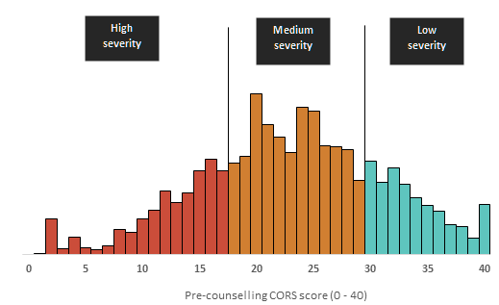
Using the interquartile ranges of students’ CORS score at pre-counselling, we can group severity into three categories: students in the highest 25 percent (n=821) of CORS pre-counselling scores (greater than 28.75), students in the middle 50 percent (n=1644; 18 – 28.75), and students in the lowest 25 percent (n=819; less than 18). Going forward, we will refer to these three groups as high severity, medium severity, and low severity.
Figure 1: Distribution of pre-counselling CORS scores, with severity grouping
c. Reasons for referral
Referrals were grouped into nine categories; throughout the report we highlight certain referral reasons where there were differences in outcomes.
Administrative data
The most common reasons for referral to Counselling in Schools are behaviour, relationships, and anxiety, stress, or trauma. The top three referral reasons are:
- behaviour (24 percent, n=1258)
- anxiety, stress, or trauma (16 percent, n=848)
- relationships (15 percent, n=755)
|
Referral reason |
Percentage |
n |
|
Behaviour |
24% |
1258 |
|
Anxiety, stress, or trauma |
16% |
848 |
|
Relationships |
15% |
755 |
|
Other |
12% |
638 |
|
Social issues |
10% |
525 |
|
Family issues |
9% |
492 |
|
Grief |
9% |
463 |
|
Low Mood |
3% |
150 |
|
Attendance |
2% |
96 |
1) Barriers to access
a) Stigma
Interviews with school leaders
We asked school leaders and counsellors, “What’s hindering their [students’] access (the student, the relationships, the process)?”
We heard one major barrier to accessing counselling is the stigma related to counselling, from students and parents and whānau. For example, a school leader told us parents and whānau might not give consent to counselling due to stigma attached to this service, fear of Oranga Tamariki involvement, or a general distrust in schools and services.
Referral works best when there is a reduction in stigma and high uptake from students, parents and whānau, and schools about counselling. This ensures multiple referral pathways, such as self, peer and parents and whānau referrals.
We heard counsellors have already been employing strategies to deliver this, through different branding of the service, advertising, allowing informal visits from students, or building trusting relationships with families.
b. Consent
Written consent can be a barrier. We heard that the need for written consent from parents and whānau can be a barrier, as it can be difficult to obtain this consent.
c. Limited access
A major barrier is the limited access to counselling in some schools. Many schools have high numbers of students deemed to have needs that require access to counselling. Due to wait lists, students who need the service are not always able to access it.
Counselling in Schools is intended to reach students with mild to moderate mental health needs. It is also intended to improve access for students, particularly for schools in lower socio-economic areas.
What we did
In this chapter, we look at whether Counselling in Schools is reaching the students who need support by examining student characteristics, their mental health needs, and barriers to access.
This section sets out:
- student characteristics
a. year level
b. gender
c. ethnicity - mental health needs
a. CORS score
b. level of distress
c. reasons for referral.
How we gathered this information
- Ministry of Education administrative data, using CORS
- Education Counts New Zealand Schools Directory
- surveys and interviews with teachers and school leaders, counsellors and managers, and parents and whānau.
What we found: an overview
The programme reaches primary school students who are in psychological distress. Seven in 10 (71 percent) of students entering counselling meet the ‘clinical cutoff’ for distress.
The programme may not be reaching students who do not show signs of distress. Three-quarters of referrals to counsellors are made by school staff, and one-quarter (24 percent) of students were referred due to their behaviour.
The programme reaches some groups who do not typically access counselling, such as boys and Māori students. Fifty-five percent of those accessing Counselling in Schools are boys and 45 percent are girls. Sixty percent of those accessing Counselling in Schools identify as Māori, similar to the average Māori roll for schools enrolled in the programme (58 percent).
The programme reaches lower numbers of Asian, Pacific, and MELAA students. Pacific students make up 8 percent of those accessing Counselling in Schools, less than the school roll of 14 percent. Asian students make up 2 percent of those accessing the service yet make up 7 percent of the roll. MELAA students make up 1 percent of those accessing Counselling in Schools and 2 percent of the school roll.
1. Student characteristics
a. Year level
Administrative data
Counselling in Schools is most commonly accessed by students in intermediate years and upper primary years. One in three students (33 percent, n=1051) are in Years 7-8, 31 percent (n=987) are in Years 5-6, 23 percent are in Years 3-4 (n=754), and 13 percent (n=426) in Years 1-2.
b. Gender
Administrative data
Boys are more likely to access Counselling in Schools than girls. Fifty-five percent (n=1786) of those accessing Counselling in Schools are boys and 45 percent (n=1436) are girls.
Interviews with school leaders and counsellors
We asked school leaders and counsellors, “What are the types of specialist support needs are being referred?”
We heard that school staff most commonly refer to Counselling in Schools for observable issues, such as behaviour (the most common referral reason; see Chapter 3). This likely contributes to more boys accessing Counselling in Schools than girls, as boys are twice as likely to be referred for behaviour compared to girls. One in three boys (33 percent, n=578) are referred to counselling for behaviour, compared to 16 percent (n=235) of girls.
We found it is important that teachers are supported to understand these gender differences and support girls to have more equitable access to support.
c. Ethnicity
Administrative data
Māori and NZ European/Pākehā students are accessing Counselling in Schools at levels comparable to or above the school roll. Six in 10 students (60 percent, n=1938) accessing Counselling in Schools identify as Māori, similar to the average Māori roll for schools enrolled in the programme (58 percent, n=24162). Nearly half (47 percent, n=1528) identify as NZ European/Pākehā, compared to 41 percent (n=16964) of the school roll.
Pacific, Asian, and MELAA students are less likely to access Counselling in Schools. Pacific students make up 8 percent (n=262) of those accessing Counselling in Schools, less than the school roll of 14 percent (n=5950). Asian students make up 2 percent (n=51) of those accessing the service yet make up 7 percent (n=2734) of the roll. MELAA students make up 1 percent (n=32) of those accessing Counselling in Schools and 2 percent (n=879) of the school roll.
The lower uptake of Counselling in Schools by Pacific, Asian, and MELAA students may indicate that different approaches are needed to ensure that students of these ethnicities are being supported with mental health challenges.
|
Ethnicity |
Accessing Counselling in Schools |
Total roll of participating schools |
|
Māori |
60% |
58% |
|
NZ European/Pākehā |
47% |
41% |
|
Pacific |
8% |
14% |
|
Asian |
2% |
7% |
|
MELAA |
1% |
2% |
2. Mental health needs
a. CORS score
Administrative data (CORS)
Most students are entering counselling with high mental health needs. Seven in 10 (71 percent, n=2329) of students entering counselling meet the ‘clinical cutoff’ for distress, as indicated by their pre-counselling score on the CORS (see Chapter 2: for explanation on CORS and the clinical cutoff). This indicates that Counselling in Schools is successfully reaching students with mental health needs.
b. Level of distress
Administrative data (CORS)
Using the interquartile ranges of students’ CORS score at pre-counselling, we can group severity into three categories: students in the highest 25 percent (n=821) of CORS pre-counselling scores (greater than 28.75), students in the middle 50 percent (n=1644; 18 – 28.75), and students in the lowest 25 percent (n=819; less than 18). Going forward, we will refer to these three groups as high severity, medium severity, and low severity.
Figure 1: Distribution of pre-counselling CORS scores, with severity grouping
c. Reasons for referral
Referrals were grouped into nine categories; throughout the report we highlight certain referral reasons where there were differences in outcomes.
Administrative data
The most common reasons for referral to Counselling in Schools are behaviour, relationships, and anxiety, stress, or trauma. The top three referral reasons are:
- behaviour (24 percent, n=1258)
- anxiety, stress, or trauma (16 percent, n=848)
- relationships (15 percent, n=755)
|
Referral reason |
Percentage |
n |
|
Behaviour |
24% |
1258 |
|
Anxiety, stress, or trauma |
16% |
848 |
|
Relationships |
15% |
755 |
|
Other |
12% |
638 |
|
Social issues |
10% |
525 |
|
Family issues |
9% |
492 |
|
Grief |
9% |
463 |
|
Low Mood |
3% |
150 |
|
Attendance |
2% |
96 |
1) Barriers to access
a) Stigma
Interviews with school leaders
We asked school leaders and counsellors, “What’s hindering their [students’] access (the student, the relationships, the process)?”
We heard one major barrier to accessing counselling is the stigma related to counselling, from students and parents and whānau. For example, a school leader told us parents and whānau might not give consent to counselling due to stigma attached to this service, fear of Oranga Tamariki involvement, or a general distrust in schools and services.
Referral works best when there is a reduction in stigma and high uptake from students, parents and whānau, and schools about counselling. This ensures multiple referral pathways, such as self, peer and parents and whānau referrals.
We heard counsellors have already been employing strategies to deliver this, through different branding of the service, advertising, allowing informal visits from students, or building trusting relationships with families.
b. Consent
Written consent can be a barrier. We heard that the need for written consent from parents and whānau can be a barrier, as it can be difficult to obtain this consent.
c. Limited access
A major barrier is the limited access to counselling in some schools. Many schools have high numbers of students deemed to have needs that require access to counselling. Due to wait lists, students who need the service are not always able to access it.
Chapter 5: What is the impact of Counselling in Schools on students' mental health?
Counselling in Schools is focused on improving the mental health outcomes of students, therefore the impacts on their mental health are a key measure of how the programme is working for students. Students, teachers and school leaders, and parents and whānau all report positive and sustained impacts on students’ mental health.
This section sets out what we found out about how Counselling in Schools is impacting students’ mental health, whether improvements in mental health are sustained, and which students are seeing mental health improvements.
What we did
In this section, we look at the overall and sustained impact of Counselling in Schools on students’ mental health outcomes, from the perspective of students, teachers, and parents and whānau.
This section sets out:
- the overall impact on students' mental health
- the sustained impact on students' mental health
- which students showed mental health improvements.
How we gathered this information
The findings in this section are based on:
- Ministry of Education administrative data, using CORS
- surveys of students
- surveys and interviews with school leaders and teachers
- surveys and interviews with counsellors and managers
- surveys of parents and whānau.
What we found: an overview
Eight out of 10 students (80 percent) improve mental health at the end of counselling compared to when they started. Eight percent report no change in mental health on the CORS whilst 12 percent report a decline in mental health at the end of counselling.
Many students, teachers, and parents and whānau told us that counselling helped across a range of mental health outcomes. Students reported improvements in how they felt in themselves (96 percent), understanding their feelings (94 percent), managing their feelings (93 percent), and getting along with others (85 percent). Eight out of ten (80 percent) teachers reported wellbeing improvements were sustained.
Those with the greater mental health needs entering counselling were more likely to see improvements in mental health. Those in the lowest category of mental health (highest severity) reports on the counselling pretest were the most likely to show improvements in mental health (90 percent), compared to those in the middle category (81 percent), or highest category (64 percent; lowest severity).
1. The overall impact on mental health
a. Improvements in mental health
Administrative data (CORS)
Eight out of 10 students (80 percent, n=1467) show improved mental health at the end of counselling, compared to when they started. Eight percent (n=147) report no change in mental health on the CORS, whilst 12 percent (n=226) report a decline in mental health at the end of counselling.
b. Students’ view
Survey data
The vast majority of students told us that counselling helped them across a range of mental health outcomes. This included how they felt in themselves (96 percent, n=312), understanding their feelings (94 percent, n=306), managing their feelings (93 percent, n=297), and getting along with others (85 percent, n=273).
We heard from students that they learned:
- improved self-regulation, including how to keep themselves calm
- how to understand their emotions and express them effectively
- how to develop self-esteem and confidence
- how to set boundaries and navigate their relationships effectively.
c. Teachers’ view
Survey data
Teachers report that students most commonly improve in how they feel about themselves and in their ability to manage their emotions. Nine out of 10 teachers observe improvements in how students felt in themselves (91 percent, n=43) and managing emotions (91 percent, n=42) following counselling. Additionally, 83 percent (n=39) of teachers report that students’ interactions with others improved following counselling.
Interviews with teachers and school leaders
In interviews with teachers and school leaders, we asked: “What were the changes you saw amongst students straight after counselling?”
We heard from teachers and school leaders that students would feel lighter and happier immediately after counselling. Additionally, teachers reported that students have been able to proactively (i.e., without being prompted) use strategies and tools to regulate their emotions in the classroom.
d. Parents and whānau view
Survey data
Nearly all parents and whānau see improvements in their child’s mental health as a result of counselling. Nearly all parents and whānau see improvements in their child’s wellbeing (98 percent, n=55) and confidence (95 percent, n=53) following counselling. Nine in 10 see improvements in their child’s ability to manage their feelings (89 percent, n=51) and in their friendships (91 percent, n=51).
Survey data
Parents and whānau attributed an improvement in wellbeing and confidence to:
- their child developing a trusting relationship with their counsellor, particularly in the way that this allowed their child to feel safe to talk to the counsellor
- their child learning to understand emotional literacy, language, and readiness to talk with parents and whānau, teachers, and friends about how they feel.
2. Sustained impact on mental health
a. Students' view
Survey data
Almost all students report that the impacts on their mental health are sustained three months or more after counselling. Three months or more after counselling, over nine in 10 students report sustained improvements in how they feel in themselves (97 percent, n=115), their ability to understand their feelings (95 percent, n=114), their ability to manage their feelings (96 percent, n=111), and over eight in 10 report sustained improvements in their friendships (86 percent, n=100).
b. Teachers’ view
Survey data
Eight in 10 teachers report that impacts on students’ mental health are sustained six months after counselling. This includes teachers’ report of student wellbeing (80 percent, n=36), students’ ability to manage emotions (84 percent, n=37), and students’ friendships (73 percent, n=33).
Interviews with teachers and school leaders
We asked teachers and school leaders “What were the students’ mental health outcomes from counselling and were they sustained?”
Teachers and school leaders, reported that impacts on wellbeing are sustained, or more likely to be sustained, if:
- there are occasional follow-ups after the students finish counselling as it allows them to be reminded of the tools and strategies they learned in counselling (and to re-engage with the service if necessary)
- strategies to self-regulate are used consistently across both school and home
- students know that support is available and can seek help proactively when they need it
- complementary support is provided from different services.
Teachers and school leaders report that when impacts are not sustained, this can often be attributed to:
- unexpected events that may trigger changes in mental wellbeing (e.g., within the home life)
- complexity of cases (e.g., with other underlying health or developmental issues).
c. Parents' and whānau view
Survey data
Parents and whānau are largely positive about the sustained impacts of counselling for their children, but less so for emotional regulation. Three in four parents and whānau report that impacts are sustained after counselling for improvements in their child’s wellbeing (74 percent, n=25), confidence (76 percent, n=26), and friendships (74 percent, n=25). Two in three (65 percent, n=22) report that the improvement in their child’s ability to manage their emotions is sustained.
3. Which students showed mental health improvements
Administrative data (CORS)
a. Mental health severity
Of the seven in 10 students (71 percent) who enter counselling with pre-test CORS scores reaching the clinical cutoff for distress, almost half (43 percent) make a significant improvement and are not in distress by the end of counselling. Of the students in the 71 percent (n=2329) that met the clinical cutoff for distress, two in five (43 percent, n=582) showed a clinically significant change, meaning a five-point or more improvement from pre-counselling to post-counselling and crossing the cutoff score of 28, so are no longer measured as being in distress.
Those with the greater mental health needs entering counselling are more likely to see improvements in mental health3. Those entering counselling with the highest severity (lowest quartile) of mental health needs are the most likely to show improvements in mental health (90 percent, n=431), compared to those with medium severity (middle two quartiles; 81 percent, n=769), or the lowest severity (highest quartile; 64 percent, n=267). Additionally, three-quarters (75 percent, n=358) of those with the worst mental health needs showed changes of at least 5 points on the CORS from pre- to post-counselling.
Those with the highest severity had an average improvement of 10 points (n=480) on the CORS from pre- to post-counselling, compared to six points (n=945) for those with medium severity of mental health, and two points (n=415) for those with the lowest severity entering counselling. These results were significant (p<0.005) when controlling for other student characteristics, including referral reason, ethnicity, gender, and year level.
b. Referral reason
Mental health outcomes do not change significantly across referral reasons. When controlling for other factors, there are no significant differences across referral reasons for mental health outcomes on the CORS.
c. Ethnicity
Pacific and Māori students are at least as likely to see an improvement in mental health from pre- to post-counselling. Nearly nine in 10 Pacific students (88 percent, n=89) see an improvement in mental health from pre- to post-counselling, compared to 80 percent of Māori (n=650) and 80 percent of NZ European/Pākehā (n=555) students. There are indications that when controlling for other factors, including severity, year level, and referral reason, Pacific students are more likely to show improvements; however, the sample size is small and this should be considered. There were too few responses from Asian and MELAA students to analyse.
d. Gender
There are no differences across gender for mental health outcomes of counselling. Eight in 10 (80 percent) of boys (n=586) and girls (n=533) show improvements in mental health from pre-to post-counselling.
e. Age
Students show similar mental health outcomes across year levels. Any observed differences seen across year levels are not significant once controlling for other factors.
Counselling in Schools is focused on improving the mental health outcomes of students, therefore the impacts on their mental health are a key measure of how the programme is working for students. Students, teachers and school leaders, and parents and whānau all report positive and sustained impacts on students’ mental health.
This section sets out what we found out about how Counselling in Schools is impacting students’ mental health, whether improvements in mental health are sustained, and which students are seeing mental health improvements.
What we did
In this section, we look at the overall and sustained impact of Counselling in Schools on students’ mental health outcomes, from the perspective of students, teachers, and parents and whānau.
This section sets out:
- the overall impact on students' mental health
- the sustained impact on students' mental health
- which students showed mental health improvements.
How we gathered this information
The findings in this section are based on:
- Ministry of Education administrative data, using CORS
- surveys of students
- surveys and interviews with school leaders and teachers
- surveys and interviews with counsellors and managers
- surveys of parents and whānau.
What we found: an overview
Eight out of 10 students (80 percent) improve mental health at the end of counselling compared to when they started. Eight percent report no change in mental health on the CORS whilst 12 percent report a decline in mental health at the end of counselling.
Many students, teachers, and parents and whānau told us that counselling helped across a range of mental health outcomes. Students reported improvements in how they felt in themselves (96 percent), understanding their feelings (94 percent), managing their feelings (93 percent), and getting along with others (85 percent). Eight out of ten (80 percent) teachers reported wellbeing improvements were sustained.
Those with the greater mental health needs entering counselling were more likely to see improvements in mental health. Those in the lowest category of mental health (highest severity) reports on the counselling pretest were the most likely to show improvements in mental health (90 percent), compared to those in the middle category (81 percent), or highest category (64 percent; lowest severity).
1. The overall impact on mental health
a. Improvements in mental health
Administrative data (CORS)
Eight out of 10 students (80 percent, n=1467) show improved mental health at the end of counselling, compared to when they started. Eight percent (n=147) report no change in mental health on the CORS, whilst 12 percent (n=226) report a decline in mental health at the end of counselling.
b. Students’ view
Survey data
The vast majority of students told us that counselling helped them across a range of mental health outcomes. This included how they felt in themselves (96 percent, n=312), understanding their feelings (94 percent, n=306), managing their feelings (93 percent, n=297), and getting along with others (85 percent, n=273).
We heard from students that they learned:
- improved self-regulation, including how to keep themselves calm
- how to understand their emotions and express them effectively
- how to develop self-esteem and confidence
- how to set boundaries and navigate their relationships effectively.
c. Teachers’ view
Survey data
Teachers report that students most commonly improve in how they feel about themselves and in their ability to manage their emotions. Nine out of 10 teachers observe improvements in how students felt in themselves (91 percent, n=43) and managing emotions (91 percent, n=42) following counselling. Additionally, 83 percent (n=39) of teachers report that students’ interactions with others improved following counselling.
Interviews with teachers and school leaders
In interviews with teachers and school leaders, we asked: “What were the changes you saw amongst students straight after counselling?”
We heard from teachers and school leaders that students would feel lighter and happier immediately after counselling. Additionally, teachers reported that students have been able to proactively (i.e., without being prompted) use strategies and tools to regulate their emotions in the classroom.
d. Parents and whānau view
Survey data
Nearly all parents and whānau see improvements in their child’s mental health as a result of counselling. Nearly all parents and whānau see improvements in their child’s wellbeing (98 percent, n=55) and confidence (95 percent, n=53) following counselling. Nine in 10 see improvements in their child’s ability to manage their feelings (89 percent, n=51) and in their friendships (91 percent, n=51).
Survey data
Parents and whānau attributed an improvement in wellbeing and confidence to:
- their child developing a trusting relationship with their counsellor, particularly in the way that this allowed their child to feel safe to talk to the counsellor
- their child learning to understand emotional literacy, language, and readiness to talk with parents and whānau, teachers, and friends about how they feel.
2. Sustained impact on mental health
a. Students' view
Survey data
Almost all students report that the impacts on their mental health are sustained three months or more after counselling. Three months or more after counselling, over nine in 10 students report sustained improvements in how they feel in themselves (97 percent, n=115), their ability to understand their feelings (95 percent, n=114), their ability to manage their feelings (96 percent, n=111), and over eight in 10 report sustained improvements in their friendships (86 percent, n=100).
b. Teachers’ view
Survey data
Eight in 10 teachers report that impacts on students’ mental health are sustained six months after counselling. This includes teachers’ report of student wellbeing (80 percent, n=36), students’ ability to manage emotions (84 percent, n=37), and students’ friendships (73 percent, n=33).
Interviews with teachers and school leaders
We asked teachers and school leaders “What were the students’ mental health outcomes from counselling and were they sustained?”
Teachers and school leaders, reported that impacts on wellbeing are sustained, or more likely to be sustained, if:
- there are occasional follow-ups after the students finish counselling as it allows them to be reminded of the tools and strategies they learned in counselling (and to re-engage with the service if necessary)
- strategies to self-regulate are used consistently across both school and home
- students know that support is available and can seek help proactively when they need it
- complementary support is provided from different services.
Teachers and school leaders report that when impacts are not sustained, this can often be attributed to:
- unexpected events that may trigger changes in mental wellbeing (e.g., within the home life)
- complexity of cases (e.g., with other underlying health or developmental issues).
c. Parents' and whānau view
Survey data
Parents and whānau are largely positive about the sustained impacts of counselling for their children, but less so for emotional regulation. Three in four parents and whānau report that impacts are sustained after counselling for improvements in their child’s wellbeing (74 percent, n=25), confidence (76 percent, n=26), and friendships (74 percent, n=25). Two in three (65 percent, n=22) report that the improvement in their child’s ability to manage their emotions is sustained.
3. Which students showed mental health improvements
Administrative data (CORS)
a. Mental health severity
Of the seven in 10 students (71 percent) who enter counselling with pre-test CORS scores reaching the clinical cutoff for distress, almost half (43 percent) make a significant improvement and are not in distress by the end of counselling. Of the students in the 71 percent (n=2329) that met the clinical cutoff for distress, two in five (43 percent, n=582) showed a clinically significant change, meaning a five-point or more improvement from pre-counselling to post-counselling and crossing the cutoff score of 28, so are no longer measured as being in distress.
Those with the greater mental health needs entering counselling are more likely to see improvements in mental health3. Those entering counselling with the highest severity (lowest quartile) of mental health needs are the most likely to show improvements in mental health (90 percent, n=431), compared to those with medium severity (middle two quartiles; 81 percent, n=769), or the lowest severity (highest quartile; 64 percent, n=267). Additionally, three-quarters (75 percent, n=358) of those with the worst mental health needs showed changes of at least 5 points on the CORS from pre- to post-counselling.
Those with the highest severity had an average improvement of 10 points (n=480) on the CORS from pre- to post-counselling, compared to six points (n=945) for those with medium severity of mental health, and two points (n=415) for those with the lowest severity entering counselling. These results were significant (p<0.005) when controlling for other student characteristics, including referral reason, ethnicity, gender, and year level.
b. Referral reason
Mental health outcomes do not change significantly across referral reasons. When controlling for other factors, there are no significant differences across referral reasons for mental health outcomes on the CORS.
c. Ethnicity
Pacific and Māori students are at least as likely to see an improvement in mental health from pre- to post-counselling. Nearly nine in 10 Pacific students (88 percent, n=89) see an improvement in mental health from pre- to post-counselling, compared to 80 percent of Māori (n=650) and 80 percent of NZ European/Pākehā (n=555) students. There are indications that when controlling for other factors, including severity, year level, and referral reason, Pacific students are more likely to show improvements; however, the sample size is small and this should be considered. There were too few responses from Asian and MELAA students to analyse.
d. Gender
There are no differences across gender for mental health outcomes of counselling. Eight in 10 (80 percent) of boys (n=586) and girls (n=533) show improvements in mental health from pre-to post-counselling.
e. Age
Students show similar mental health outcomes across year levels. Any observed differences seen across year levels are not significant once controlling for other factors.
Chapter 6: What is the impact of Counselling in Schools on students' attendance, learning, and engagement?
Students’ mental health is linked with learning, engagement, and school attendance outcomes. Counselling in Schools is primarily focused on mental health outcomes; however, it also has impacts on students’ attendance, learning, engagement, and overall classroom behaviour.
Counselling may improve students’ attendance and learning progress. Teachers also report that having the programme in the schools improves classroom behaviour. These improvements are often sustained according to students, teachers, and parents and whānau.
What we did
In this section, we look at the impact of Counselling in Schools on students’ attendance, learning, and engagement using measurement tools, and hearing the perspective of students, teachers, and parents and whānau.
This section sets out:
- impacts of counselling on attendance
- impacts of counselling on learning
- impacts of counselling on engagement
- impacts of counselling on classroom behaviour.
How we gathered this information
The findings in this section are based on:
- Ministry of Education administrative data using LEMT
- surveys of students
- surveys and interviews with school leaders and teachers
- surveys and interviews with counsellors and managers
- surveys of parents and whānau.
What we found: an overview
Teachers reported improvement in attendance for four in 10 students who had attended counselling, and improvements in learning progress for over half of students. Eight in 10 students (84 percent) reported that their own attendance had improved as a result of counselling. This was backed up by parents and whānau, nine in 10 reported that counselling had improved their child’s attendance at school.
Students, parents, and whānau also reported improvements in student learning, engagement, and attendance. These improvements were sustained over time. Students’ LEMT scores indicate an improvement in learning progress for over half (57 percent) of students. This improvement was seen by the majority of students, teachers, and parents and whānau and seen to be sustained. We heard that these improvements often stem from students’ improvement in focus and effective communication.
Classroom behaviour is a major problem in Aotearoa New Zealand. Eight in 10 teachers reported improvements in wider classroom behaviour due to counselling. Eight in 10 teachers (78 percent) report that engagement improved for the wider class after students began counselling, and six in ten (61 percent) report that achievement improved.
Students told us they learnt strategies to manage their emotions and teachers told us that students use the strategies and tools they have learnt. Students told us about some of the strategies they use to manage their emotions such as breathing techniques, talking to teachers and students when they feel angry, and when to take time to control emotions or walk away from situations.
Students who entered counselling with the highest mental health needs are more likely to see improvements in attendance and in their learning progress. Over half (61 percent) of students with the lowest mental health scores on their counselling pre-test had improvements to their attendance after counselling, compared to 39 percent of other students.
Teachers also told us the counsellors provided them with strategies and tools to help with classroom behaviours. We heard from teachers and school leaders that improvements in relationships as a result of counselling are a large reason for the improvements seen in behaviour. This is also enabling students to work together and communicate more effectively.
1. Impact on attendance
a. Impact on attendance
Administrative data (LEMT)
Teachers report over four in 10 students (44 percent, n=510) show improvement in attendance from pre- to post-counselling.
b. Student, teacher, and parent and whānau views on improved attendance
Survey data
Eight in 10 students (84 percent, n=268) reported that their own attendance had improved as a result of counselling. This was backed up by parents and whānau, nine in 10 (91 percent, n=50) reported that counselling had improved their child’s attendance at school. Seven in 10 teachers (68 percent, n=32) reported that counselling improved students’ attendance.
We heard that improved attendance often stems from the high uptake of counselling among students and the value of the counselling being school-based, with students attending school more to attend counselling sessions.
c. Sustained impact on attendance
Survey data
Students are most positive about the sustained impacts of counselling on their attendance. Nine in 10 (89 percent, n=98) students report that their improvements in attendance are sustained at least three months after finishing counselling. Six in 10 (60 percent, n=27) teachers report that the improvements in attendance are sustained six months after finishing counselling. Six in 10 (61 percent, n=20) parents and whānau also report that attendance improvements remained after their child finished counselling.
d. Improvements in attendance by referral
Administrative data (LEMT)
Students who are referred to counselling for attendance or social issues are more likely to show improvements in attendance. Seven in 10 (71 percent, n=22) of those referred for attendance showed improvements in attendance. Greater improvements in attendance are also seen for students who were referred to counselling for social issues (55 percent, n=45), compared to all students (44 percent). These differences remain significant (p<0.05) in relation to the largest referral group (behaviour) and when controlling for other factors. Regardless, these should be treated with caution given the low number of respondents in these groups.
Figure 2: Students who show improvements in attendance by referral reason
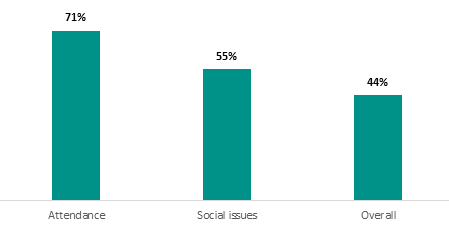
e. Improvements in attendance by ethnicity
Administrative data (LEMT)
Pacific and Māori students are at least as likely to show improvements in attendance from pre- to post-counselling. Over half (53 percent, n=47) of Pacific students show improvements in attendance from pre- to post-counselling, compared to 46 percent (n=326) of Māori students and 39 percent (n=202) of NZ European/Pākehā students. When controlling for other factors, these differences are non-significant, indicating that there may not be any real difference between the groups.
Figure 3: Students who show improvements in attendance by ethnicity
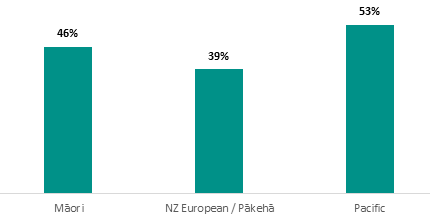
f. Improvements in attendance by level of need
Administrative data (LEMT)
Students who entered counselling with the highest mental health needs are more likely to see improvements in attendance. Over half (61 percent, n=175) of students with the lowest mental health scores on the counselling pre-test saw improvements in attendance from pre- to post-counselling, compared to 39 percent (n=335) of other students. This difference is significant when controlling for other factors (p<0.001).
This is encouraging and reflects what we found in our 2023 report Attendance: Getting Back to School, that parents’ and whānau mental health concerns for their child is one of the biggest individual drivers of whether a student attends school regularly or not.
Survey data of students and teachers and interviews with teachers
In interviews with teachers, we asked: “What were the changes you saw amongst students straight after counselling?”
In the longer term, students told us they want to be in school more as they see it as a safe place to be as a result of counselling services. Similarly, teachers told us that students are less anxious about going to school when they know there is a counsellor at school who they can talk to confidentially and safely.
2. Impact on learning
a. Impact on learning progress
Administrative data (LEMT)
Over half (57 percent, n=657) of students show improvements in learning progress from pre- to post-counselling on the LEMT.
b. Student, teacher, and parent and whānau views on improved learning progress
Survey data
Eight in 10 students (81 percent, n=257), seven in 10 teachers (72 percent, n=34), and nine in 10 parents and whānau (89 percent, n=49) reported improvements in learning progress as a result of counselling.
Students told us that their learning progress had improved due to their ability to communicate more effectively with their teachers.
c. Sustained impact on learning progress
Survey data
The improvements seen in learning progress are largely sustained, according to students, teachers, and parents and whānau. Eight in 10 students (80 percent, n=91) say that the improvements they saw in their own learning are sustained at least three months after counselling. Teachers are also positive, with seven in 10 (70 percent, n=31) reporting that impacts are sustained six months after students finish counselling. Parents and whānau are also positive, with two in three (64 percent, n=21) reporting that the impact on their child’s learning progress remained after finishing counselling.
This is likely reflective of our 2022 findings on Aotearoa New Zealand’s attendance (see Missing Out: Why Aren’t Our Children Going to School?) and aligns with national and international evidence that points to strong links between attendance and learning progress.
d. Improvements in learning progress by referral
Administrative data (LEMT)
There are no significant differences in learning progress by referral reason.
e. Improvements in learning progress by ethnicity
Administrative data (LEMT)
Pacific and Māori students are at least as likely to show improvements in learning progress from pre- to post-counselling. Over six in 10 Pacific students (62 percent, n=55) showed improvements in learning progress from pre- to post-counselling, as did 58 percent (n=406) of Māori students and 56 percent (n=286) of NZ European/Pākehā students. When controlling for other factors, there are no statistically significant differences in learning progress across ethnicities.
Figure 4: Improvements in learning progress by ethnicity
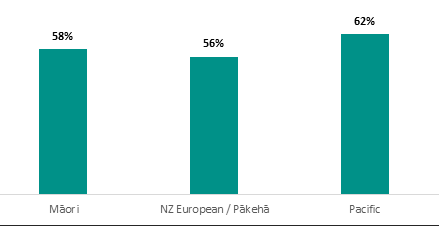
f. Improvements in learning progress by level of need
Administrative data (LEMT)
Students who entered counselling with the highest mental health needs are more likely to see improvements in learning. Two in three students (67 percent, n=190) with the lowest mental health scores on the counselling pre-test saw improvements in learning progress from pre- to post-counselling, compared to 54 percent (n=467) of other students. This difference is statistically significant (p<0.001) when controlling for other factors.
3. Impact on engagement
a. Impact on engagement
Administrative data (LEMT)
Six in 10 students (60 percent, n=689) show improvements in engagement on the LEMT.
b. Student, teacher, and parent and whānau views on improved engagement
Survey data
Students, teachers, and parents and whānau all report positive impacts on engagement. Nearly nine in 10 students (86 percent, n=274), eight in 10 teachers (83 percent, n=39), and nine in 10 parents and whānau (89 percent, n=48) report improvements in students’ school engagement.
c. Sustained impact on engagement
Survey data
The improvements seen in engagement are largely sustained, according to students, teachers, and parents and whānau. Nine in 10 students (91 percent, n=102) say that the improvements they saw in their own engagement are sustained at least three months after counselling. Teachers are also positive, with eight in 10 (78 percent, n=35) reporting that impacts on engagement are sustained six months after students finish counselling. Parents and whānau are also positive, with seven in 10 (73 percent, n=24) reporting that the impact on their child’s engagement remained after finishing counselling.
Interviews with school leaders and teachers
We asked school leaders and teachers: “What changes in engagement or learning did you see, and were they sustained?”
Similar to immediate learning engagement impact, school leaders and teachers attributed sustained impact to:
- students having better relationships with their peers
- students feeling more confident in themselves, leading to a greater willingness to work independently, in groups, and to try out new activities.
d. Improvements in engagement by referral
Administrative data (LEMT)
There are no differences in learning progress by referral reason.
e. Improvements in engagement by ethnicity
Administrative data (LEMT)
Pacific and Māori students are as likely to show improvements in engagement from pre- to post-counselling. Three in four Pacific students (74 percent, n=65) showed improvements in learning progress from pre- to post-counselling, compared to 61 percent (n=428) of Māori students and 58 percent (n=300) of NZ European/Pākehā students. When controlling for other factors, Pacific students are more likely to show improvement in engagement from pre- to post-counselling compared to other students (p<0.05).
Figure 5: Improvements in engagement by ethnicity
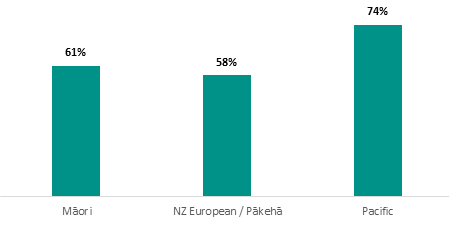
f. Improvements in engagement by level of need
Administrative data (LEMT)
Students who entered counselling with the highest mental health needs are more likely to see improvements in engagement. Seven in 10 students (71 percent, n=203) with the lowest mental health scores on the counselling pre-test saw improvements in learning progress from pre- to post-counselling, compared to 56 percent (n=486) of other students. This finding remains statistically significant when controlling for other factors (p<0.005).
Figure 6: Percentage of students who showed an improvement in engagement by level of need
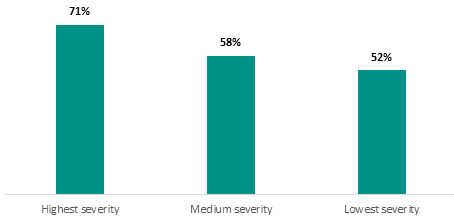
g. Improvements in engagement by gender
Administrative data (LEMT)
Boys are more likely to show improvements in engagement from pre- to post-counselling than girls. Nearly two in three (64 percent, n=364) boys showed improvement in engagement from pre- to post-counselling compared to 56 percent (n=309) of girls. This finding is statistically significant (p<0.05) when controlling for other factors.
Figure 7: Teachers reporting improvements in engagement by students’ gender
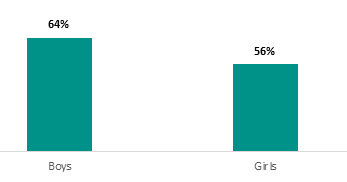
4. Impact on classroom behaviour
a. Teachers’ views on post-counselling classroom behaviour
Survey data and interviews with school leaders and teachers.
We asked school leaders and teachers: “What changes in engagement or learning did you see, and were they sustained?”
Three in four teachers (76 percent, n=35) report that behaviours in the wider class got better as a result of counselling. We heard from teachers and school leaders that improvements in relationships as a result of counselling are a large reason for the improvements they see in behaviour. With counsellor support and strategies, students can improve their ability to work together and communicate more effectively.
Students told us about some of the strategies they use to manage their emotions such as breathing techniques, talking to teachers and students when they feel angry, knowing when to take time to control emotions or walk away from situations. Similarly, we heard from teachers that many students are able to adopt the tools and strategies they learnt in counselling to proactively manage their emotions in the classroom.
As students’ behaviour improves, we heard teachers could spend less time managing behaviours and can focus more on teaching. We also heard teachers could pick up strategies and tools from counsellors, to be able to support students while in class.
We heard from a school leader that since participating in Counselling in Schools they have seen a reduction in the number of stand-downs for behaviour.
b. Impact on classroom disruption
Survey data
Teachers see improvements in engagement across the wider class as a result of counselling. Eight in 10 teachers (78 percent, n=36) report that engagement got better for the wider class. Given the links between engagement and achievementvi, it is unsurprising that six in 10 teachers (61 percent, n=28) also report that achievement for the wider class also improved as a result of Counselling in Schools.
“Students stopped leaving the classroom, reduced disruptions, reduced teacher needs for behaviour management and increased learning time.” (Teacher)
c. Reasons for referral
Administrative data
Behaviour issues are prioritised in Counselling in Schools. One in four students (24 percent, n=1258) are referred to the programme for behaviour. This aligns with what we know from our 2023 report (Time to Focus: Behaviour in our Classrooms), that behaviour is a significant challenge in our classrooms.
Some of these behaviour-related referrals may be linked to a stand-down process. We heard that for students with high behavioural needs there are also high levels of stand-downs. Some schools have re-entry requirements for stood-down students which often include time with a counsellor.
We do not have data on the behaviour of specific students as it is not contained within the administrative data, and we opted not to ask about it in surveys in favour of looking at the impact on behaviour of the wider class.
Students’ mental health is linked with learning, engagement, and school attendance outcomes. Counselling in Schools is primarily focused on mental health outcomes; however, it also has impacts on students’ attendance, learning, engagement, and overall classroom behaviour.
Counselling may improve students’ attendance and learning progress. Teachers also report that having the programme in the schools improves classroom behaviour. These improvements are often sustained according to students, teachers, and parents and whānau.
What we did
In this section, we look at the impact of Counselling in Schools on students’ attendance, learning, and engagement using measurement tools, and hearing the perspective of students, teachers, and parents and whānau.
This section sets out:
- impacts of counselling on attendance
- impacts of counselling on learning
- impacts of counselling on engagement
- impacts of counselling on classroom behaviour.
How we gathered this information
The findings in this section are based on:
- Ministry of Education administrative data using LEMT
- surveys of students
- surveys and interviews with school leaders and teachers
- surveys and interviews with counsellors and managers
- surveys of parents and whānau.
What we found: an overview
Teachers reported improvement in attendance for four in 10 students who had attended counselling, and improvements in learning progress for over half of students. Eight in 10 students (84 percent) reported that their own attendance had improved as a result of counselling. This was backed up by parents and whānau, nine in 10 reported that counselling had improved their child’s attendance at school.
Students, parents, and whānau also reported improvements in student learning, engagement, and attendance. These improvements were sustained over time. Students’ LEMT scores indicate an improvement in learning progress for over half (57 percent) of students. This improvement was seen by the majority of students, teachers, and parents and whānau and seen to be sustained. We heard that these improvements often stem from students’ improvement in focus and effective communication.
Classroom behaviour is a major problem in Aotearoa New Zealand. Eight in 10 teachers reported improvements in wider classroom behaviour due to counselling. Eight in 10 teachers (78 percent) report that engagement improved for the wider class after students began counselling, and six in ten (61 percent) report that achievement improved.
Students told us they learnt strategies to manage their emotions and teachers told us that students use the strategies and tools they have learnt. Students told us about some of the strategies they use to manage their emotions such as breathing techniques, talking to teachers and students when they feel angry, and when to take time to control emotions or walk away from situations.
Students who entered counselling with the highest mental health needs are more likely to see improvements in attendance and in their learning progress. Over half (61 percent) of students with the lowest mental health scores on their counselling pre-test had improvements to their attendance after counselling, compared to 39 percent of other students.
Teachers also told us the counsellors provided them with strategies and tools to help with classroom behaviours. We heard from teachers and school leaders that improvements in relationships as a result of counselling are a large reason for the improvements seen in behaviour. This is also enabling students to work together and communicate more effectively.
1. Impact on attendance
a. Impact on attendance
Administrative data (LEMT)
Teachers report over four in 10 students (44 percent, n=510) show improvement in attendance from pre- to post-counselling.
b. Student, teacher, and parent and whānau views on improved attendance
Survey data
Eight in 10 students (84 percent, n=268) reported that their own attendance had improved as a result of counselling. This was backed up by parents and whānau, nine in 10 (91 percent, n=50) reported that counselling had improved their child’s attendance at school. Seven in 10 teachers (68 percent, n=32) reported that counselling improved students’ attendance.
We heard that improved attendance often stems from the high uptake of counselling among students and the value of the counselling being school-based, with students attending school more to attend counselling sessions.
c. Sustained impact on attendance
Survey data
Students are most positive about the sustained impacts of counselling on their attendance. Nine in 10 (89 percent, n=98) students report that their improvements in attendance are sustained at least three months after finishing counselling. Six in 10 (60 percent, n=27) teachers report that the improvements in attendance are sustained six months after finishing counselling. Six in 10 (61 percent, n=20) parents and whānau also report that attendance improvements remained after their child finished counselling.
d. Improvements in attendance by referral
Administrative data (LEMT)
Students who are referred to counselling for attendance or social issues are more likely to show improvements in attendance. Seven in 10 (71 percent, n=22) of those referred for attendance showed improvements in attendance. Greater improvements in attendance are also seen for students who were referred to counselling for social issues (55 percent, n=45), compared to all students (44 percent). These differences remain significant (p<0.05) in relation to the largest referral group (behaviour) and when controlling for other factors. Regardless, these should be treated with caution given the low number of respondents in these groups.
Figure 2: Students who show improvements in attendance by referral reason
e. Improvements in attendance by ethnicity
Administrative data (LEMT)
Pacific and Māori students are at least as likely to show improvements in attendance from pre- to post-counselling. Over half (53 percent, n=47) of Pacific students show improvements in attendance from pre- to post-counselling, compared to 46 percent (n=326) of Māori students and 39 percent (n=202) of NZ European/Pākehā students. When controlling for other factors, these differences are non-significant, indicating that there may not be any real difference between the groups.
Figure 3: Students who show improvements in attendance by ethnicity
f. Improvements in attendance by level of need
Administrative data (LEMT)
Students who entered counselling with the highest mental health needs are more likely to see improvements in attendance. Over half (61 percent, n=175) of students with the lowest mental health scores on the counselling pre-test saw improvements in attendance from pre- to post-counselling, compared to 39 percent (n=335) of other students. This difference is significant when controlling for other factors (p<0.001).
This is encouraging and reflects what we found in our 2023 report Attendance: Getting Back to School, that parents’ and whānau mental health concerns for their child is one of the biggest individual drivers of whether a student attends school regularly or not.
Survey data of students and teachers and interviews with teachers
In interviews with teachers, we asked: “What were the changes you saw amongst students straight after counselling?”
In the longer term, students told us they want to be in school more as they see it as a safe place to be as a result of counselling services. Similarly, teachers told us that students are less anxious about going to school when they know there is a counsellor at school who they can talk to confidentially and safely.
2. Impact on learning
a. Impact on learning progress
Administrative data (LEMT)
Over half (57 percent, n=657) of students show improvements in learning progress from pre- to post-counselling on the LEMT.
b. Student, teacher, and parent and whānau views on improved learning progress
Survey data
Eight in 10 students (81 percent, n=257), seven in 10 teachers (72 percent, n=34), and nine in 10 parents and whānau (89 percent, n=49) reported improvements in learning progress as a result of counselling.
Students told us that their learning progress had improved due to their ability to communicate more effectively with their teachers.
c. Sustained impact on learning progress
Survey data
The improvements seen in learning progress are largely sustained, according to students, teachers, and parents and whānau. Eight in 10 students (80 percent, n=91) say that the improvements they saw in their own learning are sustained at least three months after counselling. Teachers are also positive, with seven in 10 (70 percent, n=31) reporting that impacts are sustained six months after students finish counselling. Parents and whānau are also positive, with two in three (64 percent, n=21) reporting that the impact on their child’s learning progress remained after finishing counselling.
This is likely reflective of our 2022 findings on Aotearoa New Zealand’s attendance (see Missing Out: Why Aren’t Our Children Going to School?) and aligns with national and international evidence that points to strong links between attendance and learning progress.
d. Improvements in learning progress by referral
Administrative data (LEMT)
There are no significant differences in learning progress by referral reason.
e. Improvements in learning progress by ethnicity
Administrative data (LEMT)
Pacific and Māori students are at least as likely to show improvements in learning progress from pre- to post-counselling. Over six in 10 Pacific students (62 percent, n=55) showed improvements in learning progress from pre- to post-counselling, as did 58 percent (n=406) of Māori students and 56 percent (n=286) of NZ European/Pākehā students. When controlling for other factors, there are no statistically significant differences in learning progress across ethnicities.
Figure 4: Improvements in learning progress by ethnicity
f. Improvements in learning progress by level of need
Administrative data (LEMT)
Students who entered counselling with the highest mental health needs are more likely to see improvements in learning. Two in three students (67 percent, n=190) with the lowest mental health scores on the counselling pre-test saw improvements in learning progress from pre- to post-counselling, compared to 54 percent (n=467) of other students. This difference is statistically significant (p<0.001) when controlling for other factors.
3. Impact on engagement
a. Impact on engagement
Administrative data (LEMT)
Six in 10 students (60 percent, n=689) show improvements in engagement on the LEMT.
b. Student, teacher, and parent and whānau views on improved engagement
Survey data
Students, teachers, and parents and whānau all report positive impacts on engagement. Nearly nine in 10 students (86 percent, n=274), eight in 10 teachers (83 percent, n=39), and nine in 10 parents and whānau (89 percent, n=48) report improvements in students’ school engagement.
c. Sustained impact on engagement
Survey data
The improvements seen in engagement are largely sustained, according to students, teachers, and parents and whānau. Nine in 10 students (91 percent, n=102) say that the improvements they saw in their own engagement are sustained at least three months after counselling. Teachers are also positive, with eight in 10 (78 percent, n=35) reporting that impacts on engagement are sustained six months after students finish counselling. Parents and whānau are also positive, with seven in 10 (73 percent, n=24) reporting that the impact on their child’s engagement remained after finishing counselling.
Interviews with school leaders and teachers
We asked school leaders and teachers: “What changes in engagement or learning did you see, and were they sustained?”
Similar to immediate learning engagement impact, school leaders and teachers attributed sustained impact to:
- students having better relationships with their peers
- students feeling more confident in themselves, leading to a greater willingness to work independently, in groups, and to try out new activities.
d. Improvements in engagement by referral
Administrative data (LEMT)
There are no differences in learning progress by referral reason.
e. Improvements in engagement by ethnicity
Administrative data (LEMT)
Pacific and Māori students are as likely to show improvements in engagement from pre- to post-counselling. Three in four Pacific students (74 percent, n=65) showed improvements in learning progress from pre- to post-counselling, compared to 61 percent (n=428) of Māori students and 58 percent (n=300) of NZ European/Pākehā students. When controlling for other factors, Pacific students are more likely to show improvement in engagement from pre- to post-counselling compared to other students (p<0.05).
Figure 5: Improvements in engagement by ethnicity
f. Improvements in engagement by level of need
Administrative data (LEMT)
Students who entered counselling with the highest mental health needs are more likely to see improvements in engagement. Seven in 10 students (71 percent, n=203) with the lowest mental health scores on the counselling pre-test saw improvements in learning progress from pre- to post-counselling, compared to 56 percent (n=486) of other students. This finding remains statistically significant when controlling for other factors (p<0.005).
Figure 6: Percentage of students who showed an improvement in engagement by level of need
g. Improvements in engagement by gender
Administrative data (LEMT)
Boys are more likely to show improvements in engagement from pre- to post-counselling than girls. Nearly two in three (64 percent, n=364) boys showed improvement in engagement from pre- to post-counselling compared to 56 percent (n=309) of girls. This finding is statistically significant (p<0.05) when controlling for other factors.
Figure 7: Teachers reporting improvements in engagement by students’ gender
4. Impact on classroom behaviour
a. Teachers’ views on post-counselling classroom behaviour
Survey data and interviews with school leaders and teachers.
We asked school leaders and teachers: “What changes in engagement or learning did you see, and were they sustained?”
Three in four teachers (76 percent, n=35) report that behaviours in the wider class got better as a result of counselling. We heard from teachers and school leaders that improvements in relationships as a result of counselling are a large reason for the improvements they see in behaviour. With counsellor support and strategies, students can improve their ability to work together and communicate more effectively.
Students told us about some of the strategies they use to manage their emotions such as breathing techniques, talking to teachers and students when they feel angry, knowing when to take time to control emotions or walk away from situations. Similarly, we heard from teachers that many students are able to adopt the tools and strategies they learnt in counselling to proactively manage their emotions in the classroom.
As students’ behaviour improves, we heard teachers could spend less time managing behaviours and can focus more on teaching. We also heard teachers could pick up strategies and tools from counsellors, to be able to support students while in class.
We heard from a school leader that since participating in Counselling in Schools they have seen a reduction in the number of stand-downs for behaviour.
b. Impact on classroom disruption
Survey data
Teachers see improvements in engagement across the wider class as a result of counselling. Eight in 10 teachers (78 percent, n=36) report that engagement got better for the wider class. Given the links between engagement and achievementvi, it is unsurprising that six in 10 teachers (61 percent, n=28) also report that achievement for the wider class also improved as a result of Counselling in Schools.
“Students stopped leaving the classroom, reduced disruptions, reduced teacher needs for behaviour management and increased learning time.” (Teacher)
c. Reasons for referral
Administrative data
Behaviour issues are prioritised in Counselling in Schools. One in four students (24 percent, n=1258) are referred to the programme for behaviour. This aligns with what we know from our 2023 report (Time to Focus: Behaviour in our Classrooms), that behaviour is a significant challenge in our classrooms.
Some of these behaviour-related referrals may be linked to a stand-down process. We heard that for students with high behavioural needs there are also high levels of stand-downs. Some schools have re-entry requirements for stood-down students which often include time with a counsellor.
We do not have data on the behaviour of specific students as it is not contained within the administrative data, and we opted not to ask about it in surveys in favour of looking at the impact on behaviour of the wider class.
Chapter 7: Is Counselling in Schools showing promise compared to other initiatives?
Counselling in Schools has been shown to be effective in improving mental health outcomes and learning outcomes for students in schools. In this chapter we set out how effective the initiative is compared to other initiatives. We found it is delivering a positive mental health impact when compared to another local initiative Mana Ake, noting contextual and delivery differences, and comparable with similar initiatives in the United Kingdom and United States.
What we did
In this section we draw comparison to similar programmes in Aotearoa New Zealand, such as Mana Ake – Stronger for Tomorrow (Mana Ake) and counselling in schools research from the United Kingdom (UK) and the United States (US).
This section sets out:
- comparisons to Mana Ake
a. limitations with this comparison - comparisons to international examples
a. limitations with this comparison.
How we gathered this information
- Ministry of Education administrative data of 5901 students using CORS
- Malatest International’s evaluation of Mana Ake
- International evidence of other in-school counselling initiatives
Comparisons to comparable programme – Mana Ake
In terms of overall improvement in mental wellbeing, Counselling in Schools is delivering a bigger increase in mental health outcomes than the Mana Ake programme. When comparing the average increase in CORS, Counselling in Schools had an average increase of seven points (out of 40) compared to 5.12 for Mana Ake (out of 36). In terms of overall effect size, Counselling in Schools has good positive effect of 1.0 compared to 0.81 for Mana Ake.
We note that these programmes are different in terms of aims, target population, delivery approach, and context, as Mana Ake is focused on psychosocial recovery. While the finding isn’t substantive enough make a direct comparison, it shows that Counselling in Schools is beneficial.
Limitations with this comparison
It is important to note that there are a range of limitations in comparison between Counselling in Schools and Mana Ake.
Mana Ake provides mental health and wellbeing support for students in primary school across Years 1-8. Mana Ake kaimahi (workers) are employed by NGO providers and support schools, families, and whānau when students are experiencing issues that impact their wellbeing such as managing emotions, friendships and bullying, parental separation, and grief and loss. Kaimahi have a diverse range of skills and include psychologists, social workers, counsellors, teachers, and youth workers.
Mana Ake was reviewed by Malatest International in 2021. The evaluation reflects the early implementation of Mana Ake.
Limited data
We are only able to compare data on improving mental wellbeing, noting the other caveats outlined below. Mana Ake has used an adjusted CORS approach.
We have based our analysis on Miller et al. (2003) and for the purposes of comparison modified the CORS score to a 9-point scale (normally used as a 10-point scale), removing students with a pre-score of 29 (80 percent of 36) and above, which is the difference between pre- and post-scores.
We use a similar adjusted approach for our comparison with Mana Ake, removing students with a pre-score of 32 and above (80 percent of 40; given Counselling in Schools used the CORS 10-point scale).
Different approaches
Mana Ake and Counselling in Schools are both delivered in school environments with a focus on improving mental health.
Mana Ake delivers more group sessions and class sessions, rather than individual sessions, with a focus on mental wellbeing, alongside wellbeing-focused interventions and wrap-around support teams.
Different populations
Mana Ake is focused on a different population – initially in Canterbury as part of psychosocial recovery, particularly at the time of evaluation. This has since expanded to Hawkes Bay, Northland, Counties Manukau, Lakes, Bay of Plenty, and West Coast.
The two programmes are also applied to different populations. Where Mana Ake applies to a full range of schools, Counselling in Schools is focused on lower socio-economic areas.
Time
This varies across providers, although ERO heard there is more flexibility in the Counselling in Schools delivery approach – with more hours of individual sessions being delivered.
Comparisons to international examples
When compared to overseas studies, the level of effectiveness for Counselling in Schools is within the range of expected outcomes. The effect size for Counselling in Schools (0.85 – not adjusted to support comparison) is similar to overseas studies of the effectiveness of counselling in schools. Meta-analyses of US and UK examples have overall medium impact on mental wellbeing (effect size of 0.45) and a large overall impact (0.87) respectively for students who received counselling. Each of these studies show a significant benefit received from counselling services within schools in other contexts.
Comparison between the impact of Counselling in Schools on mental wellbeing with overseas examples:
|
Initiative |
Effect size |
|
Counselling in Schools |
0.85 |
|
UK research into counselling in schools |
0.87 |
|
US research into counselling in schools |
0.45 |
When we consider other positive outcomes from Counselling in Schools (educational outcomes and improved behaviour in classroom settings), this highlights a high level of effectiveness compared to other initiatives.
Limitations with this comparison
Different approaches
Each jurisdiction is different. The US evidence comes primarily from studies of cognitive or behavioural interventions, and they are often group-based. The UK approach to counselling is often less structured and directive, with a less direct focus on the facilitation of educational achievement.
Limited data
The range of studies that we have been able to draw from are limited to other counselling in schools initiatives, and where they have used CORS scores to assess the impact of initiatives on mental health.
Counselling in Schools has been shown to be effective in improving mental health outcomes and learning outcomes for students in schools. In this chapter we set out how effective the initiative is compared to other initiatives. We found it is delivering a positive mental health impact when compared to another local initiative Mana Ake, noting contextual and delivery differences, and comparable with similar initiatives in the United Kingdom and United States.
What we did
In this section we draw comparison to similar programmes in Aotearoa New Zealand, such as Mana Ake – Stronger for Tomorrow (Mana Ake) and counselling in schools research from the United Kingdom (UK) and the United States (US).
This section sets out:
- comparisons to Mana Ake
a. limitations with this comparison - comparisons to international examples
a. limitations with this comparison.
How we gathered this information
- Ministry of Education administrative data of 5901 students using CORS
- Malatest International’s evaluation of Mana Ake
- International evidence of other in-school counselling initiatives
Comparisons to comparable programme – Mana Ake
In terms of overall improvement in mental wellbeing, Counselling in Schools is delivering a bigger increase in mental health outcomes than the Mana Ake programme. When comparing the average increase in CORS, Counselling in Schools had an average increase of seven points (out of 40) compared to 5.12 for Mana Ake (out of 36). In terms of overall effect size, Counselling in Schools has good positive effect of 1.0 compared to 0.81 for Mana Ake.
We note that these programmes are different in terms of aims, target population, delivery approach, and context, as Mana Ake is focused on psychosocial recovery. While the finding isn’t substantive enough make a direct comparison, it shows that Counselling in Schools is beneficial.
Limitations with this comparison
It is important to note that there are a range of limitations in comparison between Counselling in Schools and Mana Ake.
Mana Ake provides mental health and wellbeing support for students in primary school across Years 1-8. Mana Ake kaimahi (workers) are employed by NGO providers and support schools, families, and whānau when students are experiencing issues that impact their wellbeing such as managing emotions, friendships and bullying, parental separation, and grief and loss. Kaimahi have a diverse range of skills and include psychologists, social workers, counsellors, teachers, and youth workers.
Mana Ake was reviewed by Malatest International in 2021. The evaluation reflects the early implementation of Mana Ake.
Limited data
We are only able to compare data on improving mental wellbeing, noting the other caveats outlined below. Mana Ake has used an adjusted CORS approach.
We have based our analysis on Miller et al. (2003) and for the purposes of comparison modified the CORS score to a 9-point scale (normally used as a 10-point scale), removing students with a pre-score of 29 (80 percent of 36) and above, which is the difference between pre- and post-scores.
We use a similar adjusted approach for our comparison with Mana Ake, removing students with a pre-score of 32 and above (80 percent of 40; given Counselling in Schools used the CORS 10-point scale).
Different approaches
Mana Ake and Counselling in Schools are both delivered in school environments with a focus on improving mental health.
Mana Ake delivers more group sessions and class sessions, rather than individual sessions, with a focus on mental wellbeing, alongside wellbeing-focused interventions and wrap-around support teams.
Different populations
Mana Ake is focused on a different population – initially in Canterbury as part of psychosocial recovery, particularly at the time of evaluation. This has since expanded to Hawkes Bay, Northland, Counties Manukau, Lakes, Bay of Plenty, and West Coast.
The two programmes are also applied to different populations. Where Mana Ake applies to a full range of schools, Counselling in Schools is focused on lower socio-economic areas.
Time
This varies across providers, although ERO heard there is more flexibility in the Counselling in Schools delivery approach – with more hours of individual sessions being delivered.
Comparisons to international examples
When compared to overseas studies, the level of effectiveness for Counselling in Schools is within the range of expected outcomes. The effect size for Counselling in Schools (0.85 – not adjusted to support comparison) is similar to overseas studies of the effectiveness of counselling in schools. Meta-analyses of US and UK examples have overall medium impact on mental wellbeing (effect size of 0.45) and a large overall impact (0.87) respectively for students who received counselling. Each of these studies show a significant benefit received from counselling services within schools in other contexts.
Comparison between the impact of Counselling in Schools on mental wellbeing with overseas examples:
|
Initiative |
Effect size |
|
Counselling in Schools |
0.85 |
|
UK research into counselling in schools |
0.87 |
|
US research into counselling in schools |
0.45 |
When we consider other positive outcomes from Counselling in Schools (educational outcomes and improved behaviour in classroom settings), this highlights a high level of effectiveness compared to other initiatives.
Limitations with this comparison
Different approaches
Each jurisdiction is different. The US evidence comes primarily from studies of cognitive or behavioural interventions, and they are often group-based. The UK approach to counselling is often less structured and directive, with a less direct focus on the facilitation of educational achievement.
Limited data
The range of studies that we have been able to draw from are limited to other counselling in schools initiatives, and where they have used CORS scores to assess the impact of initiatives on mental health.
Chapter 8: What have we learnt?
A key contributing factor to the effectiveness of the Counselling in Schools programme is the delivery. This section includes findings from across each of the phases on what has supported effective delivery and what the barriers have been, particularly for schools and providers.
What we did
In this section, we look at what factors are important for schools and providers to successfully deliver Counselling in Schools, that have been identified through each of the three phases of this report.
The section sets out:
- What is important for schools?
- What is important for providers?
How we identified these lessons
We identified these lessons through triangulation of all of our data sources including our qualitative analysis, survey and administrative data analysis, and our discussions with experts. We synthesise what we heard works well from students, teachers and school leaders, counsellors and managers, and parents and whānau.
What we found: an overview
Based on the three phases, we have identified key lessons for the ongoing development of Counselling in Schools and other similar initiatives. These include:
- Investing in psychological support in primary schools can reduce distress and improve learning, attendance, and behaviour outcomes.
- Counselling in primary schools works best when on the school site, and when students receive more than three hours of support.
- Having multiple referral pathways by teachers, students, parents and whānau, is potentially important in order to capture students who do not exhibit obvious signs of distress.
- The programme is promising but we need to understand more about which elements are key to success to be sure it can be effectively replicated in a wider range of schools.
Lesson 1: Investing in psychological support in primary schools can reduce distress and improve learning, attendance, and behaviour outcomes.
This lesson draws on our full range of data, including our administrative data with CORS and LEMT outcomes, as well as surveys and interviews with students, teachers and school leaders, counsellors and managers, and parents and whānau. We triangulated the data from all of these sources and challenged our findings within internal sessions as well as consulting with experts.
Lesson 2: Counselling in primary schools works best when on the school site, and when students receive more than three hours of support.
Surveys with students, teachers, and school leaders, and interviews with school leaders, teachers, and parents and whānau
We asked teachers and school leaders: “What helps or gets in the way of students accessing support?”
Students, teachers, parents and whānau told us that having counsellors on-site allows easy access for those in remote areas and improves the uptake of counselling.
“A part of the other battle is that we are so removed from [the city]. At times that travel is a massive barrier for our families. So having somebody come to [our school] to work with our kids has been ideal.” (School leader)
Administrative data
Students who receive at least three hours of counselling are more likely to show improvement for both mental health and learning and engagement outcomes.
Figure 8: Percentage of students who improve in mental health and learning and engagement, by number of hours in counselling
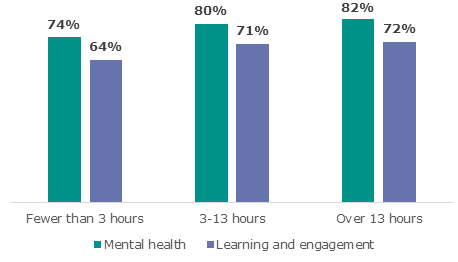
“[I’d like] to have more days that we can go to our counsellor or have no limit because some people could just be starting to open up and then their time was up.” (Student)
Lesson 3: Having multiple referral pathways by teachers, students, and parents and whānau, is potentially important in order to capture students who do not exhibit obvious signs of distress.
Administrative data
Three in four (75 percent) students are referred to counselling by school staff. The next most common referral pathways are parents and whānau (14 percent), and self-referrals (4 percent). We heard teachers are more likely to pick up observable issues such as behaviour, leading to the high referral rates for behaviour (24 percent of all referrals), when compared to less observable issues such as grief.
Interviews with counsellors, teachers, and school leaders
We asked counsellors, teachers, and school leaders: “Are there groups not accessing the service?” and, “What’s hindering their access?”
Picking up less observable issues and being referred relies on strong relationships between the student or parents and whānau with the school, to help assist students referring themselves and parents and whānau referring their child to Counselling in Schools.
“Kids are quite good at masking, and teachers don't always have that time to really have those conversations.” (School leader)
Lesson 4: The programme is promising but we need to understand more about which elements are key to success to be sure it can be effectively replicated in a wider range of schools.
Counselling in Schools is a promising programme. It shows similar positive impacts on mental health as international schoolbased counselling programmes.
However, Counselling in Schools is currently delivered in many different ways. This means that, while there are clear indications of effectiveness, it is hard to replicate effectively in a larger variety of schools.
ERO recommends there to be more development of the programme specifications to understand both value for money and what elements are key to success, and therefore essential to replicate.
A key contributing factor to the effectiveness of the Counselling in Schools programme is the delivery. This section includes findings from across each of the phases on what has supported effective delivery and what the barriers have been, particularly for schools and providers.
What we did
In this section, we look at what factors are important for schools and providers to successfully deliver Counselling in Schools, that have been identified through each of the three phases of this report.
The section sets out:
- What is important for schools?
- What is important for providers?
How we identified these lessons
We identified these lessons through triangulation of all of our data sources including our qualitative analysis, survey and administrative data analysis, and our discussions with experts. We synthesise what we heard works well from students, teachers and school leaders, counsellors and managers, and parents and whānau.
What we found: an overview
Based on the three phases, we have identified key lessons for the ongoing development of Counselling in Schools and other similar initiatives. These include:
- Investing in psychological support in primary schools can reduce distress and improve learning, attendance, and behaviour outcomes.
- Counselling in primary schools works best when on the school site, and when students receive more than three hours of support.
- Having multiple referral pathways by teachers, students, parents and whānau, is potentially important in order to capture students who do not exhibit obvious signs of distress.
- The programme is promising but we need to understand more about which elements are key to success to be sure it can be effectively replicated in a wider range of schools.
Lesson 1: Investing in psychological support in primary schools can reduce distress and improve learning, attendance, and behaviour outcomes.
This lesson draws on our full range of data, including our administrative data with CORS and LEMT outcomes, as well as surveys and interviews with students, teachers and school leaders, counsellors and managers, and parents and whānau. We triangulated the data from all of these sources and challenged our findings within internal sessions as well as consulting with experts.
Lesson 2: Counselling in primary schools works best when on the school site, and when students receive more than three hours of support.
Surveys with students, teachers, and school leaders, and interviews with school leaders, teachers, and parents and whānau
We asked teachers and school leaders: “What helps or gets in the way of students accessing support?”
Students, teachers, parents and whānau told us that having counsellors on-site allows easy access for those in remote areas and improves the uptake of counselling.
“A part of the other battle is that we are so removed from [the city]. At times that travel is a massive barrier for our families. So having somebody come to [our school] to work with our kids has been ideal.” (School leader)
Administrative data
Students who receive at least three hours of counselling are more likely to show improvement for both mental health and learning and engagement outcomes.
Figure 8: Percentage of students who improve in mental health and learning and engagement, by number of hours in counselling
“[I’d like] to have more days that we can go to our counsellor or have no limit because some people could just be starting to open up and then their time was up.” (Student)
Lesson 3: Having multiple referral pathways by teachers, students, and parents and whānau, is potentially important in order to capture students who do not exhibit obvious signs of distress.
Administrative data
Three in four (75 percent) students are referred to counselling by school staff. The next most common referral pathways are parents and whānau (14 percent), and self-referrals (4 percent). We heard teachers are more likely to pick up observable issues such as behaviour, leading to the high referral rates for behaviour (24 percent of all referrals), when compared to less observable issues such as grief.
Interviews with counsellors, teachers, and school leaders
We asked counsellors, teachers, and school leaders: “Are there groups not accessing the service?” and, “What’s hindering their access?”
Picking up less observable issues and being referred relies on strong relationships between the student or parents and whānau with the school, to help assist students referring themselves and parents and whānau referring their child to Counselling in Schools.
“Kids are quite good at masking, and teachers don't always have that time to really have those conversations.” (School leader)
Lesson 4: The programme is promising but we need to understand more about which elements are key to success to be sure it can be effectively replicated in a wider range of schools.
Counselling in Schools is a promising programme. It shows similar positive impacts on mental health as international schoolbased counselling programmes.
However, Counselling in Schools is currently delivered in many different ways. This means that, while there are clear indications of effectiveness, it is hard to replicate effectively in a larger variety of schools.
ERO recommends there to be more development of the programme specifications to understand both value for money and what elements are key to success, and therefore essential to replicate.
Appendix 1: Methodologies
What we mean by counsellors: In this report, we use the term counsellors to refer to the practitioners who are contracted by providers to schools as part of the Counselling in Schools initiative. Due to changes in the programme, counselling practitioners include practitioners who are registered with a professional body, or if not registered, working under the supervision of a registered counselling practitioner.
What we mean by mental health: Given the nature of school counselling, mental health as we are using it in this report does not refer to specific diagnosed mental health disorders; rather it refers to mental distress or lower levels of mental wellbeing. As defined by the World Health Organisation:
Mental health is a state of mental well-being that enables people to cope with the stresses of life, realise their abilities, learn well and work well, and contribute to their community. It is an integral component of health and well-being that underpins our individual and collective abilities to make decisions, build relationships and shape the world we live in.
Our evaluation questions
- To what extent did the initiative increase access to counselling for primary school students? For whom? Was access equitable?
- What was the impact of the initiative on families’ and whānau and students’ wellbeing/hauora; students’ engagement and learning; and school practices?
- What are some lessons learnt about implementation of this initiative?
Mixed-methods approach to data collection
ERO used a mixed-methods approach of surveys and interviews. This report draws on the voices of students, teachers and school leaders, counsellors and managers, parents and whānau, and experts to understand the impact of Counselling in Schools on students, and the experiences of students, school staff, counsellors, and parents and whānau. This evaluation used a complementary mix of quantitative and qualitative data sources to ensure breadth and depth in examining the key evaluation questions.
Our mixed-methods approach integrates quantitative data (administrative data and surveys) and qualitative data (focus groups and interviews); triangulating the evidence across these different data and sources. We used the triangulation process to test and refine our findings statements, allowing the weight of this collective data to form the conclusions. The rigour of the data and validity of these findings were further tested through iterative sense-making sessions with key stakeholders.
Ensuring breadth to provide judgement on the key evaluation questions occurred through:
- online surveys of:
- students
- teachers and school leaders
- counsellors and managers
- parents and whānau - a literature review, administrative data, and interviews with experts
- statistical analysis of administrative data.
Ensuring depth in understanding of what works and what needs to improve occurred through:
- interviews and focus groups with:
- students
- teachers and school leaders
- counsellors and managers
- parents and whānau
Qualitative analysis
Qualitative data was thematically analysed by an experienced team.
The qualitative data were analysed in two main ways:
- a semi-inductive approach was initially taken, whereby the interviewer notation was coded into previously established themes, organised within the key evaluation questions. Cross-interview themes were established during workshops comprising the qualitative analysis team
- following substantive analysis of both the qualitative and quantitative data, a deductive approach was taken to establish exemplars that illustrated those analyses with real-world experiences.
All quotes were gathered from verbatim records and open-ended survey responses. The research team held workshops to discuss the survey data and the interview data to identity cross-cutting themes. This also made sure that members of the research team were analysing and interpreting the data consistently, and additional investigation could be undertaken to address gaps or inconsistencies.
Administrative data
The administrative data contains information on students who have gone through Counselling in Schools, including session details, and measures of mental health and learning and engagement. The data is collated by the Ministry of Education and relies on counsellors and providers to input data on each individual student that receives counselling. The nature of the input leads to large amounts of missing data. Notably, data from group sessions did not include student characteristics, and therefore was unable to be used in any analysis of outcomes by student characteristics (e.g., ethnicity, gender, year level).
Additionally, the data contained responses from students in secondary years (Years 9+), which is not within the scope of this evaluation. We removed the identifiable secondary school data, yet due to the missing data (particularly for group sessions), there is a number of students we cannot guarantee are not secondary student responses. To reduce the risk of this skewing our results, we tested the data with and without this sample of students and found that it yielded no significant changes to our findings.
Surveys
Surveys were in the field from late March to mid-April 2024. All surveys were carried out using Survey Monkey.
Student surveys
ERO conducted the student survey using Survey Monkey. Participants were invited on the following criteria:
- students who received counselling in 2023
- in Years 4-8 in 2023.
ERO shared the links to the surveys with the Ministry of Education, who then engaged with providers, who were requested to engage five of their students to complete the survey with the counsellor. ERO identified which providers had no data, and MoE re-engaged these providers.
Teacher and school leader surveys
ERO conducted the teacher and school leader survey using Survey Monkey. Participants were invited on the following criteria:
- teachers and school leaders in schools participating in Counselling in Schools
- involved in referring students in their class who participated in Counselling in Schools.
ERO sent information and survey links to schools via email. After one week, ERO identified schools with 0 responses and re-engaged these schools via email.
Counsellor and manager surveys
ERO designed the counsellor and manager survey using Survey Monkey. Participants were invited on the following criteria:
- counsellors working in the Counselling in Schools programme, or
- managers of counsellors working in the Counselling in Schools programme.
ERO first shared the links to MoE, who then distributed the survey to providers across the regions and promoted participation.
Parents and whānau survey
ERO designed the parents and whānau survey using Survey Monkey. Participants were invited on the following criteria:
- parent/whānau/caregiver of a child who participated in Counselling in Schools in 2023.
ERO sent the parents and whānau survey to schools in the same email as the teacher and leader survey, encouraging schools to forward the survey link to the relevant parents and whānau of their school.
Sense-making
Following analysis of the administrative data, surveys, and interviews, sense-making discussions were conducted to test interpretation of the results, findings, and areas for action with:
- ERO specialists in reviewing school practice
- the project’s Expert Advisory Group, made up of sector experts
- the project’s Steering Group, made up of ERO and Ministry of Education representatives.
We then tested and refined the findings and lessons with the following groups to ensure they were useful and practical:
- representatives from the Ministry of Education
- the project Steering Group.
Informed consent
All participants were informed of the purpose of the evaluation before they agreed to participate in an interview. Participants were informed that:
- participation was voluntary and could be withdrawn at any time
- their words may be included in reporting, but no identifying details would be shared
- permission to use their information could be withdrawn at any time
- interviews were not an evaluation of their school, and their school or provider would not be identified in the resulting national report
- their information was confidential and would be kept securely subject to the provisions of the Official Information Act 1982, Privacy Act 1993, and the Public Records Act 2005 on the release and retention of information.
Interviewees consented to take part in an interview via email, or by submitting a written consent form to ERO. Their verbal consent was also sought to record their online interviews. Participants were given opportunities to query the evaluation team if they needed further information about the consent process.
Data security
Data collected from interviews, surveys, and administrative data will be stored digitally for a period of six months after the full completion of the evaluation. During this time, all data is password-protected and has limited accessibility.
Limitations
As with all research, there are some limitations to our methodology.
In terms of scope, this research:
- does not make judgements about individual schools or providers.
In terms of data collection
- We used gatekeepers to distribute the surveys which means we cannot be exactly sure of the methods used to distribute them. This could possibly lead to a skewed samplexii.
- Low survey responses for certain groups meant we were unable to analyse across participant characteristics for some samples (e.g., ethnicity).
What we mean by counsellors: In this report, we use the term counsellors to refer to the practitioners who are contracted by providers to schools as part of the Counselling in Schools initiative. Due to changes in the programme, counselling practitioners include practitioners who are registered with a professional body, or if not registered, working under the supervision of a registered counselling practitioner.
What we mean by mental health: Given the nature of school counselling, mental health as we are using it in this report does not refer to specific diagnosed mental health disorders; rather it refers to mental distress or lower levels of mental wellbeing. As defined by the World Health Organisation:
Mental health is a state of mental well-being that enables people to cope with the stresses of life, realise their abilities, learn well and work well, and contribute to their community. It is an integral component of health and well-being that underpins our individual and collective abilities to make decisions, build relationships and shape the world we live in.
Our evaluation questions
- To what extent did the initiative increase access to counselling for primary school students? For whom? Was access equitable?
- What was the impact of the initiative on families’ and whānau and students’ wellbeing/hauora; students’ engagement and learning; and school practices?
- What are some lessons learnt about implementation of this initiative?
Mixed-methods approach to data collection
ERO used a mixed-methods approach of surveys and interviews. This report draws on the voices of students, teachers and school leaders, counsellors and managers, parents and whānau, and experts to understand the impact of Counselling in Schools on students, and the experiences of students, school staff, counsellors, and parents and whānau. This evaluation used a complementary mix of quantitative and qualitative data sources to ensure breadth and depth in examining the key evaluation questions.
Our mixed-methods approach integrates quantitative data (administrative data and surveys) and qualitative data (focus groups and interviews); triangulating the evidence across these different data and sources. We used the triangulation process to test and refine our findings statements, allowing the weight of this collective data to form the conclusions. The rigour of the data and validity of these findings were further tested through iterative sense-making sessions with key stakeholders.
Ensuring breadth to provide judgement on the key evaluation questions occurred through:
- online surveys of:
- students
- teachers and school leaders
- counsellors and managers
- parents and whānau - a literature review, administrative data, and interviews with experts
- statistical analysis of administrative data.
Ensuring depth in understanding of what works and what needs to improve occurred through:
- interviews and focus groups with:
- students
- teachers and school leaders
- counsellors and managers
- parents and whānau
Qualitative analysis
Qualitative data was thematically analysed by an experienced team.
The qualitative data were analysed in two main ways:
- a semi-inductive approach was initially taken, whereby the interviewer notation was coded into previously established themes, organised within the key evaluation questions. Cross-interview themes were established during workshops comprising the qualitative analysis team
- following substantive analysis of both the qualitative and quantitative data, a deductive approach was taken to establish exemplars that illustrated those analyses with real-world experiences.
All quotes were gathered from verbatim records and open-ended survey responses. The research team held workshops to discuss the survey data and the interview data to identity cross-cutting themes. This also made sure that members of the research team were analysing and interpreting the data consistently, and additional investigation could be undertaken to address gaps or inconsistencies.
Administrative data
The administrative data contains information on students who have gone through Counselling in Schools, including session details, and measures of mental health and learning and engagement. The data is collated by the Ministry of Education and relies on counsellors and providers to input data on each individual student that receives counselling. The nature of the input leads to large amounts of missing data. Notably, data from group sessions did not include student characteristics, and therefore was unable to be used in any analysis of outcomes by student characteristics (e.g., ethnicity, gender, year level).
Additionally, the data contained responses from students in secondary years (Years 9+), which is not within the scope of this evaluation. We removed the identifiable secondary school data, yet due to the missing data (particularly for group sessions), there is a number of students we cannot guarantee are not secondary student responses. To reduce the risk of this skewing our results, we tested the data with and without this sample of students and found that it yielded no significant changes to our findings.
Surveys
Surveys were in the field from late March to mid-April 2024. All surveys were carried out using Survey Monkey.
Student surveys
ERO conducted the student survey using Survey Monkey. Participants were invited on the following criteria:
- students who received counselling in 2023
- in Years 4-8 in 2023.
ERO shared the links to the surveys with the Ministry of Education, who then engaged with providers, who were requested to engage five of their students to complete the survey with the counsellor. ERO identified which providers had no data, and MoE re-engaged these providers.
Teacher and school leader surveys
ERO conducted the teacher and school leader survey using Survey Monkey. Participants were invited on the following criteria:
- teachers and school leaders in schools participating in Counselling in Schools
- involved in referring students in their class who participated in Counselling in Schools.
ERO sent information and survey links to schools via email. After one week, ERO identified schools with 0 responses and re-engaged these schools via email.
Counsellor and manager surveys
ERO designed the counsellor and manager survey using Survey Monkey. Participants were invited on the following criteria:
- counsellors working in the Counselling in Schools programme, or
- managers of counsellors working in the Counselling in Schools programme.
ERO first shared the links to MoE, who then distributed the survey to providers across the regions and promoted participation.
Parents and whānau survey
ERO designed the parents and whānau survey using Survey Monkey. Participants were invited on the following criteria:
- parent/whānau/caregiver of a child who participated in Counselling in Schools in 2023.
ERO sent the parents and whānau survey to schools in the same email as the teacher and leader survey, encouraging schools to forward the survey link to the relevant parents and whānau of their school.
Sense-making
Following analysis of the administrative data, surveys, and interviews, sense-making discussions were conducted to test interpretation of the results, findings, and areas for action with:
- ERO specialists in reviewing school practice
- the project’s Expert Advisory Group, made up of sector experts
- the project’s Steering Group, made up of ERO and Ministry of Education representatives.
We then tested and refined the findings and lessons with the following groups to ensure they were useful and practical:
- representatives from the Ministry of Education
- the project Steering Group.
Informed consent
All participants were informed of the purpose of the evaluation before they agreed to participate in an interview. Participants were informed that:
- participation was voluntary and could be withdrawn at any time
- their words may be included in reporting, but no identifying details would be shared
- permission to use their information could be withdrawn at any time
- interviews were not an evaluation of their school, and their school or provider would not be identified in the resulting national report
- their information was confidential and would be kept securely subject to the provisions of the Official Information Act 1982, Privacy Act 1993, and the Public Records Act 2005 on the release and retention of information.
Interviewees consented to take part in an interview via email, or by submitting a written consent form to ERO. Their verbal consent was also sought to record their online interviews. Participants were given opportunities to query the evaluation team if they needed further information about the consent process.
Data security
Data collected from interviews, surveys, and administrative data will be stored digitally for a period of six months after the full completion of the evaluation. During this time, all data is password-protected and has limited accessibility.
Limitations
As with all research, there are some limitations to our methodology.
In terms of scope, this research:
- does not make judgements about individual schools or providers.
In terms of data collection
- We used gatekeepers to distribute the surveys which means we cannot be exactly sure of the methods used to distribute them. This could possibly lead to a skewed samplexii.
- Low survey responses for certain groups meant we were unable to analyse across participant characteristics for some samples (e.g., ethnicity).
Appendix 2: Data tables
These tables describe the administrative data set, including: the full set, the populations that we can guarantee are primary students, that completed both pre- and post-counselling CORS measures, and that completed both pre- and post-counselling LEMT measures. The data for group sessions was limited to school data, and as such, there are no student characteristics tied to this data, leading to the majority of the missing data.
Administrative data
|
|
All |
Primary |
CORS |
LEMT |
|
Girls |
45% |
45% |
48% |
49% |
|
Boys |
55% |
55% |
52% |
51% |
|
Māori |
60% |
60% |
58% |
63% |
|
NZ European/Pākehā |
47% |
47% |
50% |
46% |
|
Pacific |
8% |
8% |
7% |
8% |
|
Asian |
2% |
2% |
2% |
1% |
|
MELAA |
1% |
1% |
1% |
1% |
|
Year 1-2 |
13% |
13% |
11% |
13% |
|
Year 3-4 |
23% |
23% |
21% |
21% |
|
Year 5-6 |
31% |
31% |
30% |
31% |
|
Year 7-8 |
33% |
33% |
37% |
35% |
|
Ref: Behaviour |
24% |
26% |
24% |
25% |
|
Ref: Anxiety |
16% |
18% |
18% |
19% |
|
Ref: Relationships |
14% |
13% |
18% |
15% |
|
Ref: Other |
12% |
8% |
8% |
6% |
|
Ref: Social issues |
10% |
8% |
8% |
7% |
|
Ref: Family issues |
9% |
11% |
9% |
12% |
|
Ref: Grief |
9% |
10% |
11% |
11% |
|
Ref: Low mood |
3% |
4% |
3% |
3% |
|
Ref: Attendance |
2% |
2% |
2% |
3% |
|
Referrer: Staff |
75% |
73% |
65% |
66% |
|
Referrer: Whānau |
14% |
5% |
20% |
22% |
|
Referrer: Self |
4% |
18% |
6% |
6% |
|
Session: Individual |
76% |
98% |
78% |
99% |
|
Session: Small group |
10% |
X |
12% |
X |
|
Session: Large group |
4% |
X |
6% |
X |
|
Session: Class |
3% |
X |
4% |
X |
|
Session: Whānau |
5% |
2% |
1% |
1% |
|
Session: Whole school |
1% |
X |
<1% |
X |
|
Total sample (n) |
5225 |
3537 |
1840 |
1146 |
Surveys
|
Respondent |
Population |
Responses |
|
Students |
2690 (# of Year 4-8 students in 2023 cohort) |
330 |
|
Teachers and school leaders |
196 schools |
47 |
|
Counsellors and managers |
193 |
72 |
|
Parents and whānau |
Whānau of the 2690 learners |
70 |
These tables describe the administrative data set, including: the full set, the populations that we can guarantee are primary students, that completed both pre- and post-counselling CORS measures, and that completed both pre- and post-counselling LEMT measures. The data for group sessions was limited to school data, and as such, there are no student characteristics tied to this data, leading to the majority of the missing data.
Administrative data
|
|
All |
Primary |
CORS |
LEMT |
|
Girls |
45% |
45% |
48% |
49% |
|
Boys |
55% |
55% |
52% |
51% |
|
Māori |
60% |
60% |
58% |
63% |
|
NZ European/Pākehā |
47% |
47% |
50% |
46% |
|
Pacific |
8% |
8% |
7% |
8% |
|
Asian |
2% |
2% |
2% |
1% |
|
MELAA |
1% |
1% |
1% |
1% |
|
Year 1-2 |
13% |
13% |
11% |
13% |
|
Year 3-4 |
23% |
23% |
21% |
21% |
|
Year 5-6 |
31% |
31% |
30% |
31% |
|
Year 7-8 |
33% |
33% |
37% |
35% |
|
Ref: Behaviour |
24% |
26% |
24% |
25% |
|
Ref: Anxiety |
16% |
18% |
18% |
19% |
|
Ref: Relationships |
14% |
13% |
18% |
15% |
|
Ref: Other |
12% |
8% |
8% |
6% |
|
Ref: Social issues |
10% |
8% |
8% |
7% |
|
Ref: Family issues |
9% |
11% |
9% |
12% |
|
Ref: Grief |
9% |
10% |
11% |
11% |
|
Ref: Low mood |
3% |
4% |
3% |
3% |
|
Ref: Attendance |
2% |
2% |
2% |
3% |
|
Referrer: Staff |
75% |
73% |
65% |
66% |
|
Referrer: Whānau |
14% |
5% |
20% |
22% |
|
Referrer: Self |
4% |
18% |
6% |
6% |
|
Session: Individual |
76% |
98% |
78% |
99% |
|
Session: Small group |
10% |
X |
12% |
X |
|
Session: Large group |
4% |
X |
6% |
X |
|
Session: Class |
3% |
X |
4% |
X |
|
Session: Whānau |
5% |
2% |
1% |
1% |
|
Session: Whole school |
1% |
X |
<1% |
X |
|
Total sample (n) |
5225 |
3537 |
1840 |
1146 |
Surveys
|
Respondent |
Population |
Responses |
|
Students |
2690 (# of Year 4-8 students in 2023 cohort) |
330 |
|
Teachers and school leaders |
196 schools |
47 |
|
Counsellors and managers |
193 |
72 |
|
Parents and whānau |
Whānau of the 2690 learners |
70 |
Appendix 3: Learning Engagement Measurement Tool (LEMT)
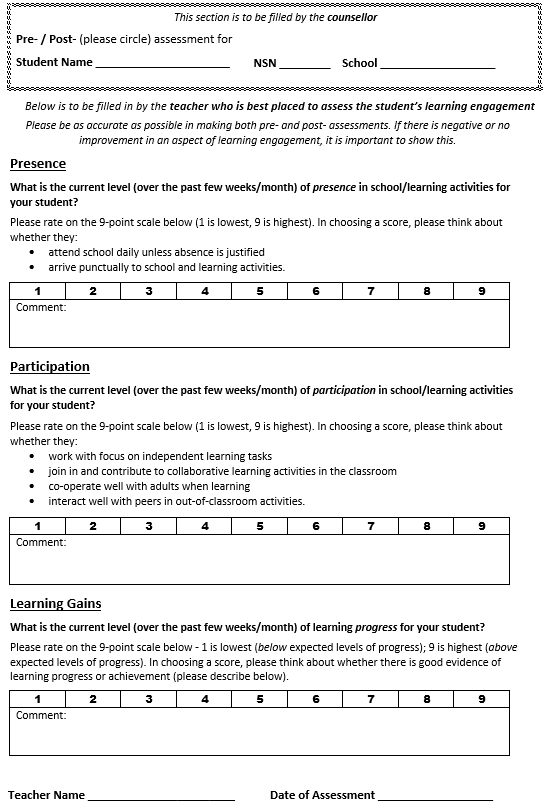
Appendix 4: Child Outcome Rating Scale (CORS)
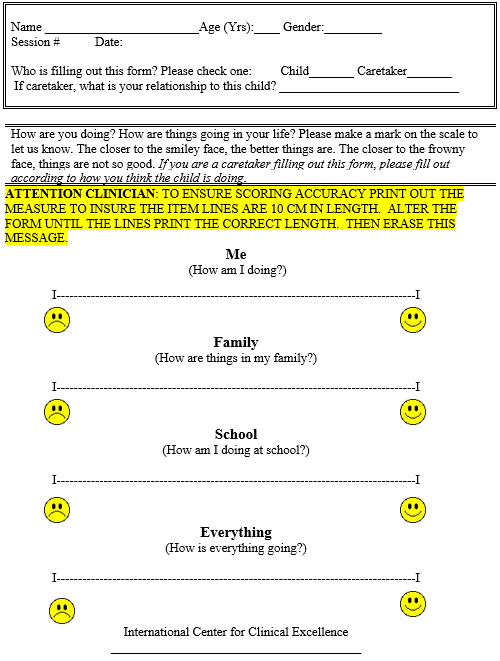
Appendix 5: Surveys
Student survey
I am:
- a girl
- a boy
- Gender diverse
- Prefer not to say
- Other
I am in:
- Year 4
- Year 5
- Year 6
- Year 7
- Year 8
- Other (please tell us)
I am: (You can choose more than one)
- New Zealand European/Pākehā
- Māori
- Samoan
- Cook Island Maori
- Tongan
- Niuean
- Fijian
- Tokelauan
- Other Pacific Peoples
- Chinese
- Indian
- Other Asian
- Other European
- Middle Eastern
- Latin American
- African
- Southeast Asian
- Don’t know
- Prefer not to say
- Another ethnic group (please tell us)
What school do you go to? (type the first letter of your school name)
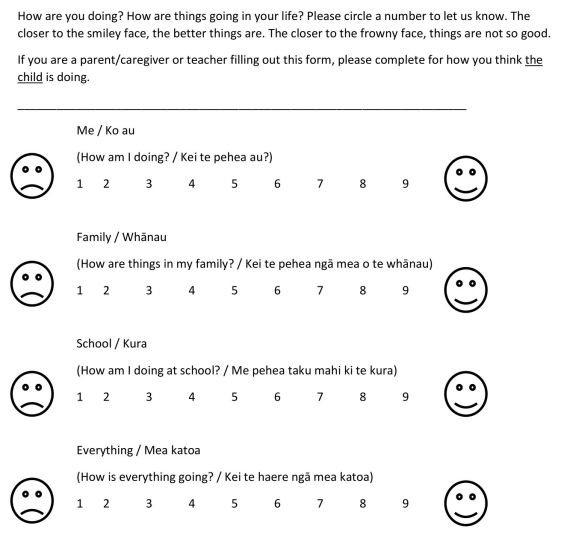
Do you think having counselling at school is a good idea?
- Yes
- No
- Don't know
Has the Awhi Mai Awhi Atu counselling practitioner worked with you at your school?
- Yes
- No
When did you see this counselling practitioner? (tick all that apply)
- This year
- Last year
- Two years ago
Who was at the meeting(s) with the counselling practitioner?: (Tick all that apply)
- Just me
- Me and a classmate
- Me and my family or caregiver
- Me and my class
- Me and my school
When thinking about counselling, what are the three most important things for counselling to work for you?:
- I like the counsellor
- The sessions being at school
- Having a safe space to go to
- Enjoyable activities in the sessions
- The tools I learned to manage my big feelings
- The sessions could include my family / whānau / caregivers
- A counsellor who is like me (e.g. from the same culture or same community)
When you were receiving counselling support, did these sessions help: (options: Yes/No)
- how you felt in yourself
- you understand your feelings
- you manage your feelings
- you want to go to school
- you join in with learning in your class
- make it easier to learn
- you get along with others at school
Are you finished having counselling sessions at your school?
- Yes
- No
Since you finished, how have your feelings changed?
- Got worse
- No change
- Got better
Since you finished, how have things at school changed?
- Got worse
- No change
- Got better
What did you learn as key take aways from your counselling sessions?
What would make it better for you?
Provider survey
Name of your counselling provider/counselling service:
I am:
- Female
- Male
- Gender diverse
- Prefer not to say
- Other
What is your age:
- Under 25 years
- 26 – 35 years
- 36 – 45 years
- 46 – 55 years
- 55+ years
- Prefer not to say
I identify as: (You can choose more than one)
- New Zealand European/Pākehā
- Māori
- Samoan
- Cook Island Māori
- Tongan
- Niuean
- Fijian
- Tokelauan
- Other Pacific Peoples
- Chinese
- Indian
- Other Asian
- Other European
- Middle Eastern
- Latin American
- African
- Southeast Asian
- Don’t know
- Prefer not to say
- Another ethnic group (please tell us)
I am answering this survey about the Awhi Mai, Awhi Atu/Counselling in Schools initiative as a: Tick all that apply.
- Manager
- Counsellor
- Other (please specify)
Are you one of the counsellors who works directly with the students?
- Yes
- No
What qualifications relevant to the counselling role do you hold? Tick all that apply
- Bachelor in Social Work / Applied Social Work
- Bachelor of Arts in Education and Psychology
- Bachelor of Counselling / Counselling Studies / Applied Counselling / Health
- Certificate in Counselling
- Diploma in Counselling
- Masters in Counselling / Applied Counselling
- Master of Educational Psychology
- Masters Social Work / Applied Social Work
- Sciences in Counselling / Counselling and Addiction
- Other relevant qualifications (please specify as qualification level and subject, such as ‘Post Grad Dip in Nursing’)
What professional bodies are you registered with? Tick all that apply
- NZAC
- OTBNZ
- SWRB NZ
- ANASW
- ANZACATA
- NZSWRB
- APPTA
- NZ Psychologist Board
- Other (please specify)
Approximately, how often did you receive professional supervision from a registered counsellor last year?
- Daily
- Weekly
- Monthly
- Bimonthly
- Four monthly
- Quarterly
- Six monthly
- Yearly
- I did not receive supervision last year
How many primary and intermediate schools did you support in 2023?
- 1
- 2
- 3
- 4
- 5+
- 0
What is the name of the school? (type the first letter of the school name)
Approximately what percentage of students that you work with require more specialist support:
- None
- 0-10%
- 11-20%
- 21-30%
- 31-40%
- 41-50%
- 51-60%
- 61-70%
- 71-80%
- 81-90%
- 91-100%
In your opinion, what are the three most important factors for counselling to be successful for students?
- Students enjoying the sessions
- Having counselling on school grounds
- Having a site where the students feel safe
- Having a counsellor who is qualified to provide counselling
- Having a counsellor who is a part of the community
- Having a counsellor who is similar background to the students
- Being clear about how counsellors work with other social supports at the school (e.g. Social Workers in Schools)
- Positive relationship between the school and the provider
- Positive relationship between the counsellor and the student
- Positive relationships between the counsellor and the whanau/family
- Involving whānau in counselling
- Other (please specify)
What aspects of Awhi Mai Awhi Atu contribute to sustained positive wellbeing for students?
What would make it better for students?
Teacher survey
What is the name of your school? (Type the first letter of your school's name).
What is your current role at the school? (Tick all that apply)
- Principal
- Board of Trustees member
- DP/AP/Senior leader
- SENCO
- Teacher
- Other (please specify)
Which of the following year groups do you teach or support? (tick all that apply)
- Primary (years 1-6)
- Intermediate (years 7-8)
- Secondary (years 9-13)
- None of the above
Approximately how many students have you referred to this Awhi Mai, Awhi Atu/Counselling in Schools service?
- 1
- 2
- 3
- 4
- 5
- 6
- 7
- 8
- 9
- 10
- 11
- 12
- 13
- 14
- 15
- 16
- 17
- 18
- 19
- 20+
Did any of your students receive counselling support in? Tick all that apply
- 2022
- 2023
- 2024
- None of my students received counselling support
In your opinion, what are the three most important factors for counselling to be successful for students?
- Students enjoying the sessions
- Having counselling on school grounds
- Having a site where the students feel safe
- Having a counsellor who is qualified to provide counselling
- Having a counsellor who is a part of the community
- Having a counsellor who is similar background to the students
- Being clear about how counsellors work with other social supports at the school (e.g. Social Workers in Schools)
- Positive relationship between the school and the provider
- Positive relationship between the counsellor and the student
- Positive relationships between the counsellor and the whanau/family
- Involving whānau in counselling
- Other, please specify
Overall, how do you think Awhi Mai Awhi Atu/Counselling in Schools impacted this group of students while they were receiving counselling: (options: got worse, no change, got better, don't know)
- Wellbeing/Hauora (happier in self)
- Participation (more involved in learning)
- Attendance
- Progress in learning
- Friendships (interactions with others)
- Strategies to help with emotions
While they were receiving counselling support, what else have you noticed as a result of counselling for students who used the service?
While this group of students were receiving counselling support, what were the immediate effects on the wider class? (options: got worse, no change, got better, don't know)
- Behaviours within the classroom
- Engagement within the classroom
- Achievement across the classroom
- Attendance at school
Six or more months after the support was provided, how do you think Awhi Mai Awhi Atu/Counselling in Schools impacted this group of students who used the service?
(options: got worse, no change, got better, don't know)
- Wellbeing/Hauora (happier in self)
- Participation (more involved in learning)
- Attendance
- Progress in learning
- Friendships (interactions with others)
- Strategies to help with emotions
What else have you noticed as a result of counselling in the longer term for those students who used the service or the wider class?
What would make this counselling better for students?
Parent and Whānau survey
I am:
- Female
- Male
- Gender diverse
- Prefer not to say
- Other
My child/ren, mokopuna who have received counselling are in:
- Year 1
- Year 2
- Year 3
- Year 4
- Year 5
- Year 6
- Year 7
- Year 8
- Other (please specify)
I identify as: (You can choose more than one)
- New Zealand European/Pākehā
- Māori
- Samoan
- Cook Island Māori
- Tongan
- Niuean
- Fijian
- Tokelauan
- Other Pacific Peoples
- Chinese
- Indian
- Other Asian
- Other European
- Middle Eastern
- Latin American
- African
- Southeast Asian
- Don’t know
- Prefer not to say
- Another ethnic group (please tell us)
What school do your child/ren, mokopuna go to? (type the first letter of your school name)
Do you know about the free counselling available for tamariki/children at your school?
- Yes
- No
Do you think having free counselling in schools a good thing?
- Yes
- No
- Don't know
Has your child met with, or about to meet with a counselling practitioner through the
Awhi Mai Awhi Atu/Counselling in Schools initiative?
- Yes
- No
- Don't know
Have you been involved in your child's counselling support?
- Yes
- No
- Prefer not to say
When did your child see the counsellor? (tick all that apply)
- This year (2024)
- Last year (2023)
- Two years ago (2022)
When thinking about counselling, what are the three most important things for counselling to work for your child?
- My child likes the counsellor
- The sessions are at school
- Having a safe space to go to
- Enjoyable activities in the sessions
- The tools my child learns to manage their big feelings
- The sessions include family / whānau / caregiver
- A counsellor who is like my child (e.g. from the same culture or same community)
Do you think that your family/whānau cultural values/needs are understood by the counselling practitioner?
- Yes
- No
- Don’t know
While your child/ren or mokopuna were receiving the counselling support, did this benefit your child’s (Yes / No)
- Wellbeing/Hauora (happier in self)
- Participation (more involved with home life)
- Attendance at school
- Progress in learning
- Confidence
- Friendships/interactions with others (school and home)
- Strategies to help with emotions
Is your child or mokopuna done seeing this counsellor at school?
- Yes
- No
Since your child finished with their counselling sessions, how have things changed for them in terms of: (got worse, no change, got better):
- Wellbeing/Hauora (happier in self)
- Participation (more involved with home life)
- Attendance at school
- Progress in learning
- Confidence
- Friendships/interactions with others (school and home)
- Strategies to help with emotions
What else have you noticed as a result of the counselling provided to your child?
What would make it better for your child?
Student survey
I am:
- a girl
- a boy
- Gender diverse
- Prefer not to say
- Other
I am in:
- Year 4
- Year 5
- Year 6
- Year 7
- Year 8
- Other (please tell us)
I am: (You can choose more than one)
- New Zealand European/Pākehā
- Māori
- Samoan
- Cook Island Maori
- Tongan
- Niuean
- Fijian
- Tokelauan
- Other Pacific Peoples
- Chinese
- Indian
- Other Asian
- Other European
- Middle Eastern
- Latin American
- African
- Southeast Asian
- Don’t know
- Prefer not to say
- Another ethnic group (please tell us)
What school do you go to? (type the first letter of your school name)
Do you think having counselling at school is a good idea?
- Yes
- No
- Don't know
Has the Awhi Mai Awhi Atu counselling practitioner worked with you at your school?
- Yes
- No
When did you see this counselling practitioner? (tick all that apply)
- This year
- Last year
- Two years ago
Who was at the meeting(s) with the counselling practitioner?: (Tick all that apply)
- Just me
- Me and a classmate
- Me and my family or caregiver
- Me and my class
- Me and my school
When thinking about counselling, what are the three most important things for counselling to work for you?:
- I like the counsellor
- The sessions being at school
- Having a safe space to go to
- Enjoyable activities in the sessions
- The tools I learned to manage my big feelings
- The sessions could include my family / whānau / caregivers
- A counsellor who is like me (e.g. from the same culture or same community)
When you were receiving counselling support, did these sessions help: (options: Yes/No)
- how you felt in yourself
- you understand your feelings
- you manage your feelings
- you want to go to school
- you join in with learning in your class
- make it easier to learn
- you get along with others at school
Are you finished having counselling sessions at your school?
- Yes
- No
Since you finished, how have your feelings changed?
- Got worse
- No change
- Got better
Since you finished, how have things at school changed?
- Got worse
- No change
- Got better
What did you learn as key take aways from your counselling sessions?
What would make it better for you?
Provider survey
Name of your counselling provider/counselling service:
I am:
- Female
- Male
- Gender diverse
- Prefer not to say
- Other
What is your age:
- Under 25 years
- 26 – 35 years
- 36 – 45 years
- 46 – 55 years
- 55+ years
- Prefer not to say
I identify as: (You can choose more than one)
- New Zealand European/Pākehā
- Māori
- Samoan
- Cook Island Māori
- Tongan
- Niuean
- Fijian
- Tokelauan
- Other Pacific Peoples
- Chinese
- Indian
- Other Asian
- Other European
- Middle Eastern
- Latin American
- African
- Southeast Asian
- Don’t know
- Prefer not to say
- Another ethnic group (please tell us)
I am answering this survey about the Awhi Mai, Awhi Atu/Counselling in Schools initiative as a: Tick all that apply.
- Manager
- Counsellor
- Other (please specify)
Are you one of the counsellors who works directly with the students?
- Yes
- No
What qualifications relevant to the counselling role do you hold? Tick all that apply
- Bachelor in Social Work / Applied Social Work
- Bachelor of Arts in Education and Psychology
- Bachelor of Counselling / Counselling Studies / Applied Counselling / Health
- Certificate in Counselling
- Diploma in Counselling
- Masters in Counselling / Applied Counselling
- Master of Educational Psychology
- Masters Social Work / Applied Social Work
- Sciences in Counselling / Counselling and Addiction
- Other relevant qualifications (please specify as qualification level and subject, such as ‘Post Grad Dip in Nursing’)
What professional bodies are you registered with? Tick all that apply
- NZAC
- OTBNZ
- SWRB NZ
- ANASW
- ANZACATA
- NZSWRB
- APPTA
- NZ Psychologist Board
- Other (please specify)
Approximately, how often did you receive professional supervision from a registered counsellor last year?
- Daily
- Weekly
- Monthly
- Bimonthly
- Four monthly
- Quarterly
- Six monthly
- Yearly
- I did not receive supervision last year
How many primary and intermediate schools did you support in 2023?
- 1
- 2
- 3
- 4
- 5+
- 0
What is the name of the school? (type the first letter of the school name)
Approximately what percentage of students that you work with require more specialist support:
- None
- 0-10%
- 11-20%
- 21-30%
- 31-40%
- 41-50%
- 51-60%
- 61-70%
- 71-80%
- 81-90%
- 91-100%
In your opinion, what are the three most important factors for counselling to be successful for students?
- Students enjoying the sessions
- Having counselling on school grounds
- Having a site where the students feel safe
- Having a counsellor who is qualified to provide counselling
- Having a counsellor who is a part of the community
- Having a counsellor who is similar background to the students
- Being clear about how counsellors work with other social supports at the school (e.g. Social Workers in Schools)
- Positive relationship between the school and the provider
- Positive relationship between the counsellor and the student
- Positive relationships between the counsellor and the whanau/family
- Involving whānau in counselling
- Other (please specify)
What aspects of Awhi Mai Awhi Atu contribute to sustained positive wellbeing for students?
What would make it better for students?
Teacher survey
What is the name of your school? (Type the first letter of your school's name).
What is your current role at the school? (Tick all that apply)
- Principal
- Board of Trustees member
- DP/AP/Senior leader
- SENCO
- Teacher
- Other (please specify)
Which of the following year groups do you teach or support? (tick all that apply)
- Primary (years 1-6)
- Intermediate (years 7-8)
- Secondary (years 9-13)
- None of the above
Approximately how many students have you referred to this Awhi Mai, Awhi Atu/Counselling in Schools service?
- 1
- 2
- 3
- 4
- 5
- 6
- 7
- 8
- 9
- 10
- 11
- 12
- 13
- 14
- 15
- 16
- 17
- 18
- 19
- 20+
Did any of your students receive counselling support in? Tick all that apply
- 2022
- 2023
- 2024
- None of my students received counselling support
In your opinion, what are the three most important factors for counselling to be successful for students?
- Students enjoying the sessions
- Having counselling on school grounds
- Having a site where the students feel safe
- Having a counsellor who is qualified to provide counselling
- Having a counsellor who is a part of the community
- Having a counsellor who is similar background to the students
- Being clear about how counsellors work with other social supports at the school (e.g. Social Workers in Schools)
- Positive relationship between the school and the provider
- Positive relationship between the counsellor and the student
- Positive relationships between the counsellor and the whanau/family
- Involving whānau in counselling
- Other, please specify
Overall, how do you think Awhi Mai Awhi Atu/Counselling in Schools impacted this group of students while they were receiving counselling: (options: got worse, no change, got better, don't know)
- Wellbeing/Hauora (happier in self)
- Participation (more involved in learning)
- Attendance
- Progress in learning
- Friendships (interactions with others)
- Strategies to help with emotions
While they were receiving counselling support, what else have you noticed as a result of counselling for students who used the service?
While this group of students were receiving counselling support, what were the immediate effects on the wider class? (options: got worse, no change, got better, don't know)
- Behaviours within the classroom
- Engagement within the classroom
- Achievement across the classroom
- Attendance at school
Six or more months after the support was provided, how do you think Awhi Mai Awhi Atu/Counselling in Schools impacted this group of students who used the service?
(options: got worse, no change, got better, don't know)
- Wellbeing/Hauora (happier in self)
- Participation (more involved in learning)
- Attendance
- Progress in learning
- Friendships (interactions with others)
- Strategies to help with emotions
What else have you noticed as a result of counselling in the longer term for those students who used the service or the wider class?
What would make this counselling better for students?
Parent and Whānau survey
I am:
- Female
- Male
- Gender diverse
- Prefer not to say
- Other
My child/ren, mokopuna who have received counselling are in:
- Year 1
- Year 2
- Year 3
- Year 4
- Year 5
- Year 6
- Year 7
- Year 8
- Other (please specify)
I identify as: (You can choose more than one)
- New Zealand European/Pākehā
- Māori
- Samoan
- Cook Island Māori
- Tongan
- Niuean
- Fijian
- Tokelauan
- Other Pacific Peoples
- Chinese
- Indian
- Other Asian
- Other European
- Middle Eastern
- Latin American
- African
- Southeast Asian
- Don’t know
- Prefer not to say
- Another ethnic group (please tell us)
What school do your child/ren, mokopuna go to? (type the first letter of your school name)
Do you know about the free counselling available for tamariki/children at your school?
- Yes
- No
Do you think having free counselling in schools a good thing?
- Yes
- No
- Don't know
Has your child met with, or about to meet with a counselling practitioner through the
Awhi Mai Awhi Atu/Counselling in Schools initiative?
- Yes
- No
- Don't know
Have you been involved in your child's counselling support?
- Yes
- No
- Prefer not to say
When did your child see the counsellor? (tick all that apply)
- This year (2024)
- Last year (2023)
- Two years ago (2022)
When thinking about counselling, what are the three most important things for counselling to work for your child?
- My child likes the counsellor
- The sessions are at school
- Having a safe space to go to
- Enjoyable activities in the sessions
- The tools my child learns to manage their big feelings
- The sessions include family / whānau / caregiver
- A counsellor who is like my child (e.g. from the same culture or same community)
Do you think that your family/whānau cultural values/needs are understood by the counselling practitioner?
- Yes
- No
- Don’t know
While your child/ren or mokopuna were receiving the counselling support, did this benefit your child’s (Yes / No)
- Wellbeing/Hauora (happier in self)
- Participation (more involved with home life)
- Attendance at school
- Progress in learning
- Confidence
- Friendships/interactions with others (school and home)
- Strategies to help with emotions
Is your child or mokopuna done seeing this counsellor at school?
- Yes
- No
Since your child finished with their counselling sessions, how have things changed for them in terms of: (got worse, no change, got better):
- Wellbeing/Hauora (happier in self)
- Participation (more involved with home life)
- Attendance at school
- Progress in learning
- Confidence
- Friendships/interactions with others (school and home)
- Strategies to help with emotions
What else have you noticed as a result of the counselling provided to your child?
What would make it better for your child?