
Insights for parents and whānau: Cell phone rules and how you can help
About this resource:
ERO looked at how well schools were implementing the ‘Phones Away for the Day’ policy. Whilst the findings are encouraging – removing cell phones has led to increased focus in the classroom, improved academic outcomes, and a reduction in bullying, nearly half of secondary students say they break the rules. Their number one reason for doing so is to stay in contact with parents and whānau. This guide aims to get greater support from parents and whānau. It outlines how removing cell phones from classrooms is beneficial for students, and how parents and whānau can support the implementation of cell phone rules.
Our featured insights
-
 Research summary | 10 min read
Do not disturb: A review of removing cell phones from New Zealand’s classrooms – Summary
20 November 2025 -
 Research report | 60 min read
Do not disturb: A review of removing cell phones from New Zealand’s classrooms
20 November 2025 -
 Good practice guide | 30 min read
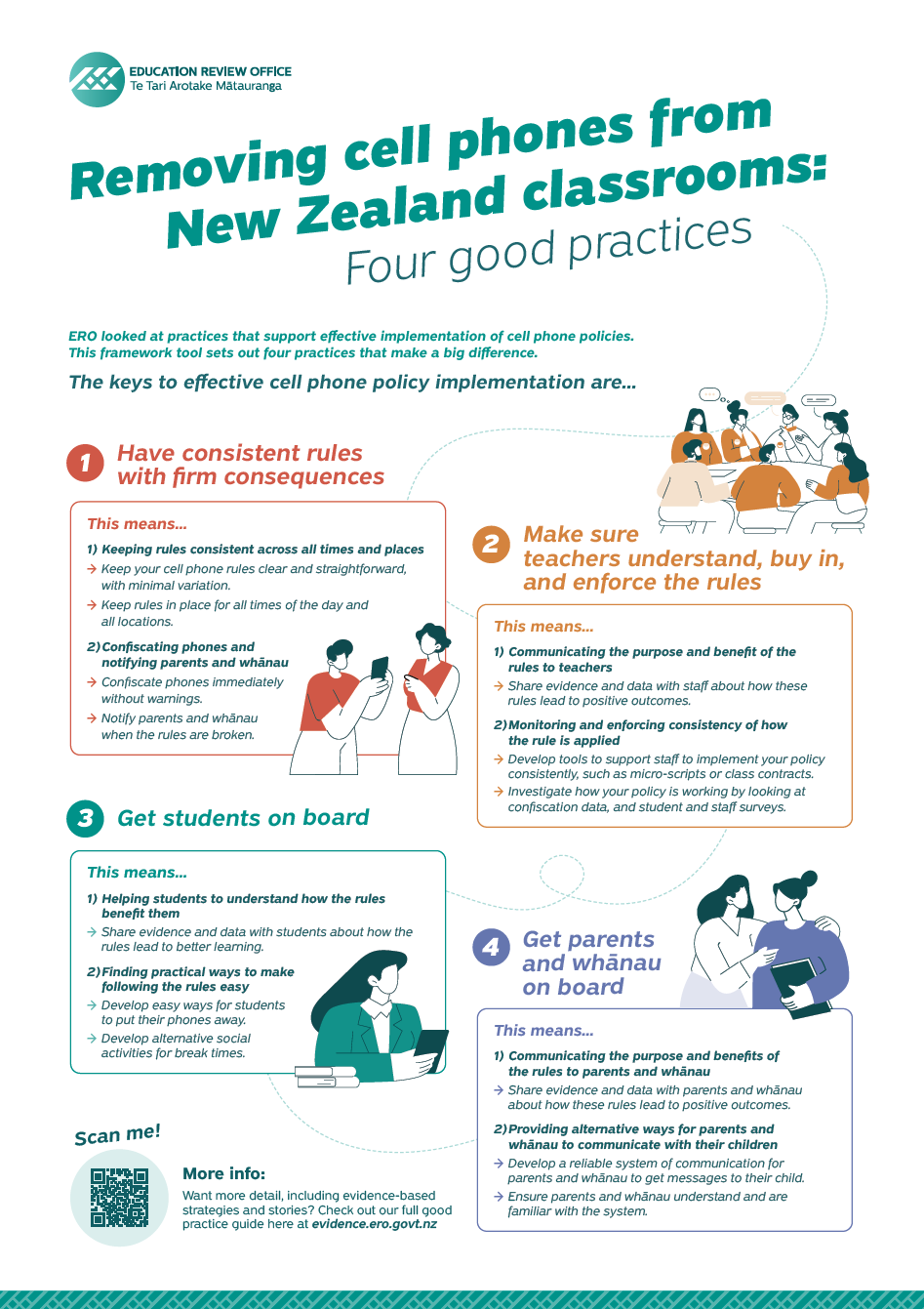
Removing cell phones from New Zealand’s classrooms: Four good practices
20 November 2025 -
 Technical report | 60 min read
Do not disturb: A review of removing cell phones from New Zealand’s classrooms – Technical appendix
20 November 2025 -
 Sector insights | 5 min read
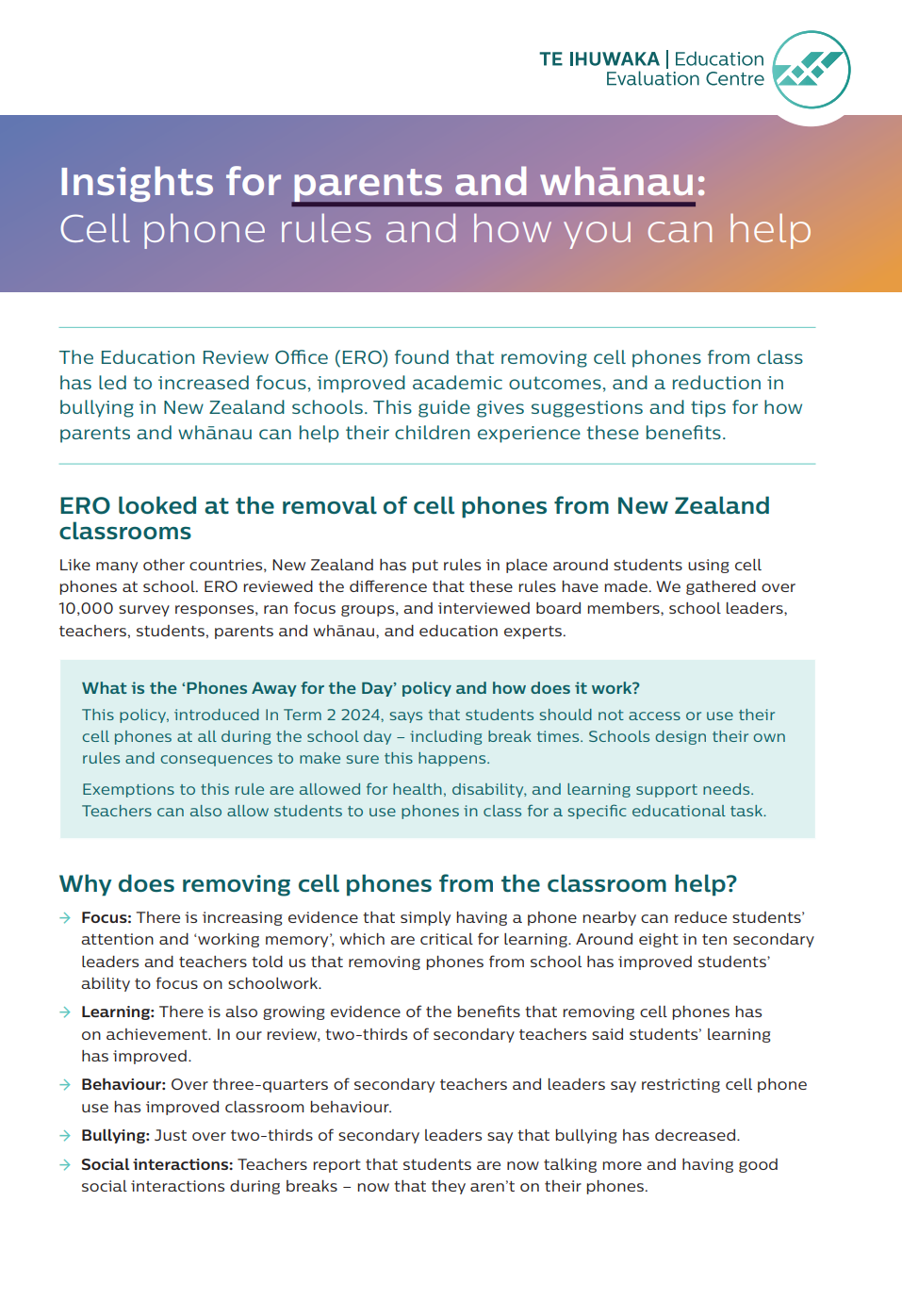
Insights for parents and whānau: Cell phone rules and how you can help
20 November 2025 -
 Research report | 5 min read
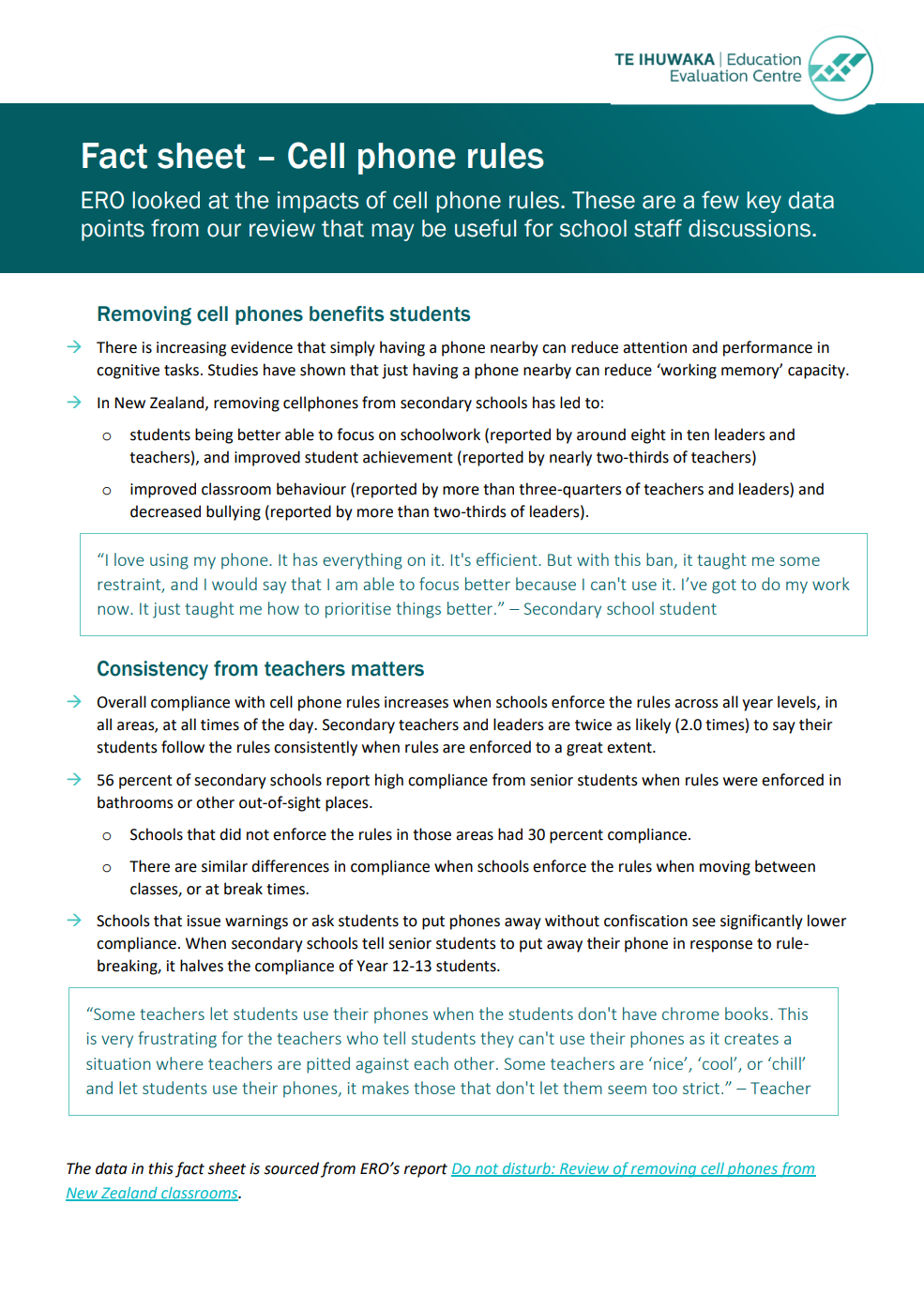
Do not disturb: Fact sheet for teachers
20 November 2025 -
 Good practice guide | 2 min read
Removing cell phones from New Zealand’s classrooms: Four good practices – Poster
20 November 2025
Read Online
Summary
ERO looked at how well schools were implementing the ‘Phones Away for the Day’ policy. Whilst the findings are encouraging – removing cell phones has led to increased focus in the classroom, improved academic outcomes, and a reduction in bullying, nearly half of secondary students say they break the rules. Their number one reason for doing so is to stay in contact with parents and whānau. This guide aims to get greater support from parents and whānau. It outlines how removing cell phones from classrooms is beneficial for students, and how parents and whānau can support the implementation of cell phone rules.
ERO looked at how well schools were implementing the ‘Phones Away for the Day’ policy. Whilst the findings are encouraging – removing cell phones has led to increased focus in the classroom, improved academic outcomes, and a reduction in bullying, nearly half of secondary students say they break the rules. Their number one reason for doing so is to stay in contact with parents and whānau. This guide aims to get greater support from parents and whānau. It outlines how removing cell phones from classrooms is beneficial for students, and how parents and whānau can support the implementation of cell phone rules.
ERO looked at the removal of cell phones from New Zealand classrooms
Like many other countries, New Zealand has put rules in place around students using cell phones at school. ERO reviewed the difference that these rules have made. We gathered over 10,000 survey responses, ran focus groups, and interviewed board members, school leaders, teachers, students, parents and whānau, and education experts.
What is the ‘Phones Away for the Day’ policy and how does it work?
This policy, introduced In Term 2 2024, says that students should not access or use their cell phones at all during the school day – including break times. Schools design their own rules and consequences to make sure this happens.
Exemptions to this rule are allowed for health, disability, and learning support needs. Teachers can also allow students to use phones in class for a specific educational task.
Like many other countries, New Zealand has put rules in place around students using cell phones at school. ERO reviewed the difference that these rules have made. We gathered over 10,000 survey responses, ran focus groups, and interviewed board members, school leaders, teachers, students, parents and whānau, and education experts.
What is the ‘Phones Away for the Day’ policy and how does it work?
This policy, introduced In Term 2 2024, says that students should not access or use their cell phones at all during the school day – including break times. Schools design their own rules and consequences to make sure this happens.
Exemptions to this rule are allowed for health, disability, and learning support needs. Teachers can also allow students to use phones in class for a specific educational task.
Why does removing cell phones from the classroom help?
- Focus: There is increasing evidence that simply having a phone nearby can reduce students’ attention and ‘working memory’, which are critical for learning. Around eight in ten secondary leaders and teachers told us that removing phones from school has improved students’ ability to focus on schoolwork.
- Learning: There is also growing evidence of the benefits that removing cell phones has on achievement. In our review, two-thirds of secondary teachers said students’ learning has improved.
- Behaviour: Over three-quarters of secondary teachers and leaders say restricting cell phone use has improved classroom behaviour.
- Bullying: Just over two-thirds of secondary leaders say that bullying has decreased.
- Social interactions: Teachers report that students are now talking more and having good social interactions during breaks – now that they aren’t on their phones.
- Focus: There is increasing evidence that simply having a phone nearby can reduce students’ attention and ‘working memory’, which are critical for learning. Around eight in ten secondary leaders and teachers told us that removing phones from school has improved students’ ability to focus on schoolwork.
- Learning: There is also growing evidence of the benefits that removing cell phones has on achievement. In our review, two-thirds of secondary teachers said students’ learning has improved.
- Behaviour: Over three-quarters of secondary teachers and leaders say restricting cell phone use has improved classroom behaviour.
- Bullying: Just over two-thirds of secondary leaders say that bullying has decreased.
- Social interactions: Teachers report that students are now talking more and having good social interactions during breaks – now that they aren’t on their phones.
Why we need parents and whānau to help
Students need to buy in to the rule
- We found that students are more likely to follow the cell phone rules when they understand why they have been implemented and how the rules benefit their learning.
- If not, they tend to see the rules as ‘unfair’. Three in ten (30 percent) of the students who use their phone at school break the rules because they disagree with them.
Mixed messages from parents and whānau make things harder
- Messaging parents and whānau is the number one reason students break the rules.
- We heard that while some parents and whānau understand prohibiting phone use can reduce distractions, others still expect to be able to reach their children, even during class time. Over 85 percent of teachers say parent support helps them implement phone rules.
- In schools where parents resist phone rules, students are nearly twice as likely to break them. For example, parents and whānau complaining to the school about their child’s phone being confiscated, gives mixed messages to students.
“I’d given zero consideration to the fact I was perhaps encouraging rule breaking. It’s so natural for me to prioritise replying to my kids, I’d not stopped to think that most of the comms could wait until they were outside of school.”
- PARENT
Students need to buy in to the rule
- We found that students are more likely to follow the cell phone rules when they understand why they have been implemented and how the rules benefit their learning.
- If not, they tend to see the rules as ‘unfair’. Three in ten (30 percent) of the students who use their phone at school break the rules because they disagree with them.
Mixed messages from parents and whānau make things harder
- Messaging parents and whānau is the number one reason students break the rules.
- We heard that while some parents and whānau understand prohibiting phone use can reduce distractions, others still expect to be able to reach their children, even during class time. Over 85 percent of teachers say parent support helps them implement phone rules.
- In schools where parents resist phone rules, students are nearly twice as likely to break them. For example, parents and whānau complaining to the school about their child’s phone being confiscated, gives mixed messages to students.
“I’d given zero consideration to the fact I was perhaps encouraging rule breaking. It’s so natural for me to prioritise replying to my kids, I’d not stopped to think that most of the comms could wait until they were outside of school.”
- PARENT
Practical steps
1) Talk to your child about the benefits of keeping their phone off at school. The rule is about improving focus, learning, behaviour, social interaction, and reducing bullying.
2) Talk with your child to decide on how to communicate without texting or calling them on their cell phone. For example, you could email their school account, or agree that any urgent messages will be delivered through the school office from now on. You can also ask the school about their ideas and processes for leaving voicemails or texting staff.
3) Support the school’s enforcement of cell phone rules. This is about making sure what you say to your child aligns with the school’s messages, including when the school puts consequences in place.
Want to know more? The full report is on ERO’s website.
1) Talk to your child about the benefits of keeping their phone off at school. The rule is about improving focus, learning, behaviour, social interaction, and reducing bullying.
2) Talk with your child to decide on how to communicate without texting or calling them on their cell phone. For example, you could email their school account, or agree that any urgent messages will be delivered through the school office from now on. You can also ask the school about their ideas and processes for leaving voicemails or texting staff.
3) Support the school’s enforcement of cell phone rules. This is about making sure what you say to your child aligns with the school’s messages, including when the school puts consequences in place.
Want to know more? The full report is on ERO’s website.