
‘Everything Was New’: Preparing and Supporting New Principals
About this resource:
More than a third of our principals have less than five years’ experience in the role, and it’s important that they are set up for success. This report looked at pathways and supports for new principals and makes a range of recommendations to improve how new and aspiring principals can be set up for success.
Related insights
Explore related documents that you might be interested in.
-
 Research summary | 8 min read
'Everything was new': Preparing and supporting new principals - Summary
13 July 2023 -
 Sector insights | 6 min read
Preparing and supporting new principals - a guide for aspiring and new principals
13 July 2023 -
 Sector insights | 2 min read
Preparing and supporting new principals - a guide for school boards
13 July 2023
Read Online
Executive summary
ERO looked at how new principals move into the role (before being appointed), as well as their first five years of being a principal. We heard from new principals, as well as key experts and school boards who work closely with new principals. We were interested to find out what pathways and supports look like currently, and the impact that these are having on principals’ preparedness and confidence in the role. We also suggest areas for improvement around these pathways and supports.
Who are our new principals?
In 2022 a third of principals are new principals, this is a big increase
When we talk about ‘new principals’, we mean those who have been in a principal role for less than five years. This is more than a third of our total principal population. We focused on new principals from schools across Aotearoa New Zealand, in both primary and secondary schools.
Aotearoa New Zealand’s principal population is changing, with more experienced principals retiring, leading to a big increase in the proportion of our principals that are in their first five years in the role. In 2022, new principals made up 37 percent of all principals, up from 27 percent in 2014. As the principal workforce is losing experienced leaders, it is crucial that our new principals are well prepared for principalship, and confident once in the role.
There are about 860 new principals. Our new principals are more likely to be Māori, to be younger, to be female, and to represent diverse cultures and ethnicities. Two‑fifths of new principals work in small and very small schools.
What is the role of a principal?
The principal role is crucial to quality education
Effective principals are vital for achieving positive, equitable outcomes for learners. Research evidence shows that the quality of principalship has the biggest influence on learner outcomes, after classroom teaching.
The principal role can be very rewarding but is complex and can differ between schools, particularly between school types and sizes, rural and urban settings, diversity of learners and communities, and more.
ERO focused on 11 key areas of the principal role:
- giving effect to Te Tiriti o Waitangi throughout the school
- working in partnership with whānau Māori, hapū, and iwi to develop a localised curriculum that is inclusive of mātauranga Māori
- establishing and maintaining a clear shared vision, strategic direction, and goals for the school
- building and maintaining positive, effective relationships with staff and learners
- building and maintaining positive, effective relationships with the school community
- ensuring the delivery of high-quality teaching practice and curriculum across the school
- working with data to monitor and evaluate teaching and learning
- working closely with diverse families and community groups to promote inclusion for all learners
- managing the school’s resources, for example finances, employment, timetabling, and property
- working effectively with the school’s board members
- ensuring the school complies with all legislative and policy requirements.
Key findings
1. How prepared are new principals?
New principals are not always well prepared for all aspects of their new role
- Only a quarter of new principals (27 percent) are prepared or very prepared for the role overall when they start.
- The complexity of the role, and the reality of the school they start in are the two main reasons new principals arrive feeling unprepared, anxious, or surprised.
- The areas in which they are most prepared are building and maintaining relationships with staff and learners, and building relationships with the school community.
- The areas in which they are least prepared are working for partnership with Māori, and the administrative and legal aspects of the role. For example, only 22 percent of new principals report being prepared for working in partnership with Māori.
2. What are the pathways to become a principal?
Prior experience in a leadership role is the best pathway. Most, but not all, principals follow this pathway.
- New principals who have previously held a school leadership role are over three times more likely to be prepared for the role.
- The overwhelming majority of principals (88 percent) have held a leadership role before reaching principalship, but one in 10 have not.
Not all those teachers who have the potential to be principals are encouraged into or aware of the pathways to become principals.
- Principals reported to us that identification and support for future principals is too often left to chance.
3. What development helps aspiring principals be prepared?
Development and support helps aspiring principals prepare.
- Development and support makes the biggest difference for preparedness in planning, managing resources, using data, delivering the curriculum, and working with Māori.
- It makes the least difference for preparedness in managing relationships with the school community and working with the school board.
Coaching and mentoring, and postgraduate programmes make the most difference to new principals’ preparedness.
- Two-thirds (67 percent) of new principals access coaching/mentoring, and half (49 percent) gain postgraduate school leadership qualifications before they start in the role.
- New principals who had participated in these programmes were twice as likely to report being prepared for their roles
4. How well supported are new principals when they start?
Not all new principals have an induction process when they start in the role and where an induction process does occur, it is of variable quality.
- Fifteen percent of boards in schools with a new principal did not provide an induction and 42 percent did not know if there had been an induction.
- New principals report that the delivery of inductions is inconsistent. Those that experienced inductions report that their usefulness is variable.
5. Do new principals gain confidence once in the role?
Principals’ confidence increases over their time in the role, but there remain key areas where they lack confidence.
- After one to two years’ experience, over half (58 percent) of new principals are confident in their role. By four to five years in the role, eight in 10 principals (81 percent) are confident in their role.
- Principals’ confidence grows the most in administration, governance, and direction setting.
- Principals’ confidence grows the least in everyday aspects of teaching and leading (in which they are already confident), partnership with Māori, working with diverse families to promote inclusion, and giving effect to Te Tiriti o Waitangi (areas where they lack confidence). Less than half of new principals are confident to give effect to Te Tiriti o Waitangi.
6. What development and support helps new principals once they are in the role?
Principals report that connecting with peers and more experienced principals and coaches is most useful.
- Nearly all (over 99 percent) new principals continue to participate in development and support opportunities once they are in the principal role, and most engage in a range of opportunities.
- Principals find development and support that involves connecting with others (e.g., coaching and mentoring, collaborative groups, and ongoing programmes) most effective for building their confidence in the role.
- Development and support that involves connecting with others is also most effective for supporting their wellbeing.
7. How well do school boards support their new principals?
School boards are not sufficiently aware of how well their new principals are faring.
- While new principals report a lack of confidence in several areas of their role, school boards rate their principals’ confidence highly across all areas of practice.
- More than two thirds (69 percent) of boards rate new principals’ wellbeing as high or very high, compared to just 23 percent of new principals themselves.
8. What is different for small schools?
Four in 10 new principals are in small schools, but those who start in small schools are less prepared, less likely to have had prior leadership experience, and have accessed less prior development and support.
- Principals who start in small schools are over 10 times more likely to have come through the non-leadership pathway than those in large schools. Twenty-two percent of new principals in small schools come from a non-leadership pathway.
- New principals starting in small schools are a third less likely to have participated in development and support before becoming a principal, and also find it less relevant.
- New principals who start in small schools are a third less likely to feel prepared than those starting in large schools. In particular, they are significantly less prepared for administrative and legal responsibilities, delivery of high-quality teaching and curriculum, and strategic planning.
Once in the role, principals in small schools are less confident in their role, can face barriers accessing the most effective development and support, and report poorer wellbeing.
- Once in the role, new principals in small schools are a quarter less likely to be confident than principals in larger schools. In particular, they are less confident at setting the direction for the school and ensuring the delivery of high-quality teaching practice and curriculum.
- New principals in small schools report having trouble accessing the most effective development and support due to isolation and difficulty getting away from school.
- Thirty-three percent of new principals in small schools report low wellbeing compared to 20 percent in large schools.
9. What is different for new tumuaki Māori – Māori principals?
New tumuaki Māori feel less prepared and are less likely to have had the opportunity to have prior leadership experience
- Nearly a third (30 percent) of new tumuaki Māori feel unprepared when they first start, compared to 14 percent of non-Māori principals.
- Eighty-three percent of new tumuaki Māori have had prior leadership experience, compared to 90 percent of non-Māori new principals.
Once in the role, new tumuaki Māori are more confident than their peers.
- Seventy-five percent of new tumuaki Māori feel confident in the role compared to 70 percent of non-Māori new principals.
- New tumuaki Māori are more confident in most (eight out of 11) areas of practice.
What do we need to do?
ERO has identified five areas for action that will help ensure new principals are set up to succeed.
|
Area 1: Establish accessible and sufficient pathways for aspiring leaders to become principals. |
|
|
Area 2: Ensure there are sufficient, accessible, and evidence-based development opportunities for aspiring principals. |
|
|
Area 3: Support the delivery of accessible and evidence-based development opportunities once new principals start in the role. |
|
|
Area 4: Prioritise preparing and supporting new principals in small schools. |
|
|
Area 5: Ensure Māori aspiring leaders have clear, well supported pathways into school leadership. |
|
|
Cross-cutting recommendation |
|
Conclusion
New principals could be better supported to move into their role with preparedness and confidence. Identification and support of new leaders, including Māori leaders, is too often left to chance. New and aspiring principals would benefit from clearer pathways into principalship, as well as better opportunities to grow their understandings and experience across the range of important parts of the role. Particular attention needs to be paid to meeting the specific needs of tumuaki Māori and new principals in small schools.
ERO’s recommendations are designed to better set up our new and aspiring principals for success, for the benefit of Aotearoa New Zealand’s learners.
ERO looked at how new principals move into the role (before being appointed), as well as their first five years of being a principal. We heard from new principals, as well as key experts and school boards who work closely with new principals. We were interested to find out what pathways and supports look like currently, and the impact that these are having on principals’ preparedness and confidence in the role. We also suggest areas for improvement around these pathways and supports.
Who are our new principals?
In 2022 a third of principals are new principals, this is a big increase
When we talk about ‘new principals’, we mean those who have been in a principal role for less than five years. This is more than a third of our total principal population. We focused on new principals from schools across Aotearoa New Zealand, in both primary and secondary schools.
Aotearoa New Zealand’s principal population is changing, with more experienced principals retiring, leading to a big increase in the proportion of our principals that are in their first five years in the role. In 2022, new principals made up 37 percent of all principals, up from 27 percent in 2014. As the principal workforce is losing experienced leaders, it is crucial that our new principals are well prepared for principalship, and confident once in the role.
There are about 860 new principals. Our new principals are more likely to be Māori, to be younger, to be female, and to represent diverse cultures and ethnicities. Two‑fifths of new principals work in small and very small schools.
What is the role of a principal?
The principal role is crucial to quality education
Effective principals are vital for achieving positive, equitable outcomes for learners. Research evidence shows that the quality of principalship has the biggest influence on learner outcomes, after classroom teaching.
The principal role can be very rewarding but is complex and can differ between schools, particularly between school types and sizes, rural and urban settings, diversity of learners and communities, and more.
ERO focused on 11 key areas of the principal role:
- giving effect to Te Tiriti o Waitangi throughout the school
- working in partnership with whānau Māori, hapū, and iwi to develop a localised curriculum that is inclusive of mātauranga Māori
- establishing and maintaining a clear shared vision, strategic direction, and goals for the school
- building and maintaining positive, effective relationships with staff and learners
- building and maintaining positive, effective relationships with the school community
- ensuring the delivery of high-quality teaching practice and curriculum across the school
- working with data to monitor and evaluate teaching and learning
- working closely with diverse families and community groups to promote inclusion for all learners
- managing the school’s resources, for example finances, employment, timetabling, and property
- working effectively with the school’s board members
- ensuring the school complies with all legislative and policy requirements.
Key findings
1. How prepared are new principals?
New principals are not always well prepared for all aspects of their new role
- Only a quarter of new principals (27 percent) are prepared or very prepared for the role overall when they start.
- The complexity of the role, and the reality of the school they start in are the two main reasons new principals arrive feeling unprepared, anxious, or surprised.
- The areas in which they are most prepared are building and maintaining relationships with staff and learners, and building relationships with the school community.
- The areas in which they are least prepared are working for partnership with Māori, and the administrative and legal aspects of the role. For example, only 22 percent of new principals report being prepared for working in partnership with Māori.
2. What are the pathways to become a principal?
Prior experience in a leadership role is the best pathway. Most, but not all, principals follow this pathway.
- New principals who have previously held a school leadership role are over three times more likely to be prepared for the role.
- The overwhelming majority of principals (88 percent) have held a leadership role before reaching principalship, but one in 10 have not.
Not all those teachers who have the potential to be principals are encouraged into or aware of the pathways to become principals.
- Principals reported to us that identification and support for future principals is too often left to chance.
3. What development helps aspiring principals be prepared?
Development and support helps aspiring principals prepare.
- Development and support makes the biggest difference for preparedness in planning, managing resources, using data, delivering the curriculum, and working with Māori.
- It makes the least difference for preparedness in managing relationships with the school community and working with the school board.
Coaching and mentoring, and postgraduate programmes make the most difference to new principals’ preparedness.
- Two-thirds (67 percent) of new principals access coaching/mentoring, and half (49 percent) gain postgraduate school leadership qualifications before they start in the role.
- New principals who had participated in these programmes were twice as likely to report being prepared for their roles
4. How well supported are new principals when they start?
Not all new principals have an induction process when they start in the role and where an induction process does occur, it is of variable quality.
- Fifteen percent of boards in schools with a new principal did not provide an induction and 42 percent did not know if there had been an induction.
- New principals report that the delivery of inductions is inconsistent. Those that experienced inductions report that their usefulness is variable.
5. Do new principals gain confidence once in the role?
Principals’ confidence increases over their time in the role, but there remain key areas where they lack confidence.
- After one to two years’ experience, over half (58 percent) of new principals are confident in their role. By four to five years in the role, eight in 10 principals (81 percent) are confident in their role.
- Principals’ confidence grows the most in administration, governance, and direction setting.
- Principals’ confidence grows the least in everyday aspects of teaching and leading (in which they are already confident), partnership with Māori, working with diverse families to promote inclusion, and giving effect to Te Tiriti o Waitangi (areas where they lack confidence). Less than half of new principals are confident to give effect to Te Tiriti o Waitangi.
6. What development and support helps new principals once they are in the role?
Principals report that connecting with peers and more experienced principals and coaches is most useful.
- Nearly all (over 99 percent) new principals continue to participate in development and support opportunities once they are in the principal role, and most engage in a range of opportunities.
- Principals find development and support that involves connecting with others (e.g., coaching and mentoring, collaborative groups, and ongoing programmes) most effective for building their confidence in the role.
- Development and support that involves connecting with others is also most effective for supporting their wellbeing.
7. How well do school boards support their new principals?
School boards are not sufficiently aware of how well their new principals are faring.
- While new principals report a lack of confidence in several areas of their role, school boards rate their principals’ confidence highly across all areas of practice.
- More than two thirds (69 percent) of boards rate new principals’ wellbeing as high or very high, compared to just 23 percent of new principals themselves.
8. What is different for small schools?
Four in 10 new principals are in small schools, but those who start in small schools are less prepared, less likely to have had prior leadership experience, and have accessed less prior development and support.
- Principals who start in small schools are over 10 times more likely to have come through the non-leadership pathway than those in large schools. Twenty-two percent of new principals in small schools come from a non-leadership pathway.
- New principals starting in small schools are a third less likely to have participated in development and support before becoming a principal, and also find it less relevant.
- New principals who start in small schools are a third less likely to feel prepared than those starting in large schools. In particular, they are significantly less prepared for administrative and legal responsibilities, delivery of high-quality teaching and curriculum, and strategic planning.
Once in the role, principals in small schools are less confident in their role, can face barriers accessing the most effective development and support, and report poorer wellbeing.
- Once in the role, new principals in small schools are a quarter less likely to be confident than principals in larger schools. In particular, they are less confident at setting the direction for the school and ensuring the delivery of high-quality teaching practice and curriculum.
- New principals in small schools report having trouble accessing the most effective development and support due to isolation and difficulty getting away from school.
- Thirty-three percent of new principals in small schools report low wellbeing compared to 20 percent in large schools.
9. What is different for new tumuaki Māori – Māori principals?
New tumuaki Māori feel less prepared and are less likely to have had the opportunity to have prior leadership experience
- Nearly a third (30 percent) of new tumuaki Māori feel unprepared when they first start, compared to 14 percent of non-Māori principals.
- Eighty-three percent of new tumuaki Māori have had prior leadership experience, compared to 90 percent of non-Māori new principals.
Once in the role, new tumuaki Māori are more confident than their peers.
- Seventy-five percent of new tumuaki Māori feel confident in the role compared to 70 percent of non-Māori new principals.
- New tumuaki Māori are more confident in most (eight out of 11) areas of practice.
What do we need to do?
ERO has identified five areas for action that will help ensure new principals are set up to succeed.
|
Area 1: Establish accessible and sufficient pathways for aspiring leaders to become principals. |
|
|
Area 2: Ensure there are sufficient, accessible, and evidence-based development opportunities for aspiring principals. |
|
|
Area 3: Support the delivery of accessible and evidence-based development opportunities once new principals start in the role. |
|
|
Area 4: Prioritise preparing and supporting new principals in small schools. |
|
|
Area 5: Ensure Māori aspiring leaders have clear, well supported pathways into school leadership. |
|
|
Cross-cutting recommendation |
|
Conclusion
New principals could be better supported to move into their role with preparedness and confidence. Identification and support of new leaders, including Māori leaders, is too often left to chance. New and aspiring principals would benefit from clearer pathways into principalship, as well as better opportunities to grow their understandings and experience across the range of important parts of the role. Particular attention needs to be paid to meeting the specific needs of tumuaki Māori and new principals in small schools.
ERO’s recommendations are designed to better set up our new and aspiring principals for success, for the benefit of Aotearoa New Zealand’s learners.
Acknowledgements
We acknowledge and thank all the new principals who shared their experiences and views through interviews and surveys. Thank you for giving your time and for sharing your stories, so that others may benefit from your successes and your challenges.
Many thanks to the sector experts who provided key insights. Our understandings were informed by information provided by the Ministry of Education, the Teaching Council of Aotearoa New Zealand (Teaching Council), New Zealand School Trustees Association (NZSTA), New Zealand Rural and Area Schools Leadership Association (NZRASLA), New Zealand Pasifika Principal Association (NZPPA) and Tautai o le Moana, New Zealand Principals Federation (NZPF), Te Akatea Māori Principals Association (Te Akatea), New Zealand Council for Educational Research (NZCER), Springboard Trust, Evaluation Associates, CORE Education, Victoria University of Wellington, and Auckland University’s Tui Tuia | Learning Circle.
Many board chairs and presiding members who work alongside new principals shared their views through surveys. We appreciate the time taken to support our fuller understanding.
Specific thanks to the members of the Expert Advisory Group who shared their strong understandings of the Aotearoa New Zealand principal pathway and support landscape. Their knowledge and wisdom guided our work. The members were:
- Kate Gainsford, Chair, Secondary Principals’ Council
- Bruce Jepsen, President, Te Akatea
- Lorraine Kerr, President, New Zealand School Trustees Association
- Frauke Meyer, Senior Lecturer in Educational Leadership, University of Auckland
- Jason Miles, Vice President, New Zealand Principals Federation
- Kate Thornton, Associate Professor and Programme Director of Masters of Secondary School Leadership, Te Herenga Waka – Victoria University of Wellington
- Denise Torrey, Head of Union, Primary Principals’ Collective Bargaining Union
- Tim White, Chief Advisor – Leadership Advisory Programme, Education Workforce, Ministry of Education
We acknowledge and thank all the new principals who shared their experiences and views through interviews and surveys. Thank you for giving your time and for sharing your stories, so that others may benefit from your successes and your challenges.
Many thanks to the sector experts who provided key insights. Our understandings were informed by information provided by the Ministry of Education, the Teaching Council of Aotearoa New Zealand (Teaching Council), New Zealand School Trustees Association (NZSTA), New Zealand Rural and Area Schools Leadership Association (NZRASLA), New Zealand Pasifika Principal Association (NZPPA) and Tautai o le Moana, New Zealand Principals Federation (NZPF), Te Akatea Māori Principals Association (Te Akatea), New Zealand Council for Educational Research (NZCER), Springboard Trust, Evaluation Associates, CORE Education, Victoria University of Wellington, and Auckland University’s Tui Tuia | Learning Circle.
Many board chairs and presiding members who work alongside new principals shared their views through surveys. We appreciate the time taken to support our fuller understanding.
Specific thanks to the members of the Expert Advisory Group who shared their strong understandings of the Aotearoa New Zealand principal pathway and support landscape. Their knowledge and wisdom guided our work. The members were:
- Kate Gainsford, Chair, Secondary Principals’ Council
- Bruce Jepsen, President, Te Akatea
- Lorraine Kerr, President, New Zealand School Trustees Association
- Frauke Meyer, Senior Lecturer in Educational Leadership, University of Auckland
- Jason Miles, Vice President, New Zealand Principals Federation
- Kate Thornton, Associate Professor and Programme Director of Masters of Secondary School Leadership, Te Herenga Waka – Victoria University of Wellington
- Denise Torrey, Head of Union, Primary Principals’ Collective Bargaining Union
- Tim White, Chief Advisor – Leadership Advisory Programme, Education Workforce, Ministry of Education
About this report
School leaders have a big impact on learning. We also know that principalship in Aotearoa New Zealand is a complex and challenging role, requiring a range of skills, knowledge, and leadership capabilities. There is a large cohort of new principals coming through, and it is vital that they are set up for success.
This report looks at the ways that this latest cohort of new principals moved into the role, and how they are being supported to develop over time. By looking closely at their experiences, and drawing on rich research evidence, we can learn how pathways and supports can be further improved.
The Education Review Office (ERO) is responsible for reviewing and reporting on the performance of early learning services, kura, and schools. As part of this role, ERO looks at how the education system supports schools to provide quality education for Aotearoa New Zealand’s learners. In this case, we looked at how well the system is supporting school principals who are new to the role (up to five years as a principal).
This report describes what we found out about pathways and supports for new principals, including the strengths and weaknesses of those pathways and supports. To do this, we looked at how principals move into the role (before being appointed), as well as their first five years of being a principal. The voices of new principals are highlighted throughout the report, as well as key experts and school board chairs/presiding members who work closely with new principals. We describe what pathways and supports look like currently, and the impact that these have on principals’ preparedness, confidence, and wellbeing in the role. We also suggest areas for improvement around these pathways and supports.
In this report, when we talk about ‘new principals’, we mean those who have been in a principal role for less than five years.
What we looked at
This evaluation looked at pathways and supports for new principals, as they move into the role and in their first five years. Our overarching question describes the purpose of our evaluation:
- How do we ensure new principals are set up to succeed?
To deliver on this purpose, we designed an evaluation to answer three key questions:
- Which pathway into principalship is best for preparing new principals for the role?
- What development and support, before principalship, are best for preparing new principals for the role?
- What development and support, once new principals are in the role, are best for building their capability?
We know based on research that high levels of self-confidence are linked to better teaching behaviours1. Our analysis draws on principals’ views about their own preparedness and confidence.
Where we looked
This report focuses on principals who have been working in the role for less than five years. We looked at principals across Aotearoa New Zealand in English-medium state and state-integrated primary and secondary schools.
How we found out about pathways, development and support for new principals
We have taken a robust, mixed-methods approach to deliver breadth and depth in this evaluation. We built our understanding of pathways, development and supports for new principals through:
→ surveys of 596 new principals – over two-thirds of all the new principals in Aotearoa
→ surveys of 317 board chairs/presiding members that work with new principals
→ statistical analysis of our survey data to show us the most important drivers of preparedness
→ in-depth interviews with 21 new principals from diverse school settings
→ in-depth interviews with 16 key experts in principal pathways and supports
→ analysis of the local and international systems, policy settings, and research evidence around pathways and supports for new and aspiring principals.
More details about our methodology are in Appendix 1.
Report structure
This report is divided into six parts.
Part 1 provides an overview of the principal role, in Aotearoa New Zealand and more widely, and describes who our new principals are and the supports available to them.
Part 2 focuses on preparation for principalship. We look at new principals’ pathways into the role, types of development and support they access, and how these affect their preparedness for the role.
Part 3 is about growing into the role. We look at the development and support new principals engage with once in the role and the effect on new principals’ confidence.
Part 4 focuses on small schools. We describe how the picture differs for new principals in small schools, and their unique challenges.
Part 5 focuses on tumuaki Māori. We describe what pathways, development, and support look like for Māori new principals, and how they can be better supported moving forward.
Part 6 sets out our key findings and recommendations for action.
School leaders have a big impact on learning. We also know that principalship in Aotearoa New Zealand is a complex and challenging role, requiring a range of skills, knowledge, and leadership capabilities. There is a large cohort of new principals coming through, and it is vital that they are set up for success.
This report looks at the ways that this latest cohort of new principals moved into the role, and how they are being supported to develop over time. By looking closely at their experiences, and drawing on rich research evidence, we can learn how pathways and supports can be further improved.
The Education Review Office (ERO) is responsible for reviewing and reporting on the performance of early learning services, kura, and schools. As part of this role, ERO looks at how the education system supports schools to provide quality education for Aotearoa New Zealand’s learners. In this case, we looked at how well the system is supporting school principals who are new to the role (up to five years as a principal).
This report describes what we found out about pathways and supports for new principals, including the strengths and weaknesses of those pathways and supports. To do this, we looked at how principals move into the role (before being appointed), as well as their first five years of being a principal. The voices of new principals are highlighted throughout the report, as well as key experts and school board chairs/presiding members who work closely with new principals. We describe what pathways and supports look like currently, and the impact that these have on principals’ preparedness, confidence, and wellbeing in the role. We also suggest areas for improvement around these pathways and supports.
In this report, when we talk about ‘new principals’, we mean those who have been in a principal role for less than five years.
What we looked at
This evaluation looked at pathways and supports for new principals, as they move into the role and in their first five years. Our overarching question describes the purpose of our evaluation:
- How do we ensure new principals are set up to succeed?
To deliver on this purpose, we designed an evaluation to answer three key questions:
- Which pathway into principalship is best for preparing new principals for the role?
- What development and support, before principalship, are best for preparing new principals for the role?
- What development and support, once new principals are in the role, are best for building their capability?
We know based on research that high levels of self-confidence are linked to better teaching behaviours1. Our analysis draws on principals’ views about their own preparedness and confidence.
Where we looked
This report focuses on principals who have been working in the role for less than five years. We looked at principals across Aotearoa New Zealand in English-medium state and state-integrated primary and secondary schools.
How we found out about pathways, development and support for new principals
We have taken a robust, mixed-methods approach to deliver breadth and depth in this evaluation. We built our understanding of pathways, development and supports for new principals through:
→ surveys of 596 new principals – over two-thirds of all the new principals in Aotearoa
→ surveys of 317 board chairs/presiding members that work with new principals
→ statistical analysis of our survey data to show us the most important drivers of preparedness
→ in-depth interviews with 21 new principals from diverse school settings
→ in-depth interviews with 16 key experts in principal pathways and supports
→ analysis of the local and international systems, policy settings, and research evidence around pathways and supports for new and aspiring principals.
More details about our methodology are in Appendix 1.
Report structure
This report is divided into six parts.
Part 1 provides an overview of the principal role, in Aotearoa New Zealand and more widely, and describes who our new principals are and the supports available to them.
Part 2 focuses on preparation for principalship. We look at new principals’ pathways into the role, types of development and support they access, and how these affect their preparedness for the role.
Part 3 is about growing into the role. We look at the development and support new principals engage with once in the role and the effect on new principals’ confidence.
Part 4 focuses on small schools. We describe how the picture differs for new principals in small schools, and their unique challenges.
Part 5 focuses on tumuaki Māori. We describe what pathways, development, and support look like for Māori new principals, and how they can be better supported moving forward.
Part 6 sets out our key findings and recommendations for action.
Part 1. Who are new principals, and what are the systems that support them?
There are changes happening in our principal population. We have a higher proportion of newer, younger, and more diverse principals than ever before. More than a third of our principals have less than five years’ experience in the role. At the same time, many of our more experienced leaders are leaving the profession. Now is the time to check in on how well-supported our new principals are to grow into their new roles.
To better understand new principals’ context, ERO looked at the ways that pathways and supports for principals in Aotearoa New Zealand differ from other countries, as well as some of the shifts in support that are happening at the moment.
This section sets out:
- What do we mean by ‘new principals’
- Why has ERO focused on new principals?
- What is different about our new principals?
- What is unique about being a principal in Aotearoa New Zealand?
- What are the current concerns about preparation and supports for our principal workforce?
1. What do we mean by ‘new’ principals?
In this report, when we talk about new principals, we mean those who have been working in a principal role in Aotearoa New Zealand for less than five years. This work focuses on new principals in English-medium state and state-integrated primary and secondary schools.
2. Why has ERO focused on new principals?
Thirty-seven percent of our principals have less than five years’ experience in the role, and this group of new principals is growing.
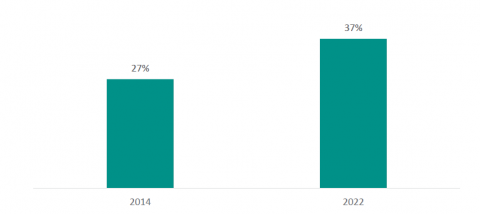
Aotearoa New Zealand is going through a big change in our principal population. Our new principals come from more diverse backgrounds, more of our experienced principals are retiring, and, crucially, there is a big increase in the proportion of our principals that are within their first five years the role. In 2022, new principals made up 37 percent of all principals – meaning that more than a third of our principals have less than five years’ experience in the job. Back in 2014, this figure was only 27 percent (see Figure 1). Generally, more than 150 principals are appointed to the role for the first time each year – this figure grew to over 200 in 2022.
Figure 1: Percentage of new principals in 2014 and 2022
The principal role is critical to quality education
Effective principals are vital for achieving positive, equitable outcomes for learners. The research evidence base is clear that the quality of principalship has the biggest influence on learner outcomes, after classroom teaching.2
In Aotearoa New Zealand, good principalship means taking a bold role in creating a school culture that is relentlessly focused on achieving equity and inclusion, and modelling the enactment of Te Tiriti o Waitangi throughout the school.3 Effective principals build strong, trusting relationships and partnerships with communities and whānau, to support student learning. They plan and develop shared goals and targets, and work towards progress and achievement for all learners.4
This report looks closely at the current landscape of pathways and supports for new principals, to identify what key actions are needed to better set new principals up to succeed in this critical role.
“We need talented and effective leaders to lead in ways that reflect the diverse identities, languages and cultures of learners in our schools, including growing the number of Māori and Pacific leaders in the system. We also need leaders who can influence people across the system to think and act differently, particularly those who work in schools with high proportions of ākonga who have been underserved within the current system.” Ministry of Education5
3. What is different about our new principals?
New principals are more likely to be Māori, to be younger, to be female, and to represent diverse cultures and ethnicities.
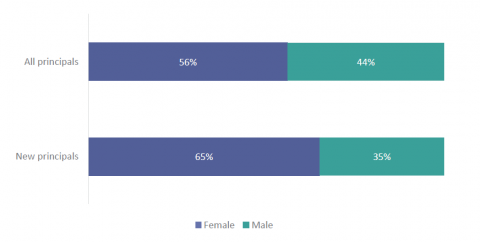
There are a total of 860 new principals (as of 2022). By looking at this cohort, and shifts over time, we can see that the workforce has been changing in some significant ways. For example, the proportion of female principals is increasing (see Figure 2).
See Table 1 for a side-by-side comparison of the new principal population to the total principal population. All the numbers in this section were supplied by the Ministry of Education.
Table 1: New principals’ demographics, compared to the wider principal population
|
Demographic breakdown (as of 2022) |
All principals (note that this group includes new principals) |
New principals
|
|
|
Total number |
2350 |
860 (37%) |
|
|
Gender |
Female |
56% |
65% |
|
Male |
44% |
35% |
|
|
Ethnicity
|
Māori |
15% |
19% |
|
Pacific |
3% |
4% |
|
|
Pākehā/NZ European |
80% |
76% |
|
|
Asian, Middle Eastern, Latin American, African, and other |
3% |
4% |
|
|
Age group |
25-34 |
1% |
3% |
|
35-44 |
15% |
27% |
|
|
45-54 |
41% |
51% |
|
|
55+ |
43% |
19% |
|
|
Educator experience |
1-5 years |
1% |
2% |
|
6-10 years |
4% |
8% |
|
|
Over 10 years |
95% |
89% |
|
Figure 2: Gender of new and all principals
New principals work in all sorts of schools, but they are more likely to be in smaller schools
As set out in Table 2, new principals are leading diverse schools across the country. They are more likely to be found in smaller and more rural schools than their more experienced peers (see Figure 3) – 39 percent of new principals are in small and very small schools, compared to 29 percent of all principals (including new ones). However, the number of new principals leading larger schools is growing. In 2014, only 14 percent of new principals were in large or very large schools, and in 2022 that proportion has grown to 26 percent.
Figure 3: Percentage of new and all principals working in small and very small schools
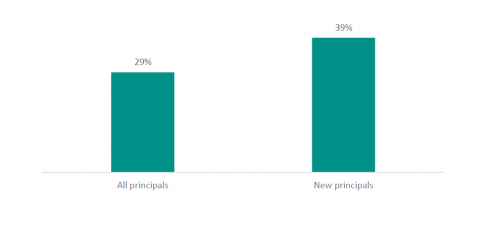
Table 2: School characteristics, for all principals compared to only new principals
|
School characteristic (as of 2022) |
All principals (note that this group includes new principals) |
New principals |
|
|
School type
|
Primary schools |
80% |
79% |
|
Secondary schools |
18% |
19% |
|
|
Specialist schools |
2% |
2% |
|
|
Intermediate schools |
5% |
4% |
|
|
School size |
Very small |
7% |
11% |
|
Small |
21% |
28% |
|
|
Medium |
36% |
33% |
|
|
Large |
22% |
19% |
|
|
Very large |
11% |
7% |
|
|
Rurality |
Main urban |
54% |
48% |
|
Secondary urban |
6% |
7% |
|
|
Minor urban |
12% |
12% |
|
|
Rural |
27% |
34% |
|
Older and more experienced principals are leaving the workforce
In 2021, 10 percent of all principals left the profession. Aotearoa New Zealand’s existing principal workforce is aging, with just under half of all principals aged 55 and over, and a growing group who are aged over 65. This means that the principal workforce is losing experienced leaders as older leaders retire out of the workforce, and gaining a growing cohort of new leaders with less principal experience.
Most of the principals who are leaving the principal workforce each year are older and more experienced educators. Of those leaving the profession in 2021, 34 percent were 55-64 years old, and a further 27 percent were over 65. Ninety-five percent of those who left the principal workforce in 2021 had over 10 years’ experience as an educator and 58 percent had over 10 years’ experience as a principal.
4. What is unique about being a principal in Aotearoa New Zealand?
Principalship in Aotearoa New Zealand is a complex role
Principals have a range of educational, managerial, administrative, and cultural leadership responsibilities in our schools. Some responsibilities differ between schools, particularly between school types and sizes, rural and urban settings, diversity of learners and communities, and more. For example, in smaller schools, principals will often have a teaching role alongside their leadership responsibilities, and principalship in rural schools often involves school maintenance duties. Generally, a principal role will involve all of the following 11 key areas of principal practice:
- Giving effect to Te Tiriti o Waitangi throughout the school (including active implementation of decolonisation and anti-racism strategies)
- Working in partnership with whānau Māori, hapū, and iwi to develop a localised curriculum that is inclusive of mātauranga Māori
- Establishing and maintaining a clear shared vision, strategic direction, and goals for the school
- Building and maintaining positive, effective relationships with staff and learners (this includes school leadership, teachers, other staff, and learners)
- Building and maintaining positive, effective relationships with the school community (this includes with parents and whānau, community groups and networks, relevant agencies, neighbouring schools and early learning services/tertiary providers, and others)
- Ensuring the delivery of high-quality teaching practice and curriculum across the school (this may involve direct or indirect leadership and oversight)
- Working with data to monitor and evaluate teaching and learning
- Working closely with diverse families and community groups to promote inclusion for all learners
- Managing the school’s resources, for example finances, employment and timetabling, and property
- Working effectively with the school’s board members
- Ensuring the school complies with all legislative and policy requirements
ERO drew on established evidence, guiding frameworks, role descriptions, and expert advice to compile this list – see Appendix 2 for more details.
Principalship in Aotearoa New Zealand is very different from other countries
Principalship in Aotearoa New Zealand varies from other comparable countries in many ways. As well as our unique bicultural context, there are differences for principals in terms of their preparation, their support, and their accountabilities. The main ways that our principalship differs from other countries are:
- We have fewer training or qualification requirements for being a principal.
- We have no minimum teaching or leadership experience requirements.
- We do not have a standardised or recommended pathway for aspiring principals to pursue.
- We have no standardised way of identifying and developing potential principals.
- We do not have prescribed professional standards specific to the principal role.
- Our schools have a lot of variation in their roll sizes, and their levels of isolation from urban centres.
- Our schools are governed by local school boards, rather than by a centralised Ministry.
- Our principals engage in a wider range of tasks and responsibilities than principals in almost all other countries.
Table 3: Ways that the principal role in Aotearoa New Zealand differs to other contexts
|
Principal role aspects |
Aotearoa New Zealand |
Examples from other OECD countries |
|
Training or qualification requirements |
To become a principal, a person must be a registered teacher with a current practising certificate. We have no standardised principalship-specific qualification or training requirements. |
In places like the United Kingdom, Canada, and some Australian states, principals must complete a standardised qualification in school leadership and management before they move into a principal role. In other countries such as Singapore and Japan, potential leaders are identified at the teacher level and provided with structured leadership‑focused training before progressing to principalship. |
|
Experience level requirements |
We have no minimum required amount of teaching or leadership experience. |
In the United States, Canada, and Australia, most states and provinces require a minimum amount of teaching experience for principals, usually between five and ten years. |
|
Selection and pathways for aspiring principals |
We have no standardised identification process or pathway for aspiring principals. |
To become a principal in Singapore, educational leaders who show promise are carefully selected and then trained to become principals by the Ministry of Education. Aspiring principals move along a ‘Leadership Track,’ from classroom teacher to subject or level head, to head of department, to vice principal, and then principal. In Japan, an aspiring principal can expect to go through three major levels in their career: teacher level, head teacher level (managing and recruiting other teachers), and then principal level. At every level there are multiple steps, based on performance and experience. The principal level has 15 steps. This process is intended to ensure that future principals are very experienced across all levels of school leadership / management. |
|
Development of aspiring principals |
We have no recommended or standardised way of developing aspiring principals. |
In Victoria, Australia, new principals are required to complete of the Victorian Aspiring Principal Assessment.6 Two assessment frameworks are used to determine the readiness of aspiring principals:
Scotland has a national development programme for aspiring principals (called headteachers)8 This programme is intended to provide aspiring headteachers with the knowledge they need to develop their leadership skills and prepare them for the strategic challenges of the role. |
|
Professional standards specific to the principal role |
We do not have centralised prescribed professional standards for principals that set out explicit expectations for principals – although there are some professional standards in collective employment agreements, such as the Secondary Principals' Collective Agreement. |
All principals (headteachers) in Scottish public schools must meet the requirements for the General Teaching Council for Scotland ‘Standard for Headship’.9 Australia has the ‘Australian Professional Standard for Principals and the Leadership Profiles’. This defines specific leadership requirements and professional practices for principals. |
|
Variation of school size and isolation |
We have a large variation of school sizes and isolation levels. While there are many large and urban schools, 27 percent of New Zealand’s schools are in rural settings, 17 percent of schools have ‘isolated’ status, and 29 percent have small/very small roll sizes (meaning fewer than 101 learners in primary schools, and fewer than 401 for secondary). |
Only Canada and Australia have similar variation in their school size and levels of isolation, with high numbers of very small schools in hard-to-reach locations, as well as larger schools in highly populated urban centres. |
|
School governance structures |
We have a decentralised education system. Local school boards, instead of national bodies, are responsible for the governance of their respective schools, including financial planning, and setting policies within the framework of national laws and priorities. Crucially, it is the school boards that are responsible for appointing principals, and it is boards that are the legal employers of principals. |
Countries like France, South Korea, and Finland have centralised school governance. In France, the Ministry of National Education sets national guidelines for teaching practices and school administration and mandates a standardised curriculum. In South Korea and Finland, the relevant ministries set the curriculum, manage educational policies, and monitor performance, but much of the pedagogical, hiring, and decision-making practices remain the responsibility of the school. |
|
Range of tasks and responsibilities |
Principals perform a wide range of tasks and responsibilities. A recent study of 35 countries found that Aotearoa New Zealand principals have the second-highest rate of responsibility for the majority of school tasks – behind the Czech Republic and just above Estonia. Our principals reported that they carried out just under 100 percent of the tasks listed in the study – which ranged from establishing policies, human resources and appointments, to determining school budgets.10 In addition, principals in our smaller schools often have a teaching role as well as principal duties, and report an even wider range of responsibilities, such as driving the school bus, cleaning, and hands-on property maintenance.11
|
Across the OECD countries that participated in that study, the average rate of responsibility for school tasks was just over half of ours (60 percent of the listed tasks). Principals in Japan, Spain, and Korea reported responsibility for less than a quarter of the tasks.12 In other countries, many tasks and responsibilities, like human resource tasks and policy development, happen at a centralised rather than school level. |
While there are some important differences, the essential role of ‘school principal’ remains largely the same across the globe. Principals have a key leadership role within their schools. They oversee and seek to improve teaching and learning, are accountable to similar regulatory bodies, and are generally seen to be the decision-makers and leaders of school operations, and a touchstone for the school community. These similarities mean that there are many ways that we can learn from what works in other countries – while retaining what is unique and important in Aotearoa New Zealand schools.
Professional standards for Australian principals
Role requirements and selection criteria for principals in Australia vary from state to state. There is only one national professional standard for Australian principals, outlined in the Australian Institute for Teaching and School Leadership’s ‘Australian Professional Standard for Principals and Leadership Profiles’13. The standard includes three leadership requirements and five professional practices.
Leadership requirements:
- Vision and values
- Knowledge and understanding
- Personal qualities, social and interpersonal skills
Professional practices:
- Leading teaching and learning
- Developing self and others
- Leading improvement, innovation and change
- Leading the management of the school
- Engaging and working with the community
This national standard, which clearly defines what good looks like, informs the more localised requirements for different Australian states.
Singapore’s highly-structured principal pathway
Singapore has a highly structured, clearly marked pathway to principalship. Training and qualification requirements are set by the Singapore Ministry of Education, who also oversee the appointment of all new principals.
In the Singapore system, aspiring educational leaders who show promise are selected by Ministry representatives to be provided with principal training. All Singaporean educators are a part of a career ladder to help identify those with potential to be promising leaders across the system. This process is laid out in the educator career ladder, which has three main streams: the Leadership Track (for principals), the Teaching Track, and the Specialist Track.
To become a principal in Singapore, a person must first be promoted along the Leadership Track: from classroom teacher, to subject or level head, to head of department, to vice principal, and then principal.
Aspiring principals also need the following experience and qualifications:
- A minimum four-year, recognised teaching qualification e.g., Bachelor’s Degree and Postgraduate Teaching Diploma/University Qualification, or a Bachelor of Special Education/Psychology
- A minimum of five years’ full-time teaching experience in an international school and/or special education school
- A minimum of three years’ senior leadership experience in education (in a role such as vice principal).
5. What are the current concerns about preparation and supports for our principal workforce?
The 2019 Tomorrow’s Schools review identified a range of issues
In 2019, a taskforce was commissioned by the government to review ‘Tomorrow’s Schools’, the reforms that changed the governance, management, and administration of Aotearoa New Zealand’s schools nearly 30 years ago. The taskforce recommended a range of changes to principals’ pathways and supports.
In their report14, the taskforce clarified the identification and appointment of quality leaders is vital, particularly in rural areas, and for schools in low socio-economic areas. However, despite the importance of leadership to school improvement, the taskforce identified that there are few structures in place to develop and sustain school leaders, or to identify and develop potential leaders early. They also found that the principal appointment process is not always robust or credible, as school boards do not always have the capability or capacity to identify quality school leaders.
The review also identified that, once in the role, it can be difficult for principals to access professional learning and development opportunities. This was often because too much of their time is taken up with matters not directly related to the core business of teaching and learning, such as property or finances.
The taskforce recommended a range of actions to address these issues, including establishing guidelines for aspiring principals, assisting boards with targeted recruitment, and helping principals to access ongoing mentoring, support, and professional learning.
More recent studies of Aotearoa New Zealand’s new principals have shown that new principals can feel overwhelmed, calling for more targeted supports.
In 2021’s ‘Rauhuia: Principals’ Voice’,15 principals reported that when they started their role, they were feeling unprepared, saying that their previous on-the-job experiences were insufficient to prepare them for the realities of principalship. They also reported that the professional learning and support that they do access, while often valued, is insufficient, and access is inequitable.16
ERO’s ‘Long Covid: Ongoing Impacts of Covid-19 on Schools and Learning’17 also identified a range of concerns:
- Increasing numbers of principals need support for their wellbeing. Covid-19 pressures have accumulated and, in 2023, four in 10 (41 percent) principals report needing more support, which is up from 26 percent in 2021. Nearly a third (30 percent) of principals say they have accessed support for their wellbeing in the past year.
- The most important reported driver of principals’ happiness is how manageable they are finding their workloads. Other key drivers are feeling connected to, and supported by, their leadership team, and having schools that have recovered from disruptions.
- Only 16 percent of principals say their workload is manageable (down from 26 percent in 2020).
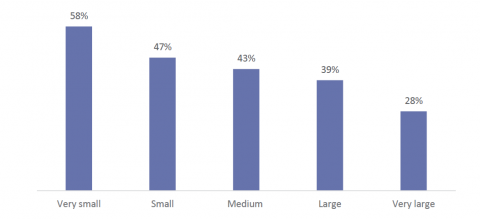
- Principals of small schools and female principals are struggling more. We continue to find that the smaller the school, the more principals struggle with their workload. Principals of very small schools (58 percent) were much more likely to find their workload unmanageable compared to principals of very large schools (28 percent) – see Figure 4. We also found that female principals (45 percent) are more likely to find their workload is unmanageable compared to male principals (38 percent).
- Filling vacancies is a concern. Nearly a quarter (23 percent) of principals say they are struggling to fill vacancies in 2023. Principals of schools in poorer communities are finding it particularly difficult (31 percent) compared with those in better-off communities (18 percent).
Figure 4: Principals who find their workload unmanageable by school size
There are a range of systems and supports in place for new principals, and many of these are undergoing changes
There are a wide range of systems and supports that are relevant for new principals. Many of these are currently undergoing or embedding new developments, largely in response to the findings of the Tomorrow’s Schools review[i] in 2019. Broadly, systems and supports include provision from:
- The Ministry of Education
- The Teaching Council
- Elected school boards
- Unions and professional associations
- Professional networks or clusters
- The Education Review Office
- Universities
- Independent providers
Table 4 sets out, broadly, what systems and support are in place, and what new developments are underway.
Table 4: Systems and supports for new principals
|
Elements of support |
Current and well-embedded supports |
Ongoing or upcoming shifts in support |
|
Employment |
School boards are the governors of their school and legal employers of the principal. They have responsibilities for performance management of principals. They can approve funding for professional learning from the school budget, and may formally or informally induct new principals, although this is not required. The Ministry of Education pays principals’ salaries.
|
The Ministry of Education is working with the Teaching Council and the profession to develop Principal Eligibility Criteria. This was introduced in the Education and Training Act 2020. These criteria will be released later in 2023. |
|
Performance and accountability |
The Teaching Council sets the professional standards for teaching in Aotearoa New Zealand. It provides frameworks, guidance, and resources around leadership development for all registered teachers, including principals, through its virtual Rauhuia | Leadership Space, launched in 2021. Principals report regularly to their school board on a range of school matters, including their own professional development and growth. Principals also sit on their school board as a member. Principals work with ERO who review the performance of schools. |
The Teaching Council is developing a ‘Learning and Measurement Framework’, which aims to clarify what successful educational leadership looks like at a system level, including clear measures. Since 2019, the Teaching Council has been rolling out a collaborative ‘professional growth cycle’ model to replace the compliance-focused ‘performance management’ of principals.
|
|
Development and support |
The Ministry of Education administers funding for professional development opportunities for principals, and provides a range of resources, tools, and guidance aimed at helping principals manage their schools effectively. The Ministry funds the established First-Time Principals’ Programme (which was first offered in 2002), offered to all new principals within their first two years in the role. The Ministry also funds Te Akatea to deliver the Māori Achievement Collaborative, a by and for principals programme for Māori educational success, and Tautai o Le Moana, a programme for leaders of Pacific learners to grow Pacific leadership capabilities. Additionally, the Ministry funds Networks of Expertise, which include leadership focused networks. Universities offer postgraduate qualifications in school leadership or school administration. This often includes a mentoring component. Independent providers of professional learning and development courses and programmes, coaching, or mentoring for school leaders. Independent providers may be contracted by the Ministry, Kāhui Ako, individual schools, or individual principals. The quality and content of independent professional development provision is not nationally regulated. Currently there are more than 400 independent providers that list ‘leadership’ as one of their professional support areas.
|
From 2022, the Ministry of Education started funding the new Huia Kaimanawa programme (run by Te Akatea Māori Principals’ Association) for new Māori principals. New Māori principals can choose to participate in either Huia Kaimanawa or the First-Time Principals’ Programme. The Ministry’s way of funding development and support has recently shifted to being regionally allocated, rather than decided by a central Ministry team. The Ministry are currently rolling out their Leadership Advisors programme, which seconds experienced principals to advise and support others. There is currently funding for 21 Leadership Advisors, around one for every 120 principals. From 2023 and up to 1 December 2024, primary principals employed under the PPCBU collective agreement and secondary principals employed under the SPCA collective agreement will be able to access dedicated funding for professional coaching and support for their leadership role.
|
|
Support and advocacy |
Networks and collectives such as Communities of Learning | Kāhui Ako (which are supported by the Ministry), regional or special-character cluster networks, and other professional collaborative groups. Unions and professional organisations provide various forms of professional support, networking opportunities, guidance and resources, advocacy and bargaining services, and other services for principals. For example, the Rural and Area School Leaders’ Association recently introduced a ‘remote support’ programme aimed at supporting principals in hard-to-reach schools.
|
From 2021, the Ministry of Education have been establishing Te Mahau, through a new structure. This is intended to provide local, responsive and integrated services to schools and kura. |
Conclusion
Our principal workforce is changing, as is the context they work within. We have a higher proportion of newer, younger, and more diverse principals than ever before. At the same time, many of our more experienced leaders are leaving the profession, and there are shifts in the support structures for new principals. Now is the time to check in on how well-supported our new principals are, to grow into their new role.
Principals in Aotearoa New Zealand have different pathways and supports to other countries, as well as differences in their role. This means that our supports and future actions need to be well-suited to the specific context of our unique school system, while still drawing on evidence about what works well elsewhere.
There are changes happening in our principal population. We have a higher proportion of newer, younger, and more diverse principals than ever before. More than a third of our principals have less than five years’ experience in the role. At the same time, many of our more experienced leaders are leaving the profession. Now is the time to check in on how well-supported our new principals are to grow into their new roles.
To better understand new principals’ context, ERO looked at the ways that pathways and supports for principals in Aotearoa New Zealand differ from other countries, as well as some of the shifts in support that are happening at the moment.
This section sets out:
- What do we mean by ‘new principals’
- Why has ERO focused on new principals?
- What is different about our new principals?
- What is unique about being a principal in Aotearoa New Zealand?
- What are the current concerns about preparation and supports for our principal workforce?
1. What do we mean by ‘new’ principals?
In this report, when we talk about new principals, we mean those who have been working in a principal role in Aotearoa New Zealand for less than five years. This work focuses on new principals in English-medium state and state-integrated primary and secondary schools.
2. Why has ERO focused on new principals?
Thirty-seven percent of our principals have less than five years’ experience in the role, and this group of new principals is growing.
Aotearoa New Zealand is going through a big change in our principal population. Our new principals come from more diverse backgrounds, more of our experienced principals are retiring, and, crucially, there is a big increase in the proportion of our principals that are within their first five years the role. In 2022, new principals made up 37 percent of all principals – meaning that more than a third of our principals have less than five years’ experience in the job. Back in 2014, this figure was only 27 percent (see Figure 1). Generally, more than 150 principals are appointed to the role for the first time each year – this figure grew to over 200 in 2022.
Figure 1: Percentage of new principals in 2014 and 2022
The principal role is critical to quality education
Effective principals are vital for achieving positive, equitable outcomes for learners. The research evidence base is clear that the quality of principalship has the biggest influence on learner outcomes, after classroom teaching.2
In Aotearoa New Zealand, good principalship means taking a bold role in creating a school culture that is relentlessly focused on achieving equity and inclusion, and modelling the enactment of Te Tiriti o Waitangi throughout the school.3 Effective principals build strong, trusting relationships and partnerships with communities and whānau, to support student learning. They plan and develop shared goals and targets, and work towards progress and achievement for all learners.4
This report looks closely at the current landscape of pathways and supports for new principals, to identify what key actions are needed to better set new principals up to succeed in this critical role.
“We need talented and effective leaders to lead in ways that reflect the diverse identities, languages and cultures of learners in our schools, including growing the number of Māori and Pacific leaders in the system. We also need leaders who can influence people across the system to think and act differently, particularly those who work in schools with high proportions of ākonga who have been underserved within the current system.” Ministry of Education5
3. What is different about our new principals?
New principals are more likely to be Māori, to be younger, to be female, and to represent diverse cultures and ethnicities.
There are a total of 860 new principals (as of 2022). By looking at this cohort, and shifts over time, we can see that the workforce has been changing in some significant ways. For example, the proportion of female principals is increasing (see Figure 2).
See Table 1 for a side-by-side comparison of the new principal population to the total principal population. All the numbers in this section were supplied by the Ministry of Education.
Table 1: New principals’ demographics, compared to the wider principal population
|
Demographic breakdown (as of 2022) |
All principals (note that this group includes new principals) |
New principals
|
|
|
Total number |
2350 |
860 (37%) |
|
|
Gender |
Female |
56% |
65% |
|
Male |
44% |
35% |
|
|
Ethnicity
|
Māori |
15% |
19% |
|
Pacific |
3% |
4% |
|
|
Pākehā/NZ European |
80% |
76% |
|
|
Asian, Middle Eastern, Latin American, African, and other |
3% |
4% |
|
|
Age group |
25-34 |
1% |
3% |
|
35-44 |
15% |
27% |
|
|
45-54 |
41% |
51% |
|
|
55+ |
43% |
19% |
|
|
Educator experience |
1-5 years |
1% |
2% |
|
6-10 years |
4% |
8% |
|
|
Over 10 years |
95% |
89% |
|
Figure 2: Gender of new and all principals
New principals work in all sorts of schools, but they are more likely to be in smaller schools
As set out in Table 2, new principals are leading diverse schools across the country. They are more likely to be found in smaller and more rural schools than their more experienced peers (see Figure 3) – 39 percent of new principals are in small and very small schools, compared to 29 percent of all principals (including new ones). However, the number of new principals leading larger schools is growing. In 2014, only 14 percent of new principals were in large or very large schools, and in 2022 that proportion has grown to 26 percent.
Figure 3: Percentage of new and all principals working in small and very small schools
Table 2: School characteristics, for all principals compared to only new principals
|
School characteristic (as of 2022) |
All principals (note that this group includes new principals) |
New principals |
|
|
School type
|
Primary schools |
80% |
79% |
|
Secondary schools |
18% |
19% |
|
|
Specialist schools |
2% |
2% |
|
|
Intermediate schools |
5% |
4% |
|
|
School size |
Very small |
7% |
11% |
|
Small |
21% |
28% |
|
|
Medium |
36% |
33% |
|
|
Large |
22% |
19% |
|
|
Very large |
11% |
7% |
|
|
Rurality |
Main urban |
54% |
48% |
|
Secondary urban |
6% |
7% |
|
|
Minor urban |
12% |
12% |
|
|
Rural |
27% |
34% |
|
Older and more experienced principals are leaving the workforce
In 2021, 10 percent of all principals left the profession. Aotearoa New Zealand’s existing principal workforce is aging, with just under half of all principals aged 55 and over, and a growing group who are aged over 65. This means that the principal workforce is losing experienced leaders as older leaders retire out of the workforce, and gaining a growing cohort of new leaders with less principal experience.
Most of the principals who are leaving the principal workforce each year are older and more experienced educators. Of those leaving the profession in 2021, 34 percent were 55-64 years old, and a further 27 percent were over 65. Ninety-five percent of those who left the principal workforce in 2021 had over 10 years’ experience as an educator and 58 percent had over 10 years’ experience as a principal.
4. What is unique about being a principal in Aotearoa New Zealand?
Principalship in Aotearoa New Zealand is a complex role
Principals have a range of educational, managerial, administrative, and cultural leadership responsibilities in our schools. Some responsibilities differ between schools, particularly between school types and sizes, rural and urban settings, diversity of learners and communities, and more. For example, in smaller schools, principals will often have a teaching role alongside their leadership responsibilities, and principalship in rural schools often involves school maintenance duties. Generally, a principal role will involve all of the following 11 key areas of principal practice:
- Giving effect to Te Tiriti o Waitangi throughout the school (including active implementation of decolonisation and anti-racism strategies)
- Working in partnership with whānau Māori, hapū, and iwi to develop a localised curriculum that is inclusive of mātauranga Māori
- Establishing and maintaining a clear shared vision, strategic direction, and goals for the school
- Building and maintaining positive, effective relationships with staff and learners (this includes school leadership, teachers, other staff, and learners)
- Building and maintaining positive, effective relationships with the school community (this includes with parents and whānau, community groups and networks, relevant agencies, neighbouring schools and early learning services/tertiary providers, and others)
- Ensuring the delivery of high-quality teaching practice and curriculum across the school (this may involve direct or indirect leadership and oversight)
- Working with data to monitor and evaluate teaching and learning
- Working closely with diverse families and community groups to promote inclusion for all learners
- Managing the school’s resources, for example finances, employment and timetabling, and property
- Working effectively with the school’s board members
- Ensuring the school complies with all legislative and policy requirements
ERO drew on established evidence, guiding frameworks, role descriptions, and expert advice to compile this list – see Appendix 2 for more details.
Principalship in Aotearoa New Zealand is very different from other countries
Principalship in Aotearoa New Zealand varies from other comparable countries in many ways. As well as our unique bicultural context, there are differences for principals in terms of their preparation, their support, and their accountabilities. The main ways that our principalship differs from other countries are:
- We have fewer training or qualification requirements for being a principal.
- We have no minimum teaching or leadership experience requirements.
- We do not have a standardised or recommended pathway for aspiring principals to pursue.
- We have no standardised way of identifying and developing potential principals.
- We do not have prescribed professional standards specific to the principal role.
- Our schools have a lot of variation in their roll sizes, and their levels of isolation from urban centres.
- Our schools are governed by local school boards, rather than by a centralised Ministry.
- Our principals engage in a wider range of tasks and responsibilities than principals in almost all other countries.
Table 3: Ways that the principal role in Aotearoa New Zealand differs to other contexts
|
Principal role aspects |
Aotearoa New Zealand |
Examples from other OECD countries |
|
Training or qualification requirements |
To become a principal, a person must be a registered teacher with a current practising certificate. We have no standardised principalship-specific qualification or training requirements. |
In places like the United Kingdom, Canada, and some Australian states, principals must complete a standardised qualification in school leadership and management before they move into a principal role. In other countries such as Singapore and Japan, potential leaders are identified at the teacher level and provided with structured leadership‑focused training before progressing to principalship. |
|
Experience level requirements |
We have no minimum required amount of teaching or leadership experience. |
In the United States, Canada, and Australia, most states and provinces require a minimum amount of teaching experience for principals, usually between five and ten years. |
|
Selection and pathways for aspiring principals |
We have no standardised identification process or pathway for aspiring principals. |
To become a principal in Singapore, educational leaders who show promise are carefully selected and then trained to become principals by the Ministry of Education. Aspiring principals move along a ‘Leadership Track,’ from classroom teacher to subject or level head, to head of department, to vice principal, and then principal. In Japan, an aspiring principal can expect to go through three major levels in their career: teacher level, head teacher level (managing and recruiting other teachers), and then principal level. At every level there are multiple steps, based on performance and experience. The principal level has 15 steps. This process is intended to ensure that future principals are very experienced across all levels of school leadership / management. |
|
Development of aspiring principals |
We have no recommended or standardised way of developing aspiring principals. |
In Victoria, Australia, new principals are required to complete of the Victorian Aspiring Principal Assessment.6 Two assessment frameworks are used to determine the readiness of aspiring principals:
Scotland has a national development programme for aspiring principals (called headteachers)8 This programme is intended to provide aspiring headteachers with the knowledge they need to develop their leadership skills and prepare them for the strategic challenges of the role. |
|
Professional standards specific to the principal role |
We do not have centralised prescribed professional standards for principals that set out explicit expectations for principals – although there are some professional standards in collective employment agreements, such as the Secondary Principals' Collective Agreement. |
All principals (headteachers) in Scottish public schools must meet the requirements for the General Teaching Council for Scotland ‘Standard for Headship’.9 Australia has the ‘Australian Professional Standard for Principals and the Leadership Profiles’. This defines specific leadership requirements and professional practices for principals. |
|
Variation of school size and isolation |
We have a large variation of school sizes and isolation levels. While there are many large and urban schools, 27 percent of New Zealand’s schools are in rural settings, 17 percent of schools have ‘isolated’ status, and 29 percent have small/very small roll sizes (meaning fewer than 101 learners in primary schools, and fewer than 401 for secondary). |
Only Canada and Australia have similar variation in their school size and levels of isolation, with high numbers of very small schools in hard-to-reach locations, as well as larger schools in highly populated urban centres. |
|
School governance structures |
We have a decentralised education system. Local school boards, instead of national bodies, are responsible for the governance of their respective schools, including financial planning, and setting policies within the framework of national laws and priorities. Crucially, it is the school boards that are responsible for appointing principals, and it is boards that are the legal employers of principals. |
Countries like France, South Korea, and Finland have centralised school governance. In France, the Ministry of National Education sets national guidelines for teaching practices and school administration and mandates a standardised curriculum. In South Korea and Finland, the relevant ministries set the curriculum, manage educational policies, and monitor performance, but much of the pedagogical, hiring, and decision-making practices remain the responsibility of the school. |
|
Range of tasks and responsibilities |
Principals perform a wide range of tasks and responsibilities. A recent study of 35 countries found that Aotearoa New Zealand principals have the second-highest rate of responsibility for the majority of school tasks – behind the Czech Republic and just above Estonia. Our principals reported that they carried out just under 100 percent of the tasks listed in the study – which ranged from establishing policies, human resources and appointments, to determining school budgets.10 In addition, principals in our smaller schools often have a teaching role as well as principal duties, and report an even wider range of responsibilities, such as driving the school bus, cleaning, and hands-on property maintenance.11
|
Across the OECD countries that participated in that study, the average rate of responsibility for school tasks was just over half of ours (60 percent of the listed tasks). Principals in Japan, Spain, and Korea reported responsibility for less than a quarter of the tasks.12 In other countries, many tasks and responsibilities, like human resource tasks and policy development, happen at a centralised rather than school level. |
While there are some important differences, the essential role of ‘school principal’ remains largely the same across the globe. Principals have a key leadership role within their schools. They oversee and seek to improve teaching and learning, are accountable to similar regulatory bodies, and are generally seen to be the decision-makers and leaders of school operations, and a touchstone for the school community. These similarities mean that there are many ways that we can learn from what works in other countries – while retaining what is unique and important in Aotearoa New Zealand schools.
Professional standards for Australian principals
Role requirements and selection criteria for principals in Australia vary from state to state. There is only one national professional standard for Australian principals, outlined in the Australian Institute for Teaching and School Leadership’s ‘Australian Professional Standard for Principals and Leadership Profiles’13. The standard includes three leadership requirements and five professional practices.
Leadership requirements:
- Vision and values
- Knowledge and understanding
- Personal qualities, social and interpersonal skills
Professional practices:
- Leading teaching and learning
- Developing self and others
- Leading improvement, innovation and change
- Leading the management of the school
- Engaging and working with the community
This national standard, which clearly defines what good looks like, informs the more localised requirements for different Australian states.
Singapore’s highly-structured principal pathway
Singapore has a highly structured, clearly marked pathway to principalship. Training and qualification requirements are set by the Singapore Ministry of Education, who also oversee the appointment of all new principals.
In the Singapore system, aspiring educational leaders who show promise are selected by Ministry representatives to be provided with principal training. All Singaporean educators are a part of a career ladder to help identify those with potential to be promising leaders across the system. This process is laid out in the educator career ladder, which has three main streams: the Leadership Track (for principals), the Teaching Track, and the Specialist Track.
To become a principal in Singapore, a person must first be promoted along the Leadership Track: from classroom teacher, to subject or level head, to head of department, to vice principal, and then principal.
Aspiring principals also need the following experience and qualifications:
- A minimum four-year, recognised teaching qualification e.g., Bachelor’s Degree and Postgraduate Teaching Diploma/University Qualification, or a Bachelor of Special Education/Psychology
- A minimum of five years’ full-time teaching experience in an international school and/or special education school
- A minimum of three years’ senior leadership experience in education (in a role such as vice principal).
5. What are the current concerns about preparation and supports for our principal workforce?
The 2019 Tomorrow’s Schools review identified a range of issues
In 2019, a taskforce was commissioned by the government to review ‘Tomorrow’s Schools’, the reforms that changed the governance, management, and administration of Aotearoa New Zealand’s schools nearly 30 years ago. The taskforce recommended a range of changes to principals’ pathways and supports.
In their report14, the taskforce clarified the identification and appointment of quality leaders is vital, particularly in rural areas, and for schools in low socio-economic areas. However, despite the importance of leadership to school improvement, the taskforce identified that there are few structures in place to develop and sustain school leaders, or to identify and develop potential leaders early. They also found that the principal appointment process is not always robust or credible, as school boards do not always have the capability or capacity to identify quality school leaders.
The review also identified that, once in the role, it can be difficult for principals to access professional learning and development opportunities. This was often because too much of their time is taken up with matters not directly related to the core business of teaching and learning, such as property or finances.
The taskforce recommended a range of actions to address these issues, including establishing guidelines for aspiring principals, assisting boards with targeted recruitment, and helping principals to access ongoing mentoring, support, and professional learning.
More recent studies of Aotearoa New Zealand’s new principals have shown that new principals can feel overwhelmed, calling for more targeted supports.
In 2021’s ‘Rauhuia: Principals’ Voice’,15 principals reported that when they started their role, they were feeling unprepared, saying that their previous on-the-job experiences were insufficient to prepare them for the realities of principalship. They also reported that the professional learning and support that they do access, while often valued, is insufficient, and access is inequitable.16
ERO’s ‘Long Covid: Ongoing Impacts of Covid-19 on Schools and Learning’17 also identified a range of concerns:
- Increasing numbers of principals need support for their wellbeing. Covid-19 pressures have accumulated and, in 2023, four in 10 (41 percent) principals report needing more support, which is up from 26 percent in 2021. Nearly a third (30 percent) of principals say they have accessed support for their wellbeing in the past year.
- The most important reported driver of principals’ happiness is how manageable they are finding their workloads. Other key drivers are feeling connected to, and supported by, their leadership team, and having schools that have recovered from disruptions.
- Only 16 percent of principals say their workload is manageable (down from 26 percent in 2020).
- Principals of small schools and female principals are struggling more. We continue to find that the smaller the school, the more principals struggle with their workload. Principals of very small schools (58 percent) were much more likely to find their workload unmanageable compared to principals of very large schools (28 percent) – see Figure 4. We also found that female principals (45 percent) are more likely to find their workload is unmanageable compared to male principals (38 percent).
- Filling vacancies is a concern. Nearly a quarter (23 percent) of principals say they are struggling to fill vacancies in 2023. Principals of schools in poorer communities are finding it particularly difficult (31 percent) compared with those in better-off communities (18 percent).
Figure 4: Principals who find their workload unmanageable by school size
There are a range of systems and supports in place for new principals, and many of these are undergoing changes
There are a wide range of systems and supports that are relevant for new principals. Many of these are currently undergoing or embedding new developments, largely in response to the findings of the Tomorrow’s Schools review[i] in 2019. Broadly, systems and supports include provision from:
- The Ministry of Education
- The Teaching Council
- Elected school boards
- Unions and professional associations
- Professional networks or clusters
- The Education Review Office
- Universities
- Independent providers
Table 4 sets out, broadly, what systems and support are in place, and what new developments are underway.
Table 4: Systems and supports for new principals
|
Elements of support |
Current and well-embedded supports |
Ongoing or upcoming shifts in support |
|
Employment |
School boards are the governors of their school and legal employers of the principal. They have responsibilities for performance management of principals. They can approve funding for professional learning from the school budget, and may formally or informally induct new principals, although this is not required. The Ministry of Education pays principals’ salaries.
|
The Ministry of Education is working with the Teaching Council and the profession to develop Principal Eligibility Criteria. This was introduced in the Education and Training Act 2020. These criteria will be released later in 2023. |
|
Performance and accountability |
The Teaching Council sets the professional standards for teaching in Aotearoa New Zealand. It provides frameworks, guidance, and resources around leadership development for all registered teachers, including principals, through its virtual Rauhuia | Leadership Space, launched in 2021. Principals report regularly to their school board on a range of school matters, including their own professional development and growth. Principals also sit on their school board as a member. Principals work with ERO who review the performance of schools. |
The Teaching Council is developing a ‘Learning and Measurement Framework’, which aims to clarify what successful educational leadership looks like at a system level, including clear measures. Since 2019, the Teaching Council has been rolling out a collaborative ‘professional growth cycle’ model to replace the compliance-focused ‘performance management’ of principals.
|
|
Development and support |
The Ministry of Education administers funding for professional development opportunities for principals, and provides a range of resources, tools, and guidance aimed at helping principals manage their schools effectively. The Ministry funds the established First-Time Principals’ Programme (which was first offered in 2002), offered to all new principals within their first two years in the role. The Ministry also funds Te Akatea to deliver the Māori Achievement Collaborative, a by and for principals programme for Māori educational success, and Tautai o Le Moana, a programme for leaders of Pacific learners to grow Pacific leadership capabilities. Additionally, the Ministry funds Networks of Expertise, which include leadership focused networks. Universities offer postgraduate qualifications in school leadership or school administration. This often includes a mentoring component. Independent providers of professional learning and development courses and programmes, coaching, or mentoring for school leaders. Independent providers may be contracted by the Ministry, Kāhui Ako, individual schools, or individual principals. The quality and content of independent professional development provision is not nationally regulated. Currently there are more than 400 independent providers that list ‘leadership’ as one of their professional support areas.
|
From 2022, the Ministry of Education started funding the new Huia Kaimanawa programme (run by Te Akatea Māori Principals’ Association) for new Māori principals. New Māori principals can choose to participate in either Huia Kaimanawa or the First-Time Principals’ Programme. The Ministry’s way of funding development and support has recently shifted to being regionally allocated, rather than decided by a central Ministry team. The Ministry are currently rolling out their Leadership Advisors programme, which seconds experienced principals to advise and support others. There is currently funding for 21 Leadership Advisors, around one for every 120 principals. From 2023 and up to 1 December 2024, primary principals employed under the PPCBU collective agreement and secondary principals employed under the SPCA collective agreement will be able to access dedicated funding for professional coaching and support for their leadership role.
|
|
Support and advocacy |
Networks and collectives such as Communities of Learning | Kāhui Ako (which are supported by the Ministry), regional or special-character cluster networks, and other professional collaborative groups. Unions and professional organisations provide various forms of professional support, networking opportunities, guidance and resources, advocacy and bargaining services, and other services for principals. For example, the Rural and Area School Leaders’ Association recently introduced a ‘remote support’ programme aimed at supporting principals in hard-to-reach schools.
|
From 2021, the Ministry of Education have been establishing Te Mahau, through a new structure. This is intended to provide local, responsive and integrated services to schools and kura. |
Conclusion
Our principal workforce is changing, as is the context they work within. We have a higher proportion of newer, younger, and more diverse principals than ever before. At the same time, many of our more experienced leaders are leaving the profession, and there are shifts in the support structures for new principals. Now is the time to check in on how well-supported our new principals are, to grow into their new role.
Principals in Aotearoa New Zealand have different pathways and supports to other countries, as well as differences in their role. This means that our supports and future actions need to be well-suited to the specific context of our unique school system, while still drawing on evidence about what works well elsewhere.
Part 2. Preparation: Pathways and supports for new principals before starting their role
We asked new principals how prepared they were for the role when they first started, and about their experiences and supports. This section of the report is focused on the time before principalship, up until new principals’ first term in the role.
ERO found that new principals are not always well prepared for their new role. Current ways of identifying and supporting future leaders onto a pathway to principalship are inconsistent, so not all new principals are benefitting from the prior experiences and supports that could set them up well for principalship. Many do not receive useful inductions. Accessing development and support activities improves their preparedness, but principals remain unprepared in some key areas.
ERO wanted to understand the impact that pathways, development, and support before becoming a principal have on new principals’ preparedness. To do this, we asked new principals about how prepared they were for the role. We analysed our data[1] to identify the most important factors for principals’ rating of being prepared.
We found three key drivers for preparedness. These are the most important factors associated with feeling prepared overall for the principal role. The drivers that most positively influence preparedness are:
- Having held a leadership position
- Having participated in coaching/mentoring
- Having participated in a postgraduate programme related to school leadership
In this section, we share what we found out about how and why these pathways and supports are so important.
This section of the report outlines:
- How prepared are principals for their first role?
- Preparedness when new principals start their first role
- Areas of the role where new principals are most prepared
- Areas of the role where new principals are least prepared
- What pathway into principalship makes the most difference?
- The pathways that new principals take into the role
- The difference that pathways make to preparedness
- What difference does development and support make to new principals’ preparedness?
- Development and support that new principals access
- The difference that development and support make to principals’ preparedness
- Inductions for new principals
1) How prepared are new principals for their first role?
a) Preparedness when new principals first start their role
Only a quarter of new principals start their new role feeling prepared
New principals are not always well prepared for their new role. Only a quarter of new principals (27 percent) indicated that they had felt prepared or very prepared for the role overall when they started.
Fifty-six percent are somewhere in the middle, indicating that they were somewhat prepared/somewhat unprepared. Worryingly, just under one-fifth of the population of new principals (18 percent) felt unprepared or very unprepared when they first started their role.
Figure 5: How prepared new principals felt when they first started their role
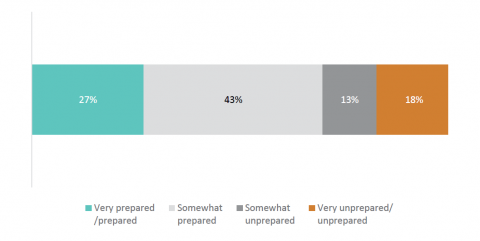
In our interviews with new principals and sector experts, we found out that there are two main reasons new principals arrive feeling unprepared, surprised, or anxious. These are:
- The complexity of the role: their new responsibilities as a principal are not aligned to their previous experiences and expertise.
- The reality of the school: their particular school setting has particular challenges.
These two reasons are unpacked below.
Some principals report that unpreparedness relates to the complexity of their role
In our interviews with new principals, we heard that they had underestimated the complexity of their new role. The principal role has tasks, responsibilities, and expectations well beyond the scope of teaching and learning. Many principals shared that they were caught off guard by the broad range of responsibilities and accountabilities with which they have no prior experience, for example, managing finances, staff employment issues, Ministry reporting, and property issues.
“You move from being a teacher or a deputy principal, which is still pretty kid- and teacher-facing, to you to being the CEO of in most cases a multi-million dollar organisation. - Expert
The local evidence base has highlighted this ‘reality shock’19 as a common challenge among new principals. Recent work by the New Zealand Principals’ Federation (NZPF) and the Ministry of Education found that new principals feel unprepared ‘because the tasks required of them in the first months in the job did not match the work they had proven themselves at on their journey into principalship.’20
“You become a teacher, you become a good teacher. You become a head of faculty, not because you're a good head of faculty, but because you were a good teacher. Well, the skills aren't actually linked. And then you become a deputy. Well, there's a bit of a link, but not much depending on what your portfolio is. And then you become a principal and that isn't really linked to what you knew [before] because you only knew about 60 percent of the stuff as a DP.” –New principal
“To add in the mix, I also have property that I oversee, and I have all of the finances that I oversee. And those weren't part of my role when I was a DP. So, it's completely different.” – New principal
“They [new principals] need help to be honest. They need help with pretty well everything … principals coming into principalship are quite regularly being exposed to things that they have not had to think about.” – Expert
Some principals report that unpreparedness relates to unexpected realities at their school
As well as role-based complexities, we also heard about challenges do to with their particular school setting. Some new principals shared that, when they arrived, their school was in a difficult state, with statutory management in place, major staffing or financial issues, or long‑outdated systems and policies.
This job [at this school] was designed for an experienced principal … I had to do all of the procedures and the manuals for the staff and codes of conduct and all of that sort of thing. I'm fortunate that, when I come back to my mentorship and all the support that I had, my previous principal, she was very clear around systems, procedures, and processes.” - New principal
b) Areas of the role where principals are most prepared
Principals are most prepared for building and maintaining relationships, and for working with data to monitor teaching and learning
We asked new principals to rate how prepared they were for 11 key areas of principal practice, when they first started as a principal.
Figure 6: Percentage of new principals who felt prepared or very prepared in each area when they first started their role
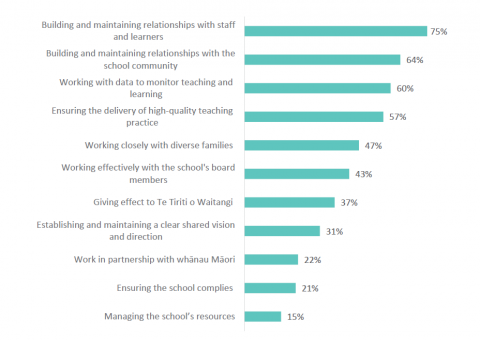
The top three areas that new principals are particularly prepared for when they start the role are:
- Building and maintaining positive, effective relationships with staff and learners
- Building and maintaining positive, effective relationships with the school community
- Working with data to monitor teaching and learning
Being a teacher involves relationship‑building and working with achievement data, so these aspects of the role are familiar to new principals. In our interviews, they affirmed that these were the parts of the role that they were very comfortable with from the outset – and often, the reason that they had seen themselves as ready for principalship.
“[I was] a teacher that had very high achievement … I was head of curriculum. For me the teaching side comes very naturally.” – New principal
“[In my] DP role I had lots of opportunities to be involved in lots of different aspects of leadership - especially working with staff." – New principal
c) Areas of the role where principals are least prepared
Principals are least prepared for working in partnership with Māori, and for the administrative and legal aspects of the role
Fewer than half of new principals feel prepared in seven of the 11 key areas when they start (as set out in Figure 6). The bottom three areas of principal practice, where preparedness is particularly poor, are:
- Managing the school’s resources, for example finances, employment, and timetabling – 15 percent of principals felt prepared/very prepared (33 percent unprepared/very unprepared)
- Ensuring the school complies with all legislative and policy requirements - 21 percent of principals felt prepared/very prepared (27 percent unprepared/very unprepared)
- Working in partnership with whānau Māori, hapū, and iwi to develop a localised curriculum - 22 percent of principals felt prepared/very prepared (20 percent unprepared/very unprepared)
Tumuaki Māori principals are more prepared for Māori partnership practices than their peers – this is set out in Part 5 of this report.
In our interviews, principals shared how they had felt alarmed by, and unprepared for, the scale of their new administrative and legal responsibilities: ‘Until you’ve got the job, you don’t know what you don’t know’ (New principal). Principals and experts described struggles to build capability in these areas prior to principalship, as they are so specific to the principal role, and to individual schools.
“When I walked in … I was getting presented all of these things and going, ‘Oh my gosh’. And then, working through trying to understand what they are…”– New principal
“What is an analysis of variance? How do you write them? And what are they? Because I got into the job and it's like, ‘Oh, this is due’. And I was like, ‘Oh, okay. What's that?’ ‘Oh, you need to do this.’ ‘Okay… What's that? And how do you go about doing that?’ … The first meeting I had with [Ministry contact] was talking about staffing and funding, and she used all these little acronyms and things. It was like, ‘Oh, okay, I'll have to go away and find out what all of those mean.’” – New principal
It is understandable that new principals would feel less prepared for the administrative and legal aspects of the role, if they have not been exposed to these tasks and processes before.
The low level of preparedness around partnering with Māori, however, is a more significant concern. In Aotearoa New Zealand, working in partnership with whānau Māori, hapu, and iwi is fundamental to enacting Te Tiriti o Waitangi, our National Education and Learning Priorities, to our codes, standards, and frameworks for leading and teaching, essential for the localised bicultural learning of all learners, and critical to the education success of tamariki and rangatahi Māori. In interviews, we heard that this lack of preparedness was rooted in being unclear about where to start and what ‘good’ looks like.
"We know that relationships and honouring the Treaty is a number one priority in every school … You know, we get it. We know that … There's no teacher or principal that I know that aren't all in for it. We know the disadvantage that our Māori students have had generationally, and we want so desperately to change that. But we don't need more, ‘Why?’ We need more, ‘How?’” – New principal
This finding reflects what we know from the established evidence base, that schools’ ‘effective means of developing relationships and partnerships with their Māori communities’21 is an area of historical and ongoing concern.22 We also know that principals have a significant impact on the quality of teaching and learning in their school,23 so their preparedness to lead their school well in this area is of critical importance. Experts that we interviewed affirmed that this area is an ongoing sector weakness, which urgently needs addressing.
“There is also a need [for new principals] to be culturally competent, and for many this is a huge learning curve in itself.” – Expert
2) What pathway into principalship makes the most difference?
a) The pathways that new principals take into the role
There are no specified or recommended pathways into principalship. This report focuses on two pathways
ERO wanted to find out how different pathways to being principal impacts their preparedness when they step into their new role. As set out in Part 1 of this report, Aotearoa New Zealand is unusual in that there are no structured, specified, or recommended pathways into principalship. However, based on expert advice, we looked at two broad pathways in this evaluation: a leadership pathway, and a non-leadership pathway.
Table 5: Pathways for new and aspiring principals
|
Leadership pathway |
Before becoming a principal, they held a senior leadership or middle-management role – roles like deputy principal (DP), assistant principal (AP), syndicate leader, head of department, faculty leader, leader of learning, specialist teacher, special education needs co-ordinator (SENCO), learning support coordinator (LSC), or held other management units. |
|
Non-leadership pathway |
Before becoming a principal, they were in a teacher role or were primarily employed in other areas of education (such as tertiary, iwi organisation, school organisation, school governance, research, resource teacher, provider of professional development, Ministry of Education, or ERO). |
See Appendix 1 for more detail about these definitions.
What we mean by ‘leadership’
In this report, we talk about leadership in a way that echoes the Teaching Council’s definition of ‘Leading Teams’ and ‘Leading Organisations’ in their Leadership Capability Framework.24 This might also be defined as ‘positional leadership.’
We recognise that leadership comes in many forms in Aotearoa New Zealand schools, and teachers also have a highly valued role in leading learning.
The overwhelming majority of principals move through a leadership pathway before principalship
Eighty-eight percent of new principals come through the leadership pathway – meaning that before becoming a principal, they had a school leadership position like DP, AP, syndicate leader, head of department, faculty leader, leader of learning, specialist teacher, SENCO, LSC, or held other management units. Only 12 percent came through the non-leadership pathway: either from a teaching role (10 percent) or other areas of education (2 percent).
Figure 7: The pathways new principals took into their role
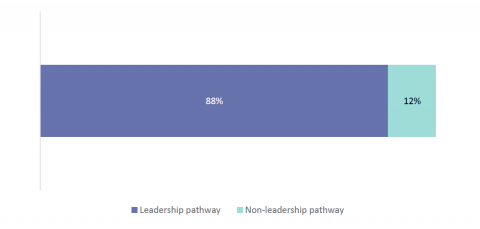
In our interviews, we heard that many principals had purposefully pursued leadership roles, in order to ‘train up’ towards a career goal of becoming a principal.
“I took the opportunities that were there. I just knew I needed to … I took as many opportunities as I could.” –New principal
“In terms of a CV, getting it towards the top of the pile, there are certain things that you kind of need to check off just get your foot in the door. I understood that there needed to be some pastoral aspects to my CV. So I did some deaning for a bit – I made sure I applied for that so people understood that I had the ability to interact with all sorts of different students and that I had some school-wide leadership” – New Principal
We also talked to principals, from both the leadership and non-leadership pathway, who stepped into the role although they had not actively aspired to it. These principals had been shoulder-tapped due to limited other candidates, an ongoing vacancy, being familiar and trusted by the school board, or having strong links to a particular community.
“It actually wasn't the right school for me to start at, but I felt like I had to apply because I'd been there for 14, 15 years.” – New principal
“It was me or no-one and our lovely [small rural] school may well have gone down the gurgler if I hadn’t ended up taking over... principalship wasn't my aim.” – New principal
Principals report that opportunities for leadership pathways are ad hoc
In our interviews with new principals and experts, we heard that opportunities to pursue a leadership pathway to principalship are too often left to chance. This finding is consistent with recent Aotearoa New Zealand-based studies that show that leadership pathways are not clearly signposted.25 Many new principals that we spoke with credit proactive former principals or personal contacts for identifying their leadership potential, and setting them on their leadership path:
“It was the foresight of my previous principals to have given me those experiences, and being brave enough to back me to do them...” – New principal
“He's been the most influential person in terms of my career development. And I wouldn't be where I am today without his guidance and support.”- New principal
While many principals benefit from personal connections and the thoughtful support of previous leaders, this is not the case for all. Such pivotal relationships were described, for example, as ‘pure luck’. This means that the identification of leadership potential and opportunities for leadership pathways are not available and accessible to everyone who could benefit from them. This finding indicates an area of concern for the sector, in terms of equitable identification of, and support and opportunities for, potential leaders.
“I got really lucky … all three of the principals I had in New Zealand have been really good at giving me the opportunities. One of the things that's become really transparent through talking to people since being appointed was how fortunate I'd been to have that breadth of experience in that sort of [leadership] arena.” - New principal
b) The difference that pathways make to preparedness
Leadership experience makes new principals more than three times more likely to be prepared for the role. It is particularly useful when prior roles involved opportunities to gain experience in a range of key aspects of the principalship
Prior experience in a leadership role is the best pathway to principalship. At the point where new principals are just stepping into their new role, those who came through the leadership pathway are more than three times more likely than those from a non-leadership pathway to be prepared for the role overall. Thirty percent of principals from non-leadership pathways report that they are prepared or very prepared, compared with just eight percent of those who come straight from teaching (or other areas of education).
Figure 8: Percentage of principals who felt prepared or very prepared for their role, by the pathway they took
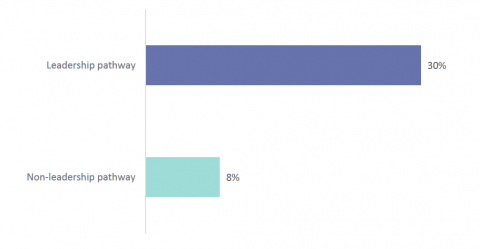
This outcome makes sense as principalship and middle/senior leadership roles have many overlapping responsibilities, including curriculum leadership, liaising with community, culturally responsive practice leadership, and more.[i] Experts and principals that we talked to affirm the value of school leadership experience in building capability ahead of principalship. However, they emphasised that leadership roles differ widely between, and within, schools. We heard that the real value in building their preparedness came from the particular responsibilities and tasks within their previous leadership roles.
“[As a dean,] I took a year group from Year 9 to 13 which I believe gave me a good insight into what happens for students at each year level. Also, it honed my skills of dealing with students (especially those with challenging needs) and their families. I used these skills a lot as DP - and as principal as well.” – New principal
“I'd attend board meetings; I would attend finance meetings. I'd understand and unpack all the finances. I'd attend property meetings. So all of those things, I was kind of prepped before I got into the role so that when I came into this principalship, I had an idea. …You know, that's not why we went into the profession. We were teachers first and foremost.” – New principal
Principals that had come straight from teaching echoed this idea, identifying smaller-scale leadership opportunities that supported their preparation:
“[In my teacher role,] I was running the garden-to-table programme – I was the facilitator there. That sounds like a little thing, but at [that school], it was actually quite big. … At one stage it was 12 classes going through the programme. So I was coordinating all of that, creating timetables for that. I job-interviewed and hired the kitchen specialist and the garden specialist. So there was that whole component in that role … there was also finances. I was doing timesheets and budgets and all sorts of those things. And I'd been a budget holder and curriculum lead for some things in the past as well. So I had all that background knowledge there, to draw on.” – New principal
“[In my teacher role, I] would organise … the school fair, and do the social club. I know they don't seem like big things, but at that time they all kind of led up to where I am now in terms of organising things outside of what you're doing in the classroom.” – New principal
Having held a leadership role makes new principals twice as likely to be prepared for working with data, strategic planning, and the compliance and resourcing aspects of the role
Principals who came through the leadership pathway are significantly more prepared than those who came through the non-leadership pathway in eight of the 11 key areas of practice.
Figure 9: How prepared new principals felt in each area by pathway
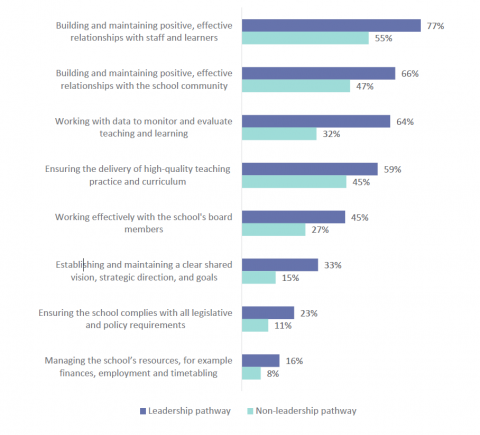
In four areas, those principals who had come through a leadership pathway are twice as likely to be prepared or very prepared. These areas are:
- working with data to monitor and evaluate teaching and learning
- establishing and maintaining a clear shared vision, strategic direction, and goals
- ensuring the school complies with all legislative and policy requirements
- managing the school’s resources, for example finances, employment and timetabling.
We explored these findings in our interviews with new principals. We heard that leadership roles can look very different at different schools, and can involve vastly different responsibilities. We learnt that their leadership pathway was most useful when it involved a range of administrative, legal, and leadership experiences and responsibilities, within their past roles. In these cases, their prior experiences matched up well with their new principal responsibilities, helping them to feel more prepared.
“I learnt quite a lot on my journey, in terms of each stage. When I was a curriculum leader, I learnt how to manage a curriculum, how to develop a curriculum, what that kind of overview looked like, how to support staff. When I was a team leader, [that was about] managing my team, supporting them in their practice, all of those sorts of things.” – New principal
“I had been the board chair at my kid's school, which actually was incredible experience for [preparing me for] the school. I've pulled on that a lot more than probably some of my other experience. So I would recommend anybody to be even a staff trustee on a board as experience.” – New principal
A leadership pathway does not make a difference to preparedness for Tiriti-based and Māori partnership practices, and inclusive practices
In three of the 11 areas, there was no significant difference between the preparedness of leaders and non-leaders. These are:
- working in partnership with whānau Māori, hapū, and iwi to develop a localised curriculum
- giving effect to Te Tiriti o Waitangi throughout the school
- working closely with diverse families and community groups to promote inclusion.
3) What difference does development and support make to new principals’ preparedness?
a) Development and support that new principals access
Nearly all new principals access some development and support related to the principal role, prior to getting the job
Eighty-nine percent of new principals had participated in relevant development and support activities before they became a principal. About two-thirds (64 percent) of new principals had participated in at least three types of development and support.
One-on-one coaching/mentoring was the most common type of development and support.
- Two-thirds (67 percent) of new principals accessed coaching/mentoring
- Over half of new principals (58 percent) accessed one-off programmes or courses
- Over half of new principals (57 percent) accessed structured, ongoing programmes for new/acting principals
- Half (49 percent) of new principals accessed postgraduate school leadership qualifications.
In addition, 70 percent of new principals described at least one other formal or informal professional learning or support they had accessed – such as professional supervision, social media platforms, or leadership learning groups.
What we mean by ‘development and support’
In this report, we talk about ‘development and support.’ This refers to purposeful participation and engagement in professional learning and development activities, that relate directly to the roles and responsibilities of an Aotearoa New Zealand principal. Development and support might be formal (e.g., structured courses or qualifications) or informal (e.g., social media groups).
b) The difference that development and support makes to principals’ preparedness
Development and support for aspiring principals makes a difference to their preparedness
ERO looked at the ways that principals’ development and support activities makes a difference to their overall preparedness for the role when they start. We found that all the types of development and support activities make a positive difference to how prepared principals are when they start.
Figure 10: Percentage of new principals who felt prepared or very prepared overall by their participation in each development activity
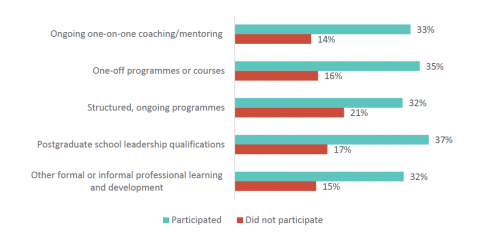
Coaching/mentoring and postgraduate programmes make the most difference to principals’ preparedness
Participating in coaching and mentoring, and postgraduate programmes are the most consistently impactful prior development and support activities, with positive impacts seen in eight of the 11 key areas of principal practice. New principals who had participated in these activities are twice as likely to report having been prepared overall for their roles.
Coaching/mentoring and postgraduate programmes are also the only development and support activities that significantly impact preparedness in building and maintaining positive, effective relationships with staff and learners, and giving effect to Te Tiriti o Waitangi.
Similar studies around professional learning and development in Aotearoa New Zealand have also identified that these forms of development and support are valued and useful.27
In interviews, we heard that postgraduate study is valued for strategic, big picture thinking. One principal shared that doing a Masters in Educational Leadership taught him ‘how much [he] didn’t know.’ This helped him to figure out where he needed to purposefully upskill before he started in the role.
We heard that coaching and mentoring was valued highly by new principals, as they feel tailored and relevant to their individual strengths and challenges. This was especially true when coaches or mentors were self-selected, knew them well, and brought a wealth of experience to share about principalship in similar contexts (e.g., rural contexts).
“I believe that the most valuable and effective support for new principals is a coaching/mentoring relationship with an experienced principal” – New principal
“I had a really good principal as a mentor … she is very systems focused and I learned a huge amount from her.” – New principal
Principals report that access to useful types of development and support is ad hoc
In interviews and open-ended survey responses, we heard that while development and support can be very useful, current support offerings are insufficient, and opportunities are ad hoc.
“It is unbelievable how little formal preparation we are given to progress into the role.” –New principal
“You can read all this stuff, but until you need it, it's not relevant, so you forget it. It's that just-in-time learning, you know? [That’s how] we talk with the kids, don't we? So it applies to us as well.” – New principal
For example, one principal shared that he was encouraged by his mentor, a keen academic, to do a Masters and then to look at moving into principalship. He affirmed that this ‘wouldn’t have occurred to [him] otherwise.’ He shared that this encouragement, and his postgraduate learning, were instrumental in seeing himself as a potential school leader – he had previously assumed that this was not a real option because he was younger than his fellow DPs at the school.
We heard that sometimes, aspiring principals seek principal mentors and leadership coaches themselves, to pursue a goal of becoming a principal. More often, however, we heard that these high-impact coaching and mentoring relationships were the result of experienced leaders spotting their leadership potential and encouraging them to build their capability.
We also heard that, where leaders do not have that proactive support for their leadership learning, they miss out:
“There were really no [aspiring principal] courses while I was a DP that I could access easily. The [regional principal collective] ran one and I was so cross at [prior principal] that he didn't pass that on to me or think to put me forward for that course. And then the deadline had closed, and I missed out.” – New principal
This finding aligns with what we heard in our interviews with experts, as well as the findings of a recent study into the experiences of all principals in Aotearoa, conducted by NZPF and the Teaching Council.28
“Everybody’s fed up with there being bits and bobs.” – Expert
“[It] depends on the proactiveness of the principal within your school as to how far you're going to advance your career.” – Expert
Development and support helps most with planning, managing resources, using data, delivering the curriculum, and working with Māori
The areas of the role that are positively impacted by all development and support activities are:
- strategic planning and goal-setting
- ensuring the delivery of high-quality curriculum
- working with data
- working in partnership with whānau Māori, hapu, and iwi
- managing the school’s resources.
In interviews, principals emphasised the usefulness of dedicated professional discussion, courses, and tools in these key areas of school leadership, emphasising the importance of direct guidance and clarity about ‘what good looks like’.
"I asked [mentor and previous principal] to let me come to those meetings [about the budget and finances], so that I could get an idea of what’s involved." – New principal
“These are courses you should be doing before you get to the next position, not after you’re there.” – New principal
Currently, development and support is not helping as much with working effectively with the board, nor positive, effective relationships with the school community
The key area of building and maintaining positive, effective relationships with the school community was not noticeably impacted by participation in any of the development and support activities. Working effectively with the school board was only slightly impacted by coaching and mentoring, and no other activities.
In interviews, principals shared that they found development and support activities most effective for building strategic understandings and discrete tasks and skills, whereas their relationship skills and community connection strategies had been built up over the course of their teaching and leadership careers. This could explain why working with the community and board are areas that are not as impacted by development activities.
c) Inductions for new principals
At least 15 percent of school boards do not deliver an induction programme for new principals to help their preparedness
Forty-three percent of board representatives indicated they had provided an induction for their new principals when they started. Fifteen percent confirmed that they had not provided an induction.
Forty-two percent of board representatives did not know if one had been provided or not. (It is important to keep in mind that board membership can change regularly, which may account for some uncertainty).
Figure 11: Percentage of board members indicating if their principal had participated in an induction
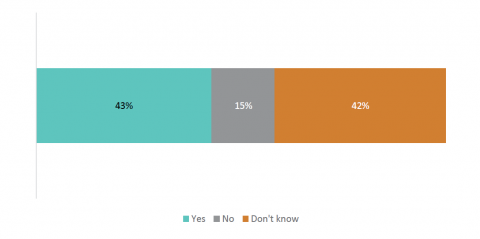
Principals report that inductions vary in usefulness
In interviews with new principals, we heard that the occurrence, quality, and usefulness of induction processes is variable. In some cases, principals had experienced a longer-term induction that included dedicated handover from the outgoing principal and valued this opportunity. Other principals shared that while their new schools’ boards and staff had made an effort to induct them into the role, the complexity and range of tasks and responsibilities was more than could be covered within their induction timeframe. These often took place during a two-week term break, or concurrent with starting in the role. Others told us that they wished they had had a formalised induction, covering the ‘nuts and bolts’ of the principal job (things like administrative and legal responsibilities) and a thorough handover from the previous principal about the specific context of the school. This aligns with the evidence base, which shows that if succession is well-planned and involves connections with the previous principal, then the new principal is more prepared to step into their role with good knowledge of the school, its staff, learners, and community.29
"I think number one is having a really good strong induction - and an induction before you're about to start at the school. Having a really good look through things like finance, your staffing, what your FTE allocation is, how the units are distributed, understanding the reasons why curriculum is the way that it is, how the growth cycle works, projects… in a school there are so many things happening at different times. When I walked in, I didn't know where anything was … That induction is key. And the more time you can get with the principal that's exiting, the better.” – New principal
“Induction needs to include information about how the school has been connecting with iwi, the quality of that relationship. There is currently a yawning gap in that area of practice, and it is important information.” - Expert
“A lot of it depends on how well your predecessor left things and what sort of transition/induction you got.” – New principal (written response)
Conclusion
Our findings show that new principals are not always well prepared for all aspects of their new role. The pathway to being a well-prepared principal in our system lacks clear guidance, and gaining a range of useful experiences and skills relies too much on ‘good luck’ and supportive personal or professional contacts. This means that current ways of identifying and supporting future leaders onto a pathway to principalship are inconsistent and ad hoc.
Although prior experience in a leadership position, combined with a diverse set of administrative and leadership experiences, helps a lot, not all new principals have benefitted from these opportunities.
Development and support makes a difference, especially coaching/mentoring and postgraduate programmes. However, these are not being accessed by all. Additionally, 15 percent of school boards do not provide any form of induction programme for new principals, and when an induction process does occur, the quality varies.
We asked new principals how prepared they were for the role when they first started, and about their experiences and supports. This section of the report is focused on the time before principalship, up until new principals’ first term in the role.
ERO found that new principals are not always well prepared for their new role. Current ways of identifying and supporting future leaders onto a pathway to principalship are inconsistent, so not all new principals are benefitting from the prior experiences and supports that could set them up well for principalship. Many do not receive useful inductions. Accessing development and support activities improves their preparedness, but principals remain unprepared in some key areas.
ERO wanted to understand the impact that pathways, development, and support before becoming a principal have on new principals’ preparedness. To do this, we asked new principals about how prepared they were for the role. We analysed our data[1] to identify the most important factors for principals’ rating of being prepared.
We found three key drivers for preparedness. These are the most important factors associated with feeling prepared overall for the principal role. The drivers that most positively influence preparedness are:
- Having held a leadership position
- Having participated in coaching/mentoring
- Having participated in a postgraduate programme related to school leadership
In this section, we share what we found out about how and why these pathways and supports are so important.
This section of the report outlines:
- How prepared are principals for their first role?
- Preparedness when new principals start their first role
- Areas of the role where new principals are most prepared
- Areas of the role where new principals are least prepared
- What pathway into principalship makes the most difference?
- The pathways that new principals take into the role
- The difference that pathways make to preparedness
- What difference does development and support make to new principals’ preparedness?
- Development and support that new principals access
- The difference that development and support make to principals’ preparedness
- Inductions for new principals
1) How prepared are new principals for their first role?
a) Preparedness when new principals first start their role
Only a quarter of new principals start their new role feeling prepared
New principals are not always well prepared for their new role. Only a quarter of new principals (27 percent) indicated that they had felt prepared or very prepared for the role overall when they started.
Fifty-six percent are somewhere in the middle, indicating that they were somewhat prepared/somewhat unprepared. Worryingly, just under one-fifth of the population of new principals (18 percent) felt unprepared or very unprepared when they first started their role.
Figure 5: How prepared new principals felt when they first started their role
In our interviews with new principals and sector experts, we found out that there are two main reasons new principals arrive feeling unprepared, surprised, or anxious. These are:
- The complexity of the role: their new responsibilities as a principal are not aligned to their previous experiences and expertise.
- The reality of the school: their particular school setting has particular challenges.
These two reasons are unpacked below.
Some principals report that unpreparedness relates to the complexity of their role
In our interviews with new principals, we heard that they had underestimated the complexity of their new role. The principal role has tasks, responsibilities, and expectations well beyond the scope of teaching and learning. Many principals shared that they were caught off guard by the broad range of responsibilities and accountabilities with which they have no prior experience, for example, managing finances, staff employment issues, Ministry reporting, and property issues.
“You move from being a teacher or a deputy principal, which is still pretty kid- and teacher-facing, to you to being the CEO of in most cases a multi-million dollar organisation. - Expert
The local evidence base has highlighted this ‘reality shock’19 as a common challenge among new principals. Recent work by the New Zealand Principals’ Federation (NZPF) and the Ministry of Education found that new principals feel unprepared ‘because the tasks required of them in the first months in the job did not match the work they had proven themselves at on their journey into principalship.’20
“You become a teacher, you become a good teacher. You become a head of faculty, not because you're a good head of faculty, but because you were a good teacher. Well, the skills aren't actually linked. And then you become a deputy. Well, there's a bit of a link, but not much depending on what your portfolio is. And then you become a principal and that isn't really linked to what you knew [before] because you only knew about 60 percent of the stuff as a DP.” –New principal
“To add in the mix, I also have property that I oversee, and I have all of the finances that I oversee. And those weren't part of my role when I was a DP. So, it's completely different.” – New principal
“They [new principals] need help to be honest. They need help with pretty well everything … principals coming into principalship are quite regularly being exposed to things that they have not had to think about.” – Expert
Some principals report that unpreparedness relates to unexpected realities at their school
As well as role-based complexities, we also heard about challenges do to with their particular school setting. Some new principals shared that, when they arrived, their school was in a difficult state, with statutory management in place, major staffing or financial issues, or long‑outdated systems and policies.
This job [at this school] was designed for an experienced principal … I had to do all of the procedures and the manuals for the staff and codes of conduct and all of that sort of thing. I'm fortunate that, when I come back to my mentorship and all the support that I had, my previous principal, she was very clear around systems, procedures, and processes.” - New principal
b) Areas of the role where principals are most prepared
Principals are most prepared for building and maintaining relationships, and for working with data to monitor teaching and learning
We asked new principals to rate how prepared they were for 11 key areas of principal practice, when they first started as a principal.
Figure 6: Percentage of new principals who felt prepared or very prepared in each area when they first started their role
The top three areas that new principals are particularly prepared for when they start the role are:
- Building and maintaining positive, effective relationships with staff and learners
- Building and maintaining positive, effective relationships with the school community
- Working with data to monitor teaching and learning
Being a teacher involves relationship‑building and working with achievement data, so these aspects of the role are familiar to new principals. In our interviews, they affirmed that these were the parts of the role that they were very comfortable with from the outset – and often, the reason that they had seen themselves as ready for principalship.
“[I was] a teacher that had very high achievement … I was head of curriculum. For me the teaching side comes very naturally.” – New principal
“[In my] DP role I had lots of opportunities to be involved in lots of different aspects of leadership - especially working with staff." – New principal
c) Areas of the role where principals are least prepared
Principals are least prepared for working in partnership with Māori, and for the administrative and legal aspects of the role
Fewer than half of new principals feel prepared in seven of the 11 key areas when they start (as set out in Figure 6). The bottom three areas of principal practice, where preparedness is particularly poor, are:
- Managing the school’s resources, for example finances, employment, and timetabling – 15 percent of principals felt prepared/very prepared (33 percent unprepared/very unprepared)
- Ensuring the school complies with all legislative and policy requirements - 21 percent of principals felt prepared/very prepared (27 percent unprepared/very unprepared)
- Working in partnership with whānau Māori, hapū, and iwi to develop a localised curriculum - 22 percent of principals felt prepared/very prepared (20 percent unprepared/very unprepared)
Tumuaki Māori principals are more prepared for Māori partnership practices than their peers – this is set out in Part 5 of this report.
In our interviews, principals shared how they had felt alarmed by, and unprepared for, the scale of their new administrative and legal responsibilities: ‘Until you’ve got the job, you don’t know what you don’t know’ (New principal). Principals and experts described struggles to build capability in these areas prior to principalship, as they are so specific to the principal role, and to individual schools.
“When I walked in … I was getting presented all of these things and going, ‘Oh my gosh’. And then, working through trying to understand what they are…”– New principal
“What is an analysis of variance? How do you write them? And what are they? Because I got into the job and it's like, ‘Oh, this is due’. And I was like, ‘Oh, okay. What's that?’ ‘Oh, you need to do this.’ ‘Okay… What's that? And how do you go about doing that?’ … The first meeting I had with [Ministry contact] was talking about staffing and funding, and she used all these little acronyms and things. It was like, ‘Oh, okay, I'll have to go away and find out what all of those mean.’” – New principal
It is understandable that new principals would feel less prepared for the administrative and legal aspects of the role, if they have not been exposed to these tasks and processes before.
The low level of preparedness around partnering with Māori, however, is a more significant concern. In Aotearoa New Zealand, working in partnership with whānau Māori, hapu, and iwi is fundamental to enacting Te Tiriti o Waitangi, our National Education and Learning Priorities, to our codes, standards, and frameworks for leading and teaching, essential for the localised bicultural learning of all learners, and critical to the education success of tamariki and rangatahi Māori. In interviews, we heard that this lack of preparedness was rooted in being unclear about where to start and what ‘good’ looks like.
"We know that relationships and honouring the Treaty is a number one priority in every school … You know, we get it. We know that … There's no teacher or principal that I know that aren't all in for it. We know the disadvantage that our Māori students have had generationally, and we want so desperately to change that. But we don't need more, ‘Why?’ We need more, ‘How?’” – New principal
This finding reflects what we know from the established evidence base, that schools’ ‘effective means of developing relationships and partnerships with their Māori communities’21 is an area of historical and ongoing concern.22 We also know that principals have a significant impact on the quality of teaching and learning in their school,23 so their preparedness to lead their school well in this area is of critical importance. Experts that we interviewed affirmed that this area is an ongoing sector weakness, which urgently needs addressing.
“There is also a need [for new principals] to be culturally competent, and for many this is a huge learning curve in itself.” – Expert
2) What pathway into principalship makes the most difference?
a) The pathways that new principals take into the role
There are no specified or recommended pathways into principalship. This report focuses on two pathways
ERO wanted to find out how different pathways to being principal impacts their preparedness when they step into their new role. As set out in Part 1 of this report, Aotearoa New Zealand is unusual in that there are no structured, specified, or recommended pathways into principalship. However, based on expert advice, we looked at two broad pathways in this evaluation: a leadership pathway, and a non-leadership pathway.
Table 5: Pathways for new and aspiring principals
|
Leadership pathway |
Before becoming a principal, they held a senior leadership or middle-management role – roles like deputy principal (DP), assistant principal (AP), syndicate leader, head of department, faculty leader, leader of learning, specialist teacher, special education needs co-ordinator (SENCO), learning support coordinator (LSC), or held other management units. |
|
Non-leadership pathway |
Before becoming a principal, they were in a teacher role or were primarily employed in other areas of education (such as tertiary, iwi organisation, school organisation, school governance, research, resource teacher, provider of professional development, Ministry of Education, or ERO). |
See Appendix 1 for more detail about these definitions.
What we mean by ‘leadership’
In this report, we talk about leadership in a way that echoes the Teaching Council’s definition of ‘Leading Teams’ and ‘Leading Organisations’ in their Leadership Capability Framework.24 This might also be defined as ‘positional leadership.’
We recognise that leadership comes in many forms in Aotearoa New Zealand schools, and teachers also have a highly valued role in leading learning.
The overwhelming majority of principals move through a leadership pathway before principalship
Eighty-eight percent of new principals come through the leadership pathway – meaning that before becoming a principal, they had a school leadership position like DP, AP, syndicate leader, head of department, faculty leader, leader of learning, specialist teacher, SENCO, LSC, or held other management units. Only 12 percent came through the non-leadership pathway: either from a teaching role (10 percent) or other areas of education (2 percent).
Figure 7: The pathways new principals took into their role
In our interviews, we heard that many principals had purposefully pursued leadership roles, in order to ‘train up’ towards a career goal of becoming a principal.
“I took the opportunities that were there. I just knew I needed to … I took as many opportunities as I could.” –New principal
“In terms of a CV, getting it towards the top of the pile, there are certain things that you kind of need to check off just get your foot in the door. I understood that there needed to be some pastoral aspects to my CV. So I did some deaning for a bit – I made sure I applied for that so people understood that I had the ability to interact with all sorts of different students and that I had some school-wide leadership” – New Principal
We also talked to principals, from both the leadership and non-leadership pathway, who stepped into the role although they had not actively aspired to it. These principals had been shoulder-tapped due to limited other candidates, an ongoing vacancy, being familiar and trusted by the school board, or having strong links to a particular community.
“It actually wasn't the right school for me to start at, but I felt like I had to apply because I'd been there for 14, 15 years.” – New principal
“It was me or no-one and our lovely [small rural] school may well have gone down the gurgler if I hadn’t ended up taking over... principalship wasn't my aim.” – New principal
Principals report that opportunities for leadership pathways are ad hoc
In our interviews with new principals and experts, we heard that opportunities to pursue a leadership pathway to principalship are too often left to chance. This finding is consistent with recent Aotearoa New Zealand-based studies that show that leadership pathways are not clearly signposted.25 Many new principals that we spoke with credit proactive former principals or personal contacts for identifying their leadership potential, and setting them on their leadership path:
“It was the foresight of my previous principals to have given me those experiences, and being brave enough to back me to do them...” – New principal
“He's been the most influential person in terms of my career development. And I wouldn't be where I am today without his guidance and support.”- New principal
While many principals benefit from personal connections and the thoughtful support of previous leaders, this is not the case for all. Such pivotal relationships were described, for example, as ‘pure luck’. This means that the identification of leadership potential and opportunities for leadership pathways are not available and accessible to everyone who could benefit from them. This finding indicates an area of concern for the sector, in terms of equitable identification of, and support and opportunities for, potential leaders.
“I got really lucky … all three of the principals I had in New Zealand have been really good at giving me the opportunities. One of the things that's become really transparent through talking to people since being appointed was how fortunate I'd been to have that breadth of experience in that sort of [leadership] arena.” - New principal
b) The difference that pathways make to preparedness
Leadership experience makes new principals more than three times more likely to be prepared for the role. It is particularly useful when prior roles involved opportunities to gain experience in a range of key aspects of the principalship
Prior experience in a leadership role is the best pathway to principalship. At the point where new principals are just stepping into their new role, those who came through the leadership pathway are more than three times more likely than those from a non-leadership pathway to be prepared for the role overall. Thirty percent of principals from non-leadership pathways report that they are prepared or very prepared, compared with just eight percent of those who come straight from teaching (or other areas of education).
Figure 8: Percentage of principals who felt prepared or very prepared for their role, by the pathway they took
This outcome makes sense as principalship and middle/senior leadership roles have many overlapping responsibilities, including curriculum leadership, liaising with community, culturally responsive practice leadership, and more.[i] Experts and principals that we talked to affirm the value of school leadership experience in building capability ahead of principalship. However, they emphasised that leadership roles differ widely between, and within, schools. We heard that the real value in building their preparedness came from the particular responsibilities and tasks within their previous leadership roles.
“[As a dean,] I took a year group from Year 9 to 13 which I believe gave me a good insight into what happens for students at each year level. Also, it honed my skills of dealing with students (especially those with challenging needs) and their families. I used these skills a lot as DP - and as principal as well.” – New principal
“I'd attend board meetings; I would attend finance meetings. I'd understand and unpack all the finances. I'd attend property meetings. So all of those things, I was kind of prepped before I got into the role so that when I came into this principalship, I had an idea. …You know, that's not why we went into the profession. We were teachers first and foremost.” – New principal
Principals that had come straight from teaching echoed this idea, identifying smaller-scale leadership opportunities that supported their preparation:
“[In my teacher role,] I was running the garden-to-table programme – I was the facilitator there. That sounds like a little thing, but at [that school], it was actually quite big. … At one stage it was 12 classes going through the programme. So I was coordinating all of that, creating timetables for that. I job-interviewed and hired the kitchen specialist and the garden specialist. So there was that whole component in that role … there was also finances. I was doing timesheets and budgets and all sorts of those things. And I'd been a budget holder and curriculum lead for some things in the past as well. So I had all that background knowledge there, to draw on.” – New principal
“[In my teacher role, I] would organise … the school fair, and do the social club. I know they don't seem like big things, but at that time they all kind of led up to where I am now in terms of organising things outside of what you're doing in the classroom.” – New principal
Having held a leadership role makes new principals twice as likely to be prepared for working with data, strategic planning, and the compliance and resourcing aspects of the role
Principals who came through the leadership pathway are significantly more prepared than those who came through the non-leadership pathway in eight of the 11 key areas of practice.
Figure 9: How prepared new principals felt in each area by pathway
In four areas, those principals who had come through a leadership pathway are twice as likely to be prepared or very prepared. These areas are:
- working with data to monitor and evaluate teaching and learning
- establishing and maintaining a clear shared vision, strategic direction, and goals
- ensuring the school complies with all legislative and policy requirements
- managing the school’s resources, for example finances, employment and timetabling.
We explored these findings in our interviews with new principals. We heard that leadership roles can look very different at different schools, and can involve vastly different responsibilities. We learnt that their leadership pathway was most useful when it involved a range of administrative, legal, and leadership experiences and responsibilities, within their past roles. In these cases, their prior experiences matched up well with their new principal responsibilities, helping them to feel more prepared.
“I learnt quite a lot on my journey, in terms of each stage. When I was a curriculum leader, I learnt how to manage a curriculum, how to develop a curriculum, what that kind of overview looked like, how to support staff. When I was a team leader, [that was about] managing my team, supporting them in their practice, all of those sorts of things.” – New principal
“I had been the board chair at my kid's school, which actually was incredible experience for [preparing me for] the school. I've pulled on that a lot more than probably some of my other experience. So I would recommend anybody to be even a staff trustee on a board as experience.” – New principal
A leadership pathway does not make a difference to preparedness for Tiriti-based and Māori partnership practices, and inclusive practices
In three of the 11 areas, there was no significant difference between the preparedness of leaders and non-leaders. These are:
- working in partnership with whānau Māori, hapū, and iwi to develop a localised curriculum
- giving effect to Te Tiriti o Waitangi throughout the school
- working closely with diverse families and community groups to promote inclusion.
3) What difference does development and support make to new principals’ preparedness?
a) Development and support that new principals access
Nearly all new principals access some development and support related to the principal role, prior to getting the job
Eighty-nine percent of new principals had participated in relevant development and support activities before they became a principal. About two-thirds (64 percent) of new principals had participated in at least three types of development and support.
One-on-one coaching/mentoring was the most common type of development and support.
- Two-thirds (67 percent) of new principals accessed coaching/mentoring
- Over half of new principals (58 percent) accessed one-off programmes or courses
- Over half of new principals (57 percent) accessed structured, ongoing programmes for new/acting principals
- Half (49 percent) of new principals accessed postgraduate school leadership qualifications.
In addition, 70 percent of new principals described at least one other formal or informal professional learning or support they had accessed – such as professional supervision, social media platforms, or leadership learning groups.
What we mean by ‘development and support’
In this report, we talk about ‘development and support.’ This refers to purposeful participation and engagement in professional learning and development activities, that relate directly to the roles and responsibilities of an Aotearoa New Zealand principal. Development and support might be formal (e.g., structured courses or qualifications) or informal (e.g., social media groups).
b) The difference that development and support makes to principals’ preparedness
Development and support for aspiring principals makes a difference to their preparedness
ERO looked at the ways that principals’ development and support activities makes a difference to their overall preparedness for the role when they start. We found that all the types of development and support activities make a positive difference to how prepared principals are when they start.
Figure 10: Percentage of new principals who felt prepared or very prepared overall by their participation in each development activity
Coaching/mentoring and postgraduate programmes make the most difference to principals’ preparedness
Participating in coaching and mentoring, and postgraduate programmes are the most consistently impactful prior development and support activities, with positive impacts seen in eight of the 11 key areas of principal practice. New principals who had participated in these activities are twice as likely to report having been prepared overall for their roles.
Coaching/mentoring and postgraduate programmes are also the only development and support activities that significantly impact preparedness in building and maintaining positive, effective relationships with staff and learners, and giving effect to Te Tiriti o Waitangi.
Similar studies around professional learning and development in Aotearoa New Zealand have also identified that these forms of development and support are valued and useful.27
In interviews, we heard that postgraduate study is valued for strategic, big picture thinking. One principal shared that doing a Masters in Educational Leadership taught him ‘how much [he] didn’t know.’ This helped him to figure out where he needed to purposefully upskill before he started in the role.
We heard that coaching and mentoring was valued highly by new principals, as they feel tailored and relevant to their individual strengths and challenges. This was especially true when coaches or mentors were self-selected, knew them well, and brought a wealth of experience to share about principalship in similar contexts (e.g., rural contexts).
“I believe that the most valuable and effective support for new principals is a coaching/mentoring relationship with an experienced principal” – New principal
“I had a really good principal as a mentor … she is very systems focused and I learned a huge amount from her.” – New principal
Principals report that access to useful types of development and support is ad hoc
In interviews and open-ended survey responses, we heard that while development and support can be very useful, current support offerings are insufficient, and opportunities are ad hoc.
“It is unbelievable how little formal preparation we are given to progress into the role.” –New principal
“You can read all this stuff, but until you need it, it's not relevant, so you forget it. It's that just-in-time learning, you know? [That’s how] we talk with the kids, don't we? So it applies to us as well.” – New principal
For example, one principal shared that he was encouraged by his mentor, a keen academic, to do a Masters and then to look at moving into principalship. He affirmed that this ‘wouldn’t have occurred to [him] otherwise.’ He shared that this encouragement, and his postgraduate learning, were instrumental in seeing himself as a potential school leader – he had previously assumed that this was not a real option because he was younger than his fellow DPs at the school.
We heard that sometimes, aspiring principals seek principal mentors and leadership coaches themselves, to pursue a goal of becoming a principal. More often, however, we heard that these high-impact coaching and mentoring relationships were the result of experienced leaders spotting their leadership potential and encouraging them to build their capability.
We also heard that, where leaders do not have that proactive support for their leadership learning, they miss out:
“There were really no [aspiring principal] courses while I was a DP that I could access easily. The [regional principal collective] ran one and I was so cross at [prior principal] that he didn't pass that on to me or think to put me forward for that course. And then the deadline had closed, and I missed out.” – New principal
This finding aligns with what we heard in our interviews with experts, as well as the findings of a recent study into the experiences of all principals in Aotearoa, conducted by NZPF and the Teaching Council.28
“Everybody’s fed up with there being bits and bobs.” – Expert
“[It] depends on the proactiveness of the principal within your school as to how far you're going to advance your career.” – Expert
Development and support helps most with planning, managing resources, using data, delivering the curriculum, and working with Māori
The areas of the role that are positively impacted by all development and support activities are:
- strategic planning and goal-setting
- ensuring the delivery of high-quality curriculum
- working with data
- working in partnership with whānau Māori, hapu, and iwi
- managing the school’s resources.
In interviews, principals emphasised the usefulness of dedicated professional discussion, courses, and tools in these key areas of school leadership, emphasising the importance of direct guidance and clarity about ‘what good looks like’.
"I asked [mentor and previous principal] to let me come to those meetings [about the budget and finances], so that I could get an idea of what’s involved." – New principal
“These are courses you should be doing before you get to the next position, not after you’re there.” – New principal
Currently, development and support is not helping as much with working effectively with the board, nor positive, effective relationships with the school community
The key area of building and maintaining positive, effective relationships with the school community was not noticeably impacted by participation in any of the development and support activities. Working effectively with the school board was only slightly impacted by coaching and mentoring, and no other activities.
In interviews, principals shared that they found development and support activities most effective for building strategic understandings and discrete tasks and skills, whereas their relationship skills and community connection strategies had been built up over the course of their teaching and leadership careers. This could explain why working with the community and board are areas that are not as impacted by development activities.
c) Inductions for new principals
At least 15 percent of school boards do not deliver an induction programme for new principals to help their preparedness
Forty-three percent of board representatives indicated they had provided an induction for their new principals when they started. Fifteen percent confirmed that they had not provided an induction.
Forty-two percent of board representatives did not know if one had been provided or not. (It is important to keep in mind that board membership can change regularly, which may account for some uncertainty).
Figure 11: Percentage of board members indicating if their principal had participated in an induction
Principals report that inductions vary in usefulness
In interviews with new principals, we heard that the occurrence, quality, and usefulness of induction processes is variable. In some cases, principals had experienced a longer-term induction that included dedicated handover from the outgoing principal and valued this opportunity. Other principals shared that while their new schools’ boards and staff had made an effort to induct them into the role, the complexity and range of tasks and responsibilities was more than could be covered within their induction timeframe. These often took place during a two-week term break, or concurrent with starting in the role. Others told us that they wished they had had a formalised induction, covering the ‘nuts and bolts’ of the principal job (things like administrative and legal responsibilities) and a thorough handover from the previous principal about the specific context of the school. This aligns with the evidence base, which shows that if succession is well-planned and involves connections with the previous principal, then the new principal is more prepared to step into their role with good knowledge of the school, its staff, learners, and community.29
"I think number one is having a really good strong induction - and an induction before you're about to start at the school. Having a really good look through things like finance, your staffing, what your FTE allocation is, how the units are distributed, understanding the reasons why curriculum is the way that it is, how the growth cycle works, projects… in a school there are so many things happening at different times. When I walked in, I didn't know where anything was … That induction is key. And the more time you can get with the principal that's exiting, the better.” – New principal
“Induction needs to include information about how the school has been connecting with iwi, the quality of that relationship. There is currently a yawning gap in that area of practice, and it is important information.” - Expert
“A lot of it depends on how well your predecessor left things and what sort of transition/induction you got.” – New principal (written response)
Conclusion
Our findings show that new principals are not always well prepared for all aspects of their new role. The pathway to being a well-prepared principal in our system lacks clear guidance, and gaining a range of useful experiences and skills relies too much on ‘good luck’ and supportive personal or professional contacts. This means that current ways of identifying and supporting future leaders onto a pathway to principalship are inconsistent and ad hoc.
Although prior experience in a leadership position, combined with a diverse set of administrative and leadership experiences, helps a lot, not all new principals have benefitted from these opportunities.
Development and support makes a difference, especially coaching/mentoring and postgraduate programmes. However, these are not being accessed by all. Additionally, 15 percent of school boards do not provide any form of induction programme for new principals, and when an induction process does occur, the quality varies.
Part 3. Growing into the role: The supports for new principals once they start the role
We asked new principals how confident they are in their role, and about the development and support activities they have accessed since they started. This section is focused on the time since they started their first principalship.
ERO found that new principals are not always getting the support that they need to learn and grow into their role. Practices related to embedding Te Tiriti o Waitangi across the school and partnering with Māori are especially challenging for many new principals, as are legal and administrative leadership. There are some important areas of practice where they lack confidence. While almost all new principals access development and support in their new job, useful supports like coaching, mentoring, and peer connection opportunities are not being accessed by all principals.
In the previous section we looked at how prepared new principals were before they started in the role. In this section, we report on the development and supports new principals access after they start in the role, and how these experiences impact on their confidence and wellbeing. We share what we found out about how and why some development and supports are so important.
To ensure that we maintain a clear distinction between how prepared new principals were when they started and how confident they have become since they started, this section does not include confidence ratings for principals who had been in the role for less than 6 months.
This section of the report outlines:
- How confident are new principals in their role?
- Overall confidence
- Areas of highest confidence
- Areas of lowest confidence
- In what areas does on-the-job experience raise confidence the most?
- Areas that increase the most with on-the-job experience
- Areas that increase the least with on-the-job experience
- What difference does development and support make?
- Engagement with development and support
- The types of development and support that make the most difference
- The types of development and support that support principals’ confidence
- The types of development and support that support principals’ wellbeing
- How aware are boards of their principals’ capability?
- Boards’ and principals’ impressions of principal confidence
- Boards’ and principals’ impressions of principal wellbeing
1) How confident are new principals in their role?
ERO asked new principals to rate how confident they are, now that they are in the principal role. We asked about their overall confidence, and also their confidence across the 11 key areas of principal practice.
a) Overall confidence
Most new principals feel confident in their role overall, and their confidence increases over time
While only a quarter start the role feeling prepared (27 percent), once in the role for at least six months (and up to five years), 71 percent of all new principals that we surveyed feel confident or very confident in their role overall.
Figure 12: How confident new principals feel overall
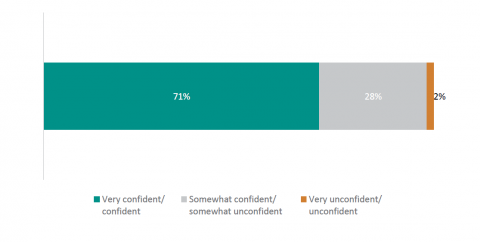
Understandably, this confidence increases with time. Fifty-eight percent of those who have been there for one to two years feel confident or very confident overall, while 81 percent of those who have been in the role for four to five years feel confident or very confident.
Figure 13: Percentage of new principals who feel confident or very confident by time in role
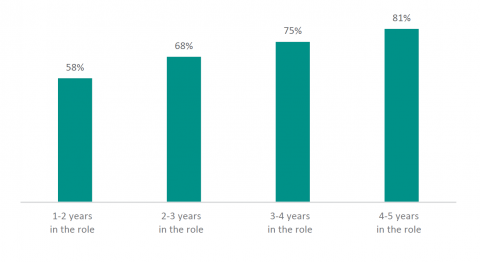
Principals that we spoke with affirmed that their confidence continues to grow as they settle into their new role. They emphasised, however, that the journey to their new level of confidence has taken a lot of energy and effort. We heard that this growth in confidence was more about recovering from a dip in confidence because they had felt so unprepared and unconfident at the start of their time in the role.
“Until you’ve got the job, you don’t know what you don’t know.” – New Principal
“We're into it on Monday with a pōwhiri and then it's been a pretty steep learning curve ever since … it’s just massive because everything, everything, was new.” – New principal
b) Areas of highest confidence
Principals are most confident in the relationship-based aspects of their role
The areas that new principals feel the most confident in are building and maintaining positive, effective relationships with staff and learners (90 percent feel confident or very confident), building and maintaining positive, effective relationships with the school community (84 percent feel confident or very confident), and working effectively with the school's board members (83 percent feel confident or very confident).
Figure 14: Percentage of new principals who feel confident or very confident in the top three areas
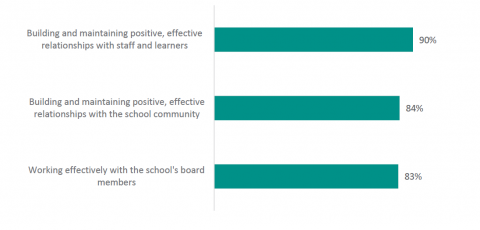
c) Areas of lowest confidence
New principals’ confidence remains particularly low in two critical areas of principal practice: Giving effect to Te Tiriti o Waitangi, and working in partnership with Māori
Giving effect to Te Tiriti o Waitangi, and working in partnership with Māori, are areas of low preparedness when new principals first started their role. This worrying picture does not improve much over time.
Less than half (48 percent) of new principals are confident in giving effect to Te Tiriti o Waitangi throughout the school. This is only a small increase (11 percentage points) from how prepared principals were when they first started.
Only about a third of new principals (37 percent) feel confident or very confident to work in partnership with whānau Māori, hapū, and iwi. This is a small (15 percentage) point increase from how prepared new principals felt when starting the role.
Figure 15: Percentage of new principals who felt prepared when they started compared to the percentage who feel confident now across different areas
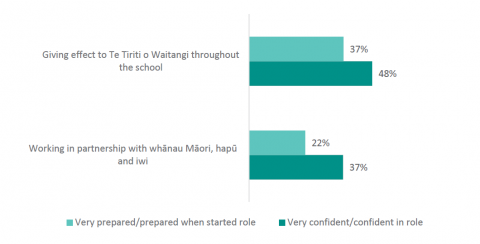
In interviews, we heard that this lack of preparedness and confidence is rooted in being unclear about where to start, and what ‘good’ looks like. Principals described their lack of clarity about what to do to build their confidence and meet expectations.
As discussed in the previous section, Tiriti-based and Māori partnership practices are crucial to the educational success of all learners in Aotearoa New Zealand’s schools. The low levels of confidence in this area across the new principal population is a serious concern.
2) In what areas does on-the-job experience raise confidence the most?
a) Areas that increase most with on-the-job experience
In aspects of the role to do with administration, governance, and direction setting, new principals’ confidence grows considerably with on-the-job experience
More than two-thirds of new principals currently feel confident or very confident across seven of the 11 key areas of practice, with significant increases in all 11 areas from how prepared they had been when they first started.
The areas for which confidence increased the most, compared to principals’ initial preparedness, are:
- Establishing and maintaining a clear shared vision, strategic direction, and goals for the school
- Managing the school resources, for example finances, employment, timetabling, and property
- Working effectively with the school’s board members
- Ensuring the school complies with all legislative and policy requirements.
Figure 16: Percentage of new principals who felt prepared when they started compared to the percentage who feel confident now across different areas
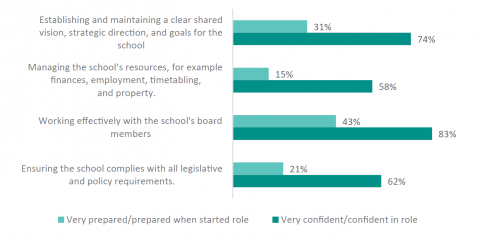
Principals grow their understanding considerably across these four areas once in the role.
However, it is concerning that confidence in the aspects of their role related to their legal and administrative responsibilities remains relatively low. Only 58 percent of new principals are currently confident in managing resources, and 62 percent are confident in ensuring their school complies with all legislative and policy requirements.
In interviews, we heard that this is due to difficulties accessing guidance and clarity about necessary tasks, deadlines, and expectations with many principals often ‘stumbling across’ information through happenstance conversations or on social media. New principals described having to ask or phone several contacts and consult a number of websites before finding the information they needed. Principals expressed frustration at the amount of time this can take, noting that it would be preferable if this information could be instantly accessible, rather than having to ‘chase it down’ themselves. Principals and experts also expressed concern about the reliability of the tools and resources being circulated.
“It would be good if someone could just tell me - if they could call me, instead of me having to call them.” – New principal
“I trawled the New Zealand Principals Facebook page. … I trawled through that looking for anything that I might not know. And, and there were some principals’ calendars – I don’t know where they got them from, I don't know how to find them on the internet, but I downloaded them. You’re like, ‘Is this legit?’” – New principal
“You should be able to click on to a tab that says, ‘Are you a beginning principal?’ Click. ‘Do you know what you can apply for?’” – New principal
“Many principals are turning to informal support, online resources and templates shared via Facebook, Google Drive. There is no guarantee that these resources are of high quality.” – Expert
Experts also shared that there is currently no register or tracking of principal appointments (or vacancies), which would tell support agencies when a new principal enters the workforce. This may be a contributing factor in the lack of targeted support reaching new principals.
b) Areas that increase the least with on-the-job experience
More on-the-job experience does not increase new principals’ confidence in six key areas
Interestingly, in six of the 11 areas, more experience is not linked to greater confidence. These areas are:
- building and maintaining positive, effective relationships with staff and learners
- ensuring the delivery of high-quality teaching practice and curriculum across the school
- working with data to monitor and evaluate teaching and learning
- giving effect to Te Tiriti o Waitangi throughout the school
- working in partnership with whānau Māori, hapū, and iwi to develop a localised curriculum that is inclusive of mātauranga Māori
- working closely with diverse families and community groups to promote inclusion for all learners.
These six areas can be summarised as parts of the principal role that are either:
-
- Everyday aspects of teaching and leading outside of principalship, where new principals are already fairly comfortable: relational and community-focused practices, and working with data. In our interviews with new principals, they affirmed these were areas of their role with which they are familiar and confident.
- Related to partnerships with Māori and Tiriti-based practice. These are areas that should be everyday aspects of teaching and leading outside of principalship – however it is well-established this is an area of practice that needs improvement across the sector. The low levels of confidence across the new principal population, as well as the limited growth in confidence shown here, is a serious concern.
3) What difference does development and support make?
a) Engagement with development and support
Principals access a wide range of development and support once in the role
New principals continue to engage with development and support opportunities once they are in the principal role, and often engage in a range of these. More than 80 percent of new principals access four or more types of development and support once in the role.
Nearly all new principals take part in collaborative groups (95 percent), and/or structured, ongoing programmes for new/acting principals (95 percent).
Most have participated in ongoing one-on-one coaching/mentoring (89 percent), one-off programmes or courses on specific aspects of the principal role (77 percent), or other formal or informal training and support (77 percent). Twenty-seven percent engage in postgraduate school leadership qualifications once in the role.
Figure 17: Participation in development and support opportunities since becoming principal
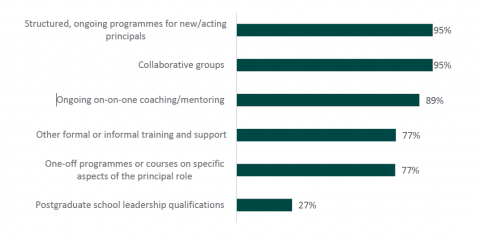
In our interviews, principals expressed that they enjoy engaging in professional learning and development, and particularly look forward to opportunities to learn and discuss practice with colleagues and peers. This aligns with what we know from the evidence base, that ‘principals are self-motivated adult learners … [who] exhibit an ongoing moral commitment to learning’.30
b) The types of development and support that make the most difference
ERO was interested in the impact of development and support activities on principals’ confidence and wellbeing. We asked principals how effective they found their participation in each type of development and support, in terms of helping with their confidence, and with their wellbeing. Because there is such high uptake of all of the development and support activities that we asked about, there were not enough principals that did not participate in those activities to be able to determine the impact of participating versus not participating on their confidence. So, we have used principals’ ratings in this section.
Principals find development and support that involves connecting with others most effective for building their confidence in the role
Their ratings of effectiveness show that they found the most benefit in supports that involve collaborative discussions and connections with other principals.
Figure 18: How effective new principals have found each type of development activity they participated in, since becoming principal
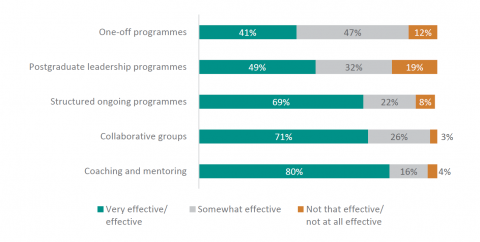
Of the principals that participated in each type of development and support:
- 80 percent found coaching and mentoring effective or very effective
- 71 percent found collaborative groups effective or very effective
- 69 percent found structured ongoing programmes effective or very effective
- 49 percent found postgraduate leadership programmes effective or very effective
- 41 percent found one-off programmes or courses effective or very effective.
This reflects what we know from the evidence base.31 Development and support that involves connecting and engaging in critical discussion with others helps leaders find effective ways of working.32 Coaching and mentoring, in particular, is valued for being personalised and specific to the leadership needs of a new principal.33 One-off programmes like webinars, meanwhile, do not provide the ongoing support and challenge needed to make lasting changes to practice.34
In our interviews, we heard that principals strongly value opportunities to problem-solve with peers and more experienced principals or coaches (including from non-educational backgrounds).
“[My mentor] has been the most influential person … I wouldn't be where I am today without his guidance and support.” – New principal
“There are several new principals up here in this area … We’ve got a little support group together which I think has been really helpful. This is a new area for me, a new community, and I feel a little bit lonely sometimes. So it's been really good to be able to reach out to other principals, people going through the same things, and say, ‘Hey, what are you doing?’ And just talking through things.” – New principal
“The most powerful support strategy for me as a new principal (in amongst a struggling school, Covid, etc.), is reaching out to other principals. I have my '24/7' group that help me at any time! I meet with each of them regularly for coffee. This mentor group has been phenomenal for my self-preservation, progress, and confidence.- New principal (written response)
Principals find development and support that involves connecting with others most effective for supporting their wellbeing in the role
In Aotearoa New Zealand, concerns have been raised about the poor wellbeing of principals in their role. This has been well-established in other studies35, and is not the focus of this report. However, good wellbeing is a big part of successfully growing into the principal role, so ERO was interested to find out about the influence that different types of development and support have on new principals’ wellbeing.
ERO asked new principals what impact they feel that development and support activities (including the additional option of the Employee Assistance Programme [EAP]) have on their wellbeing. Interestingly, the same two types came out on top for supporting wellbeing as for supporting their confidence: coaching and mentoring, and collaborative groups.
Figure 19: Percentage of new principals who feel that different development activities have had a positive impact on their wellbeing
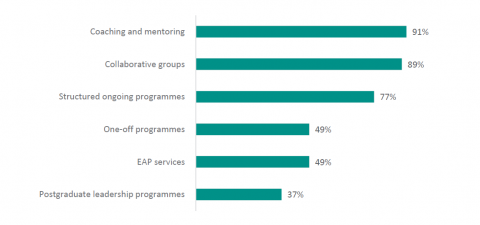
In our interviews, we heard that the reason these types of supports are so effective in terms of wellbeing is that they provide a chance to step back from the everyday tasks and reflect on the bigger picture of the role, which re-ignites principals’ passion and positivity. Collaborative groups, whether formal (such as Kāhui Ako) or informal (like coffee groups), are a particular source of comfort for principals.
“I am so grateful to my fellow beginning principals whom I started with in my Kāhui Ako. I would not have survived without them, and I know they feel the same.” – New principal
Similarly, we heard that mentoring and coaching relationships offer new principals valuable perspective and collegial support. Several principals who we spoke with had retained mentors from their previous roles, while others had new mentors through beginning principal programmes such as Huia Kaimanawa or the First-Time Principals’ Programme. In either case, they most appreciated mentors that were experienced, encouraging, and readily available for advice and support.
“I know that I can just pick up the phone and ring her at any moment … she'll make me think … she'll kind of guide and mentor me through it.” – New principal
In addition, we heard about the value of principals’ conferences and networking hui as positive sources of wellbeing support. For example, one principal shared that principal conferences are ‘a nice safe space’ to problem-solve with others, and she values this even more than their professional content. We did not ask specifically about this form of support in our surveys, but they were regularly brought up in our interviews with new principals and sector experts. Conferences offer similar collegial opportunities as coaching/mentoring and collaborative groups, which were the most highly rated forms of support in our surveys.
“Nothing replaces … actually having three or four days where you're actually getting to know some other principals, hearing their problems of practice and their wonderful innovations and being inspired, and coming back refreshed and connected.” – New principal
4) How aware are boards of their principals’ capability?
a) Boards’ and principals’ impressions of principal confidence
School boards are very positive about principals’ confidence in the role. Their views align most with principals in the areas of practice where principals are most confident
Across all areas of practice, board representatives are more positive about principals’ confidence than principals themselves. The areas where the boards’ views most closely match principals’, are the same areas where principals are most confident. These areas relate to working with data, and relationships with staff, learners, board, and community. Surveys were sent to board chairs/presiding members. They were also offered the option of passing the survey on to another board member as their representative, in cases where a different board member had more knowledge of the new principal.
Figure 20: New principals’ and boards’ impressions of principal confidence in areas where they are similar
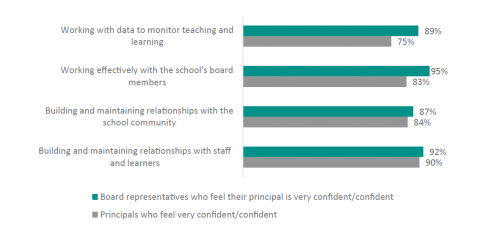
School boards are not aware of the capability issues that new principals are facing
Board representatives are overwhelmingly positive about principals’ confidence. Ninety-one percent of boards rate their new principals as confident overall, compared to only 71 percent of principals themselves.
Figure 21: New principals’ and boards’ impressions of overall confidence
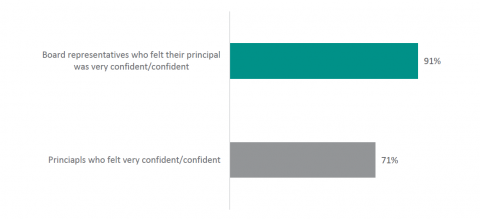
The difference is even more noticeable when principal confidence is broken down into the 11 key areas of practice. Board representatives are overwhelmingly positive about principals’ confidence in most areas of the role, with at least 88 percent of board representatives indicating that their principals are confident or very confident in eight of the 11 areas. This drops to approximately 80 percent for the area of working in partnership with whānau Māori, hapū, and iwi. The difference between the principals’ and boards’ view of confidence levels are most noticeable in the areas of practice where principals are least confident: Tiriti-related and Māori partnership practices, and compliance and resourcing aspects.
Figure 22: New principals’ and boards’ impressions of principal confidence in areas where they are dissimilar
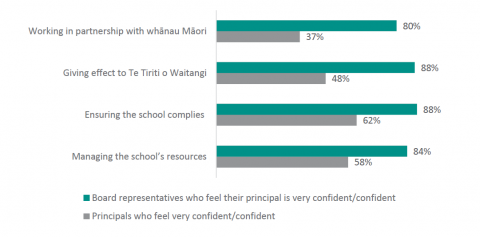
Board representatives express high levels of confidence in their principals: to do a good job, and to inform the board about their own support needs.
“Our new principal has just completed her first term as a new principal. At the time of this survey she is very confident, has numerous ideas on continuing with our strategic plan. She has made numerous plans for moving forward this year … We are very excited to see how our year plays out.” – Board chair/presiding member
“We are comfortable with the development and support opportunities that the principal has undertaken. We are however concerned that boards are not well informed about what opportunities are available, and need to rely very much on the principal identifying these.” – Board chair/presiding member
Principals told us, in interviews, about the tensions they feel between maintaining the trust of their new employers through appearing capable and positive, and their actual need for much higher levels of support. This could explain why board members are not being made aware of principals’ areas of lower confidence, it feels like a risk to principals to reveal those challenges.
“Advocating for my own wellbeing and professional learning, through budget allocation or the board, is hard as a new principal. You feel guilty doing it when the board has just hired you. You feel obliged to live up to your perceived expectations of what they want.” - New principal
b) Boards’ and principals’ impressions of principal wellbeing
School boards are not aware of the wellbeing issues that new principals are facing
There is also a significant difference between how highly board chairs and presiding members rate their principals’ wellbeing, and principals’ own reported level of wellbeing. In our survey, 69 percent of board survey respondents rated new principals’ wellbeing as high or very high, compared to just 23 percent of new principals themselves.
Figure 23: New principals’ and boards’ impressions of principal wellbeing
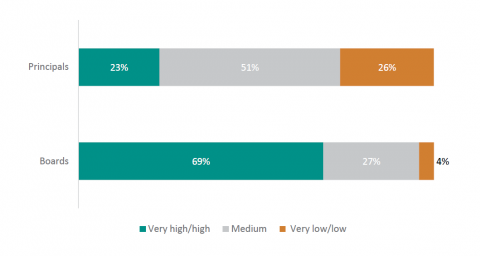
In interviews, new principals told us that they are uncomfortable sharing their wellbeing challenges and support needs with their boards, because they want to maintain an impression of ‘hold[ing] it together’.
“Even though things were being tough and changes were happening, I was still ensuring to have a positive vibe and environment within our culture. So the only one who knew that I was totally stressed out and out the gate was my husband, but no one else could see it in the forefront at all because I didn't want to fail.” – New principal
“Advocating for my own wellbeing … is hard as a new principal. …For a new or inexperienced board chair, they may not be aware of their responsibility of supporting principal wellbeing. It's uncomfortable reminding them, so you don't do it.” - New principal
Conclusion
Once in the role, principals’ confidence increases over time – but there remain key areas where they lack confidence. Practices related to embedding Te Tiriti o Waitangi across the school, and partnering with Māori are challenges, as are legal and administrative responsibilities.
To enhance their learning and wellbeing, principals benefit from development and support that involves connecting with peers and more experienced principals. However, these opportunities are not being accessed by all.
School boards are not fully aware of the capability and wellbeing issues that new principals are grappling with, indicating a need for improved communication.
We asked new principals how confident they are in their role, and about the development and support activities they have accessed since they started. This section is focused on the time since they started their first principalship.
ERO found that new principals are not always getting the support that they need to learn and grow into their role. Practices related to embedding Te Tiriti o Waitangi across the school and partnering with Māori are especially challenging for many new principals, as are legal and administrative leadership. There are some important areas of practice where they lack confidence. While almost all new principals access development and support in their new job, useful supports like coaching, mentoring, and peer connection opportunities are not being accessed by all principals.
In the previous section we looked at how prepared new principals were before they started in the role. In this section, we report on the development and supports new principals access after they start in the role, and how these experiences impact on their confidence and wellbeing. We share what we found out about how and why some development and supports are so important.
To ensure that we maintain a clear distinction between how prepared new principals were when they started and how confident they have become since they started, this section does not include confidence ratings for principals who had been in the role for less than 6 months.
This section of the report outlines:
- How confident are new principals in their role?
- Overall confidence
- Areas of highest confidence
- Areas of lowest confidence
- In what areas does on-the-job experience raise confidence the most?
- Areas that increase the most with on-the-job experience
- Areas that increase the least with on-the-job experience
- What difference does development and support make?
- Engagement with development and support
- The types of development and support that make the most difference
- The types of development and support that support principals’ confidence
- The types of development and support that support principals’ wellbeing
- How aware are boards of their principals’ capability?
- Boards’ and principals’ impressions of principal confidence
- Boards’ and principals’ impressions of principal wellbeing
1) How confident are new principals in their role?
ERO asked new principals to rate how confident they are, now that they are in the principal role. We asked about their overall confidence, and also their confidence across the 11 key areas of principal practice.
a) Overall confidence
Most new principals feel confident in their role overall, and their confidence increases over time
While only a quarter start the role feeling prepared (27 percent), once in the role for at least six months (and up to five years), 71 percent of all new principals that we surveyed feel confident or very confident in their role overall.
Figure 12: How confident new principals feel overall
Understandably, this confidence increases with time. Fifty-eight percent of those who have been there for one to two years feel confident or very confident overall, while 81 percent of those who have been in the role for four to five years feel confident or very confident.
Figure 13: Percentage of new principals who feel confident or very confident by time in role
Principals that we spoke with affirmed that their confidence continues to grow as they settle into their new role. They emphasised, however, that the journey to their new level of confidence has taken a lot of energy and effort. We heard that this growth in confidence was more about recovering from a dip in confidence because they had felt so unprepared and unconfident at the start of their time in the role.
“Until you’ve got the job, you don’t know what you don’t know.” – New Principal
“We're into it on Monday with a pōwhiri and then it's been a pretty steep learning curve ever since … it’s just massive because everything, everything, was new.” – New principal
b) Areas of highest confidence
Principals are most confident in the relationship-based aspects of their role
The areas that new principals feel the most confident in are building and maintaining positive, effective relationships with staff and learners (90 percent feel confident or very confident), building and maintaining positive, effective relationships with the school community (84 percent feel confident or very confident), and working effectively with the school's board members (83 percent feel confident or very confident).
Figure 14: Percentage of new principals who feel confident or very confident in the top three areas
c) Areas of lowest confidence
New principals’ confidence remains particularly low in two critical areas of principal practice: Giving effect to Te Tiriti o Waitangi, and working in partnership with Māori
Giving effect to Te Tiriti o Waitangi, and working in partnership with Māori, are areas of low preparedness when new principals first started their role. This worrying picture does not improve much over time.
Less than half (48 percent) of new principals are confident in giving effect to Te Tiriti o Waitangi throughout the school. This is only a small increase (11 percentage points) from how prepared principals were when they first started.
Only about a third of new principals (37 percent) feel confident or very confident to work in partnership with whānau Māori, hapū, and iwi. This is a small (15 percentage) point increase from how prepared new principals felt when starting the role.
Figure 15: Percentage of new principals who felt prepared when they started compared to the percentage who feel confident now across different areas
In interviews, we heard that this lack of preparedness and confidence is rooted in being unclear about where to start, and what ‘good’ looks like. Principals described their lack of clarity about what to do to build their confidence and meet expectations.
As discussed in the previous section, Tiriti-based and Māori partnership practices are crucial to the educational success of all learners in Aotearoa New Zealand’s schools. The low levels of confidence in this area across the new principal population is a serious concern.
2) In what areas does on-the-job experience raise confidence the most?
a) Areas that increase most with on-the-job experience
In aspects of the role to do with administration, governance, and direction setting, new principals’ confidence grows considerably with on-the-job experience
More than two-thirds of new principals currently feel confident or very confident across seven of the 11 key areas of practice, with significant increases in all 11 areas from how prepared they had been when they first started.
The areas for which confidence increased the most, compared to principals’ initial preparedness, are:
- Establishing and maintaining a clear shared vision, strategic direction, and goals for the school
- Managing the school resources, for example finances, employment, timetabling, and property
- Working effectively with the school’s board members
- Ensuring the school complies with all legislative and policy requirements.
Figure 16: Percentage of new principals who felt prepared when they started compared to the percentage who feel confident now across different areas
Principals grow their understanding considerably across these four areas once in the role.
However, it is concerning that confidence in the aspects of their role related to their legal and administrative responsibilities remains relatively low. Only 58 percent of new principals are currently confident in managing resources, and 62 percent are confident in ensuring their school complies with all legislative and policy requirements.
In interviews, we heard that this is due to difficulties accessing guidance and clarity about necessary tasks, deadlines, and expectations with many principals often ‘stumbling across’ information through happenstance conversations or on social media. New principals described having to ask or phone several contacts and consult a number of websites before finding the information they needed. Principals expressed frustration at the amount of time this can take, noting that it would be preferable if this information could be instantly accessible, rather than having to ‘chase it down’ themselves. Principals and experts also expressed concern about the reliability of the tools and resources being circulated.
“It would be good if someone could just tell me - if they could call me, instead of me having to call them.” – New principal
“I trawled the New Zealand Principals Facebook page. … I trawled through that looking for anything that I might not know. And, and there were some principals’ calendars – I don’t know where they got them from, I don't know how to find them on the internet, but I downloaded them. You’re like, ‘Is this legit?’” – New principal
“You should be able to click on to a tab that says, ‘Are you a beginning principal?’ Click. ‘Do you know what you can apply for?’” – New principal
“Many principals are turning to informal support, online resources and templates shared via Facebook, Google Drive. There is no guarantee that these resources are of high quality.” – Expert
Experts also shared that there is currently no register or tracking of principal appointments (or vacancies), which would tell support agencies when a new principal enters the workforce. This may be a contributing factor in the lack of targeted support reaching new principals.
b) Areas that increase the least with on-the-job experience
More on-the-job experience does not increase new principals’ confidence in six key areas
Interestingly, in six of the 11 areas, more experience is not linked to greater confidence. These areas are:
- building and maintaining positive, effective relationships with staff and learners
- ensuring the delivery of high-quality teaching practice and curriculum across the school
- working with data to monitor and evaluate teaching and learning
- giving effect to Te Tiriti o Waitangi throughout the school
- working in partnership with whānau Māori, hapū, and iwi to develop a localised curriculum that is inclusive of mātauranga Māori
- working closely with diverse families and community groups to promote inclusion for all learners.
These six areas can be summarised as parts of the principal role that are either:
-
- Everyday aspects of teaching and leading outside of principalship, where new principals are already fairly comfortable: relational and community-focused practices, and working with data. In our interviews with new principals, they affirmed these were areas of their role with which they are familiar and confident.
- Related to partnerships with Māori and Tiriti-based practice. These are areas that should be everyday aspects of teaching and leading outside of principalship – however it is well-established this is an area of practice that needs improvement across the sector. The low levels of confidence across the new principal population, as well as the limited growth in confidence shown here, is a serious concern.
3) What difference does development and support make?
a) Engagement with development and support
Principals access a wide range of development and support once in the role
New principals continue to engage with development and support opportunities once they are in the principal role, and often engage in a range of these. More than 80 percent of new principals access four or more types of development and support once in the role.
Nearly all new principals take part in collaborative groups (95 percent), and/or structured, ongoing programmes for new/acting principals (95 percent).
Most have participated in ongoing one-on-one coaching/mentoring (89 percent), one-off programmes or courses on specific aspects of the principal role (77 percent), or other formal or informal training and support (77 percent). Twenty-seven percent engage in postgraduate school leadership qualifications once in the role.
Figure 17: Participation in development and support opportunities since becoming principal
In our interviews, principals expressed that they enjoy engaging in professional learning and development, and particularly look forward to opportunities to learn and discuss practice with colleagues and peers. This aligns with what we know from the evidence base, that ‘principals are self-motivated adult learners … [who] exhibit an ongoing moral commitment to learning’.30
b) The types of development and support that make the most difference
ERO was interested in the impact of development and support activities on principals’ confidence and wellbeing. We asked principals how effective they found their participation in each type of development and support, in terms of helping with their confidence, and with their wellbeing. Because there is such high uptake of all of the development and support activities that we asked about, there were not enough principals that did not participate in those activities to be able to determine the impact of participating versus not participating on their confidence. So, we have used principals’ ratings in this section.
Principals find development and support that involves connecting with others most effective for building their confidence in the role
Their ratings of effectiveness show that they found the most benefit in supports that involve collaborative discussions and connections with other principals.
Figure 18: How effective new principals have found each type of development activity they participated in, since becoming principal
Of the principals that participated in each type of development and support:
- 80 percent found coaching and mentoring effective or very effective
- 71 percent found collaborative groups effective or very effective
- 69 percent found structured ongoing programmes effective or very effective
- 49 percent found postgraduate leadership programmes effective or very effective
- 41 percent found one-off programmes or courses effective or very effective.
This reflects what we know from the evidence base.31 Development and support that involves connecting and engaging in critical discussion with others helps leaders find effective ways of working.32 Coaching and mentoring, in particular, is valued for being personalised and specific to the leadership needs of a new principal.33 One-off programmes like webinars, meanwhile, do not provide the ongoing support and challenge needed to make lasting changes to practice.34
In our interviews, we heard that principals strongly value opportunities to problem-solve with peers and more experienced principals or coaches (including from non-educational backgrounds).
“[My mentor] has been the most influential person … I wouldn't be where I am today without his guidance and support.” – New principal
“There are several new principals up here in this area … We’ve got a little support group together which I think has been really helpful. This is a new area for me, a new community, and I feel a little bit lonely sometimes. So it's been really good to be able to reach out to other principals, people going through the same things, and say, ‘Hey, what are you doing?’ And just talking through things.” – New principal
“The most powerful support strategy for me as a new principal (in amongst a struggling school, Covid, etc.), is reaching out to other principals. I have my '24/7' group that help me at any time! I meet with each of them regularly for coffee. This mentor group has been phenomenal for my self-preservation, progress, and confidence.- New principal (written response)
Principals find development and support that involves connecting with others most effective for supporting their wellbeing in the role
In Aotearoa New Zealand, concerns have been raised about the poor wellbeing of principals in their role. This has been well-established in other studies35, and is not the focus of this report. However, good wellbeing is a big part of successfully growing into the principal role, so ERO was interested to find out about the influence that different types of development and support have on new principals’ wellbeing.
ERO asked new principals what impact they feel that development and support activities (including the additional option of the Employee Assistance Programme [EAP]) have on their wellbeing. Interestingly, the same two types came out on top for supporting wellbeing as for supporting their confidence: coaching and mentoring, and collaborative groups.
Figure 19: Percentage of new principals who feel that different development activities have had a positive impact on their wellbeing
In our interviews, we heard that the reason these types of supports are so effective in terms of wellbeing is that they provide a chance to step back from the everyday tasks and reflect on the bigger picture of the role, which re-ignites principals’ passion and positivity. Collaborative groups, whether formal (such as Kāhui Ako) or informal (like coffee groups), are a particular source of comfort for principals.
“I am so grateful to my fellow beginning principals whom I started with in my Kāhui Ako. I would not have survived without them, and I know they feel the same.” – New principal
Similarly, we heard that mentoring and coaching relationships offer new principals valuable perspective and collegial support. Several principals who we spoke with had retained mentors from their previous roles, while others had new mentors through beginning principal programmes such as Huia Kaimanawa or the First-Time Principals’ Programme. In either case, they most appreciated mentors that were experienced, encouraging, and readily available for advice and support.
“I know that I can just pick up the phone and ring her at any moment … she'll make me think … she'll kind of guide and mentor me through it.” – New principal
In addition, we heard about the value of principals’ conferences and networking hui as positive sources of wellbeing support. For example, one principal shared that principal conferences are ‘a nice safe space’ to problem-solve with others, and she values this even more than their professional content. We did not ask specifically about this form of support in our surveys, but they were regularly brought up in our interviews with new principals and sector experts. Conferences offer similar collegial opportunities as coaching/mentoring and collaborative groups, which were the most highly rated forms of support in our surveys.
“Nothing replaces … actually having three or four days where you're actually getting to know some other principals, hearing their problems of practice and their wonderful innovations and being inspired, and coming back refreshed and connected.” – New principal
4) How aware are boards of their principals’ capability?
a) Boards’ and principals’ impressions of principal confidence
School boards are very positive about principals’ confidence in the role. Their views align most with principals in the areas of practice where principals are most confident
Across all areas of practice, board representatives are more positive about principals’ confidence than principals themselves. The areas where the boards’ views most closely match principals’, are the same areas where principals are most confident. These areas relate to working with data, and relationships with staff, learners, board, and community. Surveys were sent to board chairs/presiding members. They were also offered the option of passing the survey on to another board member as their representative, in cases where a different board member had more knowledge of the new principal.
Figure 20: New principals’ and boards’ impressions of principal confidence in areas where they are similar
School boards are not aware of the capability issues that new principals are facing
Board representatives are overwhelmingly positive about principals’ confidence. Ninety-one percent of boards rate their new principals as confident overall, compared to only 71 percent of principals themselves.
Figure 21: New principals’ and boards’ impressions of overall confidence
The difference is even more noticeable when principal confidence is broken down into the 11 key areas of practice. Board representatives are overwhelmingly positive about principals’ confidence in most areas of the role, with at least 88 percent of board representatives indicating that their principals are confident or very confident in eight of the 11 areas. This drops to approximately 80 percent for the area of working in partnership with whānau Māori, hapū, and iwi. The difference between the principals’ and boards’ view of confidence levels are most noticeable in the areas of practice where principals are least confident: Tiriti-related and Māori partnership practices, and compliance and resourcing aspects.
Figure 22: New principals’ and boards’ impressions of principal confidence in areas where they are dissimilar
Board representatives express high levels of confidence in their principals: to do a good job, and to inform the board about their own support needs.
“Our new principal has just completed her first term as a new principal. At the time of this survey she is very confident, has numerous ideas on continuing with our strategic plan. She has made numerous plans for moving forward this year … We are very excited to see how our year plays out.” – Board chair/presiding member
“We are comfortable with the development and support opportunities that the principal has undertaken. We are however concerned that boards are not well informed about what opportunities are available, and need to rely very much on the principal identifying these.” – Board chair/presiding member
Principals told us, in interviews, about the tensions they feel between maintaining the trust of their new employers through appearing capable and positive, and their actual need for much higher levels of support. This could explain why board members are not being made aware of principals’ areas of lower confidence, it feels like a risk to principals to reveal those challenges.
“Advocating for my own wellbeing and professional learning, through budget allocation or the board, is hard as a new principal. You feel guilty doing it when the board has just hired you. You feel obliged to live up to your perceived expectations of what they want.” - New principal
b) Boards’ and principals’ impressions of principal wellbeing
School boards are not aware of the wellbeing issues that new principals are facing
There is also a significant difference between how highly board chairs and presiding members rate their principals’ wellbeing, and principals’ own reported level of wellbeing. In our survey, 69 percent of board survey respondents rated new principals’ wellbeing as high or very high, compared to just 23 percent of new principals themselves.
Figure 23: New principals’ and boards’ impressions of principal wellbeing
In interviews, new principals told us that they are uncomfortable sharing their wellbeing challenges and support needs with their boards, because they want to maintain an impression of ‘hold[ing] it together’.
“Even though things were being tough and changes were happening, I was still ensuring to have a positive vibe and environment within our culture. So the only one who knew that I was totally stressed out and out the gate was my husband, but no one else could see it in the forefront at all because I didn't want to fail.” – New principal
“Advocating for my own wellbeing … is hard as a new principal. …For a new or inexperienced board chair, they may not be aware of their responsibility of supporting principal wellbeing. It's uncomfortable reminding them, so you don't do it.” - New principal
Conclusion
Once in the role, principals’ confidence increases over time – but there remain key areas where they lack confidence. Practices related to embedding Te Tiriti o Waitangi across the school, and partnering with Māori are challenges, as are legal and administrative responsibilities.
To enhance their learning and wellbeing, principals benefit from development and support that involves connecting with peers and more experienced principals. However, these opportunities are not being accessed by all.
School boards are not fully aware of the capability and wellbeing issues that new principals are grappling with, indicating a need for improved communication.
Part 4. Small schools: Preparedness and confidence of new principals in small schools
Four in ten of our new principals are in small schools. It’s important that these principals are well supported to be prepared and confident in their role.
However, we found that new principals that start in small schools are less prepared, less likely to have had prior leadership experience, and have accessed less prior development and support. Once in the role, they are less confident, can face barriers accessing the most effective development, and report poorer wellbeing. These are concerning findings.
Nearly a third (29 percent, in 2022) of Aotearoa New Zealand’s schools are classified as having ‘small’ or ‘very small’ roll sizes. (In this report, we group both of these together, and call them ‘small schools’.) This means that they have fewer than 101 learners in primary schools and fewer than 401 learners in secondary schools. Many of these principal roles involve a classroom teaching component.
Four in ten (39 percent, in 2022) of new principals are in small schools – around 330 new principals. In this section, we set out our findings that are specifically about the preparedness and confidence of these principals.
This section of the report outlines:
- How prepared are principals in small schools?
- What pathways do small school principals take into the role?
- What development and supports do small school principals engage with before starting?
- How confident are small school principals, once in the role?
- What development and supports do new, small school principals engage with, once in the role?
- Development and support once in the role
- Wellbeing in the role
Small schools have a lot of crossover with rural schools
Many people think of small schools as being rural or ‘country schools’. But only 64 percent of Aotearoa New Zealand’s small schools are in rural settings. However, it is important to keep in mind when reading this report, that there is a lot of crossover.
In our analysis, we looked at how both school size and school rurality impact overall preparedness. We did note that principals in rural schools were less likely to be prepared overall – however, we found that their rurality was not as important a factor as the size of their school.
1) How prepared are principals in small schools?
Starting in a larger school is one of the most important factors associated with being prepared for the principal role
As discussed in Part 2 of this report, ERO analysed survey data to identify the most important factors associated with principals’ overall preparedness for the role. As well as pathways and supports (leadership experience, coaching/mentoring, and postgraduate study), an additional key factors associated with feeling more prepared overall for the principal role was starting in a larger school.
Principals who start in small schools are a third less likely to feel prepared overall than those starting in large schools
Just one-fifth (20 percent) of new principals in small and very small schools felt prepared for the principal role overall when they began, compared to 31 percent of principals in large and very large schools.
Figure 24: Percentage of new principals who felt prepared overall by school size
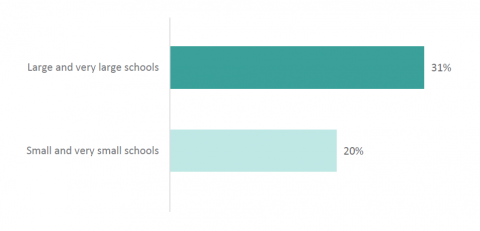
In addition to not having prior leadership experience, our interviews with experts and principals reveal three main causes for low levels of preparedness for principals in small school. These causes, set out below, relate to the breadth of their new role, their shift in school context, and their limited contact with colleagues.
- Working in small schools involves a different, broader set of tasks and responsibilities than in larger schools. For example, small school principals often have a teaching role alongside their principal duties, can be the ‘one and only’ when it comes to tasks that larger schools could delegate to DPs and others, are often required to deal with property and maintenance, and can experience difficulties hiring staff or accessing relievers. ‘I’m the caretaker, I’m the cleaner, I’m the principal, I’m the teacher. There’s a lot of hats to wear here’ (New principal). With little room for delegation of tasks, new principals feel unprepared for the breadth of their role and range of skills required.
“I compare to [neighbouring large school] where, you know, he has exactly the same requirements from the Ministry of Education as I do, but he has two DPs, a full time caretaker, a pastoral care [leader], an office admin and a financial officer. Yes, he’s got bigger numbers [of students], granted, but how much of that delegated work do I have to do as well as teach? And the answer is all of it.” – Small school new principal
- Small school principals who have moved from larger schools find that their previous experiences and skillset do not match up with their new context. Most of the principals from small schools that we talked to had moved into their role from larger schools, usually from different or larger communities. We heard that this created an extra sense of complexity on top of the challenges of the new role itself. Community relationships, and the balancing of a range of teaching and leadership responsibilities, are particularly challenging.
“I thought I was prepared for this role, having been a middle manager in a large school ... I spend most of my time being a ‘reliever’ on my principal days as it is had to get staff. The workload is not vastly different from a larger school principal but the hours available are half.” - Small school new principal
“What I didn't realise is that Auckland is a bubble … where I thought Auckland was the way things were in New Zealand, and 100 percent it is not. Ninety percent of New Zealand is this, it's living in these small towns … That has been a huge challenge.” - Small school new principal
- Small school principals have less support. Principals in small schools do not work within collaborative leadership teams, and work with few (or no) other teaching professionals with whom they can collaborate and ‘bounce ideas off’. For example, one principal described what she missed was being able to ‘just pop down the hall’ to talk to other leaders. There are also fewer support and administrative staff. A sense of isolation from others contributes to small school principals feeling unprepared, and that they are ‘just kind of left to it’.
“I think the biggest change for me here has been the isolation and the lack of any supportive person.” - Small school new principal
“We can't just catch up with someone for a coffee down the road or anything like that … Our ability to connect, other than virtually, doesn't exist.” – Small school new principal
Principals in small schools are significantly less prepared for some aspects of the role
In some key areas of the role, principals who start in small schools are significantly less prepared than those who start in large schools. These areas are:
-
- Ensuring the delivery of high-quality teaching practice and curriculum across the school
- Establishing and maintaining a clear shared vision, strategic direction, and goals
- Ensuring the school complies with all legislative and policy requirements
- Managing the school’s resources, for example finances, employment, and timetabling.
Figure 25: Percentage of new principals who felt prepared or very prepared in each area by school size
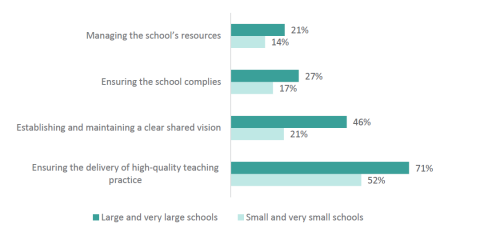
2) What pathways do small school principals take into the role?
New principals starting in small schools are a fifth less likely to have had prior leadership experience than those who start in large schools.
Principals who start in small schools are over 10 times more likely to have come straight from teaching (or other areas of education) compared to principals starting in larger schools. Twenty-two percent of principals starting in small schools came from the non-leadership pathway, compared to only two percent of principals starting in large schools.
Figure 26: New principals who came through the leadership and non-leadership pathway by school size
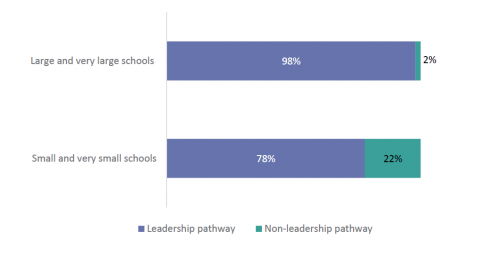
This is a concerning finding, as we know how important pathways are. Coming through a leadership pathway is one of the key drivers of preparedness for the role. This means that our smaller schools are more likely to be being led by our least experienced, least prepared new principals.
In our interviews, we heard that some principals who had struggled to secure roles in the city had found more success when applying for smaller schools in rural and isolated areas, where there were fewer applicants. This could indicate that these roles are ‘easier’ to get for less‑experienced aspiring principals. This aligns with what we heard from sector experts. They described a shift in the way principals view working in smaller, usually more rural, schools: that it is no longer seen as a desirable pathway. The teaching component of smaller school principalship, and lower remuneration for principalship in schools with smaller rolls, are off-putting to more experienced leaders.
“There is a very small amount of experienced rural principals left in the country and this needs to change. … DPs in larger schools aspire to principalship in U3+ schools and above which are predominantly in suburban areas, because of remuneration and because they are released in their DP role - so why would you ‘go back’ to a teaching role as a principal, with that level of accountability for a whole school?” - Expert
3) What development and support do small school new principals engage with before starting?
Principals that start in smaller schools are a third less likely to have participated in development and support before becoming a principal, and also found it less relevant
Principals starting in small and very small schools are less likely to have participated in development and support compared to those starting in large and very large schools.
- Forty-one percent of principals starting in smaller schools had participated in postgraduate programmes before starting – compared to 60 percent of principals starting in larger schools.
- Forty-six percent of principals starting in smaller schools had participated in ongoing structure programme before starting – compared to 69 percent of principals starting in larger schools.
- Forty-five percent of principals starting in smaller schools had participated in one-off programmes before starting – compared to 70 percent of principals starting in larger schools.
- Fifty-five percent of principals starting in smaller schools had participated in coaching and mentoring before starting – compared to 81 percent of principals starting in larger schools.
Figure 27: Participation in different development activities prior to becoming principal by school size
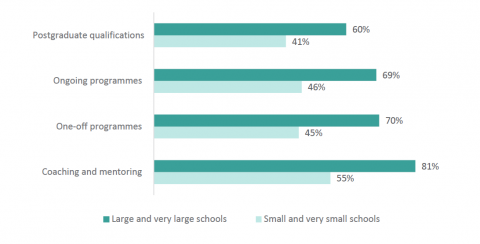
In our interviews with new principals from small schools, we heard that development and support is usually designed around a ‘typical’ larger school, and does not account for the reality of their small school setting. For example, one principal described how the case studies and scenarios within her postgraduate leadership programme were almost always about large schools, leaving her with very little understanding and preparation for the small school context she ended up working within.
“You literally have no clue what you’re doing for at least the first 12 months -especially when the office admin is as new as you are...” Small school new principal
“The juggle of teaching and leading is difficult for beginning principals in [small] schools, leaving them vulnerable. One is having to be in the headspace of leading a class of students and leading a school community, which adds to stress levels and does not leave enough time for getting to grips with a lot of the operational managerial tasks of a principal. This makes it hard to focus and ‘get up to speed’ efficiently.” – Expert
4) How confident are small school principals once in the role?
New principals in small schools are a quarter less likely to be confident than principals in larger schools
Just over half (59 percent) of new principals in small and very small schools feel confident or very confident in their role overall, which is significantly lower than their counterparts in large and very large schools (80 percent).
Figure 28: Percentage of principals who feel confident overall by school size
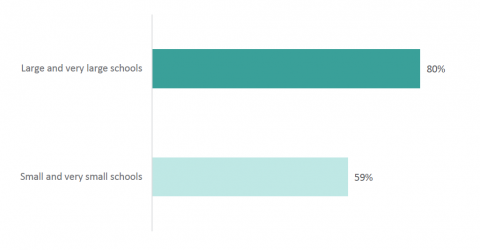
Small school principals are less confident in setting the direction for the school and ensuring the delivery of high-quality teaching practice and curriculum
The contrast between small and large school principals is particularly apparent in two key areas:
- establishing and maintaining a clear shared vision, strategic direction, and goals for the school
- ensuring the delivery of high-quality teaching practice and curriculum across the school
Figure 29: Percentage of new principals who feel confident or very confident in each area by school size
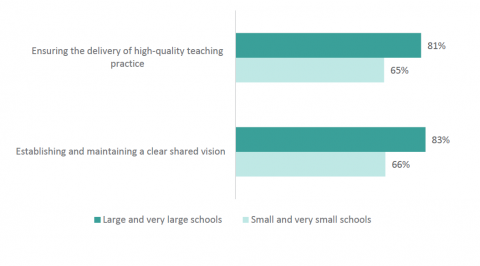
In our interviews with principals of smaller schools, and the experts that work with them, we heard about the reasons for their lower rates of confidence, including in these key strategic and curriculum delivery areas of their practice. Lower confidence stems from:
- having teaching responsibilities as well as principal duties
- having few opportunities to connect with other new and experienced principals
- challenges in working within, and gaining the trust of, a new community - including board members.
Principals shared that they struggle with wearing the different ‘hats’ of teacher and principal – often feeling that they are underperforming in both areas. One principal reported, ‘There’s that seesaw between [being a] good principal [or a] good teacher’. We heard that this is made worse by feeling alone in their role, not being able to delegate or discuss tasks, and having difficulty connecting with their new community. This is especially challenging for principals who are more accustomed to different settings and support structures, particularly if they had come up through larger schools, or are new to the area.
“Getting to know people, building those relationships [in a new small community] has been very hard, and it continues to be a challenge every day.” - Small school new principal
“It is hard … I am stuck doing admin, school visits, staff meetings, office, accounts, data, board, emails… and trying to upskill (including reading MoE stuff) somewhere amongst that…” – Small school new principal (written response)
“[Small school principals] don't have the luxury … where you have a PA [personal assistant] and you have someone who can do finance and property and sit alongside you and do all of that with you.” – Expert
In contrast, we heard from large school principals that their familiar setting and context contributes to their confidence in the role. Often, these principals had been internally promoted within the school from a senior leadership position.
“The good thing was because I stayed at the same school and took basically ended up in her position is through that, I had the breadth. I had an overview. I didn't have the depth in specific areas, but I had the breadth. So that was probably an advantage.” – Larger school New principal
“When [previous principal] went on sabbatical and I acted as principal, that was when I really thought, ‘Yeah, I can do this.’”- Larger school New principal
5) What development and support do new small school principals access once in the role?
a) Development and support once in the role
Principals in small schools report that they have trouble accessing the development and support types that are most effective
As outlined in Part Three of this report, principals most value coaching and mentoring, and collaborative groups, the most for supporting their wellbeing and for building their confidence. This was also true for small school principals, especially when they could connect with peers and mentors who had similar small, rural, or isolated school experience.
However, in our interviews we noted a clear difference between how easily small school and larger school principals are able to access these more collegial types of development and support. For example, a principal from a small school reported that, ‘Networking on my own has been hard’. Small school principals described their challenges in accessing development and support, most often due to their teaching responsibilities, difficulties finding cover, or location and travel (especially for isolated schools). This reflects recent studies36 around the challenges experienced by small school principals in rural and isolated settings.
“The teaching component [of small school principalship] means it can be difficult to attend courses for beginning principals as we struggle for relievers, being out of town. I've heard those courses are great - as of yet I haven't managed to attend any.” – Small school New principal
“What happens if I take a day off to go to a conference or a meeting or even just work at home to focus on the board report without interruption, I come back and I have to catch up on the work that piled up here. And I think this is specific to those smaller schools. Which are the very schools where usually beginning principals get their first job.” – small school New principal
Sector experts shared their concern about the impacts of isolation on the confidence and wellbeing of small school principals. They affirmed that these roles have unique challenges – particularly teaching principal roles, where principals can feel more stretched, and more isolated from the collegial support of other teachers and leaders.
“I have a sense that the level of isolation has become more paramount - I am hearing more and more about … seeing less and less of ‘real’ people come to visit them. This is not helpful for their own wellbeing and they need to engage with other professionals to grow in their role.” – Expert
“[There is a] challenge to raise an effective, capable, and successful board - particularly in [very small] schools - who are able to operate successfully in a very small community, and have any idea of how to support their principal.” - Expert
b) Wellbeing in the role
New principals in small schools experience much poorer wellbeing than principals in larger schools
Though wellbeing is a challenge across the new principal population, principals who work in smaller schools are having an even more difficult time. Thirty-three percent of new principals in small or very small schools report their wellbeing is low or very low, compared to 20 percent of new principals from large or very large schools.
Figure 30: Percentage of new principals who have low or very low wellbeing by school size
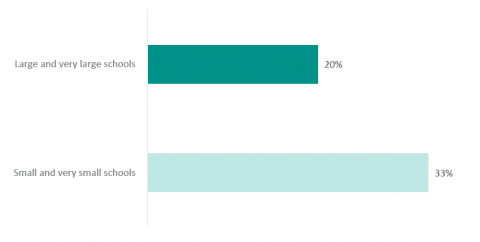
A separate piece of research conducted by ERO in 202337 had similar findings for principals of small schools. We found that school size was related to principal workload; the smaller the school, the more principals struggled with their workload. This remains true in 2023. Principals of very small schools (58 percent) are more than twice as likely to find their workload unmanageable compared to principals of very large schools (28 percent). Often these principals are themselves teaching and undertaking other roles in the absence of support staff.
Figure 31: Percentage of principals who find their workload unmanageable by school size
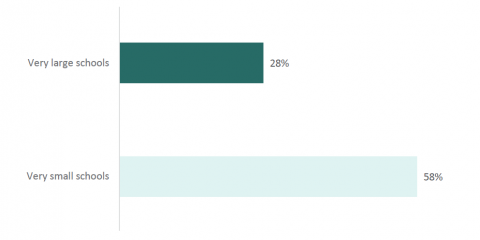
In interviews, principals in small schools emphasised their feelings of isolation and how much they missed, and needed, more opportunities for peer contact and support. In contrast, large-school principals credited their collegial supports for their good wellbeing: ‘I’m still smiling. Having the right people really makes a difference … Wellbeing is all about having good people around you’ (Large school principal). This makes sense – the evidence shows that peer support is a significant contributor to principals’ wellbeing, and the lack of this support compounds the negative impacts of isolation.38 Other Aotearoa New Zealand studies have raised concerns about the wellbeing of principals in small (particularly small, isolated, and rural) schools.39
“The lack of professional colleagues, no-one to plan lessons [or] bounce ideas off or discuss students with. It's very emotionally draining for principals, always being alone and doing everything alone, with no-one to discuss anything with.” – Small school new principal
“I wanted to share my story because while I'm very capable, I'm a very quick learner and I won't even begin to tell you what I was handed and what our school is now. … But it killed me to do it, you know what I mean? It's absolutely burnt me out. My wellbeing has suffered astronomically through this. To the point that I don't know how I wanted to do five years in this role - I don't know if I can. I don't think I can.” – Small school new principal
Conclusion
Four in ten of our new principals are in small schools, and they need better support. Our findings show that new principals that start in small schools are less prepared, less likely to have had prior leadership experience, and have accessed less prior development and support. Once in the role, they are less confident, can face barriers accessing the most effective development, and report poorer wellbeing. These are concerning findings which require urgent attention.
Four in ten of our new principals are in small schools. It’s important that these principals are well supported to be prepared and confident in their role.
However, we found that new principals that start in small schools are less prepared, less likely to have had prior leadership experience, and have accessed less prior development and support. Once in the role, they are less confident, can face barriers accessing the most effective development, and report poorer wellbeing. These are concerning findings.
Nearly a third (29 percent, in 2022) of Aotearoa New Zealand’s schools are classified as having ‘small’ or ‘very small’ roll sizes. (In this report, we group both of these together, and call them ‘small schools’.) This means that they have fewer than 101 learners in primary schools and fewer than 401 learners in secondary schools. Many of these principal roles involve a classroom teaching component.
Four in ten (39 percent, in 2022) of new principals are in small schools – around 330 new principals. In this section, we set out our findings that are specifically about the preparedness and confidence of these principals.
This section of the report outlines:
- How prepared are principals in small schools?
- What pathways do small school principals take into the role?
- What development and supports do small school principals engage with before starting?
- How confident are small school principals, once in the role?
- What development and supports do new, small school principals engage with, once in the role?
- Development and support once in the role
- Wellbeing in the role
Small schools have a lot of crossover with rural schools
Many people think of small schools as being rural or ‘country schools’. But only 64 percent of Aotearoa New Zealand’s small schools are in rural settings. However, it is important to keep in mind when reading this report, that there is a lot of crossover.
In our analysis, we looked at how both school size and school rurality impact overall preparedness. We did note that principals in rural schools were less likely to be prepared overall – however, we found that their rurality was not as important a factor as the size of their school.
1) How prepared are principals in small schools?
Starting in a larger school is one of the most important factors associated with being prepared for the principal role
As discussed in Part 2 of this report, ERO analysed survey data to identify the most important factors associated with principals’ overall preparedness for the role. As well as pathways and supports (leadership experience, coaching/mentoring, and postgraduate study), an additional key factors associated with feeling more prepared overall for the principal role was starting in a larger school.
Principals who start in small schools are a third less likely to feel prepared overall than those starting in large schools
Just one-fifth (20 percent) of new principals in small and very small schools felt prepared for the principal role overall when they began, compared to 31 percent of principals in large and very large schools.
Figure 24: Percentage of new principals who felt prepared overall by school size
In addition to not having prior leadership experience, our interviews with experts and principals reveal three main causes for low levels of preparedness for principals in small school. These causes, set out below, relate to the breadth of their new role, their shift in school context, and their limited contact with colleagues.
- Working in small schools involves a different, broader set of tasks and responsibilities than in larger schools. For example, small school principals often have a teaching role alongside their principal duties, can be the ‘one and only’ when it comes to tasks that larger schools could delegate to DPs and others, are often required to deal with property and maintenance, and can experience difficulties hiring staff or accessing relievers. ‘I’m the caretaker, I’m the cleaner, I’m the principal, I’m the teacher. There’s a lot of hats to wear here’ (New principal). With little room for delegation of tasks, new principals feel unprepared for the breadth of their role and range of skills required.
“I compare to [neighbouring large school] where, you know, he has exactly the same requirements from the Ministry of Education as I do, but he has two DPs, a full time caretaker, a pastoral care [leader], an office admin and a financial officer. Yes, he’s got bigger numbers [of students], granted, but how much of that delegated work do I have to do as well as teach? And the answer is all of it.” – Small school new principal
- Small school principals who have moved from larger schools find that their previous experiences and skillset do not match up with their new context. Most of the principals from small schools that we talked to had moved into their role from larger schools, usually from different or larger communities. We heard that this created an extra sense of complexity on top of the challenges of the new role itself. Community relationships, and the balancing of a range of teaching and leadership responsibilities, are particularly challenging.
“I thought I was prepared for this role, having been a middle manager in a large school ... I spend most of my time being a ‘reliever’ on my principal days as it is had to get staff. The workload is not vastly different from a larger school principal but the hours available are half.” - Small school new principal
“What I didn't realise is that Auckland is a bubble … where I thought Auckland was the way things were in New Zealand, and 100 percent it is not. Ninety percent of New Zealand is this, it's living in these small towns … That has been a huge challenge.” - Small school new principal
- Small school principals have less support. Principals in small schools do not work within collaborative leadership teams, and work with few (or no) other teaching professionals with whom they can collaborate and ‘bounce ideas off’. For example, one principal described what she missed was being able to ‘just pop down the hall’ to talk to other leaders. There are also fewer support and administrative staff. A sense of isolation from others contributes to small school principals feeling unprepared, and that they are ‘just kind of left to it’.
“I think the biggest change for me here has been the isolation and the lack of any supportive person.” - Small school new principal
“We can't just catch up with someone for a coffee down the road or anything like that … Our ability to connect, other than virtually, doesn't exist.” – Small school new principal
Principals in small schools are significantly less prepared for some aspects of the role
In some key areas of the role, principals who start in small schools are significantly less prepared than those who start in large schools. These areas are:
-
- Ensuring the delivery of high-quality teaching practice and curriculum across the school
- Establishing and maintaining a clear shared vision, strategic direction, and goals
- Ensuring the school complies with all legislative and policy requirements
- Managing the school’s resources, for example finances, employment, and timetabling.
Figure 25: Percentage of new principals who felt prepared or very prepared in each area by school size
2) What pathways do small school principals take into the role?
New principals starting in small schools are a fifth less likely to have had prior leadership experience than those who start in large schools.
Principals who start in small schools are over 10 times more likely to have come straight from teaching (or other areas of education) compared to principals starting in larger schools. Twenty-two percent of principals starting in small schools came from the non-leadership pathway, compared to only two percent of principals starting in large schools.
Figure 26: New principals who came through the leadership and non-leadership pathway by school size
This is a concerning finding, as we know how important pathways are. Coming through a leadership pathway is one of the key drivers of preparedness for the role. This means that our smaller schools are more likely to be being led by our least experienced, least prepared new principals.
In our interviews, we heard that some principals who had struggled to secure roles in the city had found more success when applying for smaller schools in rural and isolated areas, where there were fewer applicants. This could indicate that these roles are ‘easier’ to get for less‑experienced aspiring principals. This aligns with what we heard from sector experts. They described a shift in the way principals view working in smaller, usually more rural, schools: that it is no longer seen as a desirable pathway. The teaching component of smaller school principalship, and lower remuneration for principalship in schools with smaller rolls, are off-putting to more experienced leaders.
“There is a very small amount of experienced rural principals left in the country and this needs to change. … DPs in larger schools aspire to principalship in U3+ schools and above which are predominantly in suburban areas, because of remuneration and because they are released in their DP role - so why would you ‘go back’ to a teaching role as a principal, with that level of accountability for a whole school?” - Expert
3) What development and support do small school new principals engage with before starting?
Principals that start in smaller schools are a third less likely to have participated in development and support before becoming a principal, and also found it less relevant
Principals starting in small and very small schools are less likely to have participated in development and support compared to those starting in large and very large schools.
- Forty-one percent of principals starting in smaller schools had participated in postgraduate programmes before starting – compared to 60 percent of principals starting in larger schools.
- Forty-six percent of principals starting in smaller schools had participated in ongoing structure programme before starting – compared to 69 percent of principals starting in larger schools.
- Forty-five percent of principals starting in smaller schools had participated in one-off programmes before starting – compared to 70 percent of principals starting in larger schools.
- Fifty-five percent of principals starting in smaller schools had participated in coaching and mentoring before starting – compared to 81 percent of principals starting in larger schools.
Figure 27: Participation in different development activities prior to becoming principal by school size
In our interviews with new principals from small schools, we heard that development and support is usually designed around a ‘typical’ larger school, and does not account for the reality of their small school setting. For example, one principal described how the case studies and scenarios within her postgraduate leadership programme were almost always about large schools, leaving her with very little understanding and preparation for the small school context she ended up working within.
“You literally have no clue what you’re doing for at least the first 12 months -especially when the office admin is as new as you are...” Small school new principal
“The juggle of teaching and leading is difficult for beginning principals in [small] schools, leaving them vulnerable. One is having to be in the headspace of leading a class of students and leading a school community, which adds to stress levels and does not leave enough time for getting to grips with a lot of the operational managerial tasks of a principal. This makes it hard to focus and ‘get up to speed’ efficiently.” – Expert
4) How confident are small school principals once in the role?
New principals in small schools are a quarter less likely to be confident than principals in larger schools
Just over half (59 percent) of new principals in small and very small schools feel confident or very confident in their role overall, which is significantly lower than their counterparts in large and very large schools (80 percent).
Figure 28: Percentage of principals who feel confident overall by school size
Small school principals are less confident in setting the direction for the school and ensuring the delivery of high-quality teaching practice and curriculum
The contrast between small and large school principals is particularly apparent in two key areas:
- establishing and maintaining a clear shared vision, strategic direction, and goals for the school
- ensuring the delivery of high-quality teaching practice and curriculum across the school
Figure 29: Percentage of new principals who feel confident or very confident in each area by school size
In our interviews with principals of smaller schools, and the experts that work with them, we heard about the reasons for their lower rates of confidence, including in these key strategic and curriculum delivery areas of their practice. Lower confidence stems from:
- having teaching responsibilities as well as principal duties
- having few opportunities to connect with other new and experienced principals
- challenges in working within, and gaining the trust of, a new community - including board members.
Principals shared that they struggle with wearing the different ‘hats’ of teacher and principal – often feeling that they are underperforming in both areas. One principal reported, ‘There’s that seesaw between [being a] good principal [or a] good teacher’. We heard that this is made worse by feeling alone in their role, not being able to delegate or discuss tasks, and having difficulty connecting with their new community. This is especially challenging for principals who are more accustomed to different settings and support structures, particularly if they had come up through larger schools, or are new to the area.
“Getting to know people, building those relationships [in a new small community] has been very hard, and it continues to be a challenge every day.” - Small school new principal
“It is hard … I am stuck doing admin, school visits, staff meetings, office, accounts, data, board, emails… and trying to upskill (including reading MoE stuff) somewhere amongst that…” – Small school new principal (written response)
“[Small school principals] don't have the luxury … where you have a PA [personal assistant] and you have someone who can do finance and property and sit alongside you and do all of that with you.” – Expert
In contrast, we heard from large school principals that their familiar setting and context contributes to their confidence in the role. Often, these principals had been internally promoted within the school from a senior leadership position.
“The good thing was because I stayed at the same school and took basically ended up in her position is through that, I had the breadth. I had an overview. I didn't have the depth in specific areas, but I had the breadth. So that was probably an advantage.” – Larger school New principal
“When [previous principal] went on sabbatical and I acted as principal, that was when I really thought, ‘Yeah, I can do this.’”- Larger school New principal
5) What development and support do new small school principals access once in the role?
a) Development and support once in the role
Principals in small schools report that they have trouble accessing the development and support types that are most effective
As outlined in Part Three of this report, principals most value coaching and mentoring, and collaborative groups, the most for supporting their wellbeing and for building their confidence. This was also true for small school principals, especially when they could connect with peers and mentors who had similar small, rural, or isolated school experience.
However, in our interviews we noted a clear difference between how easily small school and larger school principals are able to access these more collegial types of development and support. For example, a principal from a small school reported that, ‘Networking on my own has been hard’. Small school principals described their challenges in accessing development and support, most often due to their teaching responsibilities, difficulties finding cover, or location and travel (especially for isolated schools). This reflects recent studies36 around the challenges experienced by small school principals in rural and isolated settings.
“The teaching component [of small school principalship] means it can be difficult to attend courses for beginning principals as we struggle for relievers, being out of town. I've heard those courses are great - as of yet I haven't managed to attend any.” – Small school New principal
“What happens if I take a day off to go to a conference or a meeting or even just work at home to focus on the board report without interruption, I come back and I have to catch up on the work that piled up here. And I think this is specific to those smaller schools. Which are the very schools where usually beginning principals get their first job.” – small school New principal
Sector experts shared their concern about the impacts of isolation on the confidence and wellbeing of small school principals. They affirmed that these roles have unique challenges – particularly teaching principal roles, where principals can feel more stretched, and more isolated from the collegial support of other teachers and leaders.
“I have a sense that the level of isolation has become more paramount - I am hearing more and more about … seeing less and less of ‘real’ people come to visit them. This is not helpful for their own wellbeing and they need to engage with other professionals to grow in their role.” – Expert
“[There is a] challenge to raise an effective, capable, and successful board - particularly in [very small] schools - who are able to operate successfully in a very small community, and have any idea of how to support their principal.” - Expert
b) Wellbeing in the role
New principals in small schools experience much poorer wellbeing than principals in larger schools
Though wellbeing is a challenge across the new principal population, principals who work in smaller schools are having an even more difficult time. Thirty-three percent of new principals in small or very small schools report their wellbeing is low or very low, compared to 20 percent of new principals from large or very large schools.
Figure 30: Percentage of new principals who have low or very low wellbeing by school size
A separate piece of research conducted by ERO in 202337 had similar findings for principals of small schools. We found that school size was related to principal workload; the smaller the school, the more principals struggled with their workload. This remains true in 2023. Principals of very small schools (58 percent) are more than twice as likely to find their workload unmanageable compared to principals of very large schools (28 percent). Often these principals are themselves teaching and undertaking other roles in the absence of support staff.
Figure 31: Percentage of principals who find their workload unmanageable by school size
In interviews, principals in small schools emphasised their feelings of isolation and how much they missed, and needed, more opportunities for peer contact and support. In contrast, large-school principals credited their collegial supports for their good wellbeing: ‘I’m still smiling. Having the right people really makes a difference … Wellbeing is all about having good people around you’ (Large school principal). This makes sense – the evidence shows that peer support is a significant contributor to principals’ wellbeing, and the lack of this support compounds the negative impacts of isolation.38 Other Aotearoa New Zealand studies have raised concerns about the wellbeing of principals in small (particularly small, isolated, and rural) schools.39
“The lack of professional colleagues, no-one to plan lessons [or] bounce ideas off or discuss students with. It's very emotionally draining for principals, always being alone and doing everything alone, with no-one to discuss anything with.” – Small school new principal
“I wanted to share my story because while I'm very capable, I'm a very quick learner and I won't even begin to tell you what I was handed and what our school is now. … But it killed me to do it, you know what I mean? It's absolutely burnt me out. My wellbeing has suffered astronomically through this. To the point that I don't know how I wanted to do five years in this role - I don't know if I can. I don't think I can.” – Small school new principal
Conclusion
Four in ten of our new principals are in small schools, and they need better support. Our findings show that new principals that start in small schools are less prepared, less likely to have had prior leadership experience, and have accessed less prior development and support. Once in the role, they are less confident, can face barriers accessing the most effective development, and report poorer wellbeing. These are concerning findings which require urgent attention.
Part 5. Tumuaki Māori: What do pathways, development, and support look like for Māori principals?
Māori principals (tumuaki Māori) have a vital and valued role in English-medium schools. It is important that Māori leaders are well supported to move into principalship, and experience success in the role. In this part of the report, we focus on the experiences of new tumuaki Māori.
We found that new tumuaki Māori are less prepared when they first start, and are less likely than their peers to have had relevant leadership experience. However, once they start in the role, new tumuaki Māori are more confident across most areas than non-Māori.
This part of the report looks at the unique experiences of new tumuaki Māori in English-medium schools. ERO worked closely with Māori education sector experts to better understand our data.
This section sets out:
- What is the proportion of new tumuaki Māori in English-medium schools?
- How prepared are new tumuaki Māori, when they first start the role?
- What pathways do new tumuaki Māori take into the role?
- How confident are new tumuaki Māori once in the role?
- What development and support do new tumuaki Māori access, once in the role?
1) What is the proportion of new tumuaki Māori in English‑medium schools?
The proportion of tumuaki Māori in English-medium schools is increasing
Between 2014 and 2022, the proportion of tumuaki Māori in English-medium schools increased. In 2014, 11 percent of all principals were Māori, and 14 percent of new principals were Māori. In 2022, these figures both increased: 15 percent of all principals were Māori, and 19 percent of new principals were Māori. The proportion of Māori in principal roles is even higher than the proportion of Māori in teacher roles: about 12 percent of teachers in English-medium schools are Māori.
Research evidence shows that Māori school staff make a big difference to the educational engagement of Māori learners and their whānau.40 We also know that principals are key figures, second only to teachers in their impact on learner outcomes.41 So, the growing proportion of tumuaki Māori is great news. The importance of a representative Māori workforce is noted in Ka Hikitia – Ka Hāpaitia, Aotearoa New Zealand’s cross-agency strategy for Māori education. It includes as a measure of success: ‘Our education workforce looks more like the population that it serves,’ and outlines the Ministry’s intention to ensure that in the future, school staff better reflect the Māori learner population.42
New supports for new and aspiring tumuaki Māori
In 2022, Te Akatea, the New Zealand Māori Principals Association, launched two programmes of support for Māori leaders – an aspiring principal programme, and one for new principals. Together, these are called Huia Kaimanawa.43 Through this programme, Te Akatea are currently supporting 40 first-time tumuaki Māori in their initial years of principalship.
2) How prepared are new tumuaki Māori when they first start in the role?
Overall, new tumuaki Māori are less prepared when they first start
Just under a third of new tumuaki Māori (30 percent) report that they are unprepared or very unprepared for the role when they first start. This is double the proportion of non-Māori principals that report that they are unprepared or very unprepared (14 percent).
Figure 32: Overall preparedness for Māori and non-Māori new principals
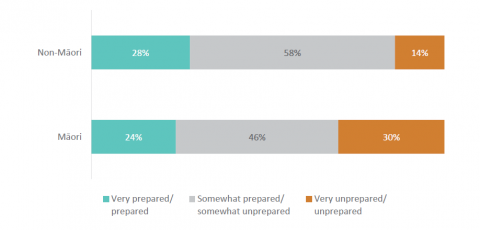
We also noted that new tumuaki Māori are more likely to be in small schools, and lower preparedness is linked to small school principalship - as set out in Part 4 of this report.
However, new tumuaki Māori are more prepared than non-Māori for giving effect to Te Tiriti o Waitangi, Māori partnership practices, and inclusive practices
New tumuaki Māori have similar levels of preparedness to their peers in most areas of practice. However, new tumuaki Māori are more prepared in three key areas. These are:
- giving effect to Te Tiriti o Waitangi throughout the school
- working in partnership with whānau Māori, hapū and iwi to develop a localised curriculum
- working closely with diverse families and community groups to promote inclusion
Figure 33: Percentage of Māori and non-Māori new principals who felt prepared
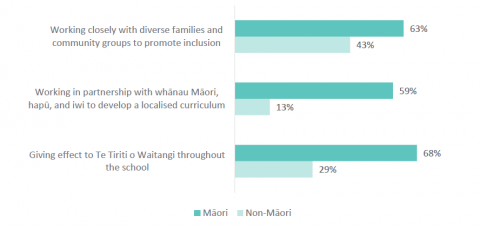
In interviews, new tumuaki Māori affirmed their strong drive to connect with their community.
“An open door policy, constantly visible, always meeting with the parent that wanted it. If I heard anything in the community, I'd call the parent in for a meeting or I'd go and see them … I wouldn't let anything lie.” – New Tumuaki Māori
“I saw that being a teacher, I could make a difference in a classroom, but [as a principal] I could make a difference in a whole school setting. And the difference that I bring to it is building positive relationships, being able to understand the need for empathy and sympathy at the same time without feeling weak.” – New Tumuaki Māori
However, we also heard that being a leader of a school community brings unique challenges and pressures for new tumuaki Māori. New tumuaki Māori feel strong, ‘weighty’ pressure in their roles. Experts emphasised that new tumuaki Māori require targeted support to grow their confidence, as Māori, within the cultural and community leadership aspects of the principal role.
“Your Māori community look to you, and you don’t have a choice. You have to take that role, even if you’re not equipped. You have to own that responsibility.” – Expert
This tension is reflected in the evidence base, which highlights a range of unspoken obligations that fall to school staff with cultural capital. Evidence shows that these staff experience a range of complex, additional social and emotional pressures in their roles. These pressures related to aspects such as needing to educate others in the school and wider sector, advocating against racism, attending events in their own time, and discomfort with enacting a tuakana role with some whānau, hapū, or iwi members.44
“For a Pākehā leader, it’s like they’re allowed to say they’re just not equipped. We [Māori] can’t say that – it’s just assumed that we are.” - Expert
3) What pathways do new tumuaki Māori take into the role?
New tumuaki Māori are less likely to have had opportunities to have school leadership experience
Eighty-three percent of new tumuaki Māori have had prior leadership experience compared to 90 percent of non-Māori new principals.
Figure 34: Pathways into the principal role for Māori and non-Māori new principals
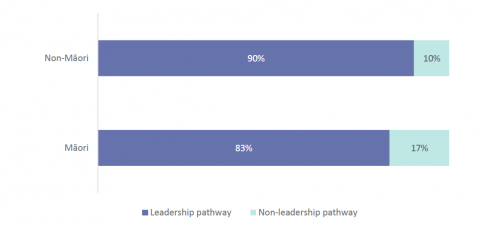
ERO engaged with tumuaki Māori from both leadership and non-leadership pathways in our interviews. We heard that they had won their positions through hard work and high achievement, often rising through the ranks of leadership positions faster than their peers. Often, they expressed gratitude for particular leaders who had recognised their leadership potential early, and who ensured they had access to opportunities to enhance their leadership capabilities and gain important experience.
“I started at [school] as a beginning teacher. In my second year of being a beginning teacher, I became a curriculum leader. In my third year of being a teacher, I became a team leader. And in my fourth year of being a teacher, I became a deputy principal” – New Tumuaki Māori
“As you could imagine, being promoted up in a school when you are quite young, I think was like 25, 26. I had to deal with teachers that had been at the school for 25, 30 years that were quite a lot older than me, and they're looking at me as a 25, 26 year old thinking, back when we used to do appraisals, ‘What do you know about good practice?’, When you're 26 years old, you're a baby, you don't know anything.’ So, you know, there's all those kinds of things that you have to navigate through as well.” – New Tumuaki Māori
As discussed earlier in this report, a leadership pathway is the best way to prepare for the principal role, compared to a non-leadership pathway (straight from teaching or other areas of education). In our interviews, tumuaki Māori and Māori education sector experts emphasised the challenges that Māori are still facing in being identified and supported into a pathway to principalship. Continued work is needed, to encourage and support potential and aspiring tumuaki Māori to step into leadership roles. We heard that tumuaki Māori, like their peers, benefit from the active encouragement of experienced leaders around them.
“It was more the leaders around me recognising the skills that I didn't know that I had. So, I had my principal … he was the first one that approached me and sowed the seeds of trying to take on more leadership responsibilities. And at that point, I didn't think that I had the skills or the capacity to do that. And it was him, I guess, mentoring and encouraging me to take on extra responsibilities.” – New Tumuaki Māori
4) How confident are new tumuaki Māori once in the role?
After becoming a principal, new tumuaki Māori are more confident in their role than their peers
Once in the role, 75 percent of new tumuaki Māori feel confident or very confident in the role overall, more than non-Māori principals (70 percent).
Figure 35: Percentage of Māori and non-Māori new principals who feel confident
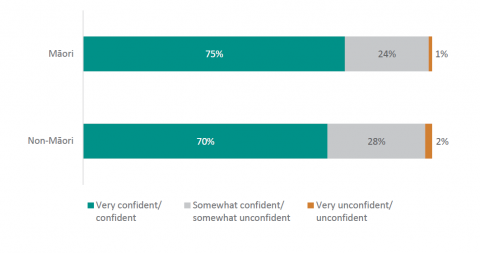
New tumuaki Māori also have higher levels of confidence in eight of the 11 key areas of practice:
- establishing and maintaining a clear vision, strategic direction, and goals
- building and maintaining positive, effective relationships with staff and learners
- building and maintaining positive, effective relationships with the school community
- ensuring the delivery of high-quality teaching practice and curriculum across the school
- giving effect to te Tiriti o Waitangi throughout the school
- working in partnership with whānau Māori, hapū, and iwi to develop a localised curriculum that is inclusive of mātauranga Māori
- working closely with diverse families and community groups to promote inclusion for all learners
- ensuring the school complies with all legislative and policy requirements.
5) What development and support do new tumuaki Māori access once in the role?
Once in the role, new tumuaki Māori have high rates of participation in development and support activities
Tumuaki Māori have high rates of participation in most development and support activities, like their peers:
- Almost all new tumuaki Māori (93 percent) participate in collaborative groups which is also the most common activity for non-Māori
- On-going programmes are the second most common activity with 91 percent of new tumuaki Māori participating in them
- Eighty-nine percent of new tumuaki Māori participate in coaching and mentoring activities.
- Seventy-one percent of new tumuaki Māori participate in one-off programmes.
The least common development activity for new tumuaki Māori is postgraduate courses, with 28 percent participating. New tumuaki Māori have similar views to their peers about how useful development and supports are, in terms of building their confidence in the role.
New tumuaki Māori have similar views about how useful development and supports are, in terms of supporting their wellbeing
We found that overall wellbeing levels are similar for Māori and non-Māori new principals. Twenty-one percent of new tumuaki Māori rated their wellbeing as high or very high, 50 percent rated it as medium and 29 percent rated it as low or very low.
Figure 36: Māori and non-Māori new principals’ wellbeing rating
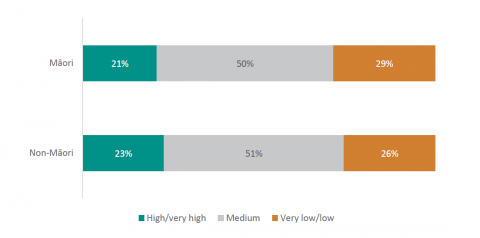
New tumuaki Māori found coaching and mentoring to be most supportive for their wellbeing. Eighty‑nine percent reported coaching and mentoring has a positive or very positive impact on their wellbeing. Collaborative opportunities have the second most positive impact on wellbeing (87 percent reported a positive or very positive impact) followed by ongoing programmes (75 percent reported a positive or very positive impact). Fifty-seven percent of new tumuaki Māori found EAP services to have a positive or very positive impact on their wellbeing. One-off programmes and postgraduate programmes had the least positive impact on wellbeing, with 53 percent and 38 percent reporting a positive or very positive impact respectively.
Figure 37: Percentage of Māori new principals reporting a positive impact on their wellbeing for development and support activities
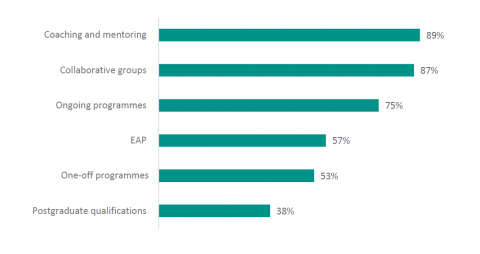
Development and support activities work best when they are culturally relevant for new tumuaki Māori
In our interviews with new tumuaki Māori, we heard that development and support opportunities are most effective for supporting both their practice and their wellbeing when they are culturally relevant to them as Māori, and are inclusive of Māori ways of leading and learning.
“I think the fact that [Māori leadership programme] take their learnings to places like Waitangi and significant [places] or onto the marae - they actually take the learning into a significant place for Māori, so that Māori are comfortable, particularly those who have grown up with that … we [tumuaki Māori] didn't necessarily grow up in a Māori context but actually having a sense of identity and belonging helps you to place yourself - being Māori. When you find your own place and sense of belonging, you're able to facilitate that for others as well. And when you're a principal, you're required to do that for all your staff and all your students also.” – Tumuaki Māori
“The people I had mentoring or talking me into making sure I was doing the right thing [were] from both the iwi and hapū” – Tumuaki Māori
I found my support in Te Tairāwhiti more aligned to my views as a Māori. We spoke te reo Māori at most hui, and when it came to planning I felt comfortable to be myself and share my ideas. In my new position I feel more constrained and pressured to focus all my energy on the core curriculum, which I find very limiting.” – Tumuaki Māori (survey response)
Māori education sector experts echoed this finding, emphasising the importance of ‘by-Māori-for-Māori’ development and support opportunities, that are contextually specific to the individual challenges often faced by new tumuaki Māori.
“What about just being able to be Māori in the system and be safe? … [Development and support needs to help] ground a person in personal, professional, and cultural safety and preparedness.” - Expert
Conclusion
The proportion of new tumuaki Māori within the wider principal population is increasing. However, new tumuaki Māori are less likely than their peers to have had leadership roles in their previous schools. More work is needed to identify and support potential Māori leaders onto a pathway to principalship. We heard that Māori leaders benefit from active support and encouragement in pursuing a principal role.
New tumuaki Māori feel less prepared for the role when they first start. Once they have settled in, however, they are more confident than their peers across most areas of principal practice. They have higher confidence in giving effect to Te Tiriti o Waitangi, Māori partnership practices, and inclusive practices, although we heard this comes with pressures and challenges. We heard that culturally relevant support and development opportunities are best for effectively supporting their practice and wellbeing.
Māori principals (tumuaki Māori) have a vital and valued role in English-medium schools. It is important that Māori leaders are well supported to move into principalship, and experience success in the role. In this part of the report, we focus on the experiences of new tumuaki Māori.
We found that new tumuaki Māori are less prepared when they first start, and are less likely than their peers to have had relevant leadership experience. However, once they start in the role, new tumuaki Māori are more confident across most areas than non-Māori.
This part of the report looks at the unique experiences of new tumuaki Māori in English-medium schools. ERO worked closely with Māori education sector experts to better understand our data.
This section sets out:
- What is the proportion of new tumuaki Māori in English-medium schools?
- How prepared are new tumuaki Māori, when they first start the role?
- What pathways do new tumuaki Māori take into the role?
- How confident are new tumuaki Māori once in the role?
- What development and support do new tumuaki Māori access, once in the role?
1) What is the proportion of new tumuaki Māori in English‑medium schools?
The proportion of tumuaki Māori in English-medium schools is increasing
Between 2014 and 2022, the proportion of tumuaki Māori in English-medium schools increased. In 2014, 11 percent of all principals were Māori, and 14 percent of new principals were Māori. In 2022, these figures both increased: 15 percent of all principals were Māori, and 19 percent of new principals were Māori. The proportion of Māori in principal roles is even higher than the proportion of Māori in teacher roles: about 12 percent of teachers in English-medium schools are Māori.
Research evidence shows that Māori school staff make a big difference to the educational engagement of Māori learners and their whānau.40 We also know that principals are key figures, second only to teachers in their impact on learner outcomes.41 So, the growing proportion of tumuaki Māori is great news. The importance of a representative Māori workforce is noted in Ka Hikitia – Ka Hāpaitia, Aotearoa New Zealand’s cross-agency strategy for Māori education. It includes as a measure of success: ‘Our education workforce looks more like the population that it serves,’ and outlines the Ministry’s intention to ensure that in the future, school staff better reflect the Māori learner population.42
New supports for new and aspiring tumuaki Māori
In 2022, Te Akatea, the New Zealand Māori Principals Association, launched two programmes of support for Māori leaders – an aspiring principal programme, and one for new principals. Together, these are called Huia Kaimanawa.43 Through this programme, Te Akatea are currently supporting 40 first-time tumuaki Māori in their initial years of principalship.
2) How prepared are new tumuaki Māori when they first start in the role?
Overall, new tumuaki Māori are less prepared when they first start
Just under a third of new tumuaki Māori (30 percent) report that they are unprepared or very unprepared for the role when they first start. This is double the proportion of non-Māori principals that report that they are unprepared or very unprepared (14 percent).
Figure 32: Overall preparedness for Māori and non-Māori new principals
We also noted that new tumuaki Māori are more likely to be in small schools, and lower preparedness is linked to small school principalship - as set out in Part 4 of this report.
However, new tumuaki Māori are more prepared than non-Māori for giving effect to Te Tiriti o Waitangi, Māori partnership practices, and inclusive practices
New tumuaki Māori have similar levels of preparedness to their peers in most areas of practice. However, new tumuaki Māori are more prepared in three key areas. These are:
- giving effect to Te Tiriti o Waitangi throughout the school
- working in partnership with whānau Māori, hapū and iwi to develop a localised curriculum
- working closely with diverse families and community groups to promote inclusion
Figure 33: Percentage of Māori and non-Māori new principals who felt prepared
In interviews, new tumuaki Māori affirmed their strong drive to connect with their community.
“An open door policy, constantly visible, always meeting with the parent that wanted it. If I heard anything in the community, I'd call the parent in for a meeting or I'd go and see them … I wouldn't let anything lie.” – New Tumuaki Māori
“I saw that being a teacher, I could make a difference in a classroom, but [as a principal] I could make a difference in a whole school setting. And the difference that I bring to it is building positive relationships, being able to understand the need for empathy and sympathy at the same time without feeling weak.” – New Tumuaki Māori
However, we also heard that being a leader of a school community brings unique challenges and pressures for new tumuaki Māori. New tumuaki Māori feel strong, ‘weighty’ pressure in their roles. Experts emphasised that new tumuaki Māori require targeted support to grow their confidence, as Māori, within the cultural and community leadership aspects of the principal role.
“Your Māori community look to you, and you don’t have a choice. You have to take that role, even if you’re not equipped. You have to own that responsibility.” – Expert
This tension is reflected in the evidence base, which highlights a range of unspoken obligations that fall to school staff with cultural capital. Evidence shows that these staff experience a range of complex, additional social and emotional pressures in their roles. These pressures related to aspects such as needing to educate others in the school and wider sector, advocating against racism, attending events in their own time, and discomfort with enacting a tuakana role with some whānau, hapū, or iwi members.44
“For a Pākehā leader, it’s like they’re allowed to say they’re just not equipped. We [Māori] can’t say that – it’s just assumed that we are.” - Expert
3) What pathways do new tumuaki Māori take into the role?
New tumuaki Māori are less likely to have had opportunities to have school leadership experience
Eighty-three percent of new tumuaki Māori have had prior leadership experience compared to 90 percent of non-Māori new principals.
Figure 34: Pathways into the principal role for Māori and non-Māori new principals
ERO engaged with tumuaki Māori from both leadership and non-leadership pathways in our interviews. We heard that they had won their positions through hard work and high achievement, often rising through the ranks of leadership positions faster than their peers. Often, they expressed gratitude for particular leaders who had recognised their leadership potential early, and who ensured they had access to opportunities to enhance their leadership capabilities and gain important experience.
“I started at [school] as a beginning teacher. In my second year of being a beginning teacher, I became a curriculum leader. In my third year of being a teacher, I became a team leader. And in my fourth year of being a teacher, I became a deputy principal” – New Tumuaki Māori
“As you could imagine, being promoted up in a school when you are quite young, I think was like 25, 26. I had to deal with teachers that had been at the school for 25, 30 years that were quite a lot older than me, and they're looking at me as a 25, 26 year old thinking, back when we used to do appraisals, ‘What do you know about good practice?’, When you're 26 years old, you're a baby, you don't know anything.’ So, you know, there's all those kinds of things that you have to navigate through as well.” – New Tumuaki Māori
As discussed earlier in this report, a leadership pathway is the best way to prepare for the principal role, compared to a non-leadership pathway (straight from teaching or other areas of education). In our interviews, tumuaki Māori and Māori education sector experts emphasised the challenges that Māori are still facing in being identified and supported into a pathway to principalship. Continued work is needed, to encourage and support potential and aspiring tumuaki Māori to step into leadership roles. We heard that tumuaki Māori, like their peers, benefit from the active encouragement of experienced leaders around them.
“It was more the leaders around me recognising the skills that I didn't know that I had. So, I had my principal … he was the first one that approached me and sowed the seeds of trying to take on more leadership responsibilities. And at that point, I didn't think that I had the skills or the capacity to do that. And it was him, I guess, mentoring and encouraging me to take on extra responsibilities.” – New Tumuaki Māori
4) How confident are new tumuaki Māori once in the role?
After becoming a principal, new tumuaki Māori are more confident in their role than their peers
Once in the role, 75 percent of new tumuaki Māori feel confident or very confident in the role overall, more than non-Māori principals (70 percent).
Figure 35: Percentage of Māori and non-Māori new principals who feel confident
New tumuaki Māori also have higher levels of confidence in eight of the 11 key areas of practice:
- establishing and maintaining a clear vision, strategic direction, and goals
- building and maintaining positive, effective relationships with staff and learners
- building and maintaining positive, effective relationships with the school community
- ensuring the delivery of high-quality teaching practice and curriculum across the school
- giving effect to te Tiriti o Waitangi throughout the school
- working in partnership with whānau Māori, hapū, and iwi to develop a localised curriculum that is inclusive of mātauranga Māori
- working closely with diverse families and community groups to promote inclusion for all learners
- ensuring the school complies with all legislative and policy requirements.
5) What development and support do new tumuaki Māori access once in the role?
Once in the role, new tumuaki Māori have high rates of participation in development and support activities
Tumuaki Māori have high rates of participation in most development and support activities, like their peers:
- Almost all new tumuaki Māori (93 percent) participate in collaborative groups which is also the most common activity for non-Māori
- On-going programmes are the second most common activity with 91 percent of new tumuaki Māori participating in them
- Eighty-nine percent of new tumuaki Māori participate in coaching and mentoring activities.
- Seventy-one percent of new tumuaki Māori participate in one-off programmes.
The least common development activity for new tumuaki Māori is postgraduate courses, with 28 percent participating. New tumuaki Māori have similar views to their peers about how useful development and supports are, in terms of building their confidence in the role.
New tumuaki Māori have similar views about how useful development and supports are, in terms of supporting their wellbeing
We found that overall wellbeing levels are similar for Māori and non-Māori new principals. Twenty-one percent of new tumuaki Māori rated their wellbeing as high or very high, 50 percent rated it as medium and 29 percent rated it as low or very low.
Figure 36: Māori and non-Māori new principals’ wellbeing rating
New tumuaki Māori found coaching and mentoring to be most supportive for their wellbeing. Eighty‑nine percent reported coaching and mentoring has a positive or very positive impact on their wellbeing. Collaborative opportunities have the second most positive impact on wellbeing (87 percent reported a positive or very positive impact) followed by ongoing programmes (75 percent reported a positive or very positive impact). Fifty-seven percent of new tumuaki Māori found EAP services to have a positive or very positive impact on their wellbeing. One-off programmes and postgraduate programmes had the least positive impact on wellbeing, with 53 percent and 38 percent reporting a positive or very positive impact respectively.
Figure 37: Percentage of Māori new principals reporting a positive impact on their wellbeing for development and support activities
Development and support activities work best when they are culturally relevant for new tumuaki Māori
In our interviews with new tumuaki Māori, we heard that development and support opportunities are most effective for supporting both their practice and their wellbeing when they are culturally relevant to them as Māori, and are inclusive of Māori ways of leading and learning.
“I think the fact that [Māori leadership programme] take their learnings to places like Waitangi and significant [places] or onto the marae - they actually take the learning into a significant place for Māori, so that Māori are comfortable, particularly those who have grown up with that … we [tumuaki Māori] didn't necessarily grow up in a Māori context but actually having a sense of identity and belonging helps you to place yourself - being Māori. When you find your own place and sense of belonging, you're able to facilitate that for others as well. And when you're a principal, you're required to do that for all your staff and all your students also.” – Tumuaki Māori
“The people I had mentoring or talking me into making sure I was doing the right thing [were] from both the iwi and hapū” – Tumuaki Māori
I found my support in Te Tairāwhiti more aligned to my views as a Māori. We spoke te reo Māori at most hui, and when it came to planning I felt comfortable to be myself and share my ideas. In my new position I feel more constrained and pressured to focus all my energy on the core curriculum, which I find very limiting.” – Tumuaki Māori (survey response)
Māori education sector experts echoed this finding, emphasising the importance of ‘by-Māori-for-Māori’ development and support opportunities, that are contextually specific to the individual challenges often faced by new tumuaki Māori.
“What about just being able to be Māori in the system and be safe? … [Development and support needs to help] ground a person in personal, professional, and cultural safety and preparedness.” - Expert
Conclusion
The proportion of new tumuaki Māori within the wider principal population is increasing. However, new tumuaki Māori are less likely than their peers to have had leadership roles in their previous schools. More work is needed to identify and support potential Māori leaders onto a pathway to principalship. We heard that Māori leaders benefit from active support and encouragement in pursuing a principal role.
New tumuaki Māori feel less prepared for the role when they first start. Once they have settled in, however, they are more confident than their peers across most areas of principal practice. They have higher confidence in giving effect to Te Tiriti o Waitangi, Māori partnership practices, and inclusive practices, although we heard this comes with pressures and challenges. We heard that culturally relevant support and development opportunities are best for effectively supporting their practice and wellbeing.
Part 6. Findings and areas for action
The three questions we asked for this evaluation have led to 13 key findings that sit across this work. Based on these findings, we have identified five areas for action, which together have the potential to strengthen pathways and support for new principals. This section sets out our findings, areas for action, and our recommendations for improvement.
This evaluation has answered three key questions:
- Which pathway into principalship is best for preparing new principals for the role?
- What development and support, before principalship, is best for preparing new principals for the role?
- What development and support, once new principals are in the role, is best for growing their capability?
Our evaluation led to 13 key findings across five areas:
- Area 1: Pathways to becoming a principal
- Area 2: Development and support for aspiring principals
- Area 3: Support once in the role
- Area 4: Pathways and support for principals in small schools
- Area 5: Pathways for Tumuaki Māori – Māori principals
Area 1: Pathways to becoming a principal
Finding 1: New principals are not always well prepared for all aspects of their new role.
- Only a quarter of new principals (27 percent) are prepared or very prepared for the role overall when they start.
- The complexity of the role, and the reality of the school they start in, are the two main reasons new principals arrive feeling unprepared, anxious, or surprised.
- The areas in which they are most prepared are building and maintaining relationships with staff and learners, and building relationships with the school community.
- The areas in which they are least prepared are working in partnership with Māori, and the administrative and legal aspects of the role. For example, only 22 percent of new principals report being prepared for working in partnership with Māori.
Finding 2: Prior experience in a leadership role is the best pathway towards principalship. Most, but not all, principals follow this pathway.
- New principals who have previously held a school leadership role are more than three times as likely to be prepared for the role.
- The overwhelming majority of principals (88 percent) have held a school leadership role before reaching principalship, but one in 10 do not.
Finding 3: Not all those teachers who have the potential to be principals are encouraged into or aware of the pathways to become principals.
- Principals reported to us that identification and support for future principals is too often left to chance.
Area 2: Development and support for aspiring principals
Finding 4: Development and support helps aspiring principals prepare
- Development and support make the biggest difference for preparedness in planning, managing resources, using data, delivering curriculum, and working with Māori.
- It makes the least difference for preparedness in managing relationships with the school community and for working with the school board.
Finding 5: Coaching and mentoring, and postgraduate programmes make the most difference to new principals’ preparedness.
- Two-thirds (67 percent) of new principals access coaching/mentoring, and half (49 percent) gain postgraduate school leadership qualifications before they start in the role.
- New principals who had participated in these activities are twice as likely to report being prepared for their roles.
Area 3: Support once in the role
Finding 6: Not all new principals have an induction process when they start in the role and where an induction process does occur, it is of variable quality.
- Fifteen percent of boards in schools with a new principal did not provide an induction and 42 percent did not know if there had been an induction.
- New principals report that the delivery of inductions is inconsistent. Those that experienced inductions report that their usefulness is variable.
Finding 7: Principals’ confidence increases over their time in the role, but there remain key areas where they lack confidence.
- After one to two years’ experience, over half (58 percent) of new principals are confident in their role. By four to five years in the role, eight in 10 principals (81 percent) are confident in their role.
- Principals’ confidence grows the most in administration, governance and direction setting.
- Principals’ confidence grows the least in everyday aspects of teaching and leading (areas in which they are already confident), partnership with Māori, working with diverse families to promote inclusion, and giving effect to Te Tiriti o Waitangi (areas where they lack confidence). Less than half of new principals are confident to give effect to Te Tiriti o Waitangi.
Finding 8: Principals report that connecting with peers and more experienced principals and coaches is most useful.
- Nearly all (over 99 percent) of new principals continue to participate in development and support opportunities once they are in the principal role, and most engage in a range of opportunities.
- Principals access a wide range of development and support once in the role, and report that support that involves connecting with peers and more experienced principals and coaches is most useful.
- Development and support that involves connecting with others is also most effective for supporting their wellbeing.
Finding 9: School boards are not sufficiently aware of how well their new principals are faring.
- While new principals report a lack of confidence in several areas of their role, school boards rate their principals’ confidence highly across all areas of practice.
- More than two thirds (69 percent) of board representatives rate new principals’ wellbeing as high or very high, compared to just 23 percent of new principals themselves.
Area 4: Pathways and support for principals in small schools
Finding 10: Four in 10 new principals are in small schools, but those who start in small schools are less prepared, less likely to have had prior leadership experience, and have accessed less prior development and support.
- Principals who start in small schools are over 10 times more likely to have come through the non-leadership pathway than those in large schools. Twenty-two percent of new principals in small schools come from a non-leadership pathway.
- New principals starting in small schools are a third less likely to have participated in development and support before becoming a principal, and also find it less relevant.
- New principals who start in small schools are a third less likely to feel prepared than those starting in large schools. In particular, they are significantly less prepared for administrative and legal responsibilities, delivery of high-quality teaching and curriculum, and strategic planning.
Finding 11: Once in the role, new principals in small schools are less confident, can face barriers accessing the most effective development and support, and report poorer wellbeing.
- Once in the role, new principals in small schools are a quarter less likely to be confident than principals in larger schools. In particular, they are less confident at setting the direction for the school and ensuring the delivery of high-quality teaching practice and curriculum.
- New principals in small schools report having trouble accessing the most effective development and support due to isolation and difficulty finding cover.
- Thirty-three percent of new principals in small schools report low or very low wellbeing compared to 20 percent in large schools.
Area 5: Pathways for new Tumuaki Māori – Māori principals
Finding 12: New tumuaki Māori feel less prepared and are less likely to have had the opportunity to have prior leadership experience.
- Nearly a third (30 percent) of new tumuaki Māori feel unprepared when they first start, compared to 14 percent of non-Māori principals.
- Eighty-three percent of new tumuaki Māori have had prior leadership experience, compared to 90 percent of non-Māori new principals.
Finding 13: Once in the role, new tumuaki Māori are more confident than their peers.
- Seventy-five percent of new tumuaki Māori feel confident in the role, compared to 70 percent of non-Māori new principals
- New tumuaki Māori are more confident in most (eight out of 11) areas of practice.
Based on these key findings, ERO has identified five areas that require action to help ensure new principals in Aotearoa New Zealand’s English‑medium schools are set up to succeed.
Five areas for action
Based on these 13 key findings, ERO has identified five areas that require action to help ensure new principals in Aotearoa New Zealand’s English-medium schools are set up to succeed.
- Establish accessible and sufficient pathways for aspiring leaders to become principals.
- Ensure there is sufficient, accessible, and evidence-based development opportunities for aspiring principals.
- Support the delivery of accessible and evidence-based development opportunities once new principals start in the role.
- Prioritise preparing and supporting principals in small schools
- Ensure Māori aspiring leaders have clear, well supported pathways into school leadership
Area 1: Establish accessible and sufficient pathways for aspiring leaders to become principals
Our findings show that having held a school leadership role is the pathway that is most effective. This pathway is taken but most, by not all, new principals. The identification and development of future leaders is currently ad hoc. Not all those teachers who have the potential to be principals are encouraged into or aware of the pathways to become principals. ERO recommends:
Recommendation 1: The Ministry of Education promotes to aspiring leaders and boards that gaining experience in leadership roles is the best pathway to being a principal and is strongly encouraged.
Recommendation 2: As the Principal Eligibility Criteria (PEC) are implemented, the Ministry of Education assesses how well they are being adopted by school boards.
Recommendation 3: The Ministry then advises Ministers on making prior leadership experience a requirement for new principals over time and on whether to move to compulsory standards for principals over time.
Recommendation 4: The Ministry of Education work with the profession to encourage and empower existing principals and school boards to develop their emerging leaders.
Recommendation 5: The Ministry of Education advises Ministers on how the profession can more systematically identify, support, and encourage prospective leaders, particularly Māori leaders.
Area 2: Ensure there are sufficient, accessible, and evidence-based development opportunities for aspiring principals
Our findings show that prior experience alone does not prepare teachers for the full range of requirements for the principal role. New principals do benefit from professional development that helps them prepare, but there is no clear picture of what is effective, when. Not all new principals have an induction process when they start in the role and where an induction process does occur, it is of variable quality. ERO recommends:
Recommendation 6: The Ministry of Education establish a core programme of development for aspiring principals, which includes:
- guidance on which development is the most effective for which elements of the role
- signposting and improving visibility and accessibility of existing development opportunities for aspiring leaders. These should include culturally appropriate offerings tailored for Māori
- strengthening development opportunities for the areas new principals are currently least prepared for (e.g., managing the school’s resources, ensuring the school complies with legislative and policy requirements, and working in partnership with whānau Māori, hapū, and iwi).
Recommendation 7: The Ministry of Education advises Ministers on options for establishing nationally or locally coordinated programmes of development and support for aspiring principals to ensure all aspiring principals can access development.
Recommendation 8: The Ministry of Education work with school boards to provide examples of, and tools for, effective induction programmes for incoming principals.
Area 3: Support the delivery of accessible and evidence-based development opportunities once new principals start in the role
Our findings show that principals’ confidence improves over time in their new role, but there remain key areas where they lack confidence. We found that effective on-the-job development and support makes a difference. ERO recommends:
Recommendation 9: The Ministry of Education establish a core programme of development for new principals, which includes:
- guidance on which development is the most effective for which elements of the role
- improving visibility and accessibility of offerings for new principals across all settings, including culturally appropriate offerings tailored for Māori
- strengthening development opportunities for the areas where confidence does not increase through experience alone (e.g., giving effect to Te Tiriti o Waitangi, working with diverse families to promote inclusion, working in partnership with whānau Māori, hapū, and iwi).
Recommendation 10: When working in schools, ERO prioritise engaging with new principals to support development in administrative, legal, and policy components of the role, and support understanding of compliance.
Recommendation 11: The Ministry of Education and Teaching Council work with peak bodies and regional principals’ associations to support professional Peer Learning Groups.
Area 4: Prioritise preparing and supporting new principals in small schools
Our findings show that principals who start in small schools are less prepared for the role and less confident over time than new principals in larger schools. Principals going into smaller schools are more likely to have limited leadership experience, and access development and support less than larger school principals. ERO recommends:
Recommendation 12: The Ministry of Education identify mechanisms to increase opportunities for aspiring principals in small and isolated schools to gain relevant leadership experience.
Recommendation 13: The Ministry of Education develops models of professional learning that are accessible and tailored to the particular needs of new principals beginning in isolated or small schools. This should be linked to the core programme of development outlined in Recommendations 6 and 9.
Recommendation 14: The Ministry of Education and Teaching Council work with peak bodies and regional principals’ associations to actively facilitate tuakana-teina groups linking small school new principals with more experienced small school principals.
Area 5: Ensure Māori aspiring leaders have clear, well supported pathways into school leadership
Our findings show that Māori new principals feel less prepared and are less likely to have had the opportunity to have prior leadership experience. ERO recommends:
Recommendation 15: The Ministry of Education identify mechanisms to increase opportunities for Māori aspiring principals to gain relevant leadership experience.
Cross-cutting recommendation
Our findings show that key information and support is not as easily accessible to new and aspiring principals as they could be. ERO recommends:
Recommendation 16: The Ministry of Education work with the Teaching Council to create a centralised hub for new and aspiring principals, which collates and signposts all information, tools, and resources relevant to pathways to principalship and support for starting out in the principal role.
Conclusion
New principals could be better supported to move into their role with preparedness and confidence. Identification and support of new leaders, including Māori leaders, is too often left to chance. New and aspiring principals would benefit from clearer pathways into principalship as well as better opportunities to grow their understandings and experience across the range of important parts of the role. Particular attention needs to be paid to meeting the specific needs of tumuaki Māori and new principals in small schools.
ERO’s recommendations are designed to better set up our new and aspiring principals for success, for the benefit of Aotearoa New Zealand’s learners.
The three questions we asked for this evaluation have led to 13 key findings that sit across this work. Based on these findings, we have identified five areas for action, which together have the potential to strengthen pathways and support for new principals. This section sets out our findings, areas for action, and our recommendations for improvement.
This evaluation has answered three key questions:
- Which pathway into principalship is best for preparing new principals for the role?
- What development and support, before principalship, is best for preparing new principals for the role?
- What development and support, once new principals are in the role, is best for growing their capability?
Our evaluation led to 13 key findings across five areas:
- Area 1: Pathways to becoming a principal
- Area 2: Development and support for aspiring principals
- Area 3: Support once in the role
- Area 4: Pathways and support for principals in small schools
- Area 5: Pathways for Tumuaki Māori – Māori principals
Area 1: Pathways to becoming a principal
Finding 1: New principals are not always well prepared for all aspects of their new role.
- Only a quarter of new principals (27 percent) are prepared or very prepared for the role overall when they start.
- The complexity of the role, and the reality of the school they start in, are the two main reasons new principals arrive feeling unprepared, anxious, or surprised.
- The areas in which they are most prepared are building and maintaining relationships with staff and learners, and building relationships with the school community.
- The areas in which they are least prepared are working in partnership with Māori, and the administrative and legal aspects of the role. For example, only 22 percent of new principals report being prepared for working in partnership with Māori.
Finding 2: Prior experience in a leadership role is the best pathway towards principalship. Most, but not all, principals follow this pathway.
- New principals who have previously held a school leadership role are more than three times as likely to be prepared for the role.
- The overwhelming majority of principals (88 percent) have held a school leadership role before reaching principalship, but one in 10 do not.
Finding 3: Not all those teachers who have the potential to be principals are encouraged into or aware of the pathways to become principals.
- Principals reported to us that identification and support for future principals is too often left to chance.
Area 2: Development and support for aspiring principals
Finding 4: Development and support helps aspiring principals prepare
- Development and support make the biggest difference for preparedness in planning, managing resources, using data, delivering curriculum, and working with Māori.
- It makes the least difference for preparedness in managing relationships with the school community and for working with the school board.
Finding 5: Coaching and mentoring, and postgraduate programmes make the most difference to new principals’ preparedness.
- Two-thirds (67 percent) of new principals access coaching/mentoring, and half (49 percent) gain postgraduate school leadership qualifications before they start in the role.
- New principals who had participated in these activities are twice as likely to report being prepared for their roles.
Area 3: Support once in the role
Finding 6: Not all new principals have an induction process when they start in the role and where an induction process does occur, it is of variable quality.
- Fifteen percent of boards in schools with a new principal did not provide an induction and 42 percent did not know if there had been an induction.
- New principals report that the delivery of inductions is inconsistent. Those that experienced inductions report that their usefulness is variable.
Finding 7: Principals’ confidence increases over their time in the role, but there remain key areas where they lack confidence.
- After one to two years’ experience, over half (58 percent) of new principals are confident in their role. By four to five years in the role, eight in 10 principals (81 percent) are confident in their role.
- Principals’ confidence grows the most in administration, governance and direction setting.
- Principals’ confidence grows the least in everyday aspects of teaching and leading (areas in which they are already confident), partnership with Māori, working with diverse families to promote inclusion, and giving effect to Te Tiriti o Waitangi (areas where they lack confidence). Less than half of new principals are confident to give effect to Te Tiriti o Waitangi.
Finding 8: Principals report that connecting with peers and more experienced principals and coaches is most useful.
- Nearly all (over 99 percent) of new principals continue to participate in development and support opportunities once they are in the principal role, and most engage in a range of opportunities.
- Principals access a wide range of development and support once in the role, and report that support that involves connecting with peers and more experienced principals and coaches is most useful.
- Development and support that involves connecting with others is also most effective for supporting their wellbeing.
Finding 9: School boards are not sufficiently aware of how well their new principals are faring.
- While new principals report a lack of confidence in several areas of their role, school boards rate their principals’ confidence highly across all areas of practice.
- More than two thirds (69 percent) of board representatives rate new principals’ wellbeing as high or very high, compared to just 23 percent of new principals themselves.
Area 4: Pathways and support for principals in small schools
Finding 10: Four in 10 new principals are in small schools, but those who start in small schools are less prepared, less likely to have had prior leadership experience, and have accessed less prior development and support.
- Principals who start in small schools are over 10 times more likely to have come through the non-leadership pathway than those in large schools. Twenty-two percent of new principals in small schools come from a non-leadership pathway.
- New principals starting in small schools are a third less likely to have participated in development and support before becoming a principal, and also find it less relevant.
- New principals who start in small schools are a third less likely to feel prepared than those starting in large schools. In particular, they are significantly less prepared for administrative and legal responsibilities, delivery of high-quality teaching and curriculum, and strategic planning.
Finding 11: Once in the role, new principals in small schools are less confident, can face barriers accessing the most effective development and support, and report poorer wellbeing.
- Once in the role, new principals in small schools are a quarter less likely to be confident than principals in larger schools. In particular, they are less confident at setting the direction for the school and ensuring the delivery of high-quality teaching practice and curriculum.
- New principals in small schools report having trouble accessing the most effective development and support due to isolation and difficulty finding cover.
- Thirty-three percent of new principals in small schools report low or very low wellbeing compared to 20 percent in large schools.
Area 5: Pathways for new Tumuaki Māori – Māori principals
Finding 12: New tumuaki Māori feel less prepared and are less likely to have had the opportunity to have prior leadership experience.
- Nearly a third (30 percent) of new tumuaki Māori feel unprepared when they first start, compared to 14 percent of non-Māori principals.
- Eighty-three percent of new tumuaki Māori have had prior leadership experience, compared to 90 percent of non-Māori new principals.
Finding 13: Once in the role, new tumuaki Māori are more confident than their peers.
- Seventy-five percent of new tumuaki Māori feel confident in the role, compared to 70 percent of non-Māori new principals
- New tumuaki Māori are more confident in most (eight out of 11) areas of practice.
Based on these key findings, ERO has identified five areas that require action to help ensure new principals in Aotearoa New Zealand’s English‑medium schools are set up to succeed.
Five areas for action
Based on these 13 key findings, ERO has identified five areas that require action to help ensure new principals in Aotearoa New Zealand’s English-medium schools are set up to succeed.
- Establish accessible and sufficient pathways for aspiring leaders to become principals.
- Ensure there is sufficient, accessible, and evidence-based development opportunities for aspiring principals.
- Support the delivery of accessible and evidence-based development opportunities once new principals start in the role.
- Prioritise preparing and supporting principals in small schools
- Ensure Māori aspiring leaders have clear, well supported pathways into school leadership
Area 1: Establish accessible and sufficient pathways for aspiring leaders to become principals
Our findings show that having held a school leadership role is the pathway that is most effective. This pathway is taken but most, by not all, new principals. The identification and development of future leaders is currently ad hoc. Not all those teachers who have the potential to be principals are encouraged into or aware of the pathways to become principals. ERO recommends:
Recommendation 1: The Ministry of Education promotes to aspiring leaders and boards that gaining experience in leadership roles is the best pathway to being a principal and is strongly encouraged.
Recommendation 2: As the Principal Eligibility Criteria (PEC) are implemented, the Ministry of Education assesses how well they are being adopted by school boards.
Recommendation 3: The Ministry then advises Ministers on making prior leadership experience a requirement for new principals over time and on whether to move to compulsory standards for principals over time.
Recommendation 4: The Ministry of Education work with the profession to encourage and empower existing principals and school boards to develop their emerging leaders.
Recommendation 5: The Ministry of Education advises Ministers on how the profession can more systematically identify, support, and encourage prospective leaders, particularly Māori leaders.
Area 2: Ensure there are sufficient, accessible, and evidence-based development opportunities for aspiring principals
Our findings show that prior experience alone does not prepare teachers for the full range of requirements for the principal role. New principals do benefit from professional development that helps them prepare, but there is no clear picture of what is effective, when. Not all new principals have an induction process when they start in the role and where an induction process does occur, it is of variable quality. ERO recommends:
Recommendation 6: The Ministry of Education establish a core programme of development for aspiring principals, which includes:
- guidance on which development is the most effective for which elements of the role
- signposting and improving visibility and accessibility of existing development opportunities for aspiring leaders. These should include culturally appropriate offerings tailored for Māori
- strengthening development opportunities for the areas new principals are currently least prepared for (e.g., managing the school’s resources, ensuring the school complies with legislative and policy requirements, and working in partnership with whānau Māori, hapū, and iwi).
Recommendation 7: The Ministry of Education advises Ministers on options for establishing nationally or locally coordinated programmes of development and support for aspiring principals to ensure all aspiring principals can access development.
Recommendation 8: The Ministry of Education work with school boards to provide examples of, and tools for, effective induction programmes for incoming principals.
Area 3: Support the delivery of accessible and evidence-based development opportunities once new principals start in the role
Our findings show that principals’ confidence improves over time in their new role, but there remain key areas where they lack confidence. We found that effective on-the-job development and support makes a difference. ERO recommends:
Recommendation 9: The Ministry of Education establish a core programme of development for new principals, which includes:
- guidance on which development is the most effective for which elements of the role
- improving visibility and accessibility of offerings for new principals across all settings, including culturally appropriate offerings tailored for Māori
- strengthening development opportunities for the areas where confidence does not increase through experience alone (e.g., giving effect to Te Tiriti o Waitangi, working with diverse families to promote inclusion, working in partnership with whānau Māori, hapū, and iwi).
Recommendation 10: When working in schools, ERO prioritise engaging with new principals to support development in administrative, legal, and policy components of the role, and support understanding of compliance.
Recommendation 11: The Ministry of Education and Teaching Council work with peak bodies and regional principals’ associations to support professional Peer Learning Groups.
Area 4: Prioritise preparing and supporting new principals in small schools
Our findings show that principals who start in small schools are less prepared for the role and less confident over time than new principals in larger schools. Principals going into smaller schools are more likely to have limited leadership experience, and access development and support less than larger school principals. ERO recommends:
Recommendation 12: The Ministry of Education identify mechanisms to increase opportunities for aspiring principals in small and isolated schools to gain relevant leadership experience.
Recommendation 13: The Ministry of Education develops models of professional learning that are accessible and tailored to the particular needs of new principals beginning in isolated or small schools. This should be linked to the core programme of development outlined in Recommendations 6 and 9.
Recommendation 14: The Ministry of Education and Teaching Council work with peak bodies and regional principals’ associations to actively facilitate tuakana-teina groups linking small school new principals with more experienced small school principals.
Area 5: Ensure Māori aspiring leaders have clear, well supported pathways into school leadership
Our findings show that Māori new principals feel less prepared and are less likely to have had the opportunity to have prior leadership experience. ERO recommends:
Recommendation 15: The Ministry of Education identify mechanisms to increase opportunities for Māori aspiring principals to gain relevant leadership experience.
Cross-cutting recommendation
Our findings show that key information and support is not as easily accessible to new and aspiring principals as they could be. ERO recommends:
Recommendation 16: The Ministry of Education work with the Teaching Council to create a centralised hub for new and aspiring principals, which collates and signposts all information, tools, and resources relevant to pathways to principalship and support for starting out in the principal role.
Conclusion
New principals could be better supported to move into their role with preparedness and confidence. Identification and support of new leaders, including Māori leaders, is too often left to chance. New and aspiring principals would benefit from clearer pathways into principalship as well as better opportunities to grow their understandings and experience across the range of important parts of the role. Particular attention needs to be paid to meeting the specific needs of tumuaki Māori and new principals in small schools.
ERO’s recommendations are designed to better set up our new and aspiring principals for success, for the benefit of Aotearoa New Zealand’s learners.
Appendix 1: Methodology
ERO used a mixed method approach of surveys and interviews. This report draws on the voices of principals, board chairs/ presiding members, and sector experts to understand new principals’ experiences, and how to best support principals in their first five years.
Design
ERO used a mixed method approach for this report. We collected both qualitative and quantitative data. The target population were principals in their first five years of the role, in English-medium schools in Aotearoa New Zealand. Data was collected through surveys and interviews. When designing both survey and interview questions, we researched and summarised some aspects of principalship - these concepts are defined and described below: role pathways, areas of practice, and types of development and support.
Role pathways
In this report, when we talk about ‘pathways’ we are referring to the roles and responsibilities that new principals held as they moved towards becoming a principal – roles they had before they were appointed as a principal. Through our surveys and interviews, ERO asked new principals whether they took a leadership or non-leadership pathway into principalship.
ERO wanted to find out what sorts of roles new principals held when they were just about to step into the principal role. In our surveys, we asked new principals to choose between the following descriptions of their roles before applying for a principalship:
- beginning teacher (received certification within the last three years)
- experienced teacher with some classroom teaching experience (3 – 10 years), who had not previously held a leadership role (deputy principal (DP), assistant principal (AP), syndicate leader, management units, other)
- experienced teacher with a large amount of classroom teaching experience (more than 10 years), who had not previously held a leadership role (AP, DP, syndicate leader, management units, other)
- middle-management role (head of department, faculty leader, leader of learning, specialist teacher, special education needs co-ordinator, learning support coordinator)
- educational leadership position (AP, DP, syndicate leader, management units)
- primarily employed in other areas of education (such as tertiary, iwi organisation, school organisation, school governance, research, resource teacher, MOE, ERO, PLD provider)
Which pathways does this report focus on?
This report focuses on the two main role types held by new principals prior to being appointed as a principal: a leadership pathway, and a teacher (or other) pathway.
Leadership pathway
Interestingly, an overwhelming proportion selected the ‘educational leadership’ position option on our survey. This means that most of our respondents were either an acting principal, deputy principal, syndicate leader, or held other management units prior to being a principal.
In response to expert advice and recognising that role definitions within and between schools can overlap or be unclear, ERO have blended the ‘educational leadership’ and ‘middle-management’ responses into one grouping, called ‘Leadership’.
Non-leadership pathway
Very small proportions of respondents selected either ‘beginning teacher’ (0.2 percent), ‘experienced teacher: 3-10 years’ (3 percent), ‘experienced teacher: more than 10 years’ (7 percent), or ‘other areas of education’ (2 percent). These numbers were too small for separate analyses, so we have blended them together. This pathway is called the ‘Non-leadership pathway’.
Areas of practice
In both surveys and interviews ERO asked about principals’ preparedness and confidence related to 11 key areas of principals’ practice:
- giving effect to Te Tiriti o Waitangi throughout the school (including active implementation of decolonisation and anti-racism strategies)
- work in partnership with whānau Māori, hapū, and iwi to develop a localised curriculum that is inclusive of mātauranga Māori
- establishing and maintaining a clear shared vision, strategic direction, and goals for the school
- building and maintaining positive, effective relationships with staff and learners (this includes school leadership, teachers, other staff, and learners)
- building and maintaining positive, effective relationships with the school community (this includes with parents and whānau, community groups and networks, relevant agencies, neighbouring schools and early learning services/tertiary, and others)
- ensuring the delivery of high-quality teaching practice and curriculum across the school (this may involve direct or indirect leadership and oversight)
- working with data to monitor and evaluate teaching and learning
- working closely with diverse families and community groups to promote inclusion for all learners
- managing the school’s resources, for example finances, employment and timetabling, and property
- working effectively with the school’s board members
- ensuring the school complies with all legislative and policy requirements.
These key areas draw from established leadership frameworks and research evidence45, as set out in Appendix 2, as well as advice from sector experts.
Types of development and support
ERO asked new principals about their participation in common types of development and support for school leaders. These are:
- One-on-one coaching/mentoring (e.g., with an experienced principal)
- One-off programmes or courses related to specific aspects of the principal role – such as webinar programmes, 1–2 day courses
- Structured, ongoing programmes for new/acting principals (such as the Māori Achievement Collective)
- Postgraduate school leadership qualifications
- Other formal or informal professional learning or support– such as professional supervision, social media platforms, or leadership learning groups.
We also asked about their participation in principals’ collaborative learning groups, and in EAP services, after they became principal.
These key development and support activities were established through a thorough desk analysis. A long‑list was formulated from the analysis and then workshopped with an internal ERO group including sector experts, resulting in a shortlist of key development activities. This shortlist was then tested and refined with the Expert Advisory Group before being finalised for use in data collection.
Analysis
Quantitative analysis
Quantitative data were statistically analysed using STATA and Excel software. Differences between groups were identified through non-parametric statistical tests. Where we report differences for groups these are significant at p < 0.05. Non-responses and ‘don’t know’ responses were excluded from response totals when calculating percentages and running statistical tests (apart from our finding on inductions, as such a high number of boards responded with ‘don’t know’). Some values differ from simple addition due to rounding.
Our analyses assume that principals’ self-efficacy (how prepared or how confident they felt) is strongly correlated with competence, and this is reflected in our reporting. This correlation is established across an array of research into range of roles. The OECD reports that a number of studies have demonstrated positive associations between teachers’ sense of self-efficacy and higher levels of student achievement and motivation, teachers’ job satisfaction and teaching behaviour.46 The approach taken in this report is consistent with those findings.
In order to determine the impact pathways had on overall preparedness and preparedness in the 11 areas we compared how prepared our survey respondents were (overall and in each area), based on which pathway they had taken.
To look at the impact development and support had on new principals’ overall preparedness and in the 11 areas, we compared levels of preparedness (overall and in each area) between the group of principals who had participated in each development activity, and the group who had not.
To determine the factors that had the biggest impact on overall preparedness, we used regression analyses. We tested multiple model specifications and have reported those variables that are statistically significant in all of them. We looked at the following independent variables’ ability to predict principals’ overall preparedness measured on a 6-point Likert scale:
- Pathways (leader, not a leader)
- School Type (primary, secondary)
- School size (very small, small, medium, large, and very large)
- Urban Area (rural, urban)
- Decile
- Having participated in:
- Coaching/mentoring
- One-off programme
- Ongoing structured programme
- Postgraduate
- Other PLD.
The significant (p< 0.05) predictors for overall preparedness were:
- Holding a leadership position (rather than a teaching position)
- Having participated in coaching/mentoring
- Having participated in postgraduate course
- School size (starting as a principal in a smaller school = less prepared).
Qualitative analysis
Qualitative data were thematically analysed by an experienced team.
Where possible, interviews were recorded, and extensive notes were taken. Following each interview, interviewers immediately held a debrief session in which the core themes of the interview were discussed and agreed. Regular analysis workshops were undertaken throughout and after the data collection period. Open-ended comments from surveys were also analysed and coded to identify key themes.
The qualitative data were analysed in two main ways:
- A semi‑inductive approach was initially taken whereby the interviewer notation was coded for key themes, organised within the three research questions. Cross-interview themes were established during workshops comprising the wider interview team.
- Following substantive analysis of both the qualitative and quantitative data, a deductive approach was taken to establish exemplars that illustrated those analyses with real‑world experiences.
All quotes were gathered from verbatim records and open-ended survey responses.
The research team held regular workshops throughout analysis to surface themes that sat across both the survey data and the interview data. This ensured that interpretation was consistent between interview teams, and additional investigation could be undertaken to address gaps or inconsistencies. Each of these workshops were attended by a peer reviewer, external to the research team.
Sense-making
Following analysis of the data from the surveys and interviews, sense-making discussions were conducted to test interpretation of the results, findings, and areas for action with:
- ERO specialists in reviewing school practice
- key individuals and organisations in the sector
- the project’s Expert Advisory Group, made up of sector experts
- the project’s Steering Group, made up of ERO and Ministry of Education representatives.
We then tested and refined the findings and recommendations with the following organisations to ensure they were useful and practical:
- Ministry of Education
- Teaching Council
- Expert Advisory Group
- Steering Group.
Principal survey
ERO conducted the principal survey using Survey Monkey. The principal survey was in the field from 4th April 2023 to 1st of May 2023 (spanning parts of Term 1, the term break and Term 2). We emailed all principals who had been in a principal role for less than five years to participate in our survey, excluding principals of Māori medium and private schools. Principals were sent the survey link in an email. There are 860 schools with new principals and we had a total of 596 principal respondents.
A full list of survey questions we asked can be found in Appendix 3.
Below is a breakdown of the new principal participants:
|
Demographic |
Number |
Percentage of participants |
Population percentage |
|
Māori |
127 |
21% |
19% |
|
Non-Māori |
469 |
79% |
81% |
|
Pacific |
32 |
5% |
4% |
|
Non-Pacific |
564 |
95% |
96% |
|
Female |
402 |
67% |
65% |
|
Male |
191 |
32% |
35% |
|
Gender diverse |
0 |
0% |
- |
|
Prefer not to say |
3 |
1% |
0% (Gender unknown) |
|
Less than 36 |
22 |
4% |
3% (25-34) |
|
36-45 years |
158 |
27% |
27% (35-44) |
|
46-55 years |
311 |
52% |
51% (45-54) |
|
55+ years |
102 |
17% |
19% (55+) |
|
Prefer not to say |
3 |
1% |
0% (Age unknown) |
|
Very small (first school) |
76 |
15% |
11% |
|
Small (first school) |
158 |
30% |
28% |
|
Medium (first school) |
180 |
34% |
33% |
|
Large (first school) |
94 |
18% |
19% |
|
Very Large (first school) |
16 |
3% |
7% |
|
Very small (current school) |
70 |
13% |
11% |
|
Small (current school) |
155 |
30% |
28% |
|
Medium (current school) |
182 |
35% |
33% |
|
Large (current school) |
98 |
19% |
19% |
|
Very large (current school) |
18 |
3% |
7% |
|
Primary (first school) |
437 |
82% |
79% |
|
Secondary (first school) |
90 |
17% |
19% |
|
Special school (first school |
7 |
1% |
2% |
|
Primary (current school) |
435 |
82% |
79% |
|
Secondary (current school) |
90 |
17% |
19% |
|
Special school (current school) |
8 |
2% |
2% |
|
Decile 1-3 (Low) (first school) |
159 |
30% |
30% |
|
Decile 4-7 (Mid) (first school) |
213 |
40% |
41% |
|
Decile 8-10 (High) (first school) |
160 |
30% |
29% |
|
Decile 1-3 (Low) (current school) |
155 |
29% |
30% |
|
Decile 4-7 (Mid) (current school) |
214 |
40% |
41% |
|
Decile 8-10 (High) (current school) |
162 |
31% |
29% |
|
Main urban area (first school) |
247 |
46% |
48% |
|
Secondary urban area (first school) |
33 |
6% |
7% |
|
Minor urban area (first school) |
50 |
9% |
12% |
|
Rural area (first school) |
204 |
38% |
34% |
|
Main urban area (current school) |
246 |
46% |
48% |
|
Secondary urban area (current school) |
35 |
7% |
7% |
|
Minor urban area (current school) |
54 |
10% |
12% |
|
Rural area (current school) |
198 |
37% |
34% |
|
Teaching principal (current school) |
211 |
35% |
Not recorded |
|
Not a teaching principal (current school) |
385 |
65% |
Not recorded |
School board survey
ERO designed the school board survey using Survey Monkey. This survey was in the field from 14th April 2023 to 2nd of May 2023 (spanning parts of both Term 1, the school holidays, and Term 2). We emailed all board chairs of schools that have a principal who has held a principal role (at any school) for less than 5 years, with a link to participate in our survey (excluding principals of Māori medium and private schools). The chair/ presiding member of the board was informed that the survey could be filled by them, or they were welcome to delegate the survey to another member of the board. Only one survey per school was filled out. There are 860 schools with new principals with experience of 5 years or less, and we received 317 survey responses.
A full list of survey questions we asked can be found in Appendix 4.
The table below describes the breakdown of board participants.
|
Demographic |
Number |
Percent |
Population percentage |
|
Very Small (current school) |
34 |
12% |
11% |
|
Small (current school) |
65 |
23% |
28% |
|
Medium (current school) |
112 |
40% |
33% |
|
Large (current school) |
58 |
21% |
19% |
|
Very large (current school) |
13 |
5% |
7% |
|
Primary (current school) |
240 |
85% |
79% |
|
Secondary (current school) |
42 |
15% |
19% |
|
Special school (current school) |
2 |
1% |
2% |
|
Decile 1-3 (Low) (current school) |
155 |
29% |
30% |
|
Decile 4-7 (Mid) (current school) |
214 |
40% |
41% |
|
Decile 8-10 (High) (current school) |
162 |
31% |
29% |
|
Main urban area (current school) |
138 |
49% |
48% |
|
Secondary urban area (current school) |
17 |
6% |
7% |
|
Minor urban area (current school) |
41 |
14% |
12% |
|
Rural area (current school) |
88 |
31% |
34% |
Expert and principal interviews
ERO talked to 21 principals and 16 experts through interviews. These were held in person, on Zoom, on the phone, and via email (experts only). We conducted these between January 2023 and May 2023.
Interviews were run as flexible, semi-structured discussions. Different combinations of team members conducted interviews, following a set protocol. Interviews were generally undertaken in pairs.
Experts
Interviews with experts included a range of professional development providers, as well as representatives from many of the principal support organisations. We also spoke with several highly experienced practising principals.
Principals
Interviews with new principals encompassed a broad sample. Rather than looking for representativity of the principal population, we sought to ensure the inclusion of voices from varied contexts, and intentionally covered schools from a range of geographical locations and equity index. Particular attention was paid to ensuring all school types and sizes were covered, and that Māori and Pacific voice were included. New principals were identified and recommended by ERO Evaluation Partners and other stakeholders such as principal associations, to create a short-list of interview candidates. Participants were then contacted and recruited by the research team.
Information and consent
Principals and experts were informed of the purpose of the evaluation before they agreed to participate in an interview. Participants were informed that:
- participation was voluntary and could be withdrawn at any time.
- permission to use their information could be withdrawn at any time.
- interviews were not an evaluation of their school, and their school would not be identified in the resulting national report.
- their information was confidential and would be kept securely subject to the provisions of the Official Information Act 1982, Privacy Act 1993, and the Public Records Act 2005 on the release and retention of information.
Interviewees consented their participation in an interview via email and by submitting a written consent form to ERO. Their verbal consent was also sought to record their online interviews.
Prior to the interview, participants were contacted by a member of the research team confirming that we would be asking them to reflect on:
- What did your path into principalship look like, and in what ways was that path helpful or not helpful for you?
- What PLD and/or support you had before becoming a principal, and the impact that it had on how prepared you were. Does anything stick out as particularly useful, or not so useful? What would have been better?
- What PLD and/or support you had after becoming a principal, and the impact that it has had on your role and on your wellbeing. Does anything stick out as particularly useful or not so useful? What would have been better?
The question prompts for principal interviews were:
- Why did you want to become a principal? (What was your pathway like?)
- What roles did you have prior to being a principal? In what SPECIFIC ways do you think those roles prepared you for the principal role?
- What would be a better/the best way to have set you up well?
- When you were thinking about a move to being a principal, what sorts of PLD or support did you have/look for?
- Were any of these especially effective – or not?
- When you started, what parts of being a principal did you feel least prepared for?
- How did you build your understanding/practice in those areas?
- Did you have a formal induction from your board? Was it useful, why/why not?
- Being a principal is a complex job. What sort of development or support did you have after becoming principal, to help you settle into your new responsibilities?
- How have you found tending to your own learning once starting in the principal role?
- Crisis management has been a large part of the principal role over the last few years - how has this impacted your practice and your wellbeing?
- What is your understanding of the $6000 wellbeing fund? What have you used it for/how do you intend to use it?
- How long do you think you’ll stay in a principal role? Why?
- Does any of your PLD or support have a positive impact on your wellbeing in the role? In what ways?
- Speculate: If you had a magic wand, and could make one change in our system for supporting new principals, what would that be?
The question prompts for expert interviews were:
- How about we start with you telling us, when you heard that we were looking into pathways and support for NPs, what was your first thought?
- You have a lot of experience and expertise in this area – what do you think most people don’t understand about … [their area of expertise, related to new principals specifically]?
- What should we know about the pathways that aspiring principals take into the role?
- What impact do you think that has on how prepared principals are for their role when they start?
- What should we know about the professional learning, development, and support that aspiring principals take into the role?
- Based on your experience, what have you found are the most useful types of PLD and support for aspiring principals?
- What would a better model or version of PLD and support for aspiring principals look like?
- What should we know about the PLD and support aspiring principals access once they’re in the role?
- In what areas do new principals usually need support?
- Based on your experience, what have you found are the most useful types of PLD and support for new principals?
- What would a better model or version of PLD and support for aspiring principals look like?
- We’ll be drawing on our findings from this project to make recommendations about how new and aspiring principals should be better supported. If you were writing those recommendations, what would you say?
- Could that work? What would need to change to make it happen?
To aid our understanding of pathways and supports for new principals, we used the findings from our surveys to provide a broad understanding of the views of the wider population and data from our interviews to provide in-depth, richer perspectives from new principals and experts.
Data security
Data collected from interviews and surveys will be stored digitally for a period of six months. During this time, all data will be password-protected and have limited accessibility.
Limitations
As with all research, there are some limitations to our methodology and methods.
In terms of scope, this research:
- does not examine specific development opportunities or programmes or comment on their quality
- Does not make judgements about individual principals’ or boards’ practice
In terms of the data collection:
- Principal survey: Since participation was voluntary, it is possible that there was a non-response bias. To address this risk, we sent the survey to all new principals on record to ensure maximum reach and held the survey open for a long duration.
- Board survey: As board chairs and members change over time it was not always possible to survey a board chair who had a comprehensive knowledge of their principals dating back to when their principal started at the school. This may have resulted in a higher number of ‘don’t know’ responses from boards. To mitigate this, board surveys could be answered by a representative with the most knowledge pertaining to the current principal.
- Interviews: Since participation in our interviews was voluntary, it relied on principals having time to engage with our research team which may have resulted in some biases in our sample. To mitigate this, we ensured that the sample reflected a wide range of settings and demographics. The research team offered a flexible approach to interviewing, enabling principals to participate when it was most suitable to their schedule. Additionally, it is also possible participants provided socially desirable responses in the interviews. We mitigated this risk by ensuring that all data would be treated confidentially, and no identifiable information would be disclosed.
In terms of data presentation:
Survey data is sometimes simplified for readability. In our survey analysis we use all levels of the Likert responses to draw conclusions about statistically significant differences. In some cases we have, for simplicity, only presented percentages in text or in graphs containing responses to just the top two or bottom two options. This is to highlight the impacts we have observed amongst different respondent groups; but the differences we comment on are always a reflection of statistically significant differences in how they responded across the whole ordinal Likert scale.
Māori participation in the research
Māori principals are a key focus of this research (as set out in Part 5). They made up 19 percent of principal survey respondents and 38 percent of new principal interview participants. Māori researchers were embedded in the research team and facilitated interviews with Māori principals. Māori education sector experts supported our design and sense-making and held positions on our Expert Advisory Group and Steering Group.
ERO used a mixed method approach of surveys and interviews. This report draws on the voices of principals, board chairs/ presiding members, and sector experts to understand new principals’ experiences, and how to best support principals in their first five years.
Design
ERO used a mixed method approach for this report. We collected both qualitative and quantitative data. The target population were principals in their first five years of the role, in English-medium schools in Aotearoa New Zealand. Data was collected through surveys and interviews. When designing both survey and interview questions, we researched and summarised some aspects of principalship - these concepts are defined and described below: role pathways, areas of practice, and types of development and support.
Role pathways
In this report, when we talk about ‘pathways’ we are referring to the roles and responsibilities that new principals held as they moved towards becoming a principal – roles they had before they were appointed as a principal. Through our surveys and interviews, ERO asked new principals whether they took a leadership or non-leadership pathway into principalship.
ERO wanted to find out what sorts of roles new principals held when they were just about to step into the principal role. In our surveys, we asked new principals to choose between the following descriptions of their roles before applying for a principalship:
- beginning teacher (received certification within the last three years)
- experienced teacher with some classroom teaching experience (3 – 10 years), who had not previously held a leadership role (deputy principal (DP), assistant principal (AP), syndicate leader, management units, other)
- experienced teacher with a large amount of classroom teaching experience (more than 10 years), who had not previously held a leadership role (AP, DP, syndicate leader, management units, other)
- middle-management role (head of department, faculty leader, leader of learning, specialist teacher, special education needs co-ordinator, learning support coordinator)
- educational leadership position (AP, DP, syndicate leader, management units)
- primarily employed in other areas of education (such as tertiary, iwi organisation, school organisation, school governance, research, resource teacher, MOE, ERO, PLD provider)
Which pathways does this report focus on?
This report focuses on the two main role types held by new principals prior to being appointed as a principal: a leadership pathway, and a teacher (or other) pathway.
Leadership pathway
Interestingly, an overwhelming proportion selected the ‘educational leadership’ position option on our survey. This means that most of our respondents were either an acting principal, deputy principal, syndicate leader, or held other management units prior to being a principal.
In response to expert advice and recognising that role definitions within and between schools can overlap or be unclear, ERO have blended the ‘educational leadership’ and ‘middle-management’ responses into one grouping, called ‘Leadership’.
Non-leadership pathway
Very small proportions of respondents selected either ‘beginning teacher’ (0.2 percent), ‘experienced teacher: 3-10 years’ (3 percent), ‘experienced teacher: more than 10 years’ (7 percent), or ‘other areas of education’ (2 percent). These numbers were too small for separate analyses, so we have blended them together. This pathway is called the ‘Non-leadership pathway’.
Areas of practice
In both surveys and interviews ERO asked about principals’ preparedness and confidence related to 11 key areas of principals’ practice:
- giving effect to Te Tiriti o Waitangi throughout the school (including active implementation of decolonisation and anti-racism strategies)
- work in partnership with whānau Māori, hapū, and iwi to develop a localised curriculum that is inclusive of mātauranga Māori
- establishing and maintaining a clear shared vision, strategic direction, and goals for the school
- building and maintaining positive, effective relationships with staff and learners (this includes school leadership, teachers, other staff, and learners)
- building and maintaining positive, effective relationships with the school community (this includes with parents and whānau, community groups and networks, relevant agencies, neighbouring schools and early learning services/tertiary, and others)
- ensuring the delivery of high-quality teaching practice and curriculum across the school (this may involve direct or indirect leadership and oversight)
- working with data to monitor and evaluate teaching and learning
- working closely with diverse families and community groups to promote inclusion for all learners
- managing the school’s resources, for example finances, employment and timetabling, and property
- working effectively with the school’s board members
- ensuring the school complies with all legislative and policy requirements.
These key areas draw from established leadership frameworks and research evidence45, as set out in Appendix 2, as well as advice from sector experts.
Types of development and support
ERO asked new principals about their participation in common types of development and support for school leaders. These are:
- One-on-one coaching/mentoring (e.g., with an experienced principal)
- One-off programmes or courses related to specific aspects of the principal role – such as webinar programmes, 1–2 day courses
- Structured, ongoing programmes for new/acting principals (such as the Māori Achievement Collective)
- Postgraduate school leadership qualifications
- Other formal or informal professional learning or support– such as professional supervision, social media platforms, or leadership learning groups.
We also asked about their participation in principals’ collaborative learning groups, and in EAP services, after they became principal.
These key development and support activities were established through a thorough desk analysis. A long‑list was formulated from the analysis and then workshopped with an internal ERO group including sector experts, resulting in a shortlist of key development activities. This shortlist was then tested and refined with the Expert Advisory Group before being finalised for use in data collection.
Analysis
Quantitative analysis
Quantitative data were statistically analysed using STATA and Excel software. Differences between groups were identified through non-parametric statistical tests. Where we report differences for groups these are significant at p < 0.05. Non-responses and ‘don’t know’ responses were excluded from response totals when calculating percentages and running statistical tests (apart from our finding on inductions, as such a high number of boards responded with ‘don’t know’). Some values differ from simple addition due to rounding.
Our analyses assume that principals’ self-efficacy (how prepared or how confident they felt) is strongly correlated with competence, and this is reflected in our reporting. This correlation is established across an array of research into range of roles. The OECD reports that a number of studies have demonstrated positive associations between teachers’ sense of self-efficacy and higher levels of student achievement and motivation, teachers’ job satisfaction and teaching behaviour.46 The approach taken in this report is consistent with those findings.
In order to determine the impact pathways had on overall preparedness and preparedness in the 11 areas we compared how prepared our survey respondents were (overall and in each area), based on which pathway they had taken.
To look at the impact development and support had on new principals’ overall preparedness and in the 11 areas, we compared levels of preparedness (overall and in each area) between the group of principals who had participated in each development activity, and the group who had not.
To determine the factors that had the biggest impact on overall preparedness, we used regression analyses. We tested multiple model specifications and have reported those variables that are statistically significant in all of them. We looked at the following independent variables’ ability to predict principals’ overall preparedness measured on a 6-point Likert scale:
- Pathways (leader, not a leader)
- School Type (primary, secondary)
- School size (very small, small, medium, large, and very large)
- Urban Area (rural, urban)
- Decile
- Having participated in:
- Coaching/mentoring
- One-off programme
- Ongoing structured programme
- Postgraduate
- Other PLD.
The significant (p< 0.05) predictors for overall preparedness were:
- Holding a leadership position (rather than a teaching position)
- Having participated in coaching/mentoring
- Having participated in postgraduate course
- School size (starting as a principal in a smaller school = less prepared).
Qualitative analysis
Qualitative data were thematically analysed by an experienced team.
Where possible, interviews were recorded, and extensive notes were taken. Following each interview, interviewers immediately held a debrief session in which the core themes of the interview were discussed and agreed. Regular analysis workshops were undertaken throughout and after the data collection period. Open-ended comments from surveys were also analysed and coded to identify key themes.
The qualitative data were analysed in two main ways:
- A semi‑inductive approach was initially taken whereby the interviewer notation was coded for key themes, organised within the three research questions. Cross-interview themes were established during workshops comprising the wider interview team.
- Following substantive analysis of both the qualitative and quantitative data, a deductive approach was taken to establish exemplars that illustrated those analyses with real‑world experiences.
All quotes were gathered from verbatim records and open-ended survey responses.
The research team held regular workshops throughout analysis to surface themes that sat across both the survey data and the interview data. This ensured that interpretation was consistent between interview teams, and additional investigation could be undertaken to address gaps or inconsistencies. Each of these workshops were attended by a peer reviewer, external to the research team.
Sense-making
Following analysis of the data from the surveys and interviews, sense-making discussions were conducted to test interpretation of the results, findings, and areas for action with:
- ERO specialists in reviewing school practice
- key individuals and organisations in the sector
- the project’s Expert Advisory Group, made up of sector experts
- the project’s Steering Group, made up of ERO and Ministry of Education representatives.
We then tested and refined the findings and recommendations with the following organisations to ensure they were useful and practical:
- Ministry of Education
- Teaching Council
- Expert Advisory Group
- Steering Group.
Principal survey
ERO conducted the principal survey using Survey Monkey. The principal survey was in the field from 4th April 2023 to 1st of May 2023 (spanning parts of Term 1, the term break and Term 2). We emailed all principals who had been in a principal role for less than five years to participate in our survey, excluding principals of Māori medium and private schools. Principals were sent the survey link in an email. There are 860 schools with new principals and we had a total of 596 principal respondents.
A full list of survey questions we asked can be found in Appendix 3.
Below is a breakdown of the new principal participants:
|
Demographic |
Number |
Percentage of participants |
Population percentage |
|
Māori |
127 |
21% |
19% |
|
Non-Māori |
469 |
79% |
81% |
|
Pacific |
32 |
5% |
4% |
|
Non-Pacific |
564 |
95% |
96% |
|
Female |
402 |
67% |
65% |
|
Male |
191 |
32% |
35% |
|
Gender diverse |
0 |
0% |
- |
|
Prefer not to say |
3 |
1% |
0% (Gender unknown) |
|
Less than 36 |
22 |
4% |
3% (25-34) |
|
36-45 years |
158 |
27% |
27% (35-44) |
|
46-55 years |
311 |
52% |
51% (45-54) |
|
55+ years |
102 |
17% |
19% (55+) |
|
Prefer not to say |
3 |
1% |
0% (Age unknown) |
|
Very small (first school) |
76 |
15% |
11% |
|
Small (first school) |
158 |
30% |
28% |
|
Medium (first school) |
180 |
34% |
33% |
|
Large (first school) |
94 |
18% |
19% |
|
Very Large (first school) |
16 |
3% |
7% |
|
Very small (current school) |
70 |
13% |
11% |
|
Small (current school) |
155 |
30% |
28% |
|
Medium (current school) |
182 |
35% |
33% |
|
Large (current school) |
98 |
19% |
19% |
|
Very large (current school) |
18 |
3% |
7% |
|
Primary (first school) |
437 |
82% |
79% |
|
Secondary (first school) |
90 |
17% |
19% |
|
Special school (first school |
7 |
1% |
2% |
|
Primary (current school) |
435 |
82% |
79% |
|
Secondary (current school) |
90 |
17% |
19% |
|
Special school (current school) |
8 |
2% |
2% |
|
Decile 1-3 (Low) (first school) |
159 |
30% |
30% |
|
Decile 4-7 (Mid) (first school) |
213 |
40% |
41% |
|
Decile 8-10 (High) (first school) |
160 |
30% |
29% |
|
Decile 1-3 (Low) (current school) |
155 |
29% |
30% |
|
Decile 4-7 (Mid) (current school) |
214 |
40% |
41% |
|
Decile 8-10 (High) (current school) |
162 |
31% |
29% |
|
Main urban area (first school) |
247 |
46% |
48% |
|
Secondary urban area (first school) |
33 |
6% |
7% |
|
Minor urban area (first school) |
50 |
9% |
12% |
|
Rural area (first school) |
204 |
38% |
34% |
|
Main urban area (current school) |
246 |
46% |
48% |
|
Secondary urban area (current school) |
35 |
7% |
7% |
|
Minor urban area (current school) |
54 |
10% |
12% |
|
Rural area (current school) |
198 |
37% |
34% |
|
Teaching principal (current school) |
211 |
35% |
Not recorded |
|
Not a teaching principal (current school) |
385 |
65% |
Not recorded |
School board survey
ERO designed the school board survey using Survey Monkey. This survey was in the field from 14th April 2023 to 2nd of May 2023 (spanning parts of both Term 1, the school holidays, and Term 2). We emailed all board chairs of schools that have a principal who has held a principal role (at any school) for less than 5 years, with a link to participate in our survey (excluding principals of Māori medium and private schools). The chair/ presiding member of the board was informed that the survey could be filled by them, or they were welcome to delegate the survey to another member of the board. Only one survey per school was filled out. There are 860 schools with new principals with experience of 5 years or less, and we received 317 survey responses.
A full list of survey questions we asked can be found in Appendix 4.
The table below describes the breakdown of board participants.
|
Demographic |
Number |
Percent |
Population percentage |
|
Very Small (current school) |
34 |
12% |
11% |
|
Small (current school) |
65 |
23% |
28% |
|
Medium (current school) |
112 |
40% |
33% |
|
Large (current school) |
58 |
21% |
19% |
|
Very large (current school) |
13 |
5% |
7% |
|
Primary (current school) |
240 |
85% |
79% |
|
Secondary (current school) |
42 |
15% |
19% |
|
Special school (current school) |
2 |
1% |
2% |
|
Decile 1-3 (Low) (current school) |
155 |
29% |
30% |
|
Decile 4-7 (Mid) (current school) |
214 |
40% |
41% |
|
Decile 8-10 (High) (current school) |
162 |
31% |
29% |
|
Main urban area (current school) |
138 |
49% |
48% |
|
Secondary urban area (current school) |
17 |
6% |
7% |
|
Minor urban area (current school) |
41 |
14% |
12% |
|
Rural area (current school) |
88 |
31% |
34% |
Expert and principal interviews
ERO talked to 21 principals and 16 experts through interviews. These were held in person, on Zoom, on the phone, and via email (experts only). We conducted these between January 2023 and May 2023.
Interviews were run as flexible, semi-structured discussions. Different combinations of team members conducted interviews, following a set protocol. Interviews were generally undertaken in pairs.
Experts
Interviews with experts included a range of professional development providers, as well as representatives from many of the principal support organisations. We also spoke with several highly experienced practising principals.
Principals
Interviews with new principals encompassed a broad sample. Rather than looking for representativity of the principal population, we sought to ensure the inclusion of voices from varied contexts, and intentionally covered schools from a range of geographical locations and equity index. Particular attention was paid to ensuring all school types and sizes were covered, and that Māori and Pacific voice were included. New principals were identified and recommended by ERO Evaluation Partners and other stakeholders such as principal associations, to create a short-list of interview candidates. Participants were then contacted and recruited by the research team.
Information and consent
Principals and experts were informed of the purpose of the evaluation before they agreed to participate in an interview. Participants were informed that:
- participation was voluntary and could be withdrawn at any time.
- permission to use their information could be withdrawn at any time.
- interviews were not an evaluation of their school, and their school would not be identified in the resulting national report.
- their information was confidential and would be kept securely subject to the provisions of the Official Information Act 1982, Privacy Act 1993, and the Public Records Act 2005 on the release and retention of information.
Interviewees consented their participation in an interview via email and by submitting a written consent form to ERO. Their verbal consent was also sought to record their online interviews.
Prior to the interview, participants were contacted by a member of the research team confirming that we would be asking them to reflect on:
- What did your path into principalship look like, and in what ways was that path helpful or not helpful for you?
- What PLD and/or support you had before becoming a principal, and the impact that it had on how prepared you were. Does anything stick out as particularly useful, or not so useful? What would have been better?
- What PLD and/or support you had after becoming a principal, and the impact that it has had on your role and on your wellbeing. Does anything stick out as particularly useful or not so useful? What would have been better?
The question prompts for principal interviews were:
- Why did you want to become a principal? (What was your pathway like?)
- What roles did you have prior to being a principal? In what SPECIFIC ways do you think those roles prepared you for the principal role?
- What would be a better/the best way to have set you up well?
- When you were thinking about a move to being a principal, what sorts of PLD or support did you have/look for?
- Were any of these especially effective – or not?
- When you started, what parts of being a principal did you feel least prepared for?
- How did you build your understanding/practice in those areas?
- Did you have a formal induction from your board? Was it useful, why/why not?
- Being a principal is a complex job. What sort of development or support did you have after becoming principal, to help you settle into your new responsibilities?
- How have you found tending to your own learning once starting in the principal role?
- Crisis management has been a large part of the principal role over the last few years - how has this impacted your practice and your wellbeing?
- What is your understanding of the $6000 wellbeing fund? What have you used it for/how do you intend to use it?
- How long do you think you’ll stay in a principal role? Why?
- Does any of your PLD or support have a positive impact on your wellbeing in the role? In what ways?
- Speculate: If you had a magic wand, and could make one change in our system for supporting new principals, what would that be?
The question prompts for expert interviews were:
- How about we start with you telling us, when you heard that we were looking into pathways and support for NPs, what was your first thought?
- You have a lot of experience and expertise in this area – what do you think most people don’t understand about … [their area of expertise, related to new principals specifically]?
- What should we know about the pathways that aspiring principals take into the role?
- What impact do you think that has on how prepared principals are for their role when they start?
- What should we know about the professional learning, development, and support that aspiring principals take into the role?
- Based on your experience, what have you found are the most useful types of PLD and support for aspiring principals?
- What would a better model or version of PLD and support for aspiring principals look like?
- What should we know about the PLD and support aspiring principals access once they’re in the role?
- In what areas do new principals usually need support?
- Based on your experience, what have you found are the most useful types of PLD and support for new principals?
- What would a better model or version of PLD and support for aspiring principals look like?
- We’ll be drawing on our findings from this project to make recommendations about how new and aspiring principals should be better supported. If you were writing those recommendations, what would you say?
- Could that work? What would need to change to make it happen?
To aid our understanding of pathways and supports for new principals, we used the findings from our surveys to provide a broad understanding of the views of the wider population and data from our interviews to provide in-depth, richer perspectives from new principals and experts.
Data security
Data collected from interviews and surveys will be stored digitally for a period of six months. During this time, all data will be password-protected and have limited accessibility.
Limitations
As with all research, there are some limitations to our methodology and methods.
In terms of scope, this research:
- does not examine specific development opportunities or programmes or comment on their quality
- Does not make judgements about individual principals’ or boards’ practice
In terms of the data collection:
- Principal survey: Since participation was voluntary, it is possible that there was a non-response bias. To address this risk, we sent the survey to all new principals on record to ensure maximum reach and held the survey open for a long duration.
- Board survey: As board chairs and members change over time it was not always possible to survey a board chair who had a comprehensive knowledge of their principals dating back to when their principal started at the school. This may have resulted in a higher number of ‘don’t know’ responses from boards. To mitigate this, board surveys could be answered by a representative with the most knowledge pertaining to the current principal.
- Interviews: Since participation in our interviews was voluntary, it relied on principals having time to engage with our research team which may have resulted in some biases in our sample. To mitigate this, we ensured that the sample reflected a wide range of settings and demographics. The research team offered a flexible approach to interviewing, enabling principals to participate when it was most suitable to their schedule. Additionally, it is also possible participants provided socially desirable responses in the interviews. We mitigated this risk by ensuring that all data would be treated confidentially, and no identifiable information would be disclosed.
In terms of data presentation:
Survey data is sometimes simplified for readability. In our survey analysis we use all levels of the Likert responses to draw conclusions about statistically significant differences. In some cases we have, for simplicity, only presented percentages in text or in graphs containing responses to just the top two or bottom two options. This is to highlight the impacts we have observed amongst different respondent groups; but the differences we comment on are always a reflection of statistically significant differences in how they responded across the whole ordinal Likert scale.
Māori participation in the research
Māori principals are a key focus of this research (as set out in Part 5). They made up 19 percent of principal survey respondents and 38 percent of new principal interview participants. Māori researchers were embedded in the research team and facilitated interviews with Māori principals. Māori education sector experts supported our design and sense-making and held positions on our Expert Advisory Group and Steering Group.
Appendix 2: Eleven key areas of principal practice
|
Key area of principal practice |
Source(s) |
Brief summary of research frameworks |
|
Giving effect to te Tiriti o Waitangi throughout the school (including active implementation of decolonisation and anti-racism strategies) |
Teaching Council: Leadership Capability Framework – Ensuring culturally responsive practice and understanding of Aotearoa New Zealand’s cultural heritage, using Te Tiriti o Waitangi as the foundation
Tū Rangatira – He Kaitiaki | Guardian, He Kaiako | Teacher and learner, He Kaiarataki | Advocate |
Principals lead Tiriti-based practice across the school, including modelling good practice and challenging staff. |
|
Work in partnership with whānau Māori, hapū, and iwi to develop a localised curriculum that is inclusive of mātauranga Māori. |
Tū Rangatira - He Kaitiaki | Guardian, He Kaiako | Teacher and learner, He Kaiarataki | Advocate.
ERO School Evaluation Indicators – Leadership
|
Principals model and act upon Māori partnership practices, to ensure the provision of localised curriculum. |
|
Establishing and maintaining a clear shared vision, strategic direction, and goals for the school
|
Department for Education UK: Headteachers’ Standards– School culture
Australian Institute for Teaching and School Leadership (AITSL): Australian Professional Standard for Principals and the Leadership – Leading improvement, innovation, and change.
Tū Rangatira – He Kaitiaki | Guardian?
Teaching Council: Leadership Capability Framework - Strategically thinking and planning
MoE Collective Agreement
|
The principal has a key role in setting the vision, strategic direction, and goals, and ensuring that decision-making across the school consistently aligns to these priorities. This work should be grounded in robust partnership with the school community, led by the principal. |
|
Building and maintaining positive, effective relationships with staff and learners (This includes school leadership, teachers other staff, and learners) |
Best Evidence Synthesis (BES) (MoE) – Build relational trust
Tū Rangatira – He Kaitiaki | Guardian
Teaching Council: Leadership Capability Framework - Building and sustaining high trust relationships
ERO School evaluation indicators – Leadership, Indicators and examples of effective practice |
Principals have a multi-faceted role in managing and supporting staff, and connecting with learners throughout the school. |
|
Building and maintaining positive, effective relationships with the school community (This includes with parents and whānau, community groups and networks, relevant agencies, neighbouring schools and early learning services/tertiary, and others) |
Teaching Council: Leadership Capability Framework – Building and sustaining high trust relationships and building and sustaining collective leadership and professional community
ERO School Evaluation Indicators – Leadership
Best Evidence Synthesis (BES) (MoE) – Build relational trust
|
Principals have a key role in connecting positively with the school community, and modelling that connectedness to all staff. |
|
Ensuring the delivery of high-quality teaching practice and curriculum across the school. (This may or may not involve direct or indirect leadership and oversight) |
BES – Planning, coordinating, and evaluating teaching and the curriculum
ERO School Evaluation Indicators – Responsive curriculum, effective teaching and opportunity to learn |
Principals have oversight of the quality and continuous evidence-based improvement of teaching and learning practices and curriculum across the school. |
|
Working with data to monitor and evaluate teaching and learning |
BES – Planning, coordinating, and evaluating teaching and the curriculum
Teaching Council: Leadership Capability Framework – Evaluating practices in relation to outcomes
Tū Rangatira - He Kaiako | teacher and learner |
To inform continuous improvement of provision, principals use evidence to inform decision-making about school practices. |
|
Working closely with diverse families and community groups to promote inclusion for all learners |
AITSL: Australian Professional Standard for Principals and the Leadership - Engaging and working with the community |
Principals model and act upon close partnerships across the school community, with particular attention to learners and families that education has traditionally underserved. |
|
Managing the school’s resources, for example finances, employment and timetabling, and property |
Department for Education UK: Headteachers’ Standards – Organisational management
Teaching Council: Leadership Capability Framework – Adept management of resources to achieve vision and goals Tū Rangatira – He Kaiwhakarite | manager, He Kanohi Matara | Visionary
|
Principals oversee the school’s resources, including human resources, alongside the school board. |
|
Working effectively with the school’s board members |
Department for Education UK: Headteachers’ Standards – School culture
AITSL: Australian Professional Standard for Principals and the Leadership – Leading the management of the school
MoE Collective Agreement |
Principals report regularly to the school board, and also sit on the board as a member. |
|
Ensuring the school complies with all legislative and policy requirements |
Teaching Council: Leadership Capability Framework – Strategically thinking and planning
Department for Education UK: Headteachers’ Standards – Governance and accountability
MoE Principals collective agreement
AITSL: Australian Professional Standard for Principals and the Leadership – Knowledge and understanding
ERO School Evaluation Indicators - Leadership
Tū Rangatira – He Kaiwakarite | Manager, He Kanohi Matara | Visionary |
Principals share responsibility for oversight of the compliance of the school with all relevant legislative and policy requirements. |
|
Key area of principal practice |
Source(s) |
Brief summary of research frameworks |
|
Giving effect to te Tiriti o Waitangi throughout the school (including active implementation of decolonisation and anti-racism strategies) |
Teaching Council: Leadership Capability Framework – Ensuring culturally responsive practice and understanding of Aotearoa New Zealand’s cultural heritage, using Te Tiriti o Waitangi as the foundation
Tū Rangatira – He Kaitiaki | Guardian, He Kaiako | Teacher and learner, He Kaiarataki | Advocate |
Principals lead Tiriti-based practice across the school, including modelling good practice and challenging staff. |
|
Work in partnership with whānau Māori, hapū, and iwi to develop a localised curriculum that is inclusive of mātauranga Māori. |
Tū Rangatira - He Kaitiaki | Guardian, He Kaiako | Teacher and learner, He Kaiarataki | Advocate.
ERO School Evaluation Indicators – Leadership
|
Principals model and act upon Māori partnership practices, to ensure the provision of localised curriculum. |
|
Establishing and maintaining a clear shared vision, strategic direction, and goals for the school
|
Department for Education UK: Headteachers’ Standards– School culture
Australian Institute for Teaching and School Leadership (AITSL): Australian Professional Standard for Principals and the Leadership – Leading improvement, innovation, and change.
Tū Rangatira – He Kaitiaki | Guardian?
Teaching Council: Leadership Capability Framework - Strategically thinking and planning
MoE Collective Agreement
|
The principal has a key role in setting the vision, strategic direction, and goals, and ensuring that decision-making across the school consistently aligns to these priorities. This work should be grounded in robust partnership with the school community, led by the principal. |
|
Building and maintaining positive, effective relationships with staff and learners (This includes school leadership, teachers other staff, and learners) |
Best Evidence Synthesis (BES) (MoE) – Build relational trust
Tū Rangatira – He Kaitiaki | Guardian
Teaching Council: Leadership Capability Framework - Building and sustaining high trust relationships
ERO School evaluation indicators – Leadership, Indicators and examples of effective practice |
Principals have a multi-faceted role in managing and supporting staff, and connecting with learners throughout the school. |
|
Building and maintaining positive, effective relationships with the school community (This includes with parents and whānau, community groups and networks, relevant agencies, neighbouring schools and early learning services/tertiary, and others) |
Teaching Council: Leadership Capability Framework – Building and sustaining high trust relationships and building and sustaining collective leadership and professional community
ERO School Evaluation Indicators – Leadership
Best Evidence Synthesis (BES) (MoE) – Build relational trust
|
Principals have a key role in connecting positively with the school community, and modelling that connectedness to all staff. |
|
Ensuring the delivery of high-quality teaching practice and curriculum across the school. (This may or may not involve direct or indirect leadership and oversight) |
BES – Planning, coordinating, and evaluating teaching and the curriculum
ERO School Evaluation Indicators – Responsive curriculum, effective teaching and opportunity to learn |
Principals have oversight of the quality and continuous evidence-based improvement of teaching and learning practices and curriculum across the school. |
|
Working with data to monitor and evaluate teaching and learning |
BES – Planning, coordinating, and evaluating teaching and the curriculum
Teaching Council: Leadership Capability Framework – Evaluating practices in relation to outcomes
Tū Rangatira - He Kaiako | teacher and learner |
To inform continuous improvement of provision, principals use evidence to inform decision-making about school practices. |
|
Working closely with diverse families and community groups to promote inclusion for all learners |
AITSL: Australian Professional Standard for Principals and the Leadership - Engaging and working with the community |
Principals model and act upon close partnerships across the school community, with particular attention to learners and families that education has traditionally underserved. |
|
Managing the school’s resources, for example finances, employment and timetabling, and property |
Department for Education UK: Headteachers’ Standards – Organisational management
Teaching Council: Leadership Capability Framework – Adept management of resources to achieve vision and goals Tū Rangatira – He Kaiwhakarite | manager, He Kanohi Matara | Visionary
|
Principals oversee the school’s resources, including human resources, alongside the school board. |
|
Working effectively with the school’s board members |
Department for Education UK: Headteachers’ Standards – School culture
AITSL: Australian Professional Standard for Principals and the Leadership – Leading the management of the school
MoE Collective Agreement |
Principals report regularly to the school board, and also sit on the board as a member. |
|
Ensuring the school complies with all legislative and policy requirements |
Teaching Council: Leadership Capability Framework – Strategically thinking and planning
Department for Education UK: Headteachers’ Standards – Governance and accountability
MoE Principals collective agreement
AITSL: Australian Professional Standard for Principals and the Leadership – Knowledge and understanding
ERO School Evaluation Indicators - Leadership
Tū Rangatira – He Kaiwakarite | Manager, He Kanohi Matara | Visionary |
Principals share responsibility for oversight of the compliance of the school with all relevant legislative and policy requirements. |
Appendix 3: Principal survey
Demographic questions
- What is your age?
- Less than 36
- 36 – 45 years
- 46 – 55 years
- 55+ years
- Prefer not to say
- How long have you been a principal (at any school, not including any acting roles)?
- Less than 6 months
- Between 6 months and 1 year
- Over 1 year but less than 2 years
- Over 2 years but less than 3 years
- Over 3 years but less than 4 years
- Over 4 years but less than 5 years
- Over 5 years
- What is your ethnicity? (tick all that apply)
- African
- Cook island Māori
- Fijian
- Indian
- Latin American
- Māori
- Niuean
- NZ European
- Other Asian
- Other ethnicity
- Other European
- Other Pacific people
- Samoan
- South East Asian
- Tongan
- Don’t know
- Prefer not to say
- What do you identify as?
- Female
- Male
- Gender diverse
- Prefer not to say
- Prefer to self-identify (please specify
- Are you currently a teaching principal?
- Yes
- No
- Prefer not to say
- What Education Region did you start your first principal role in (not including acting roles)? [drop-down option]
- What school did you start your first principal role in? [Drop down menu for each region]
- Are you still at the same school?
- Yes
- No
Multichoice questions
- What pathway best resembles how you became a principal?
- I was a beginning teacher (received certification in the 3 years prior to applying to be a principal) before becoming a principal
- I was an experienced teacher with some classroom teaching experience (3 – 10 years), who had not previously held a leadership role (AP, DP, Syndicate leader, Management units, other) before becoming a principal
- I was an experienced teacher with a large amount of classroom teaching experience (more than 10 years), who had not previously held a leadership role (AP, DP, Syndicate leader, Management units, other) before becoming a principal
- I held a middle-management role (Head of Department, faculty leader, leader of learning, specialist teacher, SENCO, LSC) before becoming a principal
- I held an educational leadership position (Acting principal, Deputy principal, Syndicate leader, Management units) before becoming a principal
- I was primarily employed in other areas of education (such as Tertiary, Iwi organisation, school organisation, school governance, research, resource teacher, MOE, ERO, PLD provider) before becoming a principal
- Other (Please specify)
- Thinking about the future, how long do you intend to continue as principal (at your current school or others)?
- More than 20 years (or until I retire if that is less than 20 years away)
- Another 10-19 years
- Another 5-9 years
- Another 3-4 years
- Another 1-2 years
- I plan to leave the principal role within the next year
Prepared – Unprepared Questions
For these questions, respondents were able to select: very prepared, prepared, somewhat prepared, somewhat unprepared, unprepared, very unprepared, or don’t know.
- Overall, how prepared for the principal role did you feel in your first term of being principal?
- In your first term of being principal, how prepared did you feel for the following areas of the role:
- Establishing and maintaining a clear shared vision, strategic direction, and goals for the school.
- Building and maintaining positive, effective relationships with staff and learners (This includes school leadership, teachers, other staff, and learners)
- Building and maintaining positive, effective relationships with the school community (This includes with parents and whānau, community groups and networks, relevant agencies, neighbouring schools and early learning services/tertiary, and others)
- Ensuring the delivery of high-quality teaching practice and curriculum across the school. (This may involve direct or indirect leadership and oversight.)
- Working with data to monitor and evaluate teaching and learning.
- Giving effect to te Tiriti o Waitangi throughout the school (including active implementation of decolonisation and anti-racism strategies).
- Work in partnership with whānau Māori, hapū and iwi to develop a localised curriculum that is inclusive of mātauranga Māori.
- Working closely with diverse families and community groups to promote inclusion for all learners.
- Managing the school’s resources, for example finances, employment and timetabling, and property.
- Working effectively with the school's board members.
- Ensuring the school complies with all legislative and policy requirements.
Very effective – Not at all effective questions
For these questions, respondents could select from: Very effective, effective, somewhat effective, not that effective, not at all effective, don’t know, or did not participate.
- Thinking back to before you became principal, please identify how effective any development and support activities you participated in were at preparing you for your principal role.
- Ongoing one-on-one coaching / mentoring (e.g., with an experienced principal)
- One-off programmes or courses on specific aspects of the principal role (e.g., webinar programmes, 1 – 2 day courses)
- Structured, ongoing programmes for new/acting principals
- Postgraduate school leadership qualifications
- Other formal or informal PLD or support (e.g., professional supervision arrangements, social media platforms, leadership learning groups etc.) (please specify)
- Since becoming principal, please identify how effective any development and support activities you participated in were at supporting you to carry out your role as principal.
- Ongoing one-on-one coaching / mentoring (e.g., with an experienced principal)
- One-off programmes or courses on specific aspects of the principal role (e.g., webinar programmes, 1 – 2 day courses)
- Structured, ongoing programmes for new/acting principals
- Postgraduate school leadership qualifications
- Other formal or informal PLD or support (e.g., professional supervision arrangements, social media platforms, leadership learning groups etc.) (please specify)
- Since becoming principal, please identify how effective any development and support activities you participated in were on your wellbeing.
- Ongoing one-on-one coaching / mentoring (e.g., with an experienced principal)
- One-off programmes or courses on specific aspects of the principal role (e.g., webinar programmes, 1 – 2 day courses)
- Structured, ongoing programmes for new/acting principals
- Postgraduate school leadership qualifications
- Other formal or informal PLD or support (e.g., professional supervision arrangements, social media platforms, leadership learning groups etc.) (please specify)
Confident –Unconfident questions
For these questions, respondents could select from: very confident, confident, somewhat confident, somewhat unconfident, unconfident, very unconfident, or don’t know
- Overall, how confident do you currently feel to carry out your role as principal?
- How confident do you currently feel in the following areas of the role:
- Establishing and maintaining a clear shared vision, strategic direction, and goals for the school.
- Building and maintaining positive, effective relationships with staff and learners (This includes school leadership, teachers, other staff, and learners)
- Building and maintaining positive, effective relationships with the school community (This includes with parents and whānau, community groups and networks, relevant agencies, neighbouring schools and early learning services/tertiary, and others)
- Ensuring the delivery of high-quality teaching practice and curriculum across the school. (This may involve direct or indirect leadership and oversight.)
- Working with data to monitor and evaluate teaching and learning.
- Giving effect to te Tiriti o Waitangi throughout the school (including active implementation of decolonisation and anti-racism strategies).
- Work in partnership with whānau Māori, hapū and iwi to develop a localised curriculum that is inclusive of mātauranga Māori.
- Working closely with diverse families and community groups to promote inclusion for all learners.
- Managing the school’s resources, for example finances, employment and timetabling, and property.
- Working effectively with the school's board members.
- Ensuring the school complies with all legislative and policy requirements.
Open-ended questions
- Is there anything else you would like to share about your preparedness in these areas?
- Is there anything else you would like to share with us about the development and support opportunities you have had in your principal journey?
Demographic questions
- What is your age?
- Less than 36
- 36 – 45 years
- 46 – 55 years
- 55+ years
- Prefer not to say
- How long have you been a principal (at any school, not including any acting roles)?
- Less than 6 months
- Between 6 months and 1 year
- Over 1 year but less than 2 years
- Over 2 years but less than 3 years
- Over 3 years but less than 4 years
- Over 4 years but less than 5 years
- Over 5 years
- What is your ethnicity? (tick all that apply)
- African
- Cook island Māori
- Fijian
- Indian
- Latin American
- Māori
- Niuean
- NZ European
- Other Asian
- Other ethnicity
- Other European
- Other Pacific people
- Samoan
- South East Asian
- Tongan
- Don’t know
- Prefer not to say
- What do you identify as?
- Female
- Male
- Gender diverse
- Prefer not to say
- Prefer to self-identify (please specify
- Are you currently a teaching principal?
- Yes
- No
- Prefer not to say
- What Education Region did you start your first principal role in (not including acting roles)? [drop-down option]
- What school did you start your first principal role in? [Drop down menu for each region]
- Are you still at the same school?
- Yes
- No
Multichoice questions
- What pathway best resembles how you became a principal?
- I was a beginning teacher (received certification in the 3 years prior to applying to be a principal) before becoming a principal
- I was an experienced teacher with some classroom teaching experience (3 – 10 years), who had not previously held a leadership role (AP, DP, Syndicate leader, Management units, other) before becoming a principal
- I was an experienced teacher with a large amount of classroom teaching experience (more than 10 years), who had not previously held a leadership role (AP, DP, Syndicate leader, Management units, other) before becoming a principal
- I held a middle-management role (Head of Department, faculty leader, leader of learning, specialist teacher, SENCO, LSC) before becoming a principal
- I held an educational leadership position (Acting principal, Deputy principal, Syndicate leader, Management units) before becoming a principal
- I was primarily employed in other areas of education (such as Tertiary, Iwi organisation, school organisation, school governance, research, resource teacher, MOE, ERO, PLD provider) before becoming a principal
- Other (Please specify)
- Thinking about the future, how long do you intend to continue as principal (at your current school or others)?
- More than 20 years (or until I retire if that is less than 20 years away)
- Another 10-19 years
- Another 5-9 years
- Another 3-4 years
- Another 1-2 years
- I plan to leave the principal role within the next year
Prepared – Unprepared Questions
For these questions, respondents were able to select: very prepared, prepared, somewhat prepared, somewhat unprepared, unprepared, very unprepared, or don’t know.
- Overall, how prepared for the principal role did you feel in your first term of being principal?
- In your first term of being principal, how prepared did you feel for the following areas of the role:
- Establishing and maintaining a clear shared vision, strategic direction, and goals for the school.
- Building and maintaining positive, effective relationships with staff and learners (This includes school leadership, teachers, other staff, and learners)
- Building and maintaining positive, effective relationships with the school community (This includes with parents and whānau, community groups and networks, relevant agencies, neighbouring schools and early learning services/tertiary, and others)
- Ensuring the delivery of high-quality teaching practice and curriculum across the school. (This may involve direct or indirect leadership and oversight.)
- Working with data to monitor and evaluate teaching and learning.
- Giving effect to te Tiriti o Waitangi throughout the school (including active implementation of decolonisation and anti-racism strategies).
- Work in partnership with whānau Māori, hapū and iwi to develop a localised curriculum that is inclusive of mātauranga Māori.
- Working closely with diverse families and community groups to promote inclusion for all learners.
- Managing the school’s resources, for example finances, employment and timetabling, and property.
- Working effectively with the school's board members.
- Ensuring the school complies with all legislative and policy requirements.
Very effective – Not at all effective questions
For these questions, respondents could select from: Very effective, effective, somewhat effective, not that effective, not at all effective, don’t know, or did not participate.
- Thinking back to before you became principal, please identify how effective any development and support activities you participated in were at preparing you for your principal role.
- Ongoing one-on-one coaching / mentoring (e.g., with an experienced principal)
- One-off programmes or courses on specific aspects of the principal role (e.g., webinar programmes, 1 – 2 day courses)
- Structured, ongoing programmes for new/acting principals
- Postgraduate school leadership qualifications
- Other formal or informal PLD or support (e.g., professional supervision arrangements, social media platforms, leadership learning groups etc.) (please specify)
- Since becoming principal, please identify how effective any development and support activities you participated in were at supporting you to carry out your role as principal.
- Ongoing one-on-one coaching / mentoring (e.g., with an experienced principal)
- One-off programmes or courses on specific aspects of the principal role (e.g., webinar programmes, 1 – 2 day courses)
- Structured, ongoing programmes for new/acting principals
- Postgraduate school leadership qualifications
- Other formal or informal PLD or support (e.g., professional supervision arrangements, social media platforms, leadership learning groups etc.) (please specify)
- Since becoming principal, please identify how effective any development and support activities you participated in were on your wellbeing.
- Ongoing one-on-one coaching / mentoring (e.g., with an experienced principal)
- One-off programmes or courses on specific aspects of the principal role (e.g., webinar programmes, 1 – 2 day courses)
- Structured, ongoing programmes for new/acting principals
- Postgraduate school leadership qualifications
- Other formal or informal PLD or support (e.g., professional supervision arrangements, social media platforms, leadership learning groups etc.) (please specify)
Confident –Unconfident questions
For these questions, respondents could select from: very confident, confident, somewhat confident, somewhat unconfident, unconfident, very unconfident, or don’t know
- Overall, how confident do you currently feel to carry out your role as principal?
- How confident do you currently feel in the following areas of the role:
- Establishing and maintaining a clear shared vision, strategic direction, and goals for the school.
- Building and maintaining positive, effective relationships with staff and learners (This includes school leadership, teachers, other staff, and learners)
- Building and maintaining positive, effective relationships with the school community (This includes with parents and whānau, community groups and networks, relevant agencies, neighbouring schools and early learning services/tertiary, and others)
- Ensuring the delivery of high-quality teaching practice and curriculum across the school. (This may involve direct or indirect leadership and oversight.)
- Working with data to monitor and evaluate teaching and learning.
- Giving effect to te Tiriti o Waitangi throughout the school (including active implementation of decolonisation and anti-racism strategies).
- Work in partnership with whānau Māori, hapū and iwi to develop a localised curriculum that is inclusive of mātauranga Māori.
- Working closely with diverse families and community groups to promote inclusion for all learners.
- Managing the school’s resources, for example finances, employment and timetabling, and property.
- Working effectively with the school's board members.
- Ensuring the school complies with all legislative and policy requirements.
Open-ended questions
- Is there anything else you would like to share about your preparedness in these areas?
- Is there anything else you would like to share with us about the development and support opportunities you have had in your principal journey?
Appendix 4: Board survey
Demographic questions
- How long has your principal been a principal (at any school, not including acting roles)?
- Less than 6 months
- Between 6 months and 1 year
- Over 1 year but less than 2 years
- Over 2 years but less than 3 years
- Over 3 years but less than 4 years
- Over 4 years but less than 5 years
- Over 5 years
- Don’t know
- The school that you are on the board of is in which education region? [drop-down menu]
- What is the name of the school you are on the board of? [drop-down menu for each region]
Multichoice questions
- When your principal started, was an induction programme provided for them?
- Yes
- No
- Don’t know
- Since being appointed principal at your school, please identify any development and support activities your principal participated in (tick all that apply)
- Collaborative principal group that meets regularly (e.g., regional support networks, professional learning collectives)
- Ongoing one-on-one coaching/mentoring (e.g., with an experienced principal)
- Structured, Ongoing programmes for new principals
- One-off programmes or courses on specific aspects of the principal role (e.g., webinar programmes, 1-2 day courses)
- Postgraduate school leadership qualifications
- I know they participated in some development and training activity but I don’t know what it was
- I don’t know if they have participated in any development or training activities
- They haven’t participated in any development and training activities
- Other formal or informal PLD support (e.g., professional supervision arrangements, social media platforms, leadership learning groups, etc) (Please specify)
- Thinking about what you know about how your principal feels about their work at this school, rate their overall sense of wellbeing in their current role
- Very high
- High
- Medium
- Low
- Very low
- Don’t know
Confident – Unconfident Questions
For these questions, respondents could select from: very confident, confident, somewhat confident, somewhat unconfident, unconfident, very unconfident, or don’t know
- Overall, how confident do you feel your principal is to carry out their role as principal?
- How confident do you feel your principal is in the following areas of their role:
- Establishing and maintaining a clear shared vision, strategic direction, and goals for the school.
- Building and maintaining positive, effective relationships with staff and learners (This includes school leadership, teachers, other staff, and learners)
- Building and maintaining positive, effective relationships with the school community (This includes with parents and whānau, community groups and networks, relevant agencies, neighbouring schools and early learning services/tertiary, and others)
- Ensuring the delivery of high-quality teaching practice and curriculum across the school. (This may involve direct or indirect leadership and oversight.)
- Working with data to monitor and evaluate teaching and learning.
- Giving effect to te Tiriti o Waitangi throughout the school (including active implementation of decolonisation and anti-racism strategies).
- Work in partnership with whānau Māori, hapū and iwi to develop a localised curriculum that is inclusive of mātauranga Māori.
- Working closely with diverse families and community groups to promote inclusion for all learners.
- Managing the school’s resources, for example finances, employment and timetabling, and property.
- Working effectively with the school's board members.
- Ensuring the school complies with all legislative and policy requirements.
Very effective – Not at all effective questions
For these questions, respondents could select from: Very effective, effective, somewhat effective, not that effective, not at all effective, don’t know, or did not participate.
- How effective were the following professional leadership development and support opportunities in supporting your principal in an areas of their role?
- Collaborative principal group that meets regularly (e.g., regional support networks, professional learning collectives)
- Ongoing one-on-one coaching/mentoring (e.g., with an experienced principal)
- Structured, Ongoing programmes for new principals
- One-off programmes or courses on specific aspects of the principal role (e.g., webinar programmes, 1-2 day courses)
- Postgraduate school leadership qualifications
- Other formal or informal PLD support (e.g., professional supervision arrangements, social media platforms, leadership learning groups, etc) (Please specify)
Open text
- Is there anything else you would like to share with us about the development and support opportunities your principal has had while at your school?
Demographic questions
- How long has your principal been a principal (at any school, not including acting roles)?
- Less than 6 months
- Between 6 months and 1 year
- Over 1 year but less than 2 years
- Over 2 years but less than 3 years
- Over 3 years but less than 4 years
- Over 4 years but less than 5 years
- Over 5 years
- Don’t know
- The school that you are on the board of is in which education region? [drop-down menu]
- What is the name of the school you are on the board of? [drop-down menu for each region]
Multichoice questions
- When your principal started, was an induction programme provided for them?
- Yes
- No
- Don’t know
- Since being appointed principal at your school, please identify any development and support activities your principal participated in (tick all that apply)
- Collaborative principal group that meets regularly (e.g., regional support networks, professional learning collectives)
- Ongoing one-on-one coaching/mentoring (e.g., with an experienced principal)
- Structured, Ongoing programmes for new principals
- One-off programmes or courses on specific aspects of the principal role (e.g., webinar programmes, 1-2 day courses)
- Postgraduate school leadership qualifications
- I know they participated in some development and training activity but I don’t know what it was
- I don’t know if they have participated in any development or training activities
- They haven’t participated in any development and training activities
- Other formal or informal PLD support (e.g., professional supervision arrangements, social media platforms, leadership learning groups, etc) (Please specify)
- Thinking about what you know about how your principal feels about their work at this school, rate their overall sense of wellbeing in their current role
- Very high
- High
- Medium
- Low
- Very low
- Don’t know
Confident – Unconfident Questions
For these questions, respondents could select from: very confident, confident, somewhat confident, somewhat unconfident, unconfident, very unconfident, or don’t know
- Overall, how confident do you feel your principal is to carry out their role as principal?
- How confident do you feel your principal is in the following areas of their role:
- Establishing and maintaining a clear shared vision, strategic direction, and goals for the school.
- Building and maintaining positive, effective relationships with staff and learners (This includes school leadership, teachers, other staff, and learners)
- Building and maintaining positive, effective relationships with the school community (This includes with parents and whānau, community groups and networks, relevant agencies, neighbouring schools and early learning services/tertiary, and others)
- Ensuring the delivery of high-quality teaching practice and curriculum across the school. (This may involve direct or indirect leadership and oversight.)
- Working with data to monitor and evaluate teaching and learning.
- Giving effect to te Tiriti o Waitangi throughout the school (including active implementation of decolonisation and anti-racism strategies).
- Work in partnership with whānau Māori, hapū and iwi to develop a localised curriculum that is inclusive of mātauranga Māori.
- Working closely with diverse families and community groups to promote inclusion for all learners.
- Managing the school’s resources, for example finances, employment and timetabling, and property.
- Working effectively with the school's board members.
- Ensuring the school complies with all legislative and policy requirements.
Very effective – Not at all effective questions
For these questions, respondents could select from: Very effective, effective, somewhat effective, not that effective, not at all effective, don’t know, or did not participate.
- How effective were the following professional leadership development and support opportunities in supporting your principal in an areas of their role?
- Collaborative principal group that meets regularly (e.g., regional support networks, professional learning collectives)
- Ongoing one-on-one coaching/mentoring (e.g., with an experienced principal)
- Structured, Ongoing programmes for new principals
- One-off programmes or courses on specific aspects of the principal role (e.g., webinar programmes, 1-2 day courses)
- Postgraduate school leadership qualifications
- Other formal or informal PLD support (e.g., professional supervision arrangements, social media platforms, leadership learning groups, etc) (Please specify)
Open text
- Is there anything else you would like to share with us about the development and support opportunities your principal has had while at your school?
References
- OECD. (2014). TALIS 2013 Results: An International Perspective on Teaching and Learning. Available from https://www.oecd.org/education/school/talis-2013-results.htm. Ministry of Education. (2016). Insights for Teachers: Year 7 – 10 teachers’ self-efficacy and job satisfaction. https://www.educationcounts.govt.nz/publications/series/insights-for-teachers/170150
- Education Review Office. (2016). School leadership that works. https://ero.govt.nz/our-research/school-leadership-that-works. Robinson, V., Hohepa, M., & Lloyd, C. (2008). Educational leadership best evidence synthesis iteration. Wellington: Ministry of Education.
- Robinson, V., Hohepa, M., & Lloyd, C. (2008). Educational leadership best evidence synthesis iteration. Wellington: Ministry of Education.
- Education Review Office. (2016). School leadership that works. https://ero.govt.nz/our-research/school-leadership-that-works
- Ministry of Education. (2019). Supporting all schools to succeed: Reform of the Tomorrow’s Schools system. https://conversation.education.govt.nz/assets/TSR/November-2019/TSR-Government-Response-WEB.pdf
- Victorian Academy of Teaching and Leadership. (2023). Victorian aspiring principal assessment overview. https://www.academy.vic.gov.au/initiatives/victorian-aspiring-principal-assessment-overview
- Australian Institute for Teaching and School Leadership. (2019). Australian professional standard for principals and the leadership profiles. https://www.aitsl.edu.au/docs/default-source/national-policy-framework/australian-professional-standard-for-principals-and-the-leadership-profiles.pdf
- Education Scotland. (2022). Into Headship. https://professionallearning.education.gov.scot/learn/programmes/into-headship/
- General Teaching Council for Scotland (2021). The standard for headship: An aspirational professional standard for Scotland’s teachers. https://www.gtcs.org.uk/wp-content/uploads/2021/09/standard-for-headship.pdf
- OECD. (2018). TALIS 2018 results (Volume II): Teachers and school leaders as valued professionals. https://www.oecd-ilibrary.org/sites/19cf08df-en/index.html?itemId=/content/publication/19cf08df-en
- Teaching Council| Matatū Aotearoa and New Zealand Principals’ Federation. (2021). Rauhuia: Principals’ voice. https://teachingcouncil.nz/assets/Files/Rauhuia-Principals-Voice-Final.pdf
- OECD. (2018). TALIS 2018 results (Volume II): Teachers and school leaders as valued professionals. https://www.oecd-ilibrary.org/sites/19cf08df-en/index.html?itemId=/content/publication/19cf08df-en
- Australian Institute for Teaching and School Leadership Limited. (2019). Australian professional standard for principals and the leadership profiles. https://www.aitsl.edu.au/docs/default-source/national-policy-framework/australian-professional-standard-for-principals-and-the-leadership-profiles
- Ministry of Education. (2019). Our schooling futures: Stronger together whiria ngā kura tūātinitini Report by the Tomorrow’s Schools Independent Taskforce. https://conversation.education.govt.nz/assets/TSR/Tomorrows-Schools-Review-Report-13Dec2018.PDF
- Teaching Council| Matatū Aotearoa and New Zealand Principals’ Federation (2021). Rauhuia: Principals’ Voice. https://teachingcouncil.nz/assets/Files/Rauhuia-Principals-Voice-Final.pdf.
- Teaching Council| Matatū Aotearoa and New Zealand Principals’ Federation (2021). Rauhuia: Principals’ Voice. https://teachingcouncil.nz/assets/Files/Rauhuia-Principals-Voice-Final.pdf Service, B., & Thornton, K. (2020). Beginning as a principal in New Zealand: learning from the sector. School Leadership & Management, 40(4), 303-320.
- Education Review Office. (2023). Long Covid: Ongoing impacts of Covid-19 on schools and learning. https://ero.govt.nz/our-research/long-covid-ongoing-impacts-of-covid-19-on-schools-and-learning.
- Ministry of Education. (2019). Our schooling futures: Stronger together whiria ngā kura tūātinitini. Report by the Tomorrow’s Schools Independent Taskforce. https://conversation.education.govt.nz/assets/TSR/Tomorrows-Schools-Review-Report-13Dec2018.PDF
- Service, B., & Thornton, K. (2020). Beginning as a principal in New Zealand: learning from the sector. School Leadership & Management, 40(4), 303-320. [page 20]
- Teaching Council| Matatū Aotearoa and New Zealand Principals’ Federation (2021) Rauhuia: Principals’ Voice. https://teachingcouncil.nz/assets/Files/Rauhuia-Principals-Voice-Final.pdf
- Berryman, M., Ford, T., & Egan, M. (2015). Developing collaborative connections between schools and Māori communities. set: Research information for teachers, 3, 18-25.
- Education Review Office. (2010). Promoting success for Māori students: Schools’ progress. https://ero.govt.nz/our-research/promoting-success-for-maori-students-schools-progress Berryman, M., Ford, T., & Egan, M. (2015). Developing collaborative connections between schools and Māori communities. set: Research information for teachers, 3, 18-25.
- Nettles, S. M., & Herrington, C. (2007). Revisiting the importance of the direct effects of school leadership on student achievement: The implications for school improvement policy. Peabody journal of education, 82(4), 724-736.
- Teaching Council. (2018). Educational Leadership Capability Framework. Education Council. https://teachingcouncilnz-uat.cwp.govt.nz/assets/Files/Leadership-Strategy/Leadership_Capability_Framework.pdf
- Wylie, C. (2017). Principals and their work: Findings from the NZCER national survey of primary and intermediate schools 2016. Wellington, New Zealand: New Zealand Council for Educational Research.
- Highfield, C. (2018). Middle leadership: the possibilities and potential. Education Council of New Zealand. Ministry of Education. (2012). Leading from the Middle. Educational Leadership for Middle and Senior Leaders.
- Service, B. & Thornton, K. (2020). Beginning as a principal in New Zealand: Learning from the sector. School Leadership & Management, 40(4), 303-320. Service, B. & Thornton, K. (2021). Learning for principals: New Zealand secondary principals describe their reality. Educational Management Administration & Leadership, 49(1), 76-92.
- Teaching Council| Matatū Aotearoa and New Zealand Principals’ Federation (2021). Rauhuia: Principals’ Voice. Available from https://teachingcouncil.nz/assets/Files/Rauhuia-Principals-Voice-Final.pdf
- Lee, L. C. (2015). School performance trajectories and the challenges for principal succession. Journal of Educational Administration, 53(2), 262-286. Fink, D., & Brayman, C. (2006). School leadership succession and the challenges of change. Educational administration quarterly, 42(1), 62-89.
- Malcolm, A. (2012). The learning Pathways of urban New Zealand Primary Principals. Massey University thesis
- Fullan, M., & Hargreaves, A. (2012). Reviving teaching with ‘professional capital’. Education week, 31(33), 30-36. Timperley, H., Wilson, A., Barrar, H., & Fung, I. (2008). Teacher professional learning and development (Vol. 18). International Adacemy of Education.
- Wylie, C., McDowall, S., Ferral, H., Felgate, R., & Visser, H. (2018). Teaching practices, school practices, and principal leadership: The first national picture 2017. Wellington, New Zealand, NZCER.
- Robertson, J. (2016). Coaching leadership: Building educational leadership capacity through partnership. New Zealand Council for Educational Research.
- Robertson, J. (2016). Coaching leadership: Building educational leadership capacity through partnership. New Zealand Council for Educational Research.
- NZEI Te Riu Roa. (2023, June). Schools face leadership crisis over next five years. Retrieved from https://www.nzeiteriuroa.org.nz/about-us/media-releases/schools-face-leadership-crisis-over-next-five-years Education Review Office. (2021). Learning in a Covid-19 World: The impact of covid-19 on teachers and principals. https://ero.govt.nz/our-research/the-impact-of-covid-19-on-teachers-and-principals-summary
- Teaching Council| Matatū Aotearoa and New Zealand Principals’ Federation (2021) Rauhuia: Principals’ Voice. Available from: https://teachingcouncil.nz/assets/Files/Rauhuia-Principals-Voice-Final.pdf Pūaotanga, I. R. (2021). Pūaotanga: Realising the potential of every child. An independent review of staffing in primary schools. Wellington: NZEI.
- Education Review Office. (2023). Long Covid: Ongoing impacts of Covid-19 on schools and learning. https://ero.govt.nz/our-research/long-covid-ongoing-impacts-of-covid-19-on-schools-and-learning.
- Bauer, S. C., Silver, L., & Schwartzer, J. (2019). The impact of isolation on new principals’ persistence: Evidence from a southern US state. Educational Management Administration & Leadership, 47(3), 383-399.Impact of isolation on new principals persistence - Bauer, Silver and Schwartzer.pdf
- Teaching Council| Matatū Aotearoa and New Zealand Principals’ Federation (2021) Rauhuia: Principals’ Voice. Available from: https://teachingcouncil.nz/assets/Files/Rauhuia-Principals-Voice-Final.pdf
- Barnes, A., Hutchings, J., Bright, N., & Taupo, K. (2012). Critical issues for whānau in English-medium schools. Set: Research Information for Teachers, (2), 12–19. Coffin, R. M. (2013). Kia mau ki tō Māoritanga-The role of Māori teachers in English medium primary schools (Doctoral dissertation, University of Waikato) McRae, H., Macfarlane, A., Webber, M., & Cookson-Cox, C. (2010). Māori students experiencing success: A pilot research project.
- Robinson, V., Hohepa, M., & Lloyd, C. (2008). Educational leadership best evidence synthesis iteration. Wellington: Ministry of Education.
- Ministry of Education. (2020). Ka hikitia – Ka hāpaitia | The Māori education strategy (English). https://www.education.govt.nz/our-work/overall-strategies-and-policies/ka-hikitia-ka-hapaitia/ka-hikitia-ka-hapaitia-the-maori-education-strategy/
- Te Akatea New Zealand Māori Principals’ Association. (n.d.). Huia Kaimanawa. Retrieved from https://www.teakatea.co.nz/huia-kaimanawa/about-huia-kaimanawa
- Bloor, D J. (1996). The workloads of Māori secondary school teachers: A national survey: Final report. A report of a national survey of Māori secondary school teachers, commissioned by Te Hurarahi Maori Motuhake. Massey University, Educational research and development centre. Gilgen, R. (2016). Tīhei Mauri Ora: Negotiating primary school teachers’ personal and professional identities as Māori (Doctoral dissertation, University of Waikato). Ministry of Education. (2016). Secondary teacher workload working group report. https://assets.education.govt.nz/public/Documents/School/working-in-a-school/ Secondary-Teacher-Workload-Working-Group-Report.pdf Santoro, N., Reid, J., Simpson, L., & McConaghy, C. (2004, November). Exploring the career experiences of Indigenous teachers: beyond policy and resource initiatives. In Positioning Education Research: Doing the public good: AARE national conference. Santoro, N., & Reid, J. A. (2006). ‘All things to all people’: Indigenous teachers in the Australian teaching profession. European journal of teacher education, 29(3), 287–303. Torepe, T., Macfarlane, A. H., Macfarlane, S., Fletcher, J., & Manning, R. (2018). Leading schooling in Aotearoa New Zealand: understanding and supporting the weight of culture for Maori teachers. Journal of Educational Leadership, Policy and Practice, 33(2), 48–59.
- Robinson, Viviane & Hohepa, Margie & Lloyd, Claire. (2009). School leadership and student outcomes: Identifying what works and why Best Evidence Synthesis Iteration (BES). Teaching Council| Matatū Aotearoa. (2018). Educational Leadership Capability Framework. https://teachingcouncil.nz/assets/Files/Leadership-Strategy/Leadership_Capability_Framework.pdf Ministry of Education. (2010). Tū rangatira. Māori medium educational Leadership. Available from https://www.educationalleaders.govt.nz/Leadership-development/Key-leadership-documents/Tu-rangatira-English
- OECD. (2014). TALIS 2013 Results: An International Perspective on Teaching and Learning. Available from https://www.oecd.org/education/school/talis-2013-results.htm Ministry of Education. (2016). Insights for Teachers: Year 7 – 10 teachers’ self-efficacy and job satisfaction. https://www.educationcounts.govt.nz/publications/series/insights-for-teachers/170150
- OECD. (2014). TALIS 2013 Results: An International Perspective on Teaching and Learning. Available from https://www.oecd.org/education/school/talis-2013-results.htm. Ministry of Education. (2016). Insights for Teachers: Year 7 – 10 teachers’ self-efficacy and job satisfaction. https://www.educationcounts.govt.nz/publications/series/insights-for-teachers/170150
- Education Review Office. (2016). School leadership that works. https://ero.govt.nz/our-research/school-leadership-that-works. Robinson, V., Hohepa, M., & Lloyd, C. (2008). Educational leadership best evidence synthesis iteration. Wellington: Ministry of Education.
- Robinson, V., Hohepa, M., & Lloyd, C. (2008). Educational leadership best evidence synthesis iteration. Wellington: Ministry of Education.
- Education Review Office. (2016). School leadership that works. https://ero.govt.nz/our-research/school-leadership-that-works
- Ministry of Education. (2019). Supporting all schools to succeed: Reform of the Tomorrow’s Schools system. https://conversation.education.govt.nz/assets/TSR/November-2019/TSR-Government-Response-WEB.pdf
- Victorian Academy of Teaching and Leadership. (2023). Victorian aspiring principal assessment overview. https://www.academy.vic.gov.au/initiatives/victorian-aspiring-principal-assessment-overview
- Australian Institute for Teaching and School Leadership. (2019). Australian professional standard for principals and the leadership profiles. https://www.aitsl.edu.au/docs/default-source/national-policy-framework/australian-professional-standard-for-principals-and-the-leadership-profiles.pdf
- Education Scotland. (2022). Into Headship. https://professionallearning.education.gov.scot/learn/programmes/into-headship/
- General Teaching Council for Scotland (2021). The standard for headship: An aspirational professional standard for Scotland’s teachers. https://www.gtcs.org.uk/wp-content/uploads/2021/09/standard-for-headship.pdf
- OECD. (2018). TALIS 2018 results (Volume II): Teachers and school leaders as valued professionals. https://www.oecd-ilibrary.org/sites/19cf08df-en/index.html?itemId=/content/publication/19cf08df-en
- Teaching Council| Matatū Aotearoa and New Zealand Principals’ Federation. (2021). Rauhuia: Principals’ voice. https://teachingcouncil.nz/assets/Files/Rauhuia-Principals-Voice-Final.pdf
- OECD. (2018). TALIS 2018 results (Volume II): Teachers and school leaders as valued professionals. https://www.oecd-ilibrary.org/sites/19cf08df-en/index.html?itemId=/content/publication/19cf08df-en
- Australian Institute for Teaching and School Leadership Limited. (2019). Australian professional standard for principals and the leadership profiles. https://www.aitsl.edu.au/docs/default-source/national-policy-framework/australian-professional-standard-for-principals-and-the-leadership-profiles
- Ministry of Education. (2019). Our schooling futures: Stronger together whiria ngā kura tūātinitini Report by the Tomorrow’s Schools Independent Taskforce. https://conversation.education.govt.nz/assets/TSR/Tomorrows-Schools-Review-Report-13Dec2018.PDF
- Teaching Council| Matatū Aotearoa and New Zealand Principals’ Federation (2021). Rauhuia: Principals’ Voice. https://teachingcouncil.nz/assets/Files/Rauhuia-Principals-Voice-Final.pdf.
- Teaching Council| Matatū Aotearoa and New Zealand Principals’ Federation (2021). Rauhuia: Principals’ Voice. https://teachingcouncil.nz/assets/Files/Rauhuia-Principals-Voice-Final.pdf Service, B., & Thornton, K. (2020). Beginning as a principal in New Zealand: learning from the sector. School Leadership & Management, 40(4), 303-320.
- Education Review Office. (2023). Long Covid: Ongoing impacts of Covid-19 on schools and learning. https://ero.govt.nz/our-research/long-covid-ongoing-impacts-of-covid-19-on-schools-and-learning.
- Ministry of Education. (2019). Our schooling futures: Stronger together whiria ngā kura tūātinitini. Report by the Tomorrow’s Schools Independent Taskforce. https://conversation.education.govt.nz/assets/TSR/Tomorrows-Schools-Review-Report-13Dec2018.PDF
- Service, B., & Thornton, K. (2020). Beginning as a principal in New Zealand: learning from the sector. School Leadership & Management, 40(4), 303-320. [page 20]
- Teaching Council| Matatū Aotearoa and New Zealand Principals’ Federation (2021) Rauhuia: Principals’ Voice. https://teachingcouncil.nz/assets/Files/Rauhuia-Principals-Voice-Final.pdf
- Berryman, M., Ford, T., & Egan, M. (2015). Developing collaborative connections between schools and Māori communities. set: Research information for teachers, 3, 18-25.
- Education Review Office. (2010). Promoting success for Māori students: Schools’ progress. https://ero.govt.nz/our-research/promoting-success-for-maori-students-schools-progress Berryman, M., Ford, T., & Egan, M. (2015). Developing collaborative connections between schools and Māori communities. set: Research information for teachers, 3, 18-25.
- Nettles, S. M., & Herrington, C. (2007). Revisiting the importance of the direct effects of school leadership on student achievement: The implications for school improvement policy. Peabody journal of education, 82(4), 724-736.
- Teaching Council. (2018). Educational Leadership Capability Framework. Education Council. https://teachingcouncilnz-uat.cwp.govt.nz/assets/Files/Leadership-Strategy/Leadership_Capability_Framework.pdf
- Wylie, C. (2017). Principals and their work: Findings from the NZCER national survey of primary and intermediate schools 2016. Wellington, New Zealand: New Zealand Council for Educational Research.
- Highfield, C. (2018). Middle leadership: the possibilities and potential. Education Council of New Zealand. Ministry of Education. (2012). Leading from the Middle. Educational Leadership for Middle and Senior Leaders.
- Service, B. & Thornton, K. (2020). Beginning as a principal in New Zealand: Learning from the sector. School Leadership & Management, 40(4), 303-320. Service, B. & Thornton, K. (2021). Learning for principals: New Zealand secondary principals describe their reality. Educational Management Administration & Leadership, 49(1), 76-92.
- Teaching Council| Matatū Aotearoa and New Zealand Principals’ Federation (2021). Rauhuia: Principals’ Voice. Available from https://teachingcouncil.nz/assets/Files/Rauhuia-Principals-Voice-Final.pdf
- Lee, L. C. (2015). School performance trajectories and the challenges for principal succession. Journal of Educational Administration, 53(2), 262-286. Fink, D., & Brayman, C. (2006). School leadership succession and the challenges of change. Educational administration quarterly, 42(1), 62-89.
- Malcolm, A. (2012). The learning Pathways of urban New Zealand Primary Principals. Massey University thesis
- Fullan, M., & Hargreaves, A. (2012). Reviving teaching with ‘professional capital’. Education week, 31(33), 30-36. Timperley, H., Wilson, A., Barrar, H., & Fung, I. (2008). Teacher professional learning and development (Vol. 18). International Adacemy of Education.
- Wylie, C., McDowall, S., Ferral, H., Felgate, R., & Visser, H. (2018). Teaching practices, school practices, and principal leadership: The first national picture 2017. Wellington, New Zealand, NZCER.
- Robertson, J. (2016). Coaching leadership: Building educational leadership capacity through partnership. New Zealand Council for Educational Research.
- Robertson, J. (2016). Coaching leadership: Building educational leadership capacity through partnership. New Zealand Council for Educational Research.
- NZEI Te Riu Roa. (2023, June). Schools face leadership crisis over next five years. Retrieved from https://www.nzeiteriuroa.org.nz/about-us/media-releases/schools-face-leadership-crisis-over-next-five-years Education Review Office. (2021). Learning in a Covid-19 World: The impact of covid-19 on teachers and principals. https://ero.govt.nz/our-research/the-impact-of-covid-19-on-teachers-and-principals-summary
- Teaching Council| Matatū Aotearoa and New Zealand Principals’ Federation (2021) Rauhuia: Principals’ Voice. Available from: https://teachingcouncil.nz/assets/Files/Rauhuia-Principals-Voice-Final.pdf Pūaotanga, I. R. (2021). Pūaotanga: Realising the potential of every child. An independent review of staffing in primary schools. Wellington: NZEI.
- Education Review Office. (2023). Long Covid: Ongoing impacts of Covid-19 on schools and learning. https://ero.govt.nz/our-research/long-covid-ongoing-impacts-of-covid-19-on-schools-and-learning.
- Bauer, S. C., Silver, L., & Schwartzer, J. (2019). The impact of isolation on new principals’ persistence: Evidence from a southern US state. Educational Management Administration & Leadership, 47(3), 383-399.Impact of isolation on new principals persistence - Bauer, Silver and Schwartzer.pdf
- Teaching Council| Matatū Aotearoa and New Zealand Principals’ Federation (2021) Rauhuia: Principals’ Voice. Available from: https://teachingcouncil.nz/assets/Files/Rauhuia-Principals-Voice-Final.pdf
- Barnes, A., Hutchings, J., Bright, N., & Taupo, K. (2012). Critical issues for whānau in English-medium schools. Set: Research Information for Teachers, (2), 12–19. Coffin, R. M. (2013). Kia mau ki tō Māoritanga-The role of Māori teachers in English medium primary schools (Doctoral dissertation, University of Waikato) McRae, H., Macfarlane, A., Webber, M., & Cookson-Cox, C. (2010). Māori students experiencing success: A pilot research project.
- Robinson, V., Hohepa, M., & Lloyd, C. (2008). Educational leadership best evidence synthesis iteration. Wellington: Ministry of Education.
- Ministry of Education. (2020). Ka hikitia – Ka hāpaitia | The Māori education strategy (English). https://www.education.govt.nz/our-work/overall-strategies-and-policies/ka-hikitia-ka-hapaitia/ka-hikitia-ka-hapaitia-the-maori-education-strategy/
- Te Akatea New Zealand Māori Principals’ Association. (n.d.). Huia Kaimanawa. Retrieved from https://www.teakatea.co.nz/huia-kaimanawa/about-huia-kaimanawa
- Bloor, D J. (1996). The workloads of Māori secondary school teachers: A national survey: Final report. A report of a national survey of Māori secondary school teachers, commissioned by Te Hurarahi Maori Motuhake. Massey University, Educational research and development centre. Gilgen, R. (2016). Tīhei Mauri Ora: Negotiating primary school teachers’ personal and professional identities as Māori (Doctoral dissertation, University of Waikato). Ministry of Education. (2016). Secondary teacher workload working group report. https://assets.education.govt.nz/public/Documents/School/working-in-a-school/ Secondary-Teacher-Workload-Working-Group-Report.pdf Santoro, N., Reid, J., Simpson, L., & McConaghy, C. (2004, November). Exploring the career experiences of Indigenous teachers: beyond policy and resource initiatives. In Positioning Education Research: Doing the public good: AARE national conference. Santoro, N., & Reid, J. A. (2006). ‘All things to all people’: Indigenous teachers in the Australian teaching profession. European journal of teacher education, 29(3), 287–303. Torepe, T., Macfarlane, A. H., Macfarlane, S., Fletcher, J., & Manning, R. (2018). Leading schooling in Aotearoa New Zealand: understanding and supporting the weight of culture for Maori teachers. Journal of Educational Leadership, Policy and Practice, 33(2), 48–59.
- Robinson, Viviane & Hohepa, Margie & Lloyd, Claire. (2009). School leadership and student outcomes: Identifying what works and why Best Evidence Synthesis Iteration (BES). Teaching Council| Matatū Aotearoa. (2018). Educational Leadership Capability Framework. https://teachingcouncil.nz/assets/Files/Leadership-Strategy/Leadership_Capability_Framework.pdf Ministry of Education. (2010). Tū rangatira. Māori medium educational Leadership. Available from https://www.educationalleaders.govt.nz/Leadership-development/Key-leadership-documents/Tu-rangatira-English
- OECD. (2014). TALIS 2013 Results: An International Perspective on Teaching and Learning. Available from https://www.oecd.org/education/school/talis-2013-results.htm Ministry of Education. (2016). Insights for Teachers: Year 7 – 10 teachers’ self-efficacy and job satisfaction. https://www.educationcounts.govt.nz/publications/series/insights-for-teachers/170150