
Education For All Our Children: Embracing Diverse Ethnicities: A Guide for School Leaders and Teachers
About this resource:
ERO looked at how education is meeting the needs of learners from ethnic communities and how schools can embrace increasing ethnic diversity. In this guide we share findings from our research, as well some practical things that school leaders and teachers can do to support better inclusion of learners from ethnic communities.
Related insights
Explore related documents that you might be interested in.
Read Online
Aotearoa New Zealand is ethnically diverse, and is rapidly becoming more so
Ethnic diversity is increasing across the country, most rapidly in urban areas. Learners will be from a wider range of ethnic communities. By 2043, it is expected just over one in four learners will identify as Asian and around one in 20 will identify as Middle Eastern, Latin American, or African (MELAA). In Auckland, more than two in five learners will identify as Asian.
As schools become more ethnically diverse, it is critical that leaders and teachers actively work to ensure they provide a safe and inclusive place for learners from ethnic communities and their whānau.
To understand how good education is for learners from ethnic communities, the Education Review Office (ERO) spoke to learners, whānau, teachers, school leaders, and community leaders, and looked at a wide range of data from other government agencies.
This guide outlines what we found and practical things that school leaders and teachers can do to make a difference for learners from ethnic communities in their schools.
|
Who are learners from ethnic communities? |
|
Ethnicity is defined as the ethnic groups that people identify with or feel they belong to. Ethnic communities included in this study are African, Asian, Latin American, and Middle Eastern. Learners from ethnic communities are very diverse with a wide range of ethnicities, religions, cultures, time in New Zealand, and family backgrounds. More than two thirds of learners from ethnic communities were born in New Zealand. Many learners have multiple ethnicities, and more than half of ethnic communities speak multiple languages. |
Figure 1: Proportion of learners (aged 5 – 19) in Aotearoa New Zealand who identify as MELAA or Asian
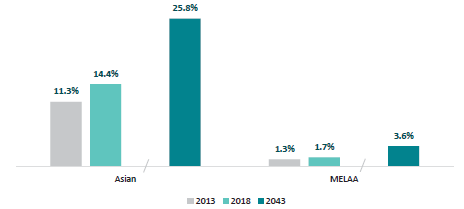
Stats NZ, 2013 and 2018 Censuses, Ethnic Group (for 2013 and 2018); and National ethnic population projections: 2018(base)–2043, Median projections (for 2043).
Figure 2: Proportion of learners (aged 5 – 19) regionally who identify as Asian
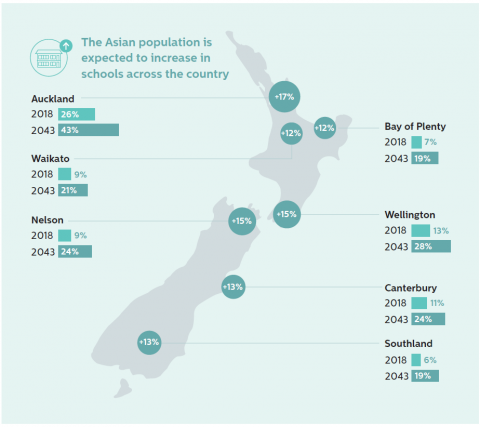
Source: Stats NZ, 2018 Census, Ethnic group (for 2018) and Subnational Population Projections 2018‑base (for 2043), Median projections (for 2043).
Ethnic diversity is increasing across the country, most rapidly in urban areas. Learners will be from a wider range of ethnic communities. By 2043, it is expected just over one in four learners will identify as Asian and around one in 20 will identify as Middle Eastern, Latin American, or African (MELAA). In Auckland, more than two in five learners will identify as Asian.
As schools become more ethnically diverse, it is critical that leaders and teachers actively work to ensure they provide a safe and inclusive place for learners from ethnic communities and their whānau.
To understand how good education is for learners from ethnic communities, the Education Review Office (ERO) spoke to learners, whānau, teachers, school leaders, and community leaders, and looked at a wide range of data from other government agencies.
This guide outlines what we found and practical things that school leaders and teachers can do to make a difference for learners from ethnic communities in their schools.
|
Who are learners from ethnic communities? |
|
Ethnicity is defined as the ethnic groups that people identify with or feel they belong to. Ethnic communities included in this study are African, Asian, Latin American, and Middle Eastern. Learners from ethnic communities are very diverse with a wide range of ethnicities, religions, cultures, time in New Zealand, and family backgrounds. More than two thirds of learners from ethnic communities were born in New Zealand. Many learners have multiple ethnicities, and more than half of ethnic communities speak multiple languages. |
Figure 1: Proportion of learners (aged 5 – 19) in Aotearoa New Zealand who identify as MELAA or Asian
Stats NZ, 2013 and 2018 Censuses, Ethnic Group (for 2013 and 2018); and National ethnic population projections: 2018(base)–2043, Median projections (for 2043).
Figure 2: Proportion of learners (aged 5 – 19) regionally who identify as Asian
Source: Stats NZ, 2018 Census, Ethnic group (for 2018) and Subnational Population Projections 2018‑base (for 2043), Median projections (for 2043).
What are the educational experiences of learners from ethnic communities?
- Many learners from ethnic communities achieve well in education.
NCEA achievement and endorsements are higher for Asian learners than the New Zealand average, and both MELAA and Asian learners are more likely to achieve University Entrance and go on to university. However, there are significant differences across ethnic communities, and within all ethnic communities there are learners who are not achieving well.
- Learners from ethnic communities experience widespread racist bullying, which too often is not taken seriously by their school.
One in five learners from ethnic communities have experienced racist bullying in the last month, and over half have seen others being bullied because of their ethnicity. Both whānau and learners report that racist bullying needs to be better identified and addressed at school. Nearly a third of learners from ethnic communities do not think their school takes racist bullying seriously.
“I still feel kind of weird taking Indian food to school as you have to eat it with your hands. One of my friends—she is Indian too, got bullied so badly for her food that she became a loner. And she tried to bring sandwiches to school even though she didn’t like them, but it was too late”. (Learner)
- Learners from ethnic communities often do not feel they belong.
Nearly one in five learners from ethnic communities reported they frequently feel they do not belong and a third feel lonely at school every week or every day. Nearly one in five also feel they have to hide their ethnic identity at school, or feel excluded from activities because of their ethnic identity. MELAA learners in particular have very low wellbeing.
“I feel like the only time you can interact with your own culture is Culture Week.” (Learner)
- Education provision does not always reflect what whānau and learners from ethnic communities want.
As Aotearoa New Zealand changes, what communities want from education changes too. Education is not currently always reflecting what whānau from ethnic communities want. Four in 10 whānau, and nearly a third of learners from ethnic communities, do not feel schoolwork is challenging enough. Almost two-thirds of whānau think schools should support their mother tongue, but there are 11 ethnic languages - including Hindi, which is the fourth most commonly spoken language in Aotearoa - which are not available as NCEA qualifications. Some whānau also want schools to teach more about religions.
- Whānau from ethnic communities face barriers to engaging with schools.
Whānau from ethnic communities want to be part of their children’s education. They attend parent information sessions more than any other activity but find information about their children’s learning insufficient or confusing. They are significantly under-represented on school Boards – for example, only 2 percent of parents on school Boards are Asian.
- Many learners from ethnic communities go on to tertiary study, but pathways are confusing, and, for some, choices are unfairly constrained by teachers’ biases.
Learners from ethnic communities are more likely to go on to tertiary study than the New Zealand average. But for some, their choices are being constrained. More than one in four secondary learners from ethnic communities’ report that teachers’ recommendations for their course selection are influenced by ethnicity. Both learners and whānau from ethnic communities find NCEA confusing, and a fifth of learners do not feel supported in choosing subjects or career pathways.
“Stereotyping of what particular ethnic groups should aspire to is very limiting and doesn’t enable students to reach their aspirations”. (Community youth leader)
- Many learners from ethnic communities achieve well in education.
NCEA achievement and endorsements are higher for Asian learners than the New Zealand average, and both MELAA and Asian learners are more likely to achieve University Entrance and go on to university. However, there are significant differences across ethnic communities, and within all ethnic communities there are learners who are not achieving well.
- Learners from ethnic communities experience widespread racist bullying, which too often is not taken seriously by their school.
One in five learners from ethnic communities have experienced racist bullying in the last month, and over half have seen others being bullied because of their ethnicity. Both whānau and learners report that racist bullying needs to be better identified and addressed at school. Nearly a third of learners from ethnic communities do not think their school takes racist bullying seriously.
“I still feel kind of weird taking Indian food to school as you have to eat it with your hands. One of my friends—she is Indian too, got bullied so badly for her food that she became a loner. And she tried to bring sandwiches to school even though she didn’t like them, but it was too late”. (Learner)
- Learners from ethnic communities often do not feel they belong.
Nearly one in five learners from ethnic communities reported they frequently feel they do not belong and a third feel lonely at school every week or every day. Nearly one in five also feel they have to hide their ethnic identity at school, or feel excluded from activities because of their ethnic identity. MELAA learners in particular have very low wellbeing.
“I feel like the only time you can interact with your own culture is Culture Week.” (Learner)
- Education provision does not always reflect what whānau and learners from ethnic communities want.
As Aotearoa New Zealand changes, what communities want from education changes too. Education is not currently always reflecting what whānau from ethnic communities want. Four in 10 whānau, and nearly a third of learners from ethnic communities, do not feel schoolwork is challenging enough. Almost two-thirds of whānau think schools should support their mother tongue, but there are 11 ethnic languages - including Hindi, which is the fourth most commonly spoken language in Aotearoa - which are not available as NCEA qualifications. Some whānau also want schools to teach more about religions.
- Whānau from ethnic communities face barriers to engaging with schools.
Whānau from ethnic communities want to be part of their children’s education. They attend parent information sessions more than any other activity but find information about their children’s learning insufficient or confusing. They are significantly under-represented on school Boards – for example, only 2 percent of parents on school Boards are Asian.
- Many learners from ethnic communities go on to tertiary study, but pathways are confusing, and, for some, choices are unfairly constrained by teachers’ biases.
Learners from ethnic communities are more likely to go on to tertiary study than the New Zealand average. But for some, their choices are being constrained. More than one in four secondary learners from ethnic communities’ report that teachers’ recommendations for their course selection are influenced by ethnicity. Both learners and whānau from ethnic communities find NCEA confusing, and a fifth of learners do not feel supported in choosing subjects or career pathways.
“Stereotyping of what particular ethnic groups should aspire to is very limiting and doesn’t enable students to reach their aspirations”. (Community youth leader)
How are schools meeting the needs of learners from ethnic communities and their whānau?
- Some schools are already innovating and adopting new practices to meet the needs of ethnic communities.
ERO visited schools and found that many were adapting what and how they teach, were connecting with ethnic communities, and increasing their understanding of their learners’ cultures and learning needs. However, we also found schools facing challenges as they adjust, that not all schools are adopting new practices, and many do not know if what they are doing is working.
- Teachers understanding of their learners, including their culture, is key to learners’ experiences at school, but this needs building.
Teachers’ understanding of cultures is not keeping up with our changing population. The teaching workforce does not reflect learners’ ethnicities. For example, only 5 percent of teachers are Asian. Whānau and learners are concerned about teachers’ lack of cultural knowledge and awareness. Teachers report having limited awareness of learners’ cultural and learning needs. More than half of teachers do not feel confident connecting with ethnic communities. Half of the learners from ethnic communities reported having their names mispronounced by their teacher.
- Some schools are already innovating and adopting new practices to meet the needs of ethnic communities.
ERO visited schools and found that many were adapting what and how they teach, were connecting with ethnic communities, and increasing their understanding of their learners’ cultures and learning needs. However, we also found schools facing challenges as they adjust, that not all schools are adopting new practices, and many do not know if what they are doing is working.
- Teachers understanding of their learners, including their culture, is key to learners’ experiences at school, but this needs building.
Teachers’ understanding of cultures is not keeping up with our changing population. The teaching workforce does not reflect learners’ ethnicities. For example, only 5 percent of teachers are Asian. Whānau and learners are concerned about teachers’ lack of cultural knowledge and awareness. Teachers report having limited awareness of learners’ cultural and learning needs. More than half of teachers do not feel confident connecting with ethnic communities. Half of the learners from ethnic communities reported having their names mispronounced by their teacher.
What are the implications for education for the future?
As Aotearoa New Zealand’s schools become more ethnically diverse there is an exciting opportunity to look again at education, including what we teach and how we teach. We have identified five big implications when considering the future of education in Aotearoa New Zealand.
- Every school needs to be able to respond to increased ethnic diversity so that learners from ethnic communities not only continue to achieve in education, but also thrive at school.
- Every school needs to be able to prevent and tackle racism.
- We need to get better at delivering education for learners from ethnic communities. This may include the types and locations of schools, and subjects taught. We must increase the cultural capability of the current teaching workforce and develop a more ethnically diverse teaching workforce for the future.
- We need to better understand the education experiences and outcomes for learners from ethnic communities and give them a stronger voice in education.
- For Aotearoa New Zealand’s future, we need education to be good for learners from ethnic communities and their whānau.
Many of these implications will take time to address and will require further policy development. The next section looks at practical things that schools can do now to make education more inclusive for learners from ethnic communities.
As Aotearoa New Zealand’s schools become more ethnically diverse there is an exciting opportunity to look again at education, including what we teach and how we teach. We have identified five big implications when considering the future of education in Aotearoa New Zealand.
- Every school needs to be able to respond to increased ethnic diversity so that learners from ethnic communities not only continue to achieve in education, but also thrive at school.
- Every school needs to be able to prevent and tackle racism.
- We need to get better at delivering education for learners from ethnic communities. This may include the types and locations of schools, and subjects taught. We must increase the cultural capability of the current teaching workforce and develop a more ethnically diverse teaching workforce for the future.
- We need to better understand the education experiences and outcomes for learners from ethnic communities and give them a stronger voice in education.
- For Aotearoa New Zealand’s future, we need education to be good for learners from ethnic communities and their whānau.
Many of these implications will take time to address and will require further policy development. The next section looks at practical things that schools can do now to make education more inclusive for learners from ethnic communities.
What can schools do to make a difference for learners from ethnic communities and their whānau?
Our research identified five key practices that schools can adopt now to ensure learners from ethnic communities and their whānau feel valued, respected, and included at school.
- School leaders prioritise learners from ethnic communities and commit to supporting, respecting, and celebrating their cultures.
- Everyone has high expectations of learners from ethnic communities.
- Teachers seek to understand, value, and respect learners’ culture in their education.
- Teachers enact culturally responsive and inclusive teaching practices.
- School leaders and teachers connect and partner with whānau and their ethnic communities.
We will briefly summarise what the evidence says about these key practices, and provide practical, real-life examples of these practices in action, from leaders and teachers as well as the learners and whanau that we spoke to.
1.School leaders prioritise learners from ethnic communities and commit to supporting, respecting, and celebrating their cultures.
What does the evidence say?
Effective leaders have a strong positive influence on students’ learning, attendance, and long-term outcomes. What they do and say matters, as it sets the standard and direction for the whole school community.
Culturally responsive leaders are able to engage teachers, learners, and whānau in discussions about inclusion, promote positive attitudes, and combat prejudices – all of which contribute to creating an inclusive school. They can facilitate teacher professional development to ensure it is culturally responsive, which then improves the classroom experiences of learners. Good leaders also focus on ensuring that lessons reflect the cultural diversity within a class, and that classrooms are places of inclusion and respect.
What’s really important?
- Ensure all policies and plans (strategic and curriculum documents) are inclusive to reflect the diversity of their learners, whānau, and communities.
- Spend time engaging respectfully with whānau and learners to learn about their aspirations and concerns. Provide additional support for families who find it difficult to navigate the system.
- Ensure there are good systems to support the sharing of good practice and for reviewing the provision and outcomes for learners from all ethnic communities.
- Establish schoolwide practices and cultural celebrations for respectful behaviour and communication that reflect an openness to differing attitudes, beliefs, and world views.
- Facilitate professional learning that supports staff to positively respond to diversity, surface unconscious bias and to teach about, and counter, discrimination.
Real life examples: what can this look like in practice?
|
Recognising and celebrating cultural diversity |
|
Leaders and teachers from one primary school we visited not only acknowledge and celebrate the diversity of their ethnic communities, but have successful strategies for meaningful engagements with whānau from ethnic communities. Teachers tap into the resources and knowledge of whānau from their ethnic communities to support their learning programmes. Whānau share their expertise on their culture in the classroom and participate in learning programmes. Resources in multiple languages are available or used for school hui and teacher meetings to assist parents to engage and help with the sharing of learning information. In this school, whānau from ethnic communities are encouraged to work as teacher aides in the classroom to support learners to use and hear their first language as they learn. It contributes to a diverse workforce. “[At this school we prioritise] Spending quality time at enrolment to hear their stories and aspirations. Shoulder tapping to ensure families with diverse ethnic backgrounds are represented when parents are involved e.g., as trip helpers. We have noticed that engaging with [a school-based] research project and inviting them to be part of a focus group has helped them to feel that their voice is valued.” (Teacher) |
2. Everyone has high expectations of learners from ethnic communities.
What does the evidence say?
Expectations of learners are key to their engagement and success. It is particularly important for learners from different cultural backgrounds or learning environments, as low expectations lead to lower achievement, satisfaction, and motivation. Communicating high expectations raises learners’ levels of interest and self-belief, which push them to attempt difficult tasks, achieve success, and grow. High expectations also show that teachers are thinking and acting inclusively, as they are holding learners from ethnic communities to the same high standards as any other learner.
What’s really important?
- Enable learners to set high expectations for themselves by creating opportunities for learners to share their aspirations, set goals, and make choices about their learning.
- Develop their understanding of each learner’s capabilities, express their expectations for the learner, offer appropriate levels of challenge, and give specific feedback on learning tasks.
- Move away from defining learners from ethnic communities primarily as ESOL or English language learners.
- Invest in, and take personal responsibility for, learners’ success.
- Provide multiple options for how learners can interact with instructional content and assessment.
Real-life examples: what can this look like in practice?
|
Academic mentoring and challenging tasks by teachers |
|
In several schools we visited, a teacher regularly meets individually with students to discuss their learning progress over their time in school. They talk about their aspirations and find ways to support them to gain credits or take courses towards achieving their goals. In one secondary school, they have a transitions team made up of leaders who meet with each senior student to discuss their aspirations and pathways. This team meets weekly to review the progress of each of their learners towards their goals. In some schools, teachers provide tasks with a high level of challenge which build on learners’ prior knowledge and learning. The tasks enable learners to make choices about their learning and to connect to their culture and language. Teachers provide specific support to enable them to access the task and experience success. |
3. Teachers seek to understand, value, and respect learners’ culture in their education.
What does the evidence say?
Teachers who learn about, affirm, and respect learners’ cultural identities, and include their cultures in their learning, have a positive influence on learning. Because these teachers value the cultural knowledge and perspectives of their learners, they can create equitable learning environments that validate and support learning for all learners.
What’s really important?
- Identify learners’ cultural and learning strengths, and learning needs, and consider ways to adapt practice to respond to these.
- Actively involve parents and whānau in decision-making and planning for their child. This might mean finding ways to communicate through language barriers, such as working with translators, school staff with language expertise (such as teacher aides), or community groups.
- Invite learners and whānau to share information about their ethnicities, cultures, and languages, and seek input to understand underpinning ideologies to avoid being tokenistic.
- Develop a welcoming, positive classroom climate that consistently promotes respect, empathy, and dialogue in classroom interactions where learners of all ethnic groups can safely connect over issues of importance.
- Model and foster inclusive language and respectful relationships which include asking learners how to pronounce their names correctly.
Real-life examples: what can this look like in practice?
|
Supporting the engagement and learning of migrant and multi-lingual students |
|
In one school a teacher works in a purposeful way to include the cultures and prior learning of students to help them engage in task-based activities. This approach includes: getting to know the learners’ strengths and needs; ‘gentle’ diagnostic activities to surface ways of thinking, interests, prior knowledge, and skills; and ‘pre loading’ discussion or activities. The teacher then discusses examples of the end-task and provides explicit teaching in response to individual needs. Students are then able to engage at the step they recognise and are supported to build towards the end task. |
4. Teachers enact culturally responsive and inclusive teaching practices.
Learners’ engagement and success in learning is supported when teachers’ practice is culturally responsive. Culturally responsive teaching better enables teachers to design their lessons and deliver a curriculum in a way that builds on the strengths and funds of knowledge learners bring to their learning. This supports students to engage meaningfully in learning and promotes their achievement.
What’s really important?
- Build understanding of culturally responsive practice for learners from ethnic communities, and reflect on the effectiveness of their own practice.
- Draw on learners’ and whānau cultural knowledge (culturally familiar scenarios, examples, vignettes), life experiences, frames of reference, languages, and communication styles to facilitate learning and tailor their teaching to be culturally responsive.
- Deliver an inclusive, localised curriculum that acknowledges the place, experiences, and histories of ethnic communities both internationally and in Aotearoa New Zealand.
- Be alert to daily opportunities to make links to cultural practices and build the cultural knowledge of all learners.
- Develop learners to think critically, examine bias in words and visual images, and confront stereotypes or racism when it appears.
Real life examples: what can this look like in practice?
|
Culturally responsive practices |
|
At one primary school, teachers acknowledge diversity by greeting students using their cultural norms, sharing news and events from their countries, and having wall displays that represent their diversity. Teachers also reported that that their lessons allow for student-led inquiries into their culture. We heard several strategies from teachers: “Use of traditional stories; encouraging inquiry related tasks centred around their [students’] culture and language.” “Inquiry focuses such as 'Stories from around the World' which focus on the cultures within the classroom. 'Taonga' focus where children shared their treasures including cultural/family treasures with their class.” "Making a language map - a Venn diagram showing all the languages students and teachers speak, learn, or are familiar with, and referring to it.” “Being responsive to their individual needs and making sure they are happy to come to school, and that themselves and their individual cultures are valued in the classroom and the wider school community.” “Researching and sharing authorship of texts of their ethnic communities' political and social history, important past and current role models, science ideas and discoveries, etc, as material for reading, talking and sharing among others.” |
5. School leaders and teachers connect and partner with whānau and their ethnic communities.
What does the evidence say?
Strong relationships between schools, whānau, and their community are key to ensuring successful outcomes for learners from ethnic communities. Involving whānau as partners in their child’s learning is crucial in promoting their progress. It also contributes to their feeling valued and included in school. When schools develop strong relationships with their ethnic communities, it increases opportunities for respectful dialogue and understanding of the varying perspectives, strengths, and needs of their whānau and learners. This helps schools to better target their support for learners and their whānau.
What’s really important?
- Ensure staff interactions with whānau are warm, welcoming, and caring.
- Provide opportunities where whānau can connect with other adults at school and contribute to school life.
- Involve parents and community members in all stages of the school planning cycle.
- Build strong relationships with ethnic community leaders.
- Communicate information about school life and learning in multiple ways and languages as much as possible.
- Regularly and respectfully seek out the perspectives of whānau from ethnic communities about their concerns, planned developments, and what works best for them.
Real life examples: what can this look like in practice?
|
Building partnerships |
|
In one primary school, where over half of their learners are from ethnic communities, teachers have many ways of connecting with whānau of learners from ethnic communities to support learning. They are open to whānau being in the school and the classroom, and provide opportunities for them to share about their cultures and to raise concerns. Teachers purposely seek opportunities to talk to their families about learning. [In] other schools we never saw the principal or teachers – asked the teacher how your child is doing, and they say, they’re fine! Here teachers are in touch with you, and they’re assessing your child constantly! [They say] your child needs help with this – let’s help them! (Parent) Regular use of a wide range of digital and face-to-face platforms provides many opportunities for meaningful learning conversations between teachers and parents. Learning partnerships are built on sustained teacher-learner-whānau relationships, developed over a three-year time period as a result of a deliberate school practice of a child only moving classes during their time at the school. Digital platforms include the Dojo app which supports learning conversations in different languages. The regular use of translators and translations for meetings, school documents and survey information also assist engagement. |
Our research identified five key practices that schools can adopt now to ensure learners from ethnic communities and their whānau feel valued, respected, and included at school.
- School leaders prioritise learners from ethnic communities and commit to supporting, respecting, and celebrating their cultures.
- Everyone has high expectations of learners from ethnic communities.
- Teachers seek to understand, value, and respect learners’ culture in their education.
- Teachers enact culturally responsive and inclusive teaching practices.
- School leaders and teachers connect and partner with whānau and their ethnic communities.
We will briefly summarise what the evidence says about these key practices, and provide practical, real-life examples of these practices in action, from leaders and teachers as well as the learners and whanau that we spoke to.
1.School leaders prioritise learners from ethnic communities and commit to supporting, respecting, and celebrating their cultures.
What does the evidence say?
Effective leaders have a strong positive influence on students’ learning, attendance, and long-term outcomes. What they do and say matters, as it sets the standard and direction for the whole school community.
Culturally responsive leaders are able to engage teachers, learners, and whānau in discussions about inclusion, promote positive attitudes, and combat prejudices – all of which contribute to creating an inclusive school. They can facilitate teacher professional development to ensure it is culturally responsive, which then improves the classroom experiences of learners. Good leaders also focus on ensuring that lessons reflect the cultural diversity within a class, and that classrooms are places of inclusion and respect.
What’s really important?
- Ensure all policies and plans (strategic and curriculum documents) are inclusive to reflect the diversity of their learners, whānau, and communities.
- Spend time engaging respectfully with whānau and learners to learn about their aspirations and concerns. Provide additional support for families who find it difficult to navigate the system.
- Ensure there are good systems to support the sharing of good practice and for reviewing the provision and outcomes for learners from all ethnic communities.
- Establish schoolwide practices and cultural celebrations for respectful behaviour and communication that reflect an openness to differing attitudes, beliefs, and world views.
- Facilitate professional learning that supports staff to positively respond to diversity, surface unconscious bias and to teach about, and counter, discrimination.
Real life examples: what can this look like in practice?
|
Recognising and celebrating cultural diversity |
|
Leaders and teachers from one primary school we visited not only acknowledge and celebrate the diversity of their ethnic communities, but have successful strategies for meaningful engagements with whānau from ethnic communities. Teachers tap into the resources and knowledge of whānau from their ethnic communities to support their learning programmes. Whānau share their expertise on their culture in the classroom and participate in learning programmes. Resources in multiple languages are available or used for school hui and teacher meetings to assist parents to engage and help with the sharing of learning information. In this school, whānau from ethnic communities are encouraged to work as teacher aides in the classroom to support learners to use and hear their first language as they learn. It contributes to a diverse workforce. “[At this school we prioritise] Spending quality time at enrolment to hear their stories and aspirations. Shoulder tapping to ensure families with diverse ethnic backgrounds are represented when parents are involved e.g., as trip helpers. We have noticed that engaging with [a school-based] research project and inviting them to be part of a focus group has helped them to feel that their voice is valued.” (Teacher) |
2. Everyone has high expectations of learners from ethnic communities.
What does the evidence say?
Expectations of learners are key to their engagement and success. It is particularly important for learners from different cultural backgrounds or learning environments, as low expectations lead to lower achievement, satisfaction, and motivation. Communicating high expectations raises learners’ levels of interest and self-belief, which push them to attempt difficult tasks, achieve success, and grow. High expectations also show that teachers are thinking and acting inclusively, as they are holding learners from ethnic communities to the same high standards as any other learner.
What’s really important?
- Enable learners to set high expectations for themselves by creating opportunities for learners to share their aspirations, set goals, and make choices about their learning.
- Develop their understanding of each learner’s capabilities, express their expectations for the learner, offer appropriate levels of challenge, and give specific feedback on learning tasks.
- Move away from defining learners from ethnic communities primarily as ESOL or English language learners.
- Invest in, and take personal responsibility for, learners’ success.
- Provide multiple options for how learners can interact with instructional content and assessment.
Real-life examples: what can this look like in practice?
|
Academic mentoring and challenging tasks by teachers |
|
In several schools we visited, a teacher regularly meets individually with students to discuss their learning progress over their time in school. They talk about their aspirations and find ways to support them to gain credits or take courses towards achieving their goals. In one secondary school, they have a transitions team made up of leaders who meet with each senior student to discuss their aspirations and pathways. This team meets weekly to review the progress of each of their learners towards their goals. In some schools, teachers provide tasks with a high level of challenge which build on learners’ prior knowledge and learning. The tasks enable learners to make choices about their learning and to connect to their culture and language. Teachers provide specific support to enable them to access the task and experience success. |
3. Teachers seek to understand, value, and respect learners’ culture in their education.
What does the evidence say?
Teachers who learn about, affirm, and respect learners’ cultural identities, and include their cultures in their learning, have a positive influence on learning. Because these teachers value the cultural knowledge and perspectives of their learners, they can create equitable learning environments that validate and support learning for all learners.
What’s really important?
- Identify learners’ cultural and learning strengths, and learning needs, and consider ways to adapt practice to respond to these.
- Actively involve parents and whānau in decision-making and planning for their child. This might mean finding ways to communicate through language barriers, such as working with translators, school staff with language expertise (such as teacher aides), or community groups.
- Invite learners and whānau to share information about their ethnicities, cultures, and languages, and seek input to understand underpinning ideologies to avoid being tokenistic.
- Develop a welcoming, positive classroom climate that consistently promotes respect, empathy, and dialogue in classroom interactions where learners of all ethnic groups can safely connect over issues of importance.
- Model and foster inclusive language and respectful relationships which include asking learners how to pronounce their names correctly.
Real-life examples: what can this look like in practice?
|
Supporting the engagement and learning of migrant and multi-lingual students |
|
In one school a teacher works in a purposeful way to include the cultures and prior learning of students to help them engage in task-based activities. This approach includes: getting to know the learners’ strengths and needs; ‘gentle’ diagnostic activities to surface ways of thinking, interests, prior knowledge, and skills; and ‘pre loading’ discussion or activities. The teacher then discusses examples of the end-task and provides explicit teaching in response to individual needs. Students are then able to engage at the step they recognise and are supported to build towards the end task. |
4. Teachers enact culturally responsive and inclusive teaching practices.
Learners’ engagement and success in learning is supported when teachers’ practice is culturally responsive. Culturally responsive teaching better enables teachers to design their lessons and deliver a curriculum in a way that builds on the strengths and funds of knowledge learners bring to their learning. This supports students to engage meaningfully in learning and promotes their achievement.
What’s really important?
- Build understanding of culturally responsive practice for learners from ethnic communities, and reflect on the effectiveness of their own practice.
- Draw on learners’ and whānau cultural knowledge (culturally familiar scenarios, examples, vignettes), life experiences, frames of reference, languages, and communication styles to facilitate learning and tailor their teaching to be culturally responsive.
- Deliver an inclusive, localised curriculum that acknowledges the place, experiences, and histories of ethnic communities both internationally and in Aotearoa New Zealand.
- Be alert to daily opportunities to make links to cultural practices and build the cultural knowledge of all learners.
- Develop learners to think critically, examine bias in words and visual images, and confront stereotypes or racism when it appears.
Real life examples: what can this look like in practice?
|
Culturally responsive practices |
|
At one primary school, teachers acknowledge diversity by greeting students using their cultural norms, sharing news and events from their countries, and having wall displays that represent their diversity. Teachers also reported that that their lessons allow for student-led inquiries into their culture. We heard several strategies from teachers: “Use of traditional stories; encouraging inquiry related tasks centred around their [students’] culture and language.” “Inquiry focuses such as 'Stories from around the World' which focus on the cultures within the classroom. 'Taonga' focus where children shared their treasures including cultural/family treasures with their class.” "Making a language map - a Venn diagram showing all the languages students and teachers speak, learn, or are familiar with, and referring to it.” “Being responsive to their individual needs and making sure they are happy to come to school, and that themselves and their individual cultures are valued in the classroom and the wider school community.” “Researching and sharing authorship of texts of their ethnic communities' political and social history, important past and current role models, science ideas and discoveries, etc, as material for reading, talking and sharing among others.” |
5. School leaders and teachers connect and partner with whānau and their ethnic communities.
What does the evidence say?
Strong relationships between schools, whānau, and their community are key to ensuring successful outcomes for learners from ethnic communities. Involving whānau as partners in their child’s learning is crucial in promoting their progress. It also contributes to their feeling valued and included in school. When schools develop strong relationships with their ethnic communities, it increases opportunities for respectful dialogue and understanding of the varying perspectives, strengths, and needs of their whānau and learners. This helps schools to better target their support for learners and their whānau.
What’s really important?
- Ensure staff interactions with whānau are warm, welcoming, and caring.
- Provide opportunities where whānau can connect with other adults at school and contribute to school life.
- Involve parents and community members in all stages of the school planning cycle.
- Build strong relationships with ethnic community leaders.
- Communicate information about school life and learning in multiple ways and languages as much as possible.
- Regularly and respectfully seek out the perspectives of whānau from ethnic communities about their concerns, planned developments, and what works best for them.
Real life examples: what can this look like in practice?
|
Building partnerships |
|
In one primary school, where over half of their learners are from ethnic communities, teachers have many ways of connecting with whānau of learners from ethnic communities to support learning. They are open to whānau being in the school and the classroom, and provide opportunities for them to share about their cultures and to raise concerns. Teachers purposely seek opportunities to talk to their families about learning. [In] other schools we never saw the principal or teachers – asked the teacher how your child is doing, and they say, they’re fine! Here teachers are in touch with you, and they’re assessing your child constantly! [They say] your child needs help with this – let’s help them! (Parent) Regular use of a wide range of digital and face-to-face platforms provides many opportunities for meaningful learning conversations between teachers and parents. Learning partnerships are built on sustained teacher-learner-whānau relationships, developed over a three-year time period as a result of a deliberate school practice of a child only moving classes during their time at the school. Digital platforms include the Dojo app which supports learning conversations in different languages. The regular use of translators and translations for meetings, school documents and survey information also assist engagement. |
Useful resources
If you want to find out more about our study, you can read the full report: Education for all our Children: Embracing Diverse Ethnicities
- Ministry for Ethnic Communities: Community Directory. https://www.ethniccommunities.govt.nz/community-directory/
- Teaching Council of Aotearoa New Zealand: Unteach Racism https://teachingcouncil.nz/resource-centre/unteach-racism/
- The Education Hub: What is culturally responsive teaching? https://theeducationhub.org.nz/what-is-culturally-responsive-teaching/
- New York State Education: Culturally Responsive-Sustaining
- Education Framework. http://www.nysed.gov/common/nysed/files/programs/crs/culturally-responsive-sustaining-education-framework.pdf
|
We appreciate the work of all those who supported this research, particularly the learners, parents and whānau from diverse ethnic communities, community leaders, and teachers, and leaders from schools, who shared with us their experiences, views, and insights through interviews, group discussions, and surveys. Their experiences are at the heart of what we have learnt. We thank you for giving your time, and for sharing your knowledge and experiences so openly and whole‑heartedly. |
If you want to find out more about our study, you can read the full report: Education for all our Children: Embracing Diverse Ethnicities
- Ministry for Ethnic Communities: Community Directory. https://www.ethniccommunities.govt.nz/community-directory/
- Teaching Council of Aotearoa New Zealand: Unteach Racism https://teachingcouncil.nz/resource-centre/unteach-racism/
- The Education Hub: What is culturally responsive teaching? https://theeducationhub.org.nz/what-is-culturally-responsive-teaching/
- New York State Education: Culturally Responsive-Sustaining
- Education Framework. http://www.nysed.gov/common/nysed/files/programs/crs/culturally-responsive-sustaining-education-framework.pdf
|
We appreciate the work of all those who supported this research, particularly the learners, parents and whānau from diverse ethnic communities, community leaders, and teachers, and leaders from schools, who shared with us their experiences, views, and insights through interviews, group discussions, and surveys. Their experiences are at the heart of what we have learnt. We thank you for giving your time, and for sharing your knowledge and experiences so openly and whole‑heartedly. |